


From helping to protect communities from floods and wildfires to improving our physical and mental health, nature provides countless irreplaceable benefits—and it provides these benefits in a remarkably cost-effective manner. Nature’s Dividends: The Economic, Health and Safety Benefits of Investing in Nature, a report commissioned by The Nature Conservancy, compiles research from nearly 1,500 studies and articles. Together, this research tells a powerful story: Protecting, restoring and enhancing nature is an essential way to support thriving communities and economies in the United States.
Download
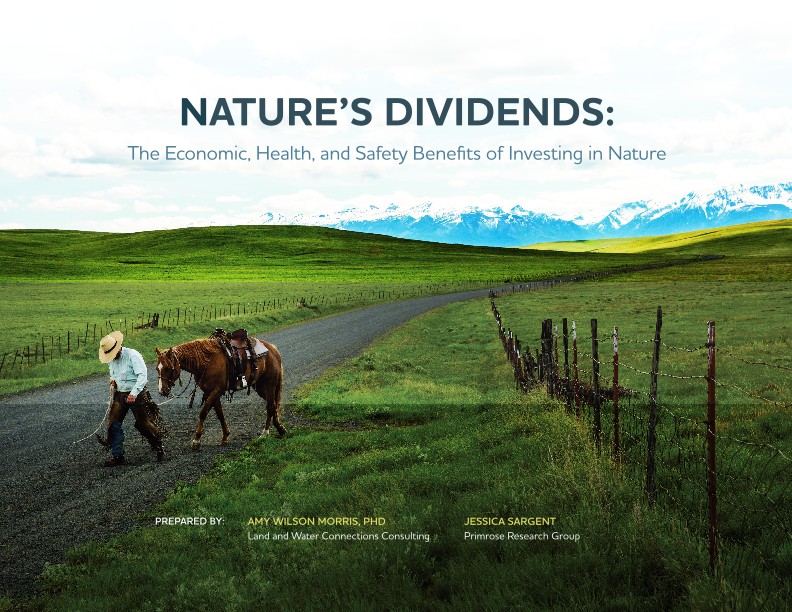
Conservation is a cost-effective way to grow the economy, protect public safety and reduce healthcare costs
Download Explore state-level fact sheetsNature’s Dividends: By the Numbers
-

4:1
The national average return on investment for conservation funding.
-

$640B
Outdoor recreation accounts for 2.3%, or $640 billion, of the U.S. economy.
-

10x
Water from unprotected watersheds can cost 10 times as much as water from protected ones.
-

89%
Nine in 10 Americans agree that “even with federal budget problems, funding to safeguard land, air and water should not be cut.”
-

$7
Every dollar invested in forest restoration and wetland protection can save up to $7 in wildfire and flooding costs.
-

$1.5B
For 10 years, the Department of Defense leveraged $1.5 billion with nearly $1.4 billion from partner contributions to protect more than 1.3 million acres of land.

Nature's Dividends
Nature is the backbone of the U.S. economy
Investing in nature drives consumer spending and local job creation. Forests, rivers, mountains, coasts and other natural landscapes attract new businesses and residents. In addition, investments in conservation, habitat restoration and public lands support millions of jobs across the country.
Ecological restoration
Ecological restoration is a growing sector in the economy. Ecological restoration directly employs approximately 126,000 workers and generates roughly $9.5 billion in sales each year. It also supports an additional 95,000 jobs and $15 billion in economic output through indirect spending.
Outdoor recreation
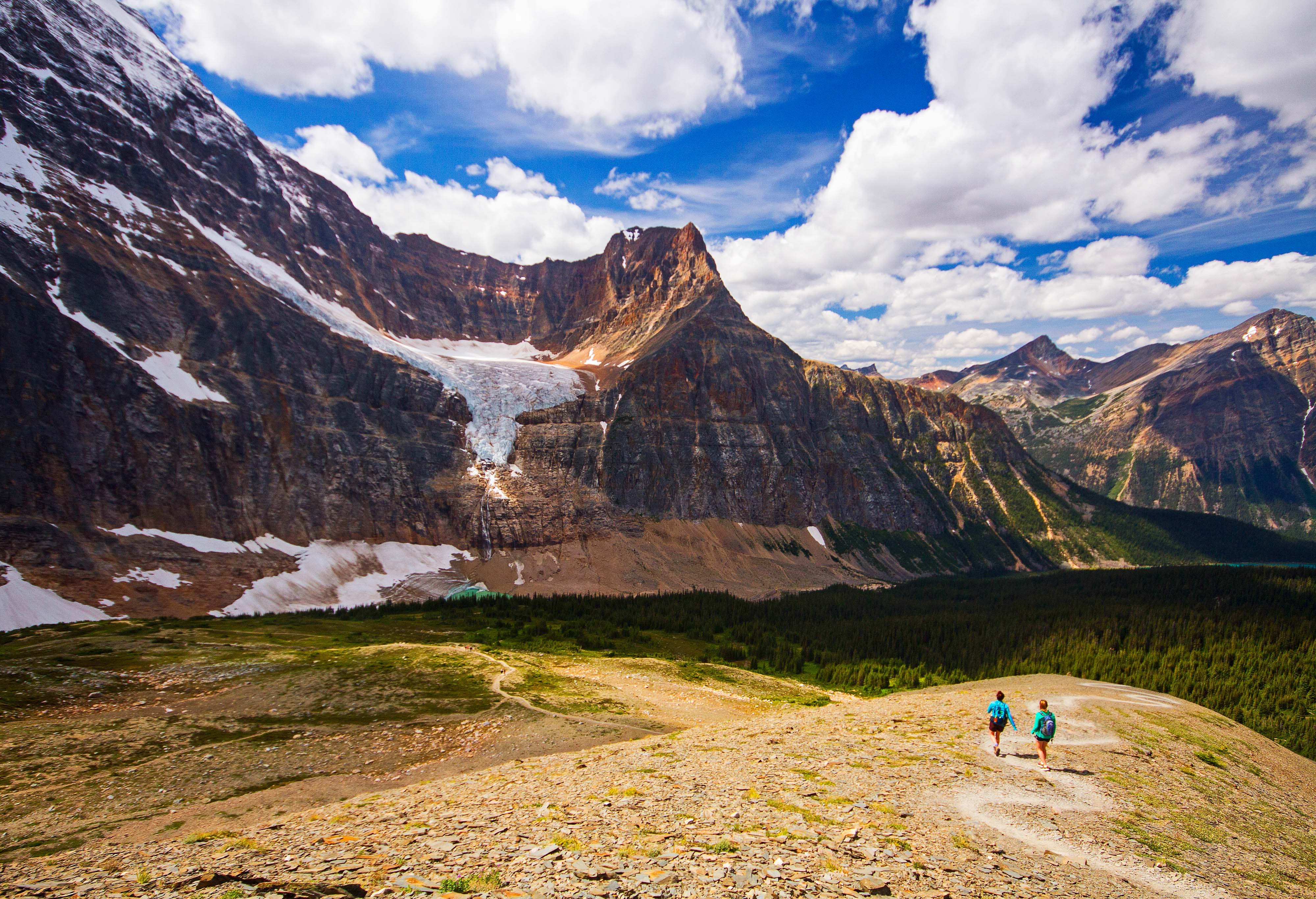
The outdoor recreation economy is a major and growing contributor to the U.S. economy. In 2023, the outdoor recreation economy accounted for $640 billion, or 2.3%, of the national Gross Domestic Product. Outdoor recreation supports nearly 5 million jobs—3% of national employment.
Wildlife-focused recreation is big business. In 2022, 39.9 million Americans fished, 14.4 million hunted and 148.3 million participated in wildlife watching, generating $395 billion in economic activity.

Case Study: Wildlife supports jobs in Montana
Outdoor recreation and related tourism are cornerstones of Montana’s economy. In 2023, Montana welcomed more than 12.5 million non-resident visitors, whose activities created a ripple effect of economic benefits statewide. MacNeil Lyons, a wildlife guide in Yellowstone National Park, is just one of the thousands of Montanans whose livelihoods depend on the state’s public lands.
Tell Congress: Protect Conservation Funding
Clean air and water, public lands, healthy forests and so much more are all on the line. We must urge Congress to preserve funding for conservation solutions that help people and nature thrive.

Nature's Dividends
Nature supports the health of working lands and fisheries
Farms and ranches
Farms and ranches are critical to the U.S. economy. In 2023, agriculture and related industries added $9.5 trillion to the economy and supported 47 million jobs. Programs through the U.S. Department of Agriculture and other federal agencies help farmers and ranchers protect and conserve their land. Voluntary conservation easements, for example, supported in part by federal programs, have helped to keep nearly 8 million acres of agricultural land in production.
Working forests
Through harvesting timber, the forest products industry generates $435 billion in economic activity each year and directly supports nearly 1 million jobs. Working forests help to supply clean water, wildlife habitat and outdoor recreation opportunities.
Fisheries
Nationwide, in 2022, the commercial fisheries and seafood industry generated $183 billion in sales and supported 1.6 million full- and part-time jobs. Commercial fisheries are highly dependent on programs that protect fish habitats and reduce water pollution.

Case study: Restoring longleaf pine in Alabama
Salem Saloom is among the 1 million Americans whose livelihoods directly depend on timber harvesting. Saloom owns a commercial tree farm in Alabama. In 2004, Hurricane Ivan destroyed a million dollars worth of timber, mainly loblolly pine, on his land. Thanks to help from the federal government’s Farm Bill, Saloom received the expert guidance and funding he needed to plant 1,100 acres of longleaf pine. This rarer species is slower growing than loblolly pine but more resistant to storms, and also offers superior wildlife habitat.
Nature's Dividends
Protecting and restoring nature enhances public safety
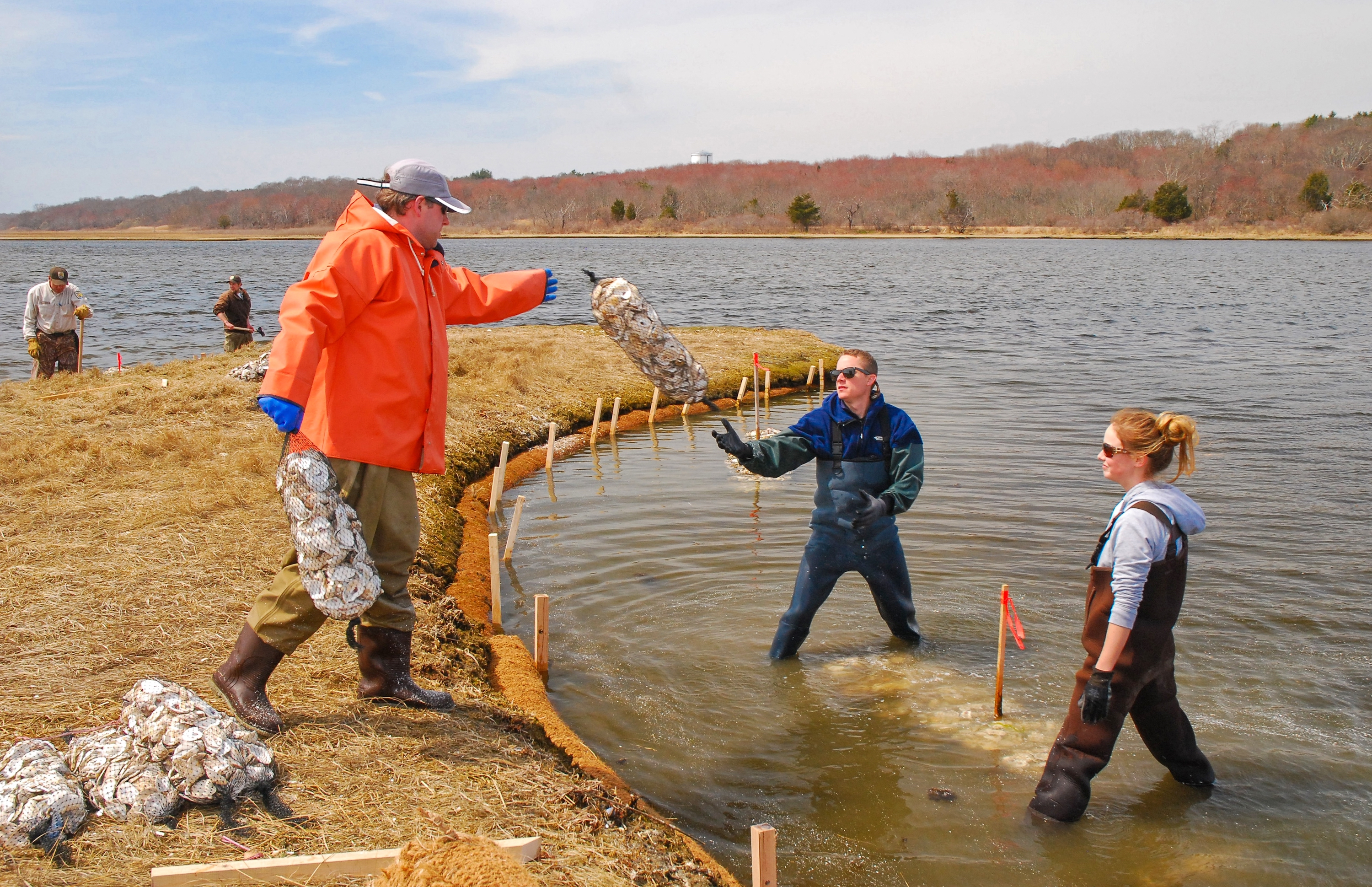
Healthy, well-managed natural habitats, such as wetlands and forests, help protect communities from floods, storms, wildfires and drought. Below are just a few of the countless ways that “green infrastructure” protects lives and property.
Drinking water
Conserved natural lands—including parks, open spaces, wetlands and forests—help filter rainfall and runoff and protect drinking water sources. Treating drinking water from unprotected watersheds can cost 10 times as much as from protected watersheds.
Flooding
Flooding is the most expensive natural hazard across the U.S. Protecting and restoring wetlands, floodplains, dunes and other habitats is a cost-effective way to protect communities from floods and storms. Coastal wetlands alone provide $23.2 billion in storm protection services each year.
Wildfire
Good forest and grassland management—including efforts to safely remove or burn overcrowded trees and dense underbrush—reduces the risk of catastrophic fires. A recent study shows that every $1 invested in forest restoration and fuels reduction returns up to $7 in benefits.
National security
Natural lands and open spaces around military installations help to increase military readiness by reducing lost training days, mitigating noise conflicts with nearby communities and preserving operations (e.g., live-fire training), among other benefits. From 2003 to 2024, the U.S. Department of Defense and partner organizations protected 1.3 million acres of land as buffer zones around military bases, ranges and other installations.

Case study: Urban trees cool down Philadelphia
Urban trees support public safety. Across the U.S., urban trees provide the equivalent of $3.8 billion in air pollution removal each year. These trees also play a critical role in reducing heat. Ground temperatures in areas shaded by trees can be a remarkable 45 degrees Fahrenheit cooler than unshaded, paved-over areas. In Philadelphia, a heat mapping project found that neighborhoods without many trees or green spaces were more than 10 degrees Fahrenheit warmer than other parts of the city. The Philly Tree Plan, launched in 2023, aims to reach 30% tree canopy cover in every Philadelphia neighborhood by planting and protecting trees. This plan was funded in part by an Inflation Reduction Act grant administered by the U.S. Forest Service.
How federal funding benefits Americans
Mission Possible
Clean water to drink, parks to hike in, farmland where healthy food is grown—all of this and more is made possible by federal conservation policies and programs. Watch videos from across the United States to learn how people in the country benefit from investments in public lands, habitat restoration, agriculture and more.


Nature's Dividends
Access to nature improves our physical and mental health
Hundreds of scientific studies have found that time spent in nature makes us healthier and happier. Close-to-home green spaces are linked to a host of benefits. These include lower rates of asthma, heart disease and diabetes; improved immune function; and lower incidences of preterm birth and low birth weight, both of which are linked to numerous health issues throughout life. Exposure to nature also lessens the symptoms of mental health conditions such as attention-deficit/hyperactivity disorder, post-traumatic stress disorder and depression—and is even linked to lower rates of crime.

Case study: How nature alleviates PTSD symptoms
Time spent in awe-inspiring natural landscapes fosters measurable improvements in mental health conditions. University of California Berkeley researchers studied two groups—military veterans and at-risk urban teens—before and after river rafting trips. Study participants reported, on average, a 29% reduction in post-traumatic stress disorder symptoms and a 21% reduction in general stress.
Stay Informed on Conservation Policy
Sign up to receive monthly news and policy updates from The Nature Conservancy.
Explore More

Advancing U.S. Policy
Learn how TNC partners with national, state and local governments to advance federal policy solutions that work for people and nature in the U.S.

America's Public Lands
A majority of Americans agree that funding to safeguard land, air and water should be protected. Learn how TNC is working to defend and protect our public lands.

Defending Climate Policy Wins
Learn how TNC is meeting this moment by defending government policies related to nature and clean energy.