
 Benefits
 Partnerships


Diving Deep on Oyster Aquaculture and Restoration
To safeguard coastal health, TNC is both restoring oyster reefs and working directly with shellfish farmers.
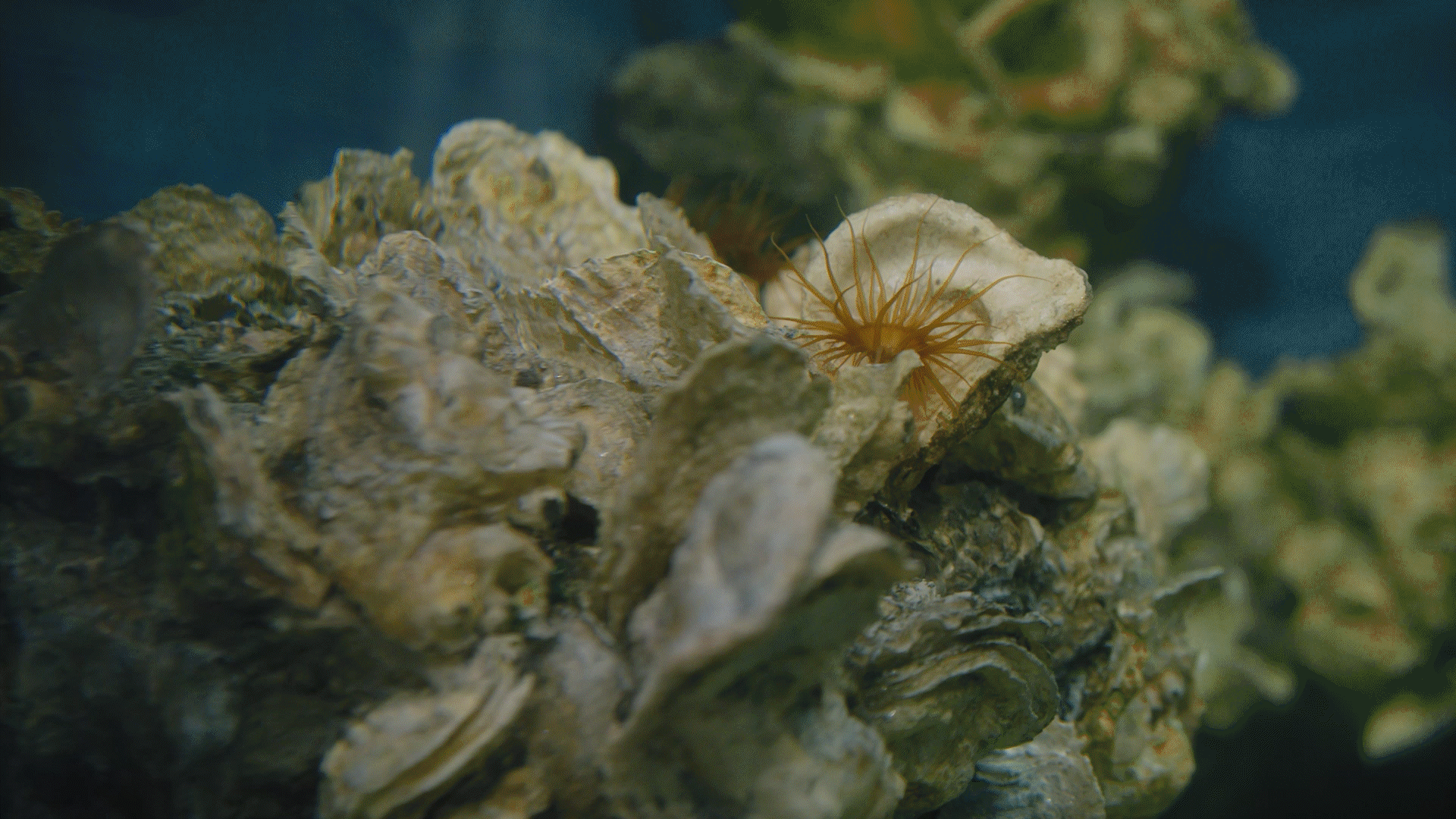
Underwater Oyster Reef The complex, natural structure of an oyster reef keeps coastal ecosystems strong. © TNC

Much like coral reefs in tropical waters, shellfish reefs are some of the best coastal habitat for young fish and sea creatures. While best known as a tasty delicacy, oysters and the reefs they build play a critical role in marine ecosystems—and, increasingly, in coastal communities.
Over the last few decades, oyster populations have dramatically decreased by 90%, causing a surge of global restoration efforts. Partnering with communities, agencies, the aquaculture industry and other public and private partners, The Nature Conservancy has been doing work across North America for years, and the efforts are paying off. We’re seeing incredible progress in the fight to bring back these powerful habitats, and the benefits these incredible shellfish provide our human communities continue to expand.


Oyster populations are in steep decline across the Atlantic and worldwide, driven by a range of human and environmental threats.

of oyster population lost since 1970, on average.

diseases identified that threaten oyster populations.

increase in harmful nutrient pollution and sedimentation.

new or increased predators as ocean temperatures rise.
Innovative solutions to environmental challenges—delivered monthly.
Like so much of our work across the globe, our oyster work is done alongside a variety of public, private, nonprofit and local community groups. Since oysters are such a robust economic driver, our oyster reef restoration partnerships can include restaurateurs, harvesters, universities and economic development entities.
TNC’s Supporting Oysters through Aquaculture Restoration (SOAR) program is one example of an unexpected partnership that has proven essential to this work: our partnership with the aquaculture industry, or oyster farmers. Oysters grown and harvested for restaurant seafood menus provide all the ecological benefits of wild live oysters, and shell recycling programs power restoration efforts.
This win-win for coastal economies and climate resilience evolved after years of conservation partnerships and continues to drive science and innovation.
TNC has played an important role in oyster restoration work for decades, from restoration efforts in the Gulf Coast and Chesapeake Bay, habitat restoration in Florida's Pensacola and Perdido Bays and shellfish restoration coalitions in Maine. A few highlights:


TNC and NOAA’s Restoration Center elevated oyster reefs as an ecosystem in need of restoration nationwide and formed a Shellfish Network to develop and share best practices to accelerate shellfish restoration.
Learn More
When Chesapeake Bay states considered introducing a Chinese oyster species to replenish plummeting oyster fisheries, TNC mobilized states, scientific bodies and NGOs over six years, successfully lobbying against them.
Learn More
After more than 30 years protecting land, TNC in New Hampshire began working in the water. Oyster restoration became a focal point in the strategy to protect the Granite State's unique inland estuary known as Great Bay.
Learn More
New Hampshire took ownership of the Oyster Conservationist Program, a first-of-its-kind opportunity at TNC through which volunteers from around Great Bay raise baby oysters that are later placed on restored oyster reefs.
Learn More
A TNC-led working group made recommendations to the state of Maryland for an alternative plan focused on large-scale native oyster ecological restoration in the Chesapeake Bay and stronger investment in aquaculture.
Learn More
TNC and NGO partners around the Chesapeake lobbied for investment in oysters at the state and federal levels, as well as better science to inform the restoration process.
Learn More
TNC’s early reef restoration projects in Massachusetts laid the foundation for expanded restoration, partnerships with local oyster farmers and the formation of the Massachusetts Shellfish Initiative.

TNC’s Shellfish Reefs at Risk study elevated oyster reefs alongside coral reefs as globally imperiled ecosystems, driving greater attention to protection, management and restoration worldwide.
Learn More
TNC & partners began restoring Half Moon Reef (a 54-acre oyster reef in Matagorda Bay, TX) generating significant ecological, social and economic benefits & establishing a blueprint for coastal restoration in the Gulf.
Learn More
TNC joined partners to announce in 2014 the restoration of oyster reefs in 10 tributaries in the Chesapeake—the world's most ambitious goal for oyster restoration.
Learn More
With partners at RT International, TNC launches the OysterFlows app, a tool that models the effect of upstream river flow scenarios on oysters in SW Louisiana.
Learn More
In 2015, TNC received a $1.9M NFWF GEBF award for design, permitting and pre-restoration monitoring of Pensacola East Bay Oyster Restoration Phase I, developing permit-ready designs through a Technical Advisory Group.
Learn More
TNC in Maine launches Maine’s first shellfish restoration pilot project in Phippsburg, Maine, growing oysters and blue mussels.
Learn More
In 2019, TNC received a $15.1M NFWF GEBF award to construct 33 oyster reefs along 6.5 miles of shoreline in East and Blackwater Bays, using limestone rock and innovative oyster reef designs to enhance recruitment.

TNC collaborated with Society of Ecological Restoration to take restoration to a global scale, sharing knowledge and techniques pioneered in the U.S. and translating this knowledge for local application around the world.
Learn More
The project transitions to partner ownership—a local partnership forms to take over the Basin Oyster Project, including the Town of Phippsburg Conservation Committee, Colby College and Manomet Conservation Sciences.
Learn More
TNC forms a research collaboration with Northeastern University, Cotuit Oyster Company, Island Creek Oysters and NOAA Fisheries quantifying the environmental benefits of oyster farming and to gauge public perception.
Learn More
From 2019 to 2021, TNC led the development of Florida’s first ecosystem-based oyster management plan for Pensacola Bay using a science-based process that engaged harvesters, agencies, scientists and community partners.
Learn More
In 2020, TNC and RTI secured funding from the National Academy of Science to expand the OysterFlows app project to other Gulf estuaries with oysters that are sensitive to freshwater disturbance.
Learn More
As part of the $20M+ Tyndall Coastal Resilience Project, TNC will construct six subtidal oyster reef breakwaters using innovative reef designs to enhance coastal resilience and oyster habitat in St. Andrew Bay.
Learn More
From 2023 to 2027, TNC provided technical and scientific support to the Pensacola Bay Oyster Restoration Initiative, a $10.9M NOAA-funded effort to design and permit 600 ha of oyster habitat and restore the first 100 ha.
Learn More
As of 2024, TNC created nine miles of oyster reef habitat along Louisiana’s Gulf Coast at Vermilion Bay, Grand Isle, St. Bernard marshes and Calcasieu Lake.
Learn More
It was announced in 2025 that the ambitious goal of restoring oyster reefs in 10 Chesapeake Bay tributaries had been successful, making it the world’s largest completed oyster restoration initiative.
Learn MoreAn innovation in how we thought about oyster restoration was sparked in the early days of the COVID-19 pandemic. TNC piloted a program to work with oyster farmers (aquaculture) through the Supporting Oyster Aquaculture and Restoration (SOAR) program.


TNC completed Restoration by Design, a blueprint for oyster restoration in NH, leading to a pilot partnering with shellfish farmers on restoration in New Hampshire, with promising preliminary results.
Learn More
Live oyster reef engineers weren't the only thing the seafood industry could help our coastal scientists solve—they also had tons (literally) of shell that we could use as substrate.

By buying oysters from oyster farmers for our work, we supported fishing jobs in coastal economies while continuing the work of restoring oyster reefs.

A pilot oyster shell recycling program launched in Mississippi in 2023. Save Our Shells (SOS) highlights the impact that shell recycling can have on restoring oyster reef habitat and a once-thriving Gulf Coast industry.
Learn More
After the SOAR program’s success, TNC in Massachusetts built on that restorative aquaculture model by connecting growers with the NRCS Environmental Quality Incentives Program to receive funds for restoration work.
Learn MoreWe continue to scale oyster restoration efforts, from living shoreline projects to water quality partnerships with state agencies and collaboration with offshore wind.


Starting in 2026, TNC will construct an oyster reef breakwater, the first nature-based solution to be implemented at Tyndall Air Force Base in Florida.
Learn more
With the partnership between The Rich North Sea, the Native Oyster Restoration Alliance & many restoration partners, TNC's goal is to embed oyster reef restoration as a nature-positive design standard in OSW development.
Learn More
As part of the Native Olympia Oyster Collaboration, TNC and partners are working to raise awareness and bring native Olympia Oysters back to the San Francisco Bay.
Learn MoreOur Mission
In support of our mission to conserve the lands and waters on which all life depends, The Nature Conservancy's 2030 Goals address the two global crises of biodiversity loss and climate change. Restoring oyster reefs advances our 2030 Goals by improving biodiversity and helping to lessen the worst effects of climate change for coastal communities.

Oysters have enormous positive impact on communities, livelihoods and millions of the oceans’ inhabitants. Here are a few ways we’ve seen success.

marine species using oyster reefs for habitat in the Gulf

SOAR program planted 5.6 million oysters to date in 8 states

jobs supported by oyster farming on the Atlantic Coast

TNC's done oyster work in all coastal states on mainland US

increase in effectiveness protecting shorelines from erosion

increase in economic activity from TX's Half Moon Reef alone
Explore the map below or scroll through projects for just a few examples of the numerous oyster restoration initiatives, projects, partnerships and programs TNC has led or supported with partners.
No results are shown. To see results, turn on the toggle switches in the legend.

Oyster Restoration Project
The Basin Oyster Project is a collaborative initiative founded by TNC in Maine and now run by the Town of Phippsburg, Colby College, Manomet Conservation Sciences and Maine Oyster Company, who are working together to build oyster reefs in Maine.
Image © Clark Tate

Oyster Restoration Project
Great Bay is the largest estuary north of the Chesapeake. Learn how New Hampshire scientists and oyster farmers are partnering through SOAR to help us understand water quality, habitat needs and the best restoration techniques for Great Bay.
Image © Jerry and Marcy Monkman/EcoPhotography.com

Oyster Restoration Project
In the Chesapeake Bay, TNC and partners, including state and federal agencies as well as other non-profits, have been working together in an aggressive and concerted effort to restore oyster reefs in 10 bay tributaries.
Image © Erika Nortemann/TNC

Oyster Restoration Project
In Massachusetts, TNC kicked off a restoration project on Cape Cod in close partnership with the town and the state Division of Marine Fisheries. It’s part of a larger habitat restoration strategy for building resilience along the coast with a combination of oyster reef, eelgrass & salt marsh restoration—marking a shift from site-scale oyster projects toward system-scale multi-habitat restoration.
Image © Mike Gearin

Oyster Restoration Project
In 2016 and 2017, TNC and state partners built 17 experimental oyster reefs in two coastal lagoons or “salt ponds” using recycled oyster and clam shells. Multiple strains of oyster spat were tested (locally sourced vs. hatchery-raised) and post-construction monitoring continued over several years.
Image © Madison Geraci

Oyster Restoration Project
In 2025, TNC supported a Delaware Inland Bays restoration project that strengthened collaboration between aquaculture and conservation partners. The project created new opportunities for growers to raise and supply oysters for restoration and monitored a 5,000-square-foot reef built with recycled shell. Local farmers contributed 66,000 diploid oysters to the reef.
Image © Delaware Center for the Inland Bays

Oyster Restoration Project
In Maryland, the SOAR program has purchased and deployed a total to date of nearly 1.5 million oysters replanted in the Bay. Recently, the MD SOAR program purchased market-size diploid oysters ready to spawn to help immediately increase oyster populations and reproduction rates on sanctuary reefs.
Image © Patrick Bloodgood/U.S. Army photo

Oyster Restoration Project
Through SOAR, WNBA star Sue Wicks’ farm sold 20,000 oysters for transplant in Moriches Bay, one of six SOAR sites set up around New York with the help of the New York State Department of Environmental Conservation.
Image © Sue Wicks

Oyster Restoration Project
At Wachapreague, volunteers build reefs by hand using lightweight materials, while in the Piankatank River, barges place substrate at a larger scale.
Image © Daniel White/TNC

Oyster Restoration Project
The Nature Conservancy joined the North Carolina Coastal Federation in working toward the return of healthy oyster reefs along North Carolina’s shoreline. So far, they've built more than 3,000 linear feet of oyster reef and 50 acres of deep-water oyster sanctuaries, in addition to a thriving shell recycling program, in partnership with a thriving culinary community.
Image © Lora Eddy

Oyster Restoration Project
The Boyd Living Shoreline in Georgetown is helping to reduce erosion at Morgan Park while also creating new habitat for crabs, birds, fish and shrimp.
Image © Cara Chancellor/TNC

Oyster Restoration Project
TNC’s first two pilot living shoreline projects were constructed on Sapelo Island in 2008. To date, projects are underway or completed on Little St. Simons Island, Cannon’s Point Preserve, Little Cumberland Island, Tybee Island and Skidaway Island.
Image © Marc Del Santro

Oyster Restoration Project
TNC’s work in Pensacola Bay led to a restoration plan being adopted and the establishment of the Pensacola and Perdido Bays Estuary Program, whose mission is to implement the plan. The plan includes areas for aquaculture, reef restoration and other marine uses.
Image © Anne Birch/TNC

Oyster Restoration Project
The Nature Conservancy and partners are collaborating to rebuild oyster reefs across the Gulf, and Louisiana is one of the most viable places for oyster reef restoration.
Image © JCW Creative

Oyster Restoration Project
The “Save Our Shells” oyster shell recycling program started collecting shells in 2024, expanding to 18 restaurants across the MS coast, and has collected more than 500,000 pounds of shells that will be used for restoration projects in the Mississippi Sound.
Image © Tony Jupp

Oyster Restoration Project
Named after the late Bay St. Louis resident and legendary Hancock County chef and restaurant owner Tony Trapani, an approximately 40-acre oyster reef was built in 2024 in the Bay of St. Louis. The project came about in response to natural and man-made disasters that decimated local oyster populations in this part of the Gulf Coast of Mississippi.
Image © The Nature Conservancy

Oyster Restoration Project
In 2024, TNC, Texas Sea Grant and San Leon Oyster Fest restored Rett Reef, a 10-acre oyster reef in Galveston Bay and the first non-harvestable oyster reef restoration project led by a commercial harvester in Texas. This innovative partnership between the oyster industry and restoration practitioners demonstrates how people and nature can thrive together.
Image © Claire Everett

Oyster Restoration Project
Across the Southern Delta Gulf Coast, restoration work is underway that includes oyster reef building, shell recycling programs, river oyster restoration and oyster management planning.
Image © Bridget Besaw

Oyster Restoration Project
Four years after Half Moon Reef’s completion, biodiversity was 1,014% greater on the reef than on the adjacent bay bottom.
Image © Jerod Foster/TNC

Oyster Restoration Project
TNC is working with partners in California to restore the once-plentiful native Olympia oyster beds. In Elkhorn Slough, we’re working on the state’s first remote setting experiment, piloting a restoration process where oyster larvae are transported from controlled hatcheries to the wild restoration site.
Image © Kiliii Yuyan

Oyster Restoration Project
Most of the oysters cultivated in Washington and Oregon waters are non-native, the Pacific oyster being the most common. But thanks to TNC, the Olympia oyster is cultivated in small quantities and is hopefully poised for a comeback—with some help. They are all good neighbors, doing their part to make Pacific Northwest saltwater bays and estuaries cleaner.
Image © TNC Washington

Oyster Restoration Project
The Oregon Coastal Mariculture Collaborative (OCMC) is a collaborative of Oregon-based organizations, brought together by a shared focus on restorative mariculture (aquaculture of shellfish & seaweeds) on the Oregon coast, with support from The Nature Conservancy and partners.
Image © Hannah Letinich
Restoring oyster reef systems is work we can't accomplish alone. Here are some of the ways we are working with our partners to bring back abundant oyster reefs in support of healthy coastal ecosystems.

We convene oyster farmers, state and local shellfish regulators, researchers, environmental organizations and estuary champions to work together.

Aquaculture and oyster farmer partnerships help support coastal jobs while providing conservationists with high-quality oysters.

As a science-led organization, we publish and share numerous scientific resources and tools for conservation.

We collaborate with and direct funding to partners who are working on oyster restoration, and support with tools and expertise to ensure greater impact.

Peer knowledge sharing, like the SOAR learning exchange, allows oyster restoration and aquaculture teams across the globe to connect and learn.

We work to educate and inspire as many people as possible to lead restoration efforts in their own communities.
Browse Resources
As a science-led organization, we ground our work in the best data and current research. Here are a few sites to explore scientific content published by TNC and our partners. Aquaculture Science is a site focused on oyster restoration through aquaculture, and Conservation Gateway hosts resources across many topics, but can be filtered by keyword.

Our work to rebuild oyster populations extends far beyond North America. Explore some of our oyster reef restoration projects, past and present, from around the world.
In April 2026, The Rich North Sea, the Native Oyster Restoration Alliance and TNC announced a new collaboration to accelerate the large-scale development of native oyster reefs at offshore wind farms in the North Sea. Learn More
Less than 10% of Australia’s natural shellfish reefs remain. Following the COVID-19 pandemic, TNC Australia and the Australian Government formed a partnership to deliver Australia’s largest marine initiative to date. Learn More
A small crab was discovered for the first time in Hong Kong on TNC's project reef. This exciting development gives us hope and shows how vital shellfish reef ecosystems are in supporting a variety of species. Learn More

 Return

Listen to the story:
Oyster restoration and aquaculture is the topic of episode one of “Nature is the Solution,” TNC in Massachusetts’ podcast showcasing nature’s role in securing a future where people and nature thrive.
Learn more about oyster restoration projects from Maine to Texas, Washington to California and waters in between.


Read more stories about our oyster restoration work.
Join Us
Support our work across the globe as we work to conserve the lands and waters on which all life depends.


