
Nature as a Common Language
The Volgenau Virginia Coast Reserve’s Summer School Shorexplorers Program
By Sophia Torres, Communications Specialist

I haven’t walked into an elementary school in more than 21 years. But as I step into Kiptopeke Elementary School on the Eastern Shore, everything feels strangely familiar. I quickly find the administration office, where I get directions to the class that I’m here to visit.
My job at The Nature Conservancy (TNC) has taken me to many restoration sites—from oyster reefs to fire lines—where I documented all the great conservation work TNC does. My days typically involve a lot of learning from scientists and a lot of figuring out how to turn complex topics into easy-to-understand one-minute videos for social media and our website.
But today, instead of stomping through mud, I am back in a classroom to observe TNC VA's Shorexplorers program and take photos. I’m still learning—but this time from 10 year olds who could be nature’s future advocates.

When I arrive, I find Kate Coleman, TNC’s conservation education specialist, and Leah Smith, summer environmental education intern, with their students sitting in a U-shaped lineup of desks. A virtual board—which has certainly changed a lot since I was in fifth grade, when we had a plain old whiteboard—dominates the front of the room. Leah and Kate introduce me as Miss Sophia and let the kids know that I will be taking photos during their lesson.
Class begins with Leah and Kate recapping the story of eelgrass and bay scallops—how both once disappeared from the Eastern Shore, but after many years of restoration, they’re finally returning.
The kids already know this history by heart. They excitedly list the species they had spotted on their field trip with Kate and Leah the previous week: “My favorite was the seahorse,” one says. “We saw a pipefish,” another adds. Next, they are asked to write in their booklets using complete sentences, and I notice many of them struggle to spell the words they know how to speak—something very familiar to me when I was their age and new to this country.


Language and Nature
When I was nine, I moved from Ecuador to Connecticut for my mom’s work. Like many immigrant kids, she enrolled me in school even though I didn’t yet know how to speak or write the language. Long days spent sitting, listening and making mistakes slowly helped me learn English and begin participating in class. Because of that, I know exactly what the kids are feeling—and it makes me genuinely happy to see Leah and Kate patiently spelling out words for them, the same way teachers once did for me. Even though I am shy, I want to help them somehow. They ask how to spell a word again; I quickly offer it in both English and Spanish. One of the kids’ faces lights up as he asks, “¿Hablas Español?” I’m not sure if he is relieved to hear his language or excited to see someone who looks and sounds like him in a “teacher” role. I hope it’s both.
After that first word, they look at me when they need help, using their best Spanglish skills to complete the day’s classwork. I help the kids throughout the rest of the class. They finish their writing, then prepare a posterboard for their final presentations. We color, decorate and practice presenting. After just two hours with these kids, I’m having so much fun that I briefly contemplate changing professions. Even though I will not take that route, I am very proud to work in an organization with a program like this one.
Learn About Eelgrass
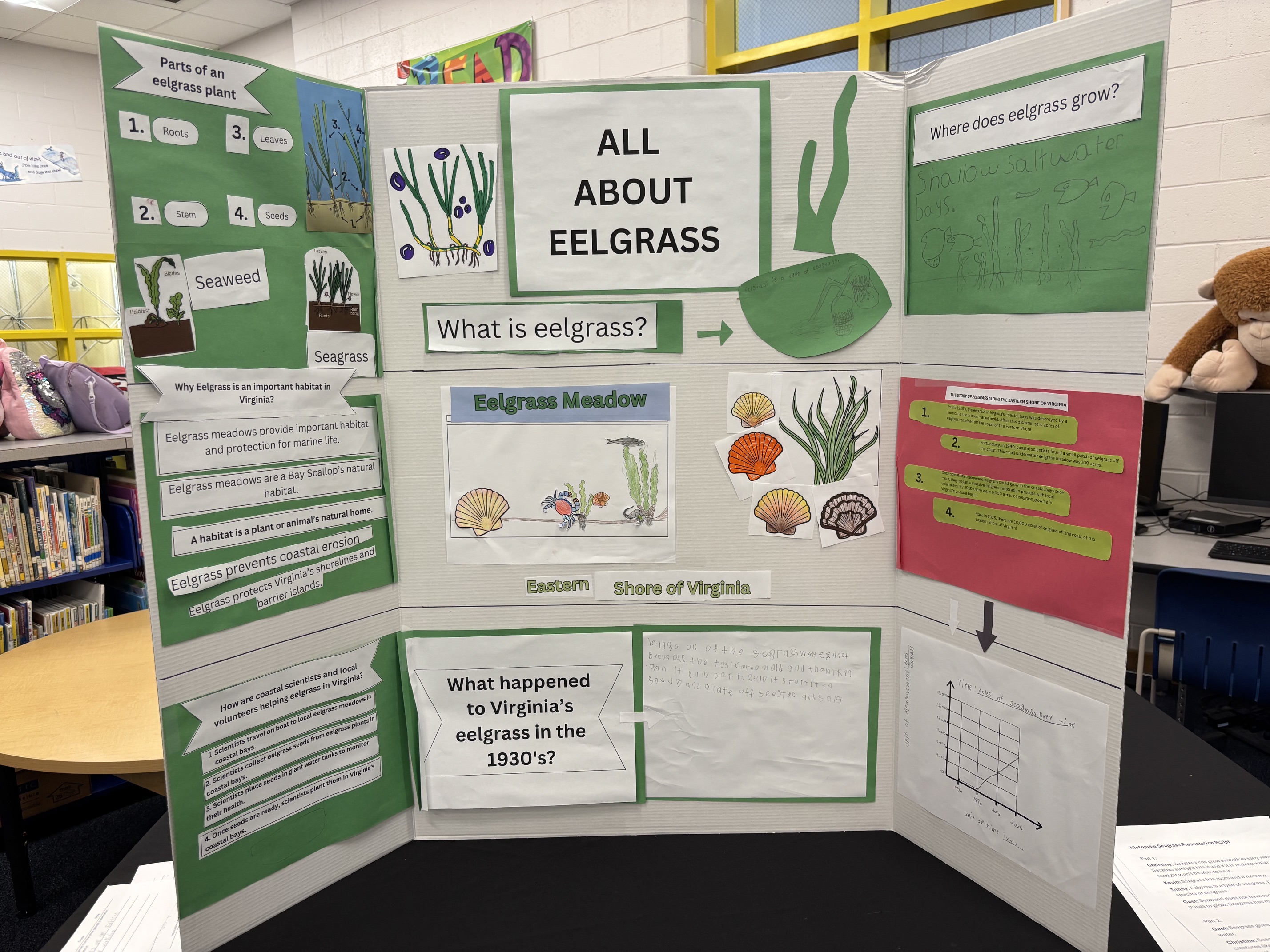
Dive into the ecology, history and restoration of eelgrass on Virginia’s Eastern Shore by exploring this poster created by Kiptopeke Elementary School students during the Shorexplorers summer program.
History
In the early 1930s, a noxious slime mold and the powerful Chesapeake-Potomac Hurricane combined to devastate seagrass meadows in Virginia’s coastal bays. While seagrasses did regenerate in the Chesapeake, they never returned to Virginia’s other coastal bays.
Eelgrass vs. Seaweed
The key difference between eelgrass and seaweed is that eelgrass has rhizomes, or underground stems, that anchor the plant in the sediment and help stabilize the surrounding sand.
Conservation Work
Scientists began a massive eelgrass restoration process with local volunteers, and by 2010, there were 6,000 acres of eelgrass growing in Virginia’s coastal bays.
Today, there are more than 10,000 acres of eelgrass off the coast of Virginia’s Eastern Shore.
Wildlife
Eelgrass provides valuable habitat for a wide variety of marine life, including blue crabs, pipefish, shrimp and bay scallops!

 Return
How Shorexplorers Builds Confidence Through Outdoor Learning
TNC’s Summer School Shorexplorers is a four-week program with one class a week where kids learn science and natural history and take a field trip to experience everything first-hand. The program follows the Meaningful Watershed Educational Experience (MWEE) model, connecting hands‑on environmental learning with grade‑level standards in science, math, English, writing and history, helping rising fifth‑grade students, who need remedial support or have chronic absenteeism, build confidence and curiosity through real‑world exploration.
Before today, I hadn’t considered this side of conservation. Beyond the great work TNC does with partners and in the field, the organization is shaping communities and securing a future where kids can experience and enjoy the natural world around them. The Volgenau Virginia Coast Reserve’s (VVCR) education program takes the next step by bringing kids directly into these places so they can learn from them firsthand and build a connection to their own backyard, which is essential for the future of these landscapes, while inspiring the next generation of stewards.
What started in 2015 with just a few classes at each grade level now reaches nearly every school on the Eastern Shore, serving about 1,000 students in fifth, seventh and 10th grade each year. The students learn through field experiences offered throughout the school year and the Shorexplorers program during the summer. It also offers hands-on teacher training that helps bring watershed education from the field into the classroom.
Conservation Starts with Community
Every child needs patience and understanding—but for an immigrant kid, that support can be transformative. Teachers can become a safe space, a glimpse of what life in a new country can feel like. Learning about their new home, discovering places where they can play and feel welcome helps build a sense of belonging and safety. I’m certain this program—and the kindness and patience Leah and Kate bring to their teaching—will stay with these kids for a long time. I know I still carry gratitude for the teacher who helped me learn English after school.
Beyond the work with schools, the VVCR team seeks to reach the entire Eastern Shore community. Recognizing that language can be a barrier, they organize a variety of community events—many of them bilingual—where people from all backgrounds can connect with nature, learn about it and engage directly with TNC staff. VVCR’s approach is holistic, rooted in the understanding that conservation has its greatest impact when everyone comes together to care for the natural world through community engagement, education and, of course, sound science.
Related Stories

Volgenau Virginia Coast Reserve
Discover how the Volgenau Virginia Coast Reserve protects barrier islands, restores coastal habitats, and supports resilient Eastern Shore communities through science‑driven conservation.

Restoring what was lost: How science and community are bringing back bay scallops
After nearly a century of extinction, seagrass restoration and other conservation work could lead to a scallop resurgence in Virginia’s coastal bays.