
Chesapeake Bay
Securing clean water and protecting critical habitats in our nation’s largest estuary.

- Phone: 301-897-8570
-
Follow


Our goal is to restore a healthy Chesapeake Bay that supports over 3,600 species of plants and animals, thriving local communities, and sustainable industries such as fisheries, farming, and tourism.
One for the Bay
Help support cleaner water, healthier habitat & more abundant life in the Chesapeake Bay.
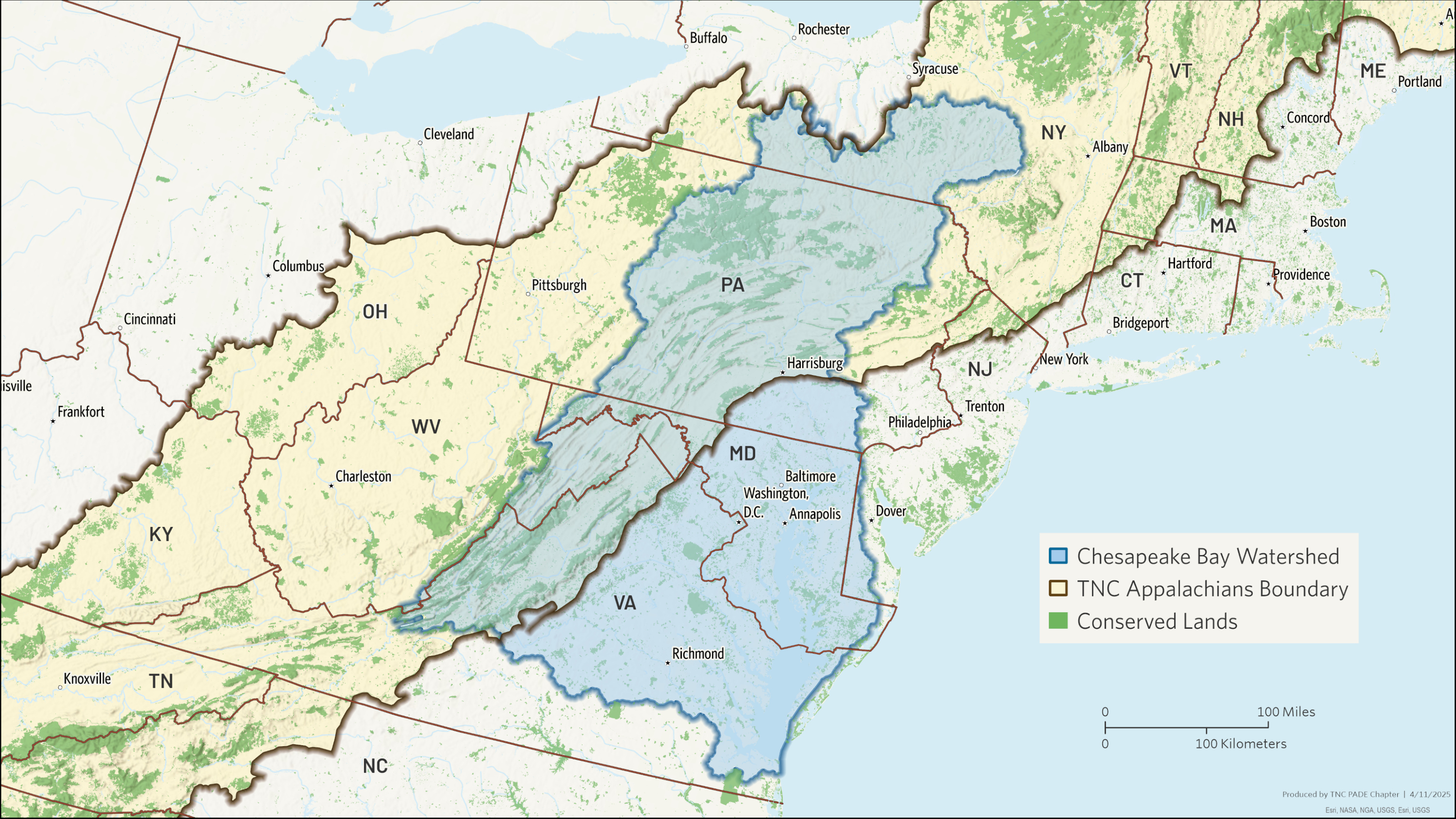
DonateThe Nature Conservancy is focused on conservation at the scale of entire ecosystems. As North America’s largest estuary, the Chesapeake Bay’s watershed—the area of land that feeds all the water draining into it—covers approximately 64,000 square miles and includes thousands of streams and rivers across six states and the District of Columbia.
Much of the Chesapeake Bay’s watershed lies within the Appalachians—another priority landscape for TNC. Due to their importance in tackling climate change and protecting biodiversity, we are committed to conserving these two globally important landscapes in this critical decade. And in order to succeed, we need your partnership and support.
The Chesapeake Bay Watershed
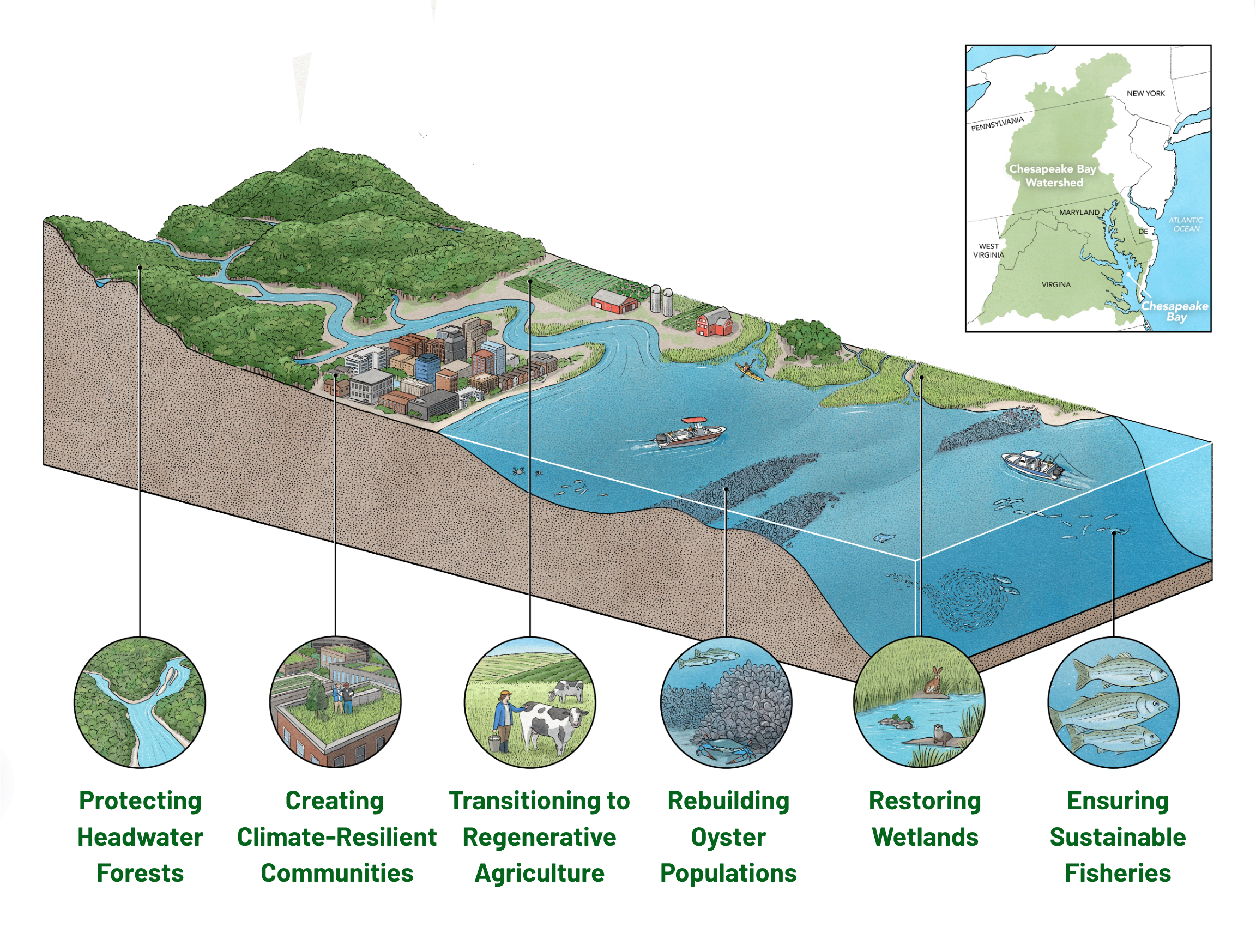
The health of Chesapeake Bay Watershed relies on conservation work all across the landscape. As water begins its journey in Appalachian forest headwaters, flowing through communities and agricultural fields, and eventually emptying out into the Bay, it is crucial that we take a multi-pronged approach to preserving this vital resource. TNC works hard in all areas of the watershed to help protect and restore the Bay.
Explore our work across the watershed in the graphic.
Protecting Headwater Forests
The health of the Chesapeake Bay begins upstream in the forests of the Appalachians, which safeguard drinking water for millions of people. We are working to protect, connect and improve the management of these globally significant forests and waters to conserve biodiversity and safeguard local communities.
Creating Climate-Resilient Communities
Stronger storms are overwhelming outdated infrastructure, making runoff the fastest growing source of Bay pollution. We partner with communities to improve stormwater management using data, technology, nature-based solutions and realtime tools that reduce flooding, protect water quality and help neighborhoods adapt to a changing climate.
Transitioning to Regenerative Agriculture
Food production—on land and in water—is deeply tied to the health of the Bay. Agriculture contributes the largest amount of nutrients to the Bay and is a primary driver of dead zones, where animals and plants can’t survive. We work with farmers, aquaculture growers and their trusted advisors to pilot new incentives and technologies, support diversified agricultural systems and restore habitat in key locations.
Rebuilding Oyster Populations
Oysters are a keystone species that filter water, support fisheries and protect shorelines. We’re restoring them at scale and developing business models that reward more oysters in the water. During COVID, we bought 1.5 million oysters from aquaculture farmers and placed them in sanctuaries to build reefs.
Restoring Wetlands
Wetlands from the headwaters to marshes that fringe the Bay filter pollution, reduce flooding, protect coasts and provide vital habitat across the Chesapeake watershed. We’re partnering with conservation groups, agencies and businesses to restore wetlands in key locations and develop new financing models that scale this essential work.
Ensuring Sustainable Fisheries
The Bay is a vital nursery for iconic fish such as striped bass, American shad, Atlantic sturgeon and Atlantic menhaden who spend portions of their lives in the Bay and portions offshore in the ocean. Commercial and recreational fisheries play an integral role in the culture and economy of Chesapeake communities. We are working on science and policy to improve fishing and marine ecosystems for generations to come.

 Return


Explore the Bay States
Learn more about our efforts in each state.
Delaware
TNC works in Delaware to restore wetlands, floodplains, and streams at the edges and downstream of agricultural fields, and works with trusted advisors and farmers to implement practices in field to keep nutrients growing food and out of our waterways. This improves water quality in local streams and rivers and downstream into the Chesapeake Bay.
Maryland/DC
TNC Maryland’s work in the Chesapeake Bay helps restore wetlands, forests, and coastal habitats across the estuary, which is especially critical in a state where roughly 90% of its more than 7,000 miles of shoreline borders the Bay.
New York
From the Bay’s northern headwaters, TNC works in New York to protect and restore aquatic habitats, supporting healthier ecosystems throughout the watershed.
Pennsylvania
TNC helps restore wetlands, floodplains, and streams at the edges and downstream of agricultural fields in Pennsylvania, and works with trusted advisors and farmers to implement practices in field to keep nutrients growing food and out of our waterways. This improves water quality in local streams and rivers and downstream into the Chesapeake Bay.
Virginia
In Virginia, TNC supports large‑scale oyster reef restoration and is restoring wetlands, floodplains, and streams in agricultural landscapes and fringing the Chesapeake Bay.
West Virginia
In West Virginia—part of the Bay’s Appalachian headwaters—TNC focuses on restoring forests, streams, and wetlands to improve clean water flowing into the Chesapeake Bay.
Return
Chesapeake News

The Human Side of Restoration: How Social Science Drives Our Work in the Chesapeake Bay
At The Nature Conservancy, we recognize that restoring the Chesapeake Bay requires more than understanding ecology, hydrology and water quality. It requires understanding people.

The Nature Conservancy Celebrates Historic Passage of the Delaware Wetlands Stewardship Act
Delaware passes the Wetlands Stewardship Act, protecting 75,000 acres of freshwater wetlands. The Nature Conservancy celebrates this landmark conservation milestone.

The Chesapeake Bay: TNC’s Newest Global Foodscape
The Chesapeake Bay was recently named as a priority landscape for TNC’s Global Regenerative Foodscapes strategy.
The stories below highlight the variety of ways that TNC is working across Delaware, Maryland/DC, New York, Pennsylvania, Virginia and West Virginia to protect and restore the Chesapeake Bay.

Restoring Oysters
Bringing Back an Icon

Oyster Restoration in the Chesapeake
For generations, oysters have played an important role in the Chesapeake Bay’s economy as a food that locals, tourists and the global market love.

SOAR: Supporting Oyster Aquaculture and Restoration
Helping oyster farmers impacted by COVID-19 and the resulting economic downturn by purchasing surplus oysters and placing them on nearby oyster restoration projects.

Aquaculture by Design Chesapeake Bay
Can oyster aquaculture help make the Chesapeake Bay cleaner, faster?
Sustainable Farming
Promoting Clean Water

Agriculture in Maryland
Engaging with Maryland's largest industry to keep nutrients on our farms and out of our waterways.

Agriculture in Pennsylvania
Partnering with local farmers to ensure clean water, thriving habitats, and sustainable food sources.

4R Nutrient Stewardship
The PA4R Alliance brings together diverse partners to help farmers achieve Chesapeake Bay water quality goals.
Restoring Waterways with Farmers
Learn how TNC is working with local farmers to apply science-based stream, floodplain and wetlands restoration projects in Lebanon and Lancaster Counties.


Discover the Benefits of Manure Injection
Every poop counts! Learn how manure injection and nutrient management planners are helping farmers maximize manure nutrients and reduce nitrogen fertilizer costs.
Reducing Stormwater
Reducing Stormwater

Curbing Stormwater Pollution
TNC has been a leader in Washington, D.C.’s Stormwater Retention Credit market using green infrastructure to reduce stormwater pollution.

Planning for a Rainy Day
Washington, D.C., combines regulations with a new credit market to keep polluted stormwater out of its rivers.

Ten Years in, D.C.’s Stormwater Credit Market is Thriving and Still Growing
Ten years ago, Washington D.C. established the Stormwater Retention Credit (SRC) market, a first-of-its-kind approach to stormwater management.

Green Infrastructure for Cities
NatureVest aims to help cities accelerate their use of green infrastructure to manage stormwater runoff.
Restoring Wetlands
Restoring Wetlands

The Pocomoke River: A Wild & Scenic Connector of Nature and Community Across Delmarva
Discover how the Pocomoke River, one of the wildest and most scenic waterways on the East Coast, connects communities, supports conservation and showcases the natural beauty of the Delmarva Peninsula.

Freeing a Trapped River
Celebrating 10 years of restoration, partnership and the largest ecological restoration in Maryland’s history.

In Water We Trust
The Virginia Aquatic Resources Trust Fund marks a quarter century of restoring wetlands and streams.

Pocomoke River: Restoration and Partnership
A healthy Chesapeake Bay is in our grasp. Partnership and collaboration is critical to restoring wetlands and floodplains at a meaningful scale.

Tackling Climate Change
Tackling Climate Change

Maryland's Legislative Priorities
We're striving for a greener, more resilient Maryland through policy solutions that work for people and the planet.

Climate Solutions
Advancing innovative, science-based solutions that match the urgency of the climate crisis.

Climate Change
Protecting and restoring healthy natural systems in Virginia to withstand a changing climate and rising seas.
Protecting Land to Protect the Bay


_Harold_Malde_4000x2200.jpg?crop=244%2C0%2C3510%2C2200&wid=1500&hei=940&scl=2.3404255319148937)



Resources
Download
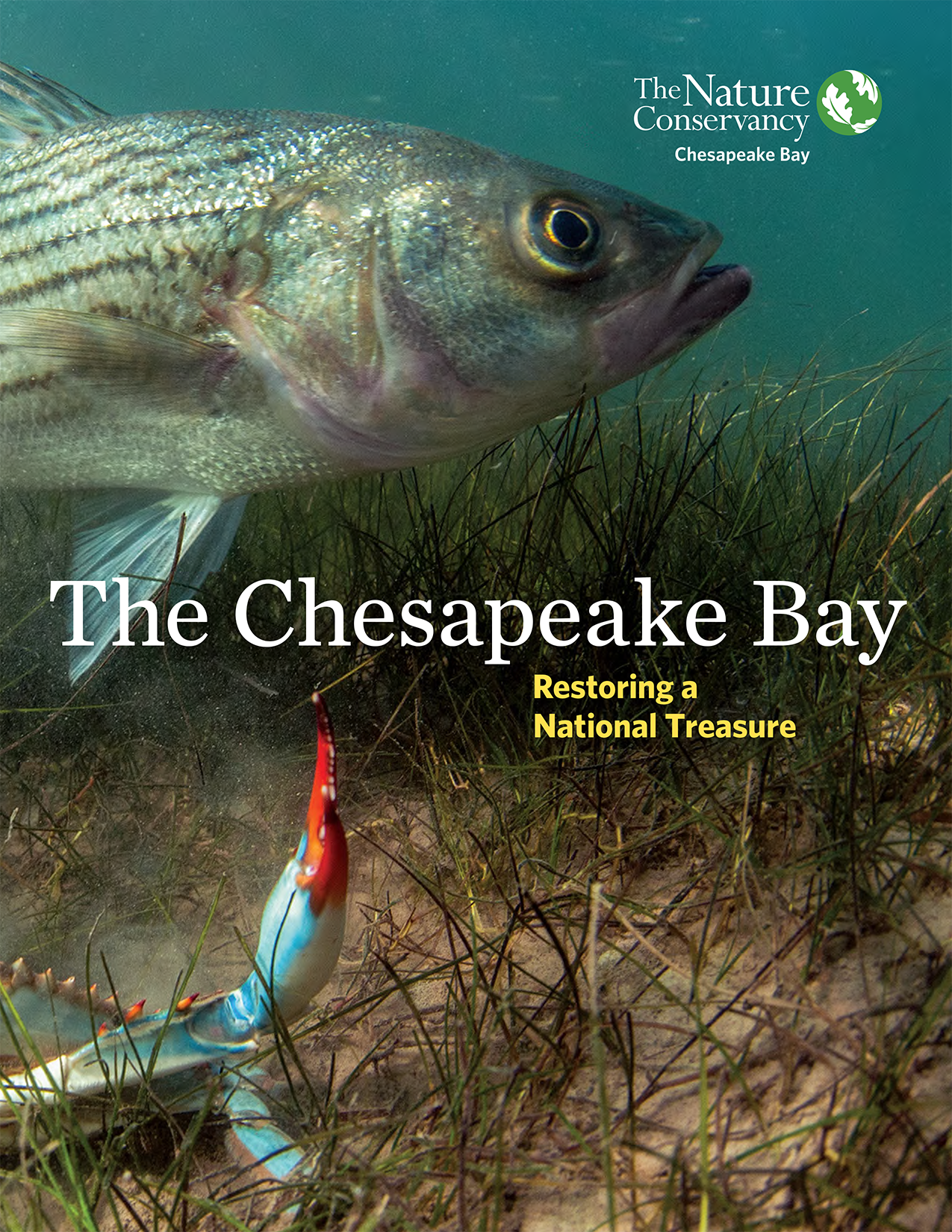
Help us reach our 2030 goals for a healthier and more resilient Chesapeake Bay.
DownloadDownload
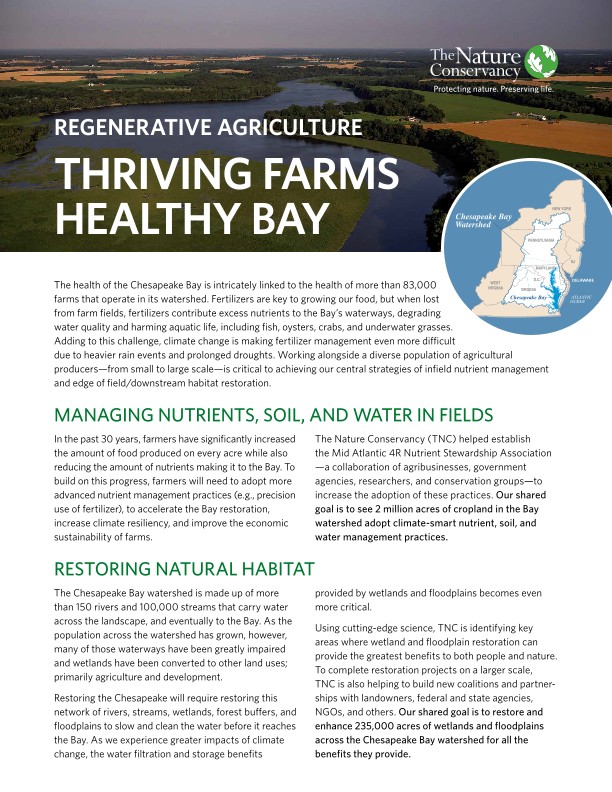
The health of the Chesapeake Bay is intricately linked to the health of more than 83,000 farms that operate in its watershed.
DownloadStay in Touch
Subscribe to Nature News, our monthly e-newsletter. Get the latest news and updates about our conservation efforts locally and around the world, delivered straight to your inbox.