


Offshore Wind Opportunity Offshore wind infrastructure can deliver both renewable energy and marine habitat restoration. © Jeff Dem
Europe’s native oyster reefs have all but vanished. Once spanning 1.75 million hectares and supporting thriving marine ecosystems, these vital habitats have been decimated by overfishing, pollution and coastal development. Today, the European flat oyster (Ostrea edulis) survives only in scattered, degraded patches. But offshore wind energy offers an unprecedented opportunity to reverse this loss and restore balance to the ocean.

What we want is the habitat back. The habitat couldn’t grow and function the same way without the oysters. They’re the engineers that make it happen.
The Ecosystem Engineers We Lost
European native oysters may be small at just 5 to 11 centimeters, but they sustain entire ecosystems. When oysters settle together, they form complex reef structures filled with nooks and crannies that shelter fish, crabs, shrimp and countless other marine species. Over time, these reefs become underwater cities bursting with life. Even seabirds like oystercatchers depend on them for food.
They also improve water quality and clarity: oysters are filter-feeders that sieve tiny particles from the water to eat, and just one adult oyster can filter up to 200 liters of water per day. Dense oyster reefs even help reduce coastal erosion, protect saltmarsh and seagrass beds, and can act as carbon sinks.
“Restoring oyster reef means that inevitably, we talk a lot about oysters,” says Dr. Boze Hancock, senior marine habitat restoration scientist at TNC. “But it’s not actually the oysters that are the important thing. What we want is the habitat back. The habitat couldn’t grow and function the same way without the oysters. They’re the engineers that make it happen.”
When these reefs disappeared in the North Sea, we lost far more than a species: we lost the foundations of entire ecosystems. A recent study using the IUCN Red List of Ecosystems criteria classified European oyster reefs as “collapsed.”

The Offshore Wind Opportunity
If you’ve ever stood in the surf and felt sand shift beneath your feet, you’ve experienced the same forces that challenge offshore wind turbines. Ocean currents and waves erode sediments around turbine foundations in a process called scour. To protect against it, engineers (the human kind) place large rocks around each base.
Which leads us to the breakthrough:
Those scour-protection rocks are the same size and type used in oyster reef restoration worldwide and often make up the most expensive part of reef construction.
With the EU expected to install 140 GW of new offshore wind capacity between 2025 and 2030, millions of tons of suitable rock habitat will soon be deployed across the North Sea.
The innovation is simple yet powerful: add oyster larvae to the rocks before they’re installed underwater. A small change with enormous ecological potential, transforming renewable energy infrastructure into thriving marine ecosystems.


How Oyster Restoration with Offshore Wind Works
The process, known as remote setting, involves allowing flat oyster larvae (spat) to settle on rock substrates inside seawater-filled containers. A single 8 cm female oyster can produce around one million larvae, and larger individuals can release up to two million in a single spawning.
Once the baby oysters are established on these rocks, they’re deployed around turbine foundations and cable crossings, where the oysters begin forming new reef structures that grow and strengthen over time.
This integrated approach creates a nature-positive offshore wind model—restoring native oysters while supporting Europe’s clean-energy transition and marine biodiversity goals.
Boze Hancock is advancing this approach through collaborative projects in Belgium and the Netherlands, working alongside industry partners, NGOs and other marine scientists.
“I’ve spent my life trying to figure out how to restore marine habitats at a scale that’s relevant to the ocean,” says Hancock. “For that, you need some pretty muscular help. And the offshore wind construction industry is that big. If we can get habitat restoration and offshore wind combined, then we're working at a scale that really makes a difference.”
If we can get habitat restoration and offshore wind combined, then we're working at a scale that really makes a difference.

Proving the Concept: Restoration in Action
These pilot efforts are producing critical data to prove feasibility and scalability—paving the way for oyster reef restoration across Europe’s growing offshore wind sector.

Stress Testing Oysters in Belgium
The ReefCovery project developed and tested a state‑of‑the‑art oyster settlement container system, resulting in hundreds of thousands of settled spat on roughly 5,000 stones. Researchers then used the spat‑on‑stone for additional tests simulating offshore installation methods to assess post‑installation survival, such as spat‑on‑stone installation serving as oyster reef substrate using fall‑pipes.
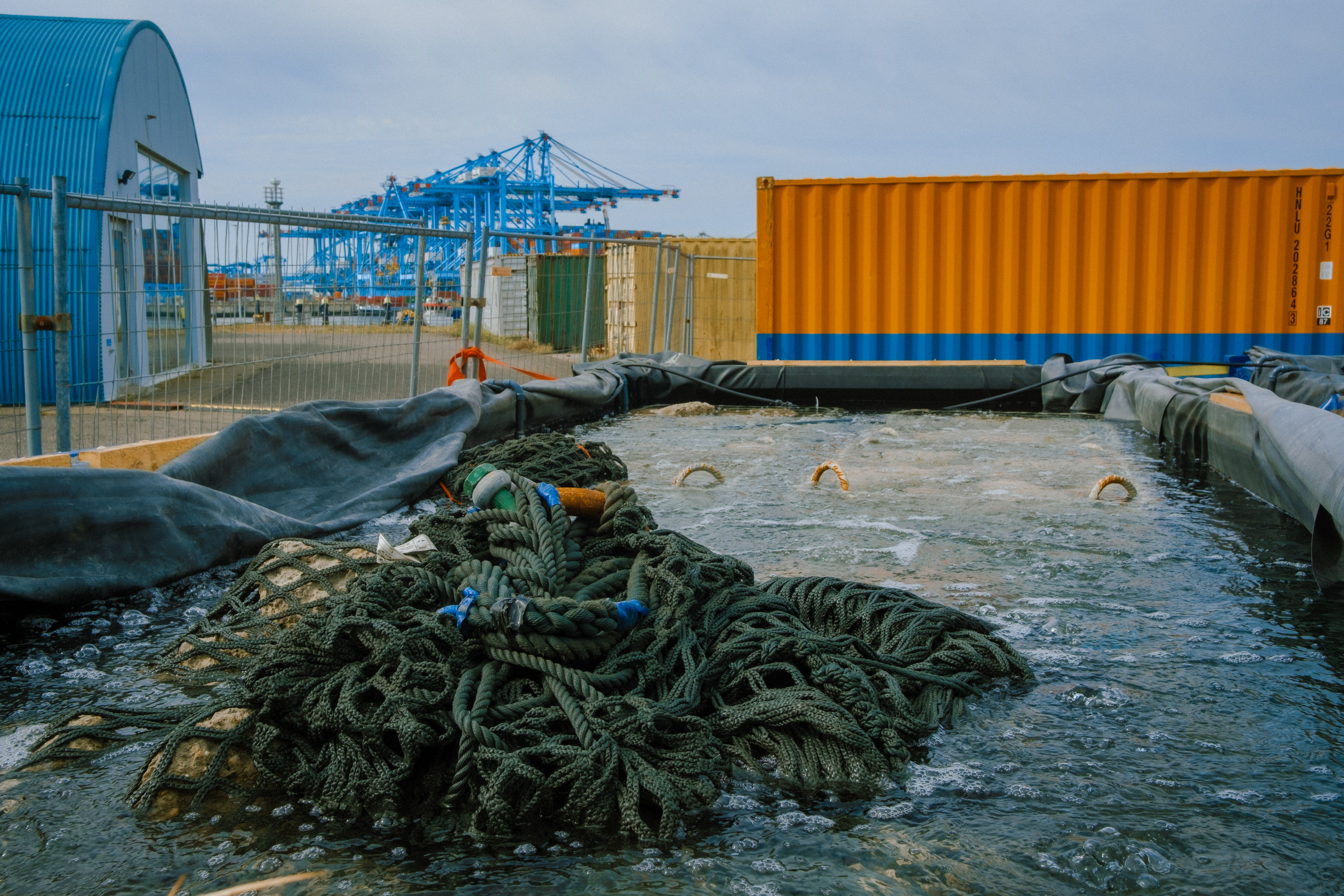
Cable Crossing Habitat Restoration
The RESO project is pioneering a remote setting technique that integrates oyster restoration into the construction and maintenance of maritime infrastructure. This approach involves growing oysters directly on scour protection, which can be applied at subsea cable crossings, offshore wind foundations, and other marine structures.
Powering Oyster Habitat Restoration with Policy
To scale these efforts, policymakers must embed nature-positive design into renewable energy auctions, the competitive processes that determine who develops new offshore wind projects.
Historically, auctions prioritized only one metric: lowest price per kilowatt hour. But the cheapest projects aren’t always the most sustainable.
Forward-thinking countries, like the Netherlands, now include non-price criteria in their evaluations, rewarding developers that commit to biodiversity enhancement and ecosystem restoration, and community benefits. In a recent Dutch tender, 45% of evaluation criteria focused on nature and biodiversity outcomes, not just cost.
This represents a paradigm shift: climate mitigation and ocean restoration, delivered together at scale.
The opportunity is clear. Offshore wind infrastructure can, and should, form the foundation of large-scale marine ecosystem recovery. The technology exists, the science supports it and pilot projects are proving it works.
Now, we need policy frameworks that make nature-positive offshore wind the new standard. With smart, forward-looking auction design, Europe’s offshore wind revolution can do more than power our clean-energy future—it can restore life to the ocean.
This is how we can address our most urgent environmental challenges, climate change and biodiversity loss, through one unlikely but powerful alliance. It shows that climate action and nature restoration go hand in hand, strengthening each other to create a more resilient and thriving planet.
Download
How non-price criteria in renewable energy auctions can help deliver for climate, nature and people.
DownloadRelated Reading

Offshore Wind Opportunities
Offshore wind can help meet energy needs, reduce carbon pollution and could benefit marine life and ocean habitats around the world.

How to Build a Renewable Energy Future in Europe that Is Good for People and Nature
To go climate-neutral, Europe must accelerate its renewable energy. If we site solar and wind projects smartly, we'll reduce costs, conserve natural and cultural resources, and support equity.

Clean Energy Transition
We no longer need to choose between abundant energy and a cleaner environment. A renewable energy revolution is happening across the globe.