interstitialRedirectModalTitle

interstitialRedirectModalMessage

Places We Protect

Harrington Preserve

Rhode Island

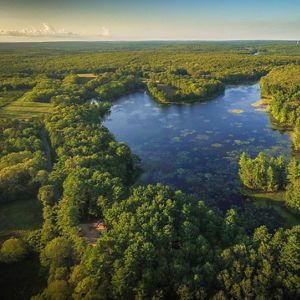
Aerial view of a small, rectangular hayfield surrounding by green forest reaching to the horizon in all directions.
Family Forest The Harringtons cared for this land for generations and ultimately chose to conserve it. © Russell Laman

Once a family tree farm, the land is open for all to enjoy nature.

Overview

Description

The Bernard and Donald Harrington Preserve offers hikers easy and moderate trails that start from two different trailheads. (Please note that the paths are not marked, so AllTrails or another trails app will be helpful.)

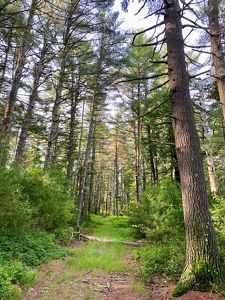
The south side of preserve is accessible from Henry Brown Road via a kid-friendly, out-and-back trail that climbs gradually through tall white pine trees. The north side has more rugged terrain, featuring boulders, stone walls and a beaver pond, with a web of paths that extend from the Big River trail system.

The two trails do not connect across Henry Brown Road. Please see the Visit tab for parking and other details.

Dogs must be leashed at all times.

The Harrington Preserve is open to hunting under rules updated annually by DEM. Hikers must wear fluorescent orange during hunting season.

Access

OPEN TO THE PUBLIC

Trails are unmarked; use AllTrails to navigate around the north side of the preserve.

Hours

Open year-round during daylight hours.

Highlights

Hiking and birdwatching

Size

319 acres

Explore our work in Rhode Island

Photos from Harrington Preserve

Tag your preserve visits on Instagram with #HarringtonPreserve to have your photos featured here!

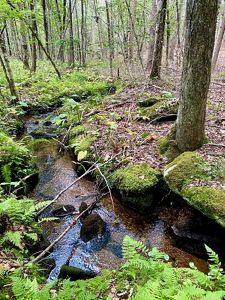
A tiny stream with deep mossy banks winds through ferns and oak trees.
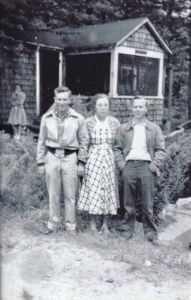
Black-and-white image of two young man standing with an older woman standing by a cabin, dressed in the style of the 1940s.
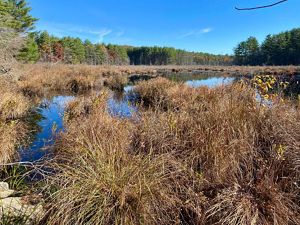
Open wetland in fall with tussocks of dried vegetation in the foreground and pine forest in the distance.
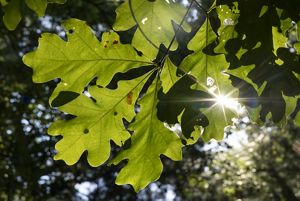
Cluster of light green leaves with rounded lobes viewed from underneath as the sun shines through.
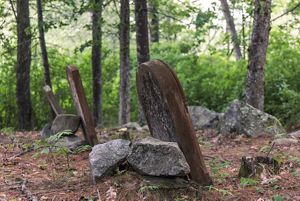
Three reddish headstones propped up by granite stones in a small forest clearing.
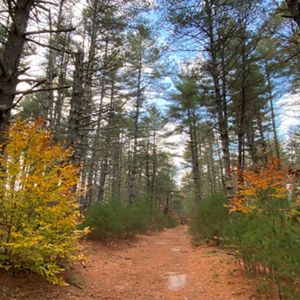
A wide grassy path with rows of tall white pine trees on both sides.
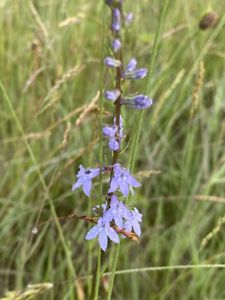
Small, deeply lobed, pale purple flowers arranged on a thin stalk, growing in a meadow.
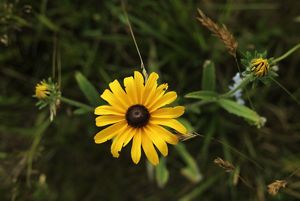
Single flat-topped wildflower with a dark brown center surrounded by a circle of golden yellow petals.
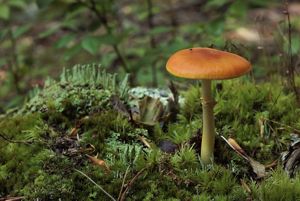
Flat-topped orange mushroom surrounded by green moss on the forest floor.
Open hayfield with fresh green grass ringed by a pine forest in the distance.

Things to consider when visiting

  • There are two parking areas for this preserve. To explore the south side, park on the wide, flat shoulder between the houses at 170 and 200 Henry Brown Road,. There is room for 6-8 vehicles near utility pole #22.

    To hike the north side, park at the Big River Management Area's Hopkins Hill lot, located at approximately 500 Hopkins Hill Road. Cross Hopkins Hill Road and follow the Big River mountain bike trails for one mile to the Harrington Preserve.

    Please see the Trails tab for details.

  • Note: This preserve's trails are unmarked, with many side paths. Areas may be seasonally wet or overgrown. We recommend using AllTrails or another trails app to avoid getting lost.

    Please respect our neighbors' property. Some trails continue off the preserve and onto neighboring land without signage. The trail map provides a few landmarks to look for as you approach the preserve's boundaries.

    Harrington South/Fire Trail (2.2 miles round trip): Park on the wide, flat shoulder between the houses at 170 and 180 Henry Brown Road. Enter the preserve at a low spot in the stone wall near utility pole #22 and follow a short, rough path through a gap in the pines, heading toward the edge of a hayfield. Small fieldstones indicate a historic cemetery there.

    Turn left, avoiding our neighbor's property, and walk toward the forest (approximately a tenth of a mile.) Turn right when you reach the eastern edge of the field and enter the forest at gap in a stone wall. Follow the old fire road into the woods, climbing gradually through the preserve and ending within sight of Hopkins Hill Road.

    Return to your car by the same route, using the cemetery sign as a landmark for the parking area. Highlights include views of Pendock Brook and the Harrington family cabin. 

    Harrington North via Big River Expresway (3.6 miles round trip): Start at the Big River Management Area parking lot on Hopkins Hill Road in West Greenwich. Cross the street and follow the mountain bike path into the forest, gradually walking downhill. After a half mile, cross the stream and turn right. Follow the stream for 250 feet and turn left, hiking back up a steeper hill. At the top of the hill, you’ll reach what is essentially a 6-way intersection. Continue straight but then bear right to avoid walking on the paved access road for Hopkins Hill Sand & Stone. Soon you’ll cross that road at a slight, right diagonal to pick up the trail on the other side.

    Approximately one mile from the parking area, the trail enters the Harrington Preserve at a stone wall. You'll see a red maple swamp with wetland pools on the right, followed by a cluster of granite boulders as you climb a small hill. At the top of the hill, turn right at the four-way intersection to start a 1.1-mile loop. The unmarked trail takes many twists and turns and is a just faint path on the ground in places.

    Follow the winding trail and cross a second shallow stream. Bear right through the stone foundation of an old home, and then in 200 feet, turn left at a three-way intersection, passing between two large boulders. Here, you’ll see a fascinating complex of ancient stone walls that stop and start among boulders of all sizes, with the stream babbling below.

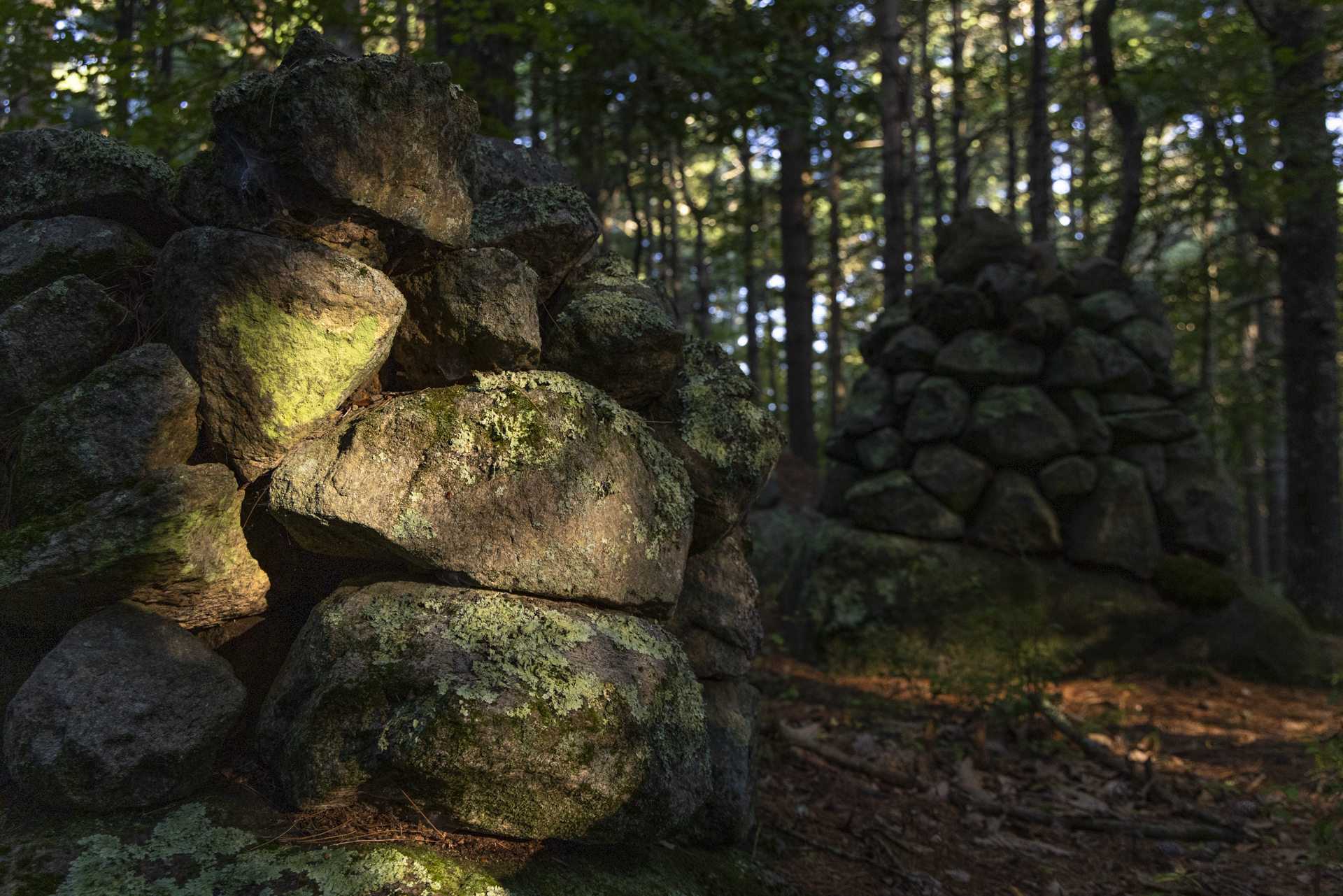
    The trail then makes a fairly rugged but short climb to the top of a hill. Where the trail splits, bear left and a short distance ahead, turn left again onto a well-defined path that was once a logging trail. The trail passes by a dozen impressive cairns, consisting of rocks piled on top of boulders or exposed bedrock. At the next four-way intersection, go straight to see the historic cemetery, which overlooks a beaver pond.

    Returning to that trail intersection, turn left to explore spur trails into the western half of the preserve. This will add 1.7 miles to your hike.

    Or turn right to continue the loop, with the beaver pond on your right. Cross a stream once more and look for a narrower trail that bears to the left, about 50 feet after the stream. Follow this path back to the intersection at the top of a hill, closing the loop. Continue straight ahead, retracing your steps through the forest, and cross back over the paved road for the gravel bank. At the 6-way intersection, take the second left and head downhill. At the bottom of the hill, turn right and then take a quick left over the stream to return to the parking lot.


  • The Harrington Preserve helps protect the headwaters of the Queen’s River, one of Rhode Island’s healthiest coldwater streams, and provides habitat for a wide range of plants and animals.

    Plants: The Harrington Preserve features a diverse, second-growth forest community. White pines and oaks dominate the tree canopy, with some black birch, red maple and sassafras. The shrub layer is generally comprised of black huckleberry, giving way to sweet pepperbush in wetter soils.

    Birds: The forest provides habitat for barred owls and red-shouldered hawks, plus a number of migratory songbirds, including blue-gray gnatcatchers, wood thrushes and eastern towhees.

    Animals: Common woodland mammals in the area include white-tailed deer, eastern coyote, fisher and red squirrel. Pendock Brook and other wetlands provide excellent habitat for frogs and salamanders. In summer, ebony jewelwing damselflies, with vivid emerald green bodies and velvety black wings, flutter over the stream banks.

  • We hope you enjoy visiting TNC’s preserves in any season. We ask that you please observe the following guidelines:

    • Stay on established trails.
    • Dogs are permitted but must be leashed at all times.
    • Respect preserve hours (one hour before sunrise to one hour after sunset). Overnight camping is not allowed.
    • Do not ride horses or any motorized vehicle through preserve or on the trails.
    • Do not remove plants or other living materials from a preserve and do not disturb any stone walls or other historic features.
    • Remove any trash you create and, if possible, any garbage that you see left by someone else.
    • In the spring, summer and fall, dress in long pants and socks to avoid deer ticks. After any walk on a preserve, it is a good idea to check for ticks when you return home.
    • Be careful! Your safety is your responsibility.
Sunlight touches round, lichen-covered stones, piled to form a large cairn.
Stacked Stones Tall cairns dot the preserve's landscape, possibly an example of Indigenous stonework. © Russell Laman

History

The Harrington Preserve is part of the traditional homelands of the Narragansett people. 

In the 1700s, the land was owned by the Casey family, now buried in the fieldstone cemetery at the edge of the hayfield. Around 1800, the property passed to the Whitfords, and Caleb Whitford ran a general store here. 

The Harrington family acquired the property in 1925, and in 1941, they built their family camp near Pendock Brook. Brothers Bernie and Don Harrington operated a tree farm that supplied logs to the Harrington Lumber sawmill until 2010. 

In 1999, the Harrington brothers worked with TNC and the Champlin Foundation to conserve 207 acres on the north side of Henry Brown Road, ensuring the land would not be developed. TNC later acquired another 105 acres from their descendents with funding from DEM, the Ginty Memorial Endowment Fund and the Bafflin Foundation. The new preserve was established in 2025. 


Nearby Preserves

Need more nature? Visit The Nature Conservancy's other preserves.

Find More Places We Protect

The Nature Conservancy owns nearly 1,500 preserves covering more than 2.5 million acres across all 50 states. These lands protect wildlife and natural systems, serve as living laboratories for innovative science and connect people to the natural world.

See the Complete Map

Support Our Work

Your contributions help us continue our conservation work in Rhode Island.