

How Conservation Grows
Some of New Hampshire's most significant conservation successes began with a single step and grew from there. Others are just getting started.
A protected property here. A prescribed burn there. Dumping recycled shell in the water near where an oyster reef historically existed.
None of these efforts came with a guarantee of success or a clear picture of what they might become. They began as opportunities to conserve a habitat, restore a place or try something new.
Over the past 65 years, The Nature Conservancy in New Hampshire has worked alongside communities, partners, supporters, and volunteers to protect the lands and waters that make the Granite State special. Some of that work produced immediate results. Other efforts unfolded over decades, growing from individual projects into lasting conservation programs with impacts far beyond their original scope.
As TNC celebrates its 75th anniversary as an organization worldwide and New Hampshire marks 65 years of conservation work in the state, it's a fitting time to look back at a few ideas that started small and grew into something much larger, and at the work underway today that can grow and shape the future of conservation in the Granite State.

From Protected Places to Connected Landscapes
When The Nature Conservancy began working in New Hampshire in 1961, much of the focus was on protecting important places before they were lost. One property at a time, those efforts helped conserve forests, wetlands, mountains, and river corridors across the state.


Fall at the First: Fall at the Louis Cabot Preserve, TNC's first protection project in New Hampshire. © Eric Aldrich/TNC
Sheldrick Forest: Taken in Sheldrick Forest in the Monadnock Highlands region of New Hampshire. © Eric Aldrich/TNC
Snowshoeing to the Summit: A snowshoer takes in the dramatic views of the Presidential Range in the Mount Washington Valley from Black Cap Trail in the Green Hills Preserve near North Conway, NH. © Ben Herndon
Surry Mountain: A rainbow enhances the colors of fall over Surry Mountain in southwestern New Hampshire. © Jeff Lougee/TNC
The goal of this work was often straightforward: protect places with exceptional natural value or rare species and ensure they would remain conserved for generations to come.
Those early projects are an important part of our history. They conserve unique ecosystems (some even globally rare), provide habitat for wildlife, protect drinking water sources, and give people places to explore and connect with nature. A lot of these places turned into the preserves we know and love. But looking back, it's clear they also created the foundation for something larger.
Conservation has evolved considerably over the past six decades. Nature doesn't recognize borders or state lines. Scientists now think about how landscapes function as connected systems and how forests, fields, rivers, floodplains, and wetlands help plants and animals adapt to changing conditions.

Concepts like wildlife connectivity and climate resilience have become central to conservation planning. What started as protecting individual parcels of land has blossomed into larger-scale, innovative efforts like fostering healthy forests in a changing climate, replanting floodplains along the Connecticut River, and improving wildlife crossings across the Appalachian Mountains.
None of that replaces the importance of protecting land. In many ways, it reinforces it. The connected landscapes we talk about today exist because people had the foresight to protect important places decades ago. It's exciting to see that what started as individual conservation projects helped create a network of lands that continues to benefit both people and nature across New Hampshire.
Learning to Work with Fire
The idea of intentionally setting fires on conservation land can sound counterintuitive. In the Ossipee Pine Barrens, however, fire has always been part of the landscape.
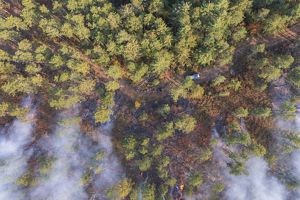

Restoration From Above: Specially trained wildland firefighters manage a controlled burn in the Ossipee Pine Barrens. © Jeff Lougee/TNC
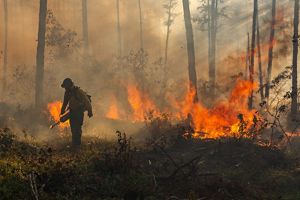
All Aglow: Northern New Hampshire Land Steward Mike Crawford lights a controlled burn in the Ossipee Pine Barrens. © Jeff Lougee/TNC
Scrub Oak: Fall brings a wash of color to the scrub oaks at Ossipee Pine Barrens. © Daryl Burtnett/TNC
A Burning Glow: The sun shines through the pitch pines during a controlled burn in the Ossipee Pine Barrens. © Jeff Lougee/TNC
For thousands of years, fires, sparked by lightning or set by Indigenous peoples, shaped these forests. Many of the plants and animals evolved alongside these periodic fires, creating a globally rare and ecologically diverse ecosystem. However, as natural fire cycles became less common during the 20th century, the pine barrens began to change.
In 2005, TNC began laying the groundwork to reverse that trend. But bringing fire back to the Ossipee Pine Barrens was not a quick or simple process. It required years of planning, scientific research, specialized training and ongoing engagement with nearby communities before any flame was ever lighted.

Working With Fire
We're using fire thoughtfully and collaboratively to heal forests and protect communities.
See Our Fire Work in New HampshireMore than 20 years later, controlled burns have become an essential tool for restoring and maintaining the pine barrens. Today, carefully planned burns help maintain this unique habitat, support rare species, encourage native vegetation, better protect the community living nearby, and preserve one of New Hampshire's most distinctive places. What began as a new restoration tool in our toolbox is now one of the most significant long-term ecological management programs we manage in New Hampshire.
This work is a reminder that conservation is not always about preserving a landscape exactly as it is. Sometimes it involves restoring natural processes that have shaped a place for thousands of years.


From Protecting Great Bay to Restoring It
There was a time when The Nature Conservancy did not have an in-water coastal program in New Hampshire. Today, oyster restoration is one of the most visible examples of conservation in action in our coastal watershed.

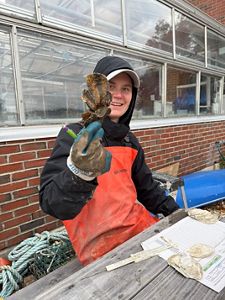

SOAR Program: TNC's Brianna Group and Cedar Point Oyster Company's Steve Weglarz add oysters to a restoration reef near Nanny Island in New Hampshire. © Jerry and Marcy Monkman/EcoPhotography
Big Baby Oyster: This oyster Kelsey is holding is only 5 months old and already 63mm—almost the size of a petite oyster (or a tube of lip balm)! © Brianna Group/TNC
Sunset over Great Bay: This unique inland estuary is the focal point of TNC's coastal conservation efforts in New Hampshire. © Eric Aldrich/TNC
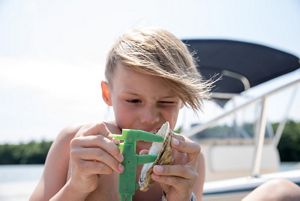
Measuring Oysters: The Bloom family and their grandkids, John (pictured) and Macaulay, foster and monitor oyster spat for a restoration project near their home at Grand Bay in New Hampshire. © Jennifer Emerling
Long before The Nature Conservancy began restoring oyster reefs in Great Bay, conservation work was already taking root throughout New Hampshire's coastal watershed.
For decades, TNC and our partners have worked to protect forests, wetlands, shorelines, and other lands that help support the health of Great Bay and the rivers and streams that flow into it. In 1994, TNC became a founding partner of the Great Bay Resource Protection Partnership, a collaborative effort that continues to bring conservation organizations and agencies together around a shared vision for the region. Since its creation, the partnership has contributed to more than 112,000 acres of conserved land, and has helped advance land protection, stewardship and conservation planning throughout the watershed.
That collaborative approach laid the groundwork for what came next.


In the early 2000s, a generous gift from a donor created an opportunity for TNC to expand our coastal work beyond the shoreline and into the estuary itself. What began as a new investment in coastal and marine conservation helped launch our in-water restoration efforts and opened the door to new partnerships, research, restoration, and volunteer projects.
What started with a few spat (baby oysters) on shells is today one of the most visible examples of that work.

Oyster reefs create habitat for other species, improve water quality and strengthen the resilience of coastal ecosystems. Reefs once covered around 1,000 acres in Great Bay. But due to disease, pollution and historic overharvesting, that number has sharply declined over the last 50 years. This is why scientists, restoration practitioners, volunteers, shellfish farmers and community partners are working together to rebuild oyster reefs in Great Bay and improve the health of the estuary. Since 2009, these efforts have restored more than 28 acres of reef and 3.5 million oysters, helping to improve water quality and provide essential habitat for fish and other marine life.
Over the past few decades, we've been able to grow a fledgling in-water program into the flourishing, multi-faceted program it is today, including a robust volunteer effort, collaborations with oyster farmers, knowledge-sharing opportunities with aquaculturists around the globe, and strong partnerships with scientists and organizations around the seacoast, all working together for a healthier, more sustainable Great Bay.
The Seeds We're Planting Today

Looking back, it's easy to see how conservation efforts have grown over time. What started as protecting land became connected landscapes. Prescribed fire became an essential restoration tool. A new coastal conservation program grew into a network of partnerships, volunteers, scientists, local businesses, and in-water restoration efforts.
So what's the work we're trailblazing today? And will it all make a difference?
In addition to what has now become our tried-and-true conservation work, we're making investments in ideas that science suggests will make a difference. Their full impact may not be measured for years or even decades. But just like the projects that came before them, they're starting with a belief that something worth protecting, restoring or reimagining today has the power to transform conservation in New Hampshire (and beyond!) in the future.
Reconnecting Rivers
For decades, freshwater conservation in New Hampshire focused on protecting the shorelines that follow our rivers. Today, we're beginning to think bigger.
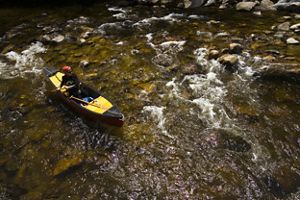
River Recreation: Paddling through rapids on the Ashuelot River in Surry, New Hampshire. © Jerry and Marcy Monkman/EcoPhotography
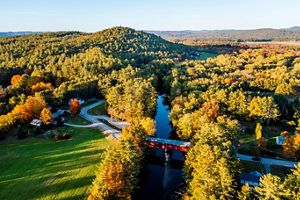
Reconnecting a Region: The Ashuelot River is part of a larger network of rivers connecting New Hampshire to the Connecticut River and the Atlantic Ocean. © Jerry Monkman/EcoPhotography
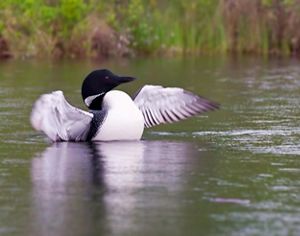
Common Loon: A loon flaps his wings in the Connecticut River in northern New Hampshire. © Darrell Bodnar
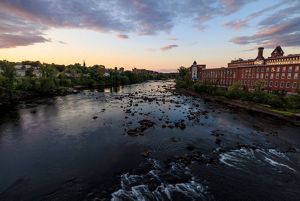
The Merrimack River: The view upstream from the Granite Street Bridge in Manchester, NH. © Jerry Monkman/EcoPhotography
Healthy rivers don't stop at property boundaries. That may sound obvious, but it's shaping some of the most ambitious freshwater conservation work happening in New Hampshire today.
For decades, efforts to conserve rivers often focused on protecting important places along them. That work remains essential. What feels different now is the growing focus on how entire river systems function and what happens when those systems are reconnected.

You can see that shift along the Ashuelot River, where we are working with partners and communities to explore what the future of the Fiske Mill Dam and reconnecting the river in Hinsdale might look like. You can also see it along the Merrimack River, where an updated conservation plan brings together ecological science and community priorities to identify opportunities for conservation, recreation, healthier, more resilient communities and cleaner waterways across one of New England's most important watersheds. Along the Upper Connecticut River in northern New Hampshire, floodplain forest restoration is helping to filter water, reduce flooding, store carbon and provide habitat for wildlife, while upgrades to road-stream crossings in the watershed are making travel safer for wildlife and people.
These projects look very different from one another. Some focus on restoring fish passage. Others focus on flood resilience. Others start with conversations about how people experience their rivers and what they want those places to become. What connects them is a belief that working at the scale of a watershed can unlock opportunities that individual projects might never achieve on their own. We're still at the beginning of that story, but, the benefits could ripple across New Hampshire's rivers for decades to come.
Helping Salt Marsh Adapt
Salt marshes have been part of TNC’s coastal conservation work in New Hampshire for a long time. But in the face of sea-level rise and a changing climate, protection is no longer enough to ensure these special habitats will endure for generations.

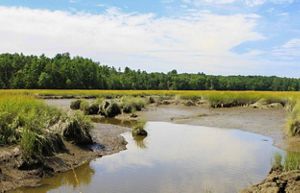
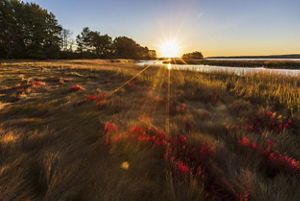
Lubberland Creek Preserve: Lubberland Creek is a tidal creek that flows through the salt marsh at Lubberland Creek Preserve into Great Bay in Newmarket, New Hampshire © Jerry and Marcy Monkman/EcoPhotography.com
Lubberland Creek: Lubberland Creek meanders through the salt marsh at The Nature Conservancy’s Lubberland Creek Preserve in Newmarket, New Hampshire. © Rebecca Laflam
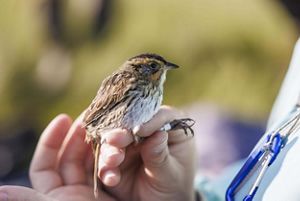
Saltmarsh Sparrow: UNH scientist Talia Kuras holds a salt marsh sparrow that was just banded and outfitted with a GPS transmitter at the Lubberland Creek Preserve in Newmarket. © Jerry and Marcy Monkman/EcoPhotography
Dawn on the Marsh: Dawn on the salt marsh at The Nature Conservancy's Lubberland Creek Preserve in Newmarket, New Hampshire. © Jerry and Marcy Monkman/EcoPhotography
At Lubberland Creek Preserve, we have spent decades stewarding a landscape where the forest, tidal creek and salt marsh all meet Great Bay.
For years, protecting places like this was one of the clearest ways to help salt marshes endure. That work still matters. But sea level rise and climate change are changing what these habitats need from us. A salt marsh can be protected and still be at risk of drowning with rising water levels or if tides cannot ebb and flow naturally. Losing our salt marshes would mean negative impacts to species diversity, shoreline erosion control and storm surge protection.


That is why we are working with partners to move beyond protection and into active restoration of our salt marshes. At Philbrick Pond in North Hampton, replacing a road crossing that restricted tidal flow and was prone to flooding is making passage for vehicles safer while also restoring the natural movement of water through the salt marsh. We are also testing innovative restoration approaches here that, while still relatively new in New Hampshire, have the potential to have positive, lasting impacts on marsh health and resiliency.
At Lubberland Creek Preserve, research and planning are helping us understand what this salt marsh may need in order to persist as conditions change. Replacing the former flood-prone road-stream crossing on Bay Road now allows Lubberland Creek to ebb and flow naturally with the tide as it passes under the road. In addition to providing safe passage for fish and wildlife, it also creates the opportunity for salt marsh grasses to migrate upland (yes, grass can move!) as sea levels rise. Meanwhile, researchers are fitting salt marsh sparrows with tiny, solar-powered transmitters to better understand how they use the marsh and how changing conditions may be affecting behavior. The data and learnings will inform what steps we take next in restoring this habitat.
Protection and stewardship are core to our mission. And science is pointing us toward an evolution in our stewardship: restoring tidal flow, improving salt marsh health, understanding how wildlife uses these places, and making room for these habitats to shift as conditions change. It is careful, long-term work, rooted in the belief that the salt marshes we have protected for decades deserve more than protection. They deserve a future.
Preparing for a Changing Climate
Not long ago, climate change was one of many challenges conservationists were thinking about. Today, it touches nearly every aspect of our work.
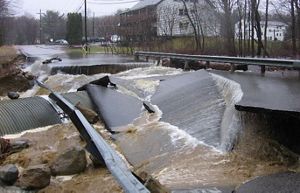


Washed Out: The failure of the culvert under Topaz Drive in Barrington, New Hampshire in 2007 trapped residents of the Emerald Acres Cooperative for three days. © Lori Wingate/Emerald Acres Cooperative
Tree Cage: Protective cage around a sapling. Tree cages are a climate-smart forest management strategy being explored thanks to funding from TNC's Natural Climate Solutions Accelerator. © Jerry and Marcy Monkman/EcoPhotography
New Hampshire State House: The New Hampshire State House in Concord. © Daryl Burtnett/TNC
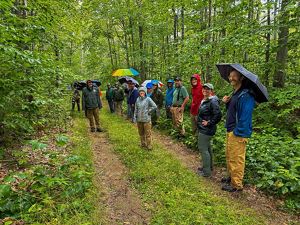
Collaboration is Key: Staff from federal agencies, local land trusts and others working in conservation explore a Climate Resilient Forest Management project in New Hampshire. © Jeff Lougee/TNC
That shift has changed the kinds of questions we're asking. How can forests remain healthy as the climate shifts and invasive pests and pathogens threaten our trees? How can communities reduce flood risks while improving the health of local rivers? What role can nature play in helping people adapt to heavier rainfall, hotter summers, milder winters, and more extreme weather?
The answers are taking shape in different ways across New Hampshire. At places like Green Hills and Surry Mountain, we are testing climate-smart forestry practices designed to help forests remain healthy and diverse for generations to come. In communities like Manchester, residents are helping identify the priorities and solutions that will shape local resilience efforts. Projects like the Topaz Drive crossing in Barrington demonstrate how investments in climate-smart infrastructure can reduce flood risks for residents while reconnecting habitat for fish and wildlife.


Just as important is the work happening beyond any one project. We are helping advance science-based policies and solutions that can strengthen resilience at a much larger scale, ensuring that climate adaptation becomes part of how communities identify needs, plan, invest, and prepare for the future.
Climate change is not a challenge that can be solved at a single preserve, in a single town or through a single project. Meeting this moment requires new ways of thinking about our work on the ground and in the water, collaboration with communities and action at the policy level. The conservation choices we make today will help determine how well New Hampshire's people, lands and waters are prepared for the changes ahead.

Six Projects that Transformed the Work of TNC
Seventy-five years ago, a group of scientists formed The Nature Conservancy to protect threatened natural areas through direct action—often working with local communities to purchase lands outright. These are some of the milestones and pivot points that pushed TNC to grow, develop new strategies and engage with people like never before.
The Long View
So much of our conservation work is now so familiar that it's hard to imagine a time when it didn't exist. Land protection, prescribed fire and oyster restoration are all well-established parts of conservation in New Hampshire today. But every one of them started as a new idea that required people willing to try something different, and for you to be willing to support it.
The work happening now, from reconnecting rivers and restoring salt marshes to helping communities prepare for a changing climate and experimenting with new techniques to make forests healthier, may not yet have stood the test of time, but that is exactly why it all matters. The science is helping point the way forward, and the decisions we make today will shape what conservation looks like in New Hampshire (and beyond) in the years to come.


Support New Hampshire Nature
Make a Lasting Impact
You have the power to make a difference for New Hampshire and for our planet. Your support will help fund groundbreaking science and conservation that help us protect more than 300,000 acres of land across the Granite State.
