


The Power of Community Solar
The Nature Conservancy and its partners have completed solar installations on four community buildings in eastern Kentucky.
The Nature Conservancy and its partners at Mountain Association and HOMES, Inc. have completed solar installations on four community buildings in eastern Kentucky since 2022. The Cumberland Forest Project’s Community Fund provides most of the installation funding, but other grants and funding from the community organizations themselves have also enabled the projects.
The Community Fund originated with mineral royalties resulting from the small amount of mining that still takes place on the Cumberland Forest Project. The Nature Conservancy determined that all of these royalties would be reinvested into the communities of Virginia, Tennessee and Kentucky. The solar installations in eastern Kentucky are helping community organizations save much-needed funds on their energy bills and instead invest that money into their missions. “We realized our community funds could make a real difference,” says Heather Jeffs, director of external affairs for The Nature Conservancy in Kentucky.
Community Centered
The Nature Conservancy’s first community solar installation took place in 2022 at the Middlesboro Community Center, a city-owned building that hosts community events such as weddings and birthdays. The installation is saving the city approximately $4,000 per year on the building’s energy bills.
“With the Middlesboro Community Center hosting a kitchen, a gym and a public pool, it has been an exceptional facility to save electric costs with solar,” says Josh Bills, a certified energy manager with Mountain Association. "With the pool operational in the summer, the electric use skyrockets in the summer. Thankfully, that is when solar shines the brightest. Before solar, the Center’s electric bill would approach $2,500 in a summer month due to the pool pumps and filtering. Now, the most we see in a summer month is a $1,400 electric bill. The rest of the year, when the pool is closed, and since the building is heated with natural gas, the Center has been charged no more than the minimum electric bill, that being the monthly $65 fee for the meter. In the two years since the solar panels were installed in January of 2024, the City of Middlesboro’s budget has been enhanced by more than $17,000 from solar offsetting. Those payments would have gone to the investor-owned electric utility serving Middlesboro, that is headquartered many counties away!"
Solar Installation in Middlesboro


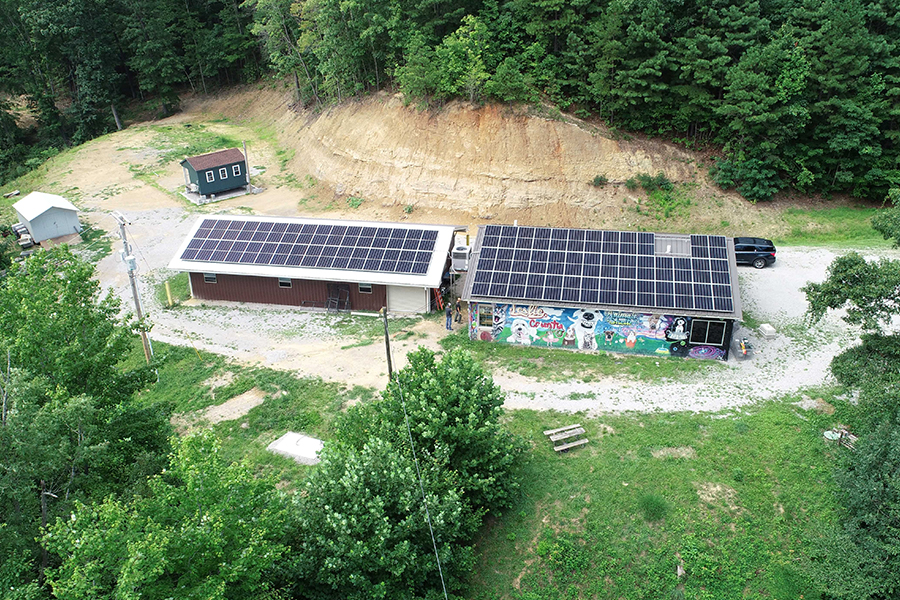
Solar Panels Bring Clean Energy to a Kentucky Animal Shelter
In 2024, solar panels were installed on the Leslie County Animal Shelter. The panels are saving the shelter approximately 40,000 kilowatt hours of energy every year, amounting to an annual savings of nearly $6,000—about 70% of the shelter’s energy bill.
“The animal shelter is at the end of the circuit line, and there are a lot of trees on the way there; power outages happen,” Bills says. “We installed battery storage for backup, just in case the power goes out.”
“It just made economic sense for the county,” said Anna Carey of Leslie County Fiscal Court; Carey worked on the Leslie County Animal Shelter’s solar installation project, which was funded by the Community Fund. “We knew it would decrease the shelter's bills and we could hook it up to batteries. This offered more long-term resiliency.”
Historically, Leslie County’s economy was fueled by coal. In a community that once relied so heavily on the coal industry, clean energy can be a touchy subject. Carey thinks that, once people see how much money the county saves and can invest in other community services, this solar project and any that come in the future will be readily welcomed. It’s also an example of how the region can continue its legacy of energy production and one more way historic coal revenue contributes to its continued energy security today.
Carey also appreciates that this solar installation was an example of the county testing a new solution. The cost to the county was low, the benefits and savings could be significant and it could end up being a case study for the county on reducing costs elsewhere at other municipal buildings.
“We’re lucky. I don’t know how we got so lucky,” Carey said of receiving the grant funding. “It’s the fiscal court’s job to be fiscally responsible. So, we’re doing our job. Sometimes it’s that simple.”
Solar in Action at Community Action Center
In 2025, solar panels were installed at KCEOC Community Action Partnership. Established in 1964 as one of the original 23 Community Action Agencies as part of President Lyndon Johnson’s declaration of the “War on Poverty,” KCEOC provides education, housing and food assistance, home weatherization, job training and more to eastern Kentuckians.
“This solar project is actually two projects in one!” says Bills. “The solar is fully offsetting the electric use from two electric meters serving KCEOC, with expected electricity cost savings greater than $9,000 each year for KCEOC’s Emergency Support Center, a 23-bed facility providing a safe setting for adults and families experiencing homelessness to find relief and supportive services. Care was taken as well to ensure that the installation is battery-ready and can easily incorporate battery storage one day for resilient emergency backup power, without having to undo or redo what has been installed so far. In just the first four months of operation, solar has offset 38,060 kWh, saving the ESC more than $4,000!”
Check out this video, from Solar Energy Living, LLC, the team that installed the panels at the KCEOC site.
Solar Installation at KCEOC


Building More Sustainable Communities
Red Bird Mission also received solar panels in 2025. The panels added to an existing installation on the organization’s school, furthering its energy cost savings. Red Bird Mission provides education, housing improvement, economic opportunity and health care for eastern Kentuckians.
“Even with the solar modules installed, the installer is still navigating interconnection approval with KY Power, so the added solar has not been commissioned yet,” says Bills. “That said, we are looking forward to it getting approval and getting turned on. This will take solar up from offsetting 10% with the system in place since August of 2020 to offsetting more than 25% of annual usage!”
Solar Installation at Red Bird Mission


We aren't finished yet. The Nature Conservancy and its partners are preparing for more community solar installations in the near future. We thank all of our community partners for working with us toward a more energy-efficient Kentucky!

Kentucky Nature News
Sign up to receive monthly conservation news and updates from TNC in Kentucky. Learn more about important conservation news near you.
Working in the Region

Powering Change in the Appalachian Mountains
The Appalachians have long been known for coal. But a quiet shift is taking place as many Kentuckians, like Bobby Stallard, are redefining their relationship with energy by turning to solar power.

The Cumberland Forest Project: Conservation at Scale
With many years in the making, this innovative project demonstrates the climate benefits of sustainable forest management while providing positive conservation, community and financial returns.

Cumberland Forest Community Fund
Supporting nature-based economic and community development in the Appalachian regions of Southwest Virginia, Tennessee and Kentucky.