


Nature-Strong Communities in the Midwest
Throughout the Midwest, communities are embracing nature-based solutions that help protect people from severe weather, maintain clean air and water, and provide food and energy.

The communities of Marshall Square are building a healthier future through regreening efforts led by Latinos Progresando
Near the South Side of Chicago, between Pilsen and Little Village, you’ll find Marshall Square—a vibrant, bustling corridor home to some of the best authentic Mexican restaurants in the city. Full of long-time residents, the close-knit neighborhoods are majority Mexican immigrant communities and support many locally owned businesses, from flower boutiques to beauty parlors to repair shops. But for a long time, this area was missing something:
Trees.


“The tree canopy was very, very low, especially along the commercial routes,” says Nubia Willman, chief programs officer for Latinos Progresando, a nonprofit serving the communities of Marshall Square. “You have all these diesel trucks generating additional pollution, but very little nature to mitigate that. That really propelled the need, especially in regard to air quality, to increase the tree canopy and green spaces in the area.”
As part of Latinos Progresando’s mission to support and empower the communities of Marshall Square, they partnered with The Nature Conservancy (TNC) in 2018 on a variety of regreening and environmental projects, including air quality monitoring, tree planting and a schoolyard transformation project that provided a thriving greenspace for kids and neighbors.
“A crucial part of TNC’s mission is helping communities like Marshall Square become more resilient to climate change impacts, and that work is made possible by partnerships with local groups like Latinos Progresando,” says Joel Zavala, director of community partnership and engagement for TNC in Illinois. “These communities are facing multiple environmental burdens, more so than others, so these locally led regreening efforts carry a lot of impact.”
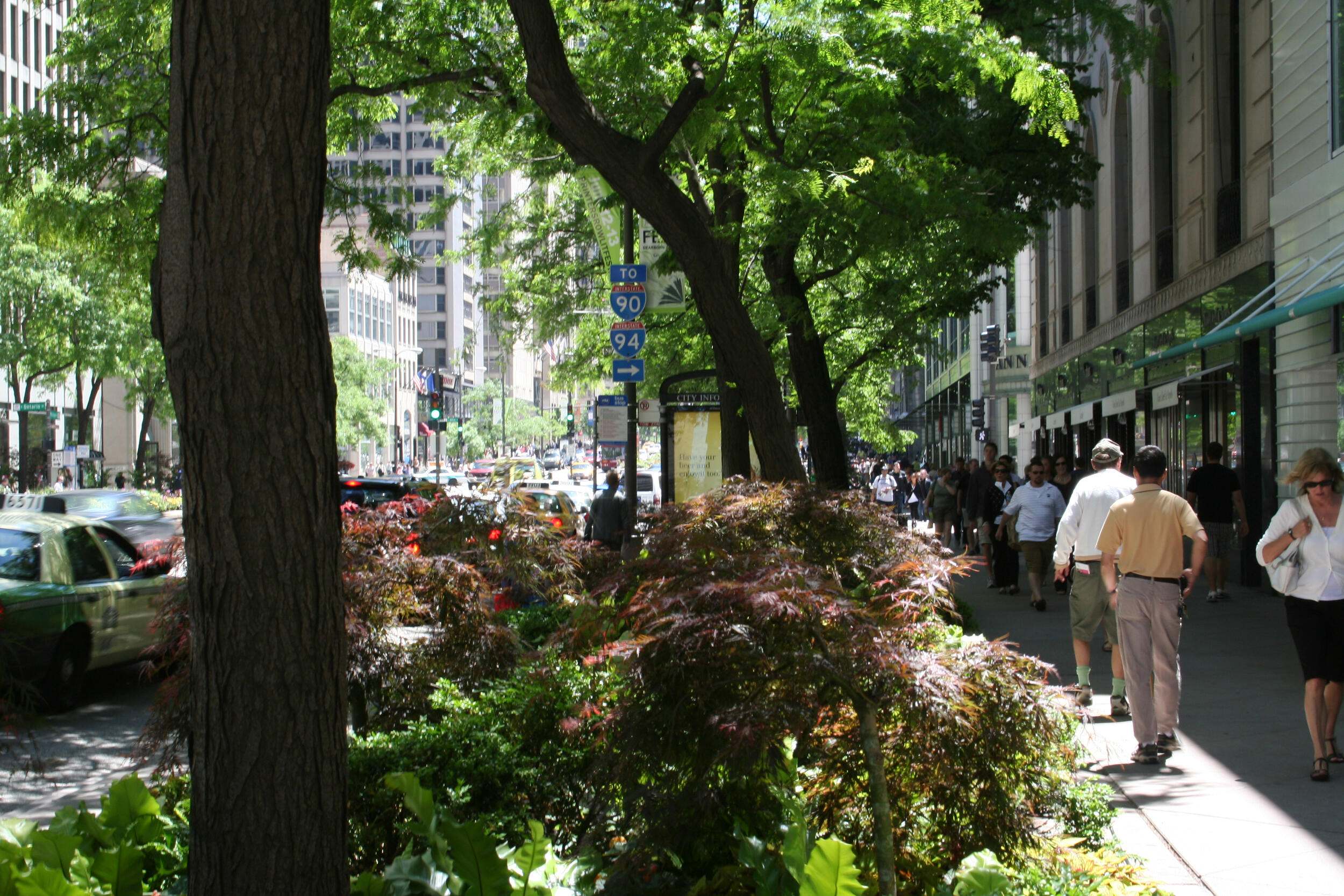
Wander through many neighborhoods in Chicago, and you’ll be surrounded by towering honey locusts, leafy swamp white oaks and dreamy Great Wall lilacs. But not in Marshall Square, where the tree canopy coverage only averaged 15 to 18 percent, far below the region’s average of 23 percent.
The lack of trees isn’t merely an aesthetic issue—trees provide many important services to communities, such as intercepting stormwater, which can help mitigate flood risk. Their shade also helps alleviate the “heat island effect” where asphalt surfaces absorb and radiate more heat, which can negatively impact human health.
Most important for the residents of Marshall Square, trees can help improve air quality by capturing particulate matter, a pollution that arises from the burning of fossil fuels that can be densest in areas near highways and factories. This type of pollution is particularly harmful to people and can lead to respiratory illnesses and other health conditions.
From cooling the sidewalks to improving heart health, planting trees in cities adds a lot more than just beauty to urban communities. Click on each tag over the photo to the right to learn more!
Shade from urban trees blocks the heat absorbed and released by asphalt surfaces and can cool cities by 2 to 4 degrees Fahrenheit.
Along urban streets—especially ones with a lot of traffic—trees filter out the particulate matter emitted from vehicles' exhaust, improving air quality for communities.
Get into how urban trees impact air pollution
For a deeper dive into urban trees and air pollution, check out this study and this study, published by the U.S. Forest Service.
Urban trees can reduce cardiovascular disease risk for residents by reducing inflammation through improved air quality and providing a calming greenspace that reduces stress and lowers blood pressure, among other benefits.
Dive into how trees affect heart health:
U.S Forest Service: Plant a tree and save a life?
American Heart Association: Greenspaces and Cardiovascular Health
Urban trees provide much-needed shelter and food for native and migrating birds, pollinators and other wildlife in areas where their normal habitats have been destroyed or disrupted.
Discover more about wildlife and urban trees:
U.S. Forest Service: Urban Forests as Habitat for People and Wildlife (PDF)
University of Kentucky Urban Forest Initiative: Wildlife Connections: Habitat Trees
ArboristNow Urban Forestry: Urban Trees: Nature's Skyscrapers for City Wildlife
Urban trees invite and encourage physical activity in residents, such as walking, which helps to improve overall health and wellness in city communities.
Explore more about trees and physical activity:
USDA: Mentally and Physically, Trees Make a Difference
Arbor Day Foundation: 6 Ways Urban Trees Make You More Active Outdoors
Yale Climate Connections: The little-known physical and mental health benefits of urban trees
Urban trees play a crucial role in ensuring cleaner water by helping cities effectively manage stormwater runoff. They slow the rate at which rain hits the ground, allowing the soil to absorb more water, filter out contaminants and ease the burden on storm drains. This reduces flood risk and improves water quality.
Get more info on urban trees and stormwater:
Arbor Day Foundation: Trees Tame Stormwater
Arbor Day Foundation: How Trees Can Retain Stormwater Runoff

 Return
Follow conservation in our cities and beyond with our monthly Nature News.
Subscribe for Nature StoriesTo aid efforts to identify and improve the air quality of their neighborhoods, local community members volunteered to collect data using pollution monitors. The monitors were provided by a collaboration between Latinos Progresando, TNC and the Environmental Law & Policy Center, who then used the information to create an air quality map of Marshall Square.
“We would never have known how poor the air quality was or that the tree canopy was so bad had we not done this,” Nubia says. “We knew there was a lot of smog, and a lot of people have asthma, but our partnerships provided the expertise we needed to really understand the data and make those connections. That information supported our argument to the city for bringing resources back to the neighborhood.”
Latinos Progresando and TNC worked with local community members, who engaged in a robust letter-writing campaign to plant more trees through a city initiative called “Our Roots Chicago.” As part of this initiative, Latinos Progresando, TNC, and the Chicago Department of Transportation carried out the largest tree-planting project by the city in collaboration with partner organizations at the time.
Over the course of a single summer, 122 trees were planted along Cermak Road, California Avenue and Kedzie Avenue—three of the largest and busiest streets in the neighborhood—that previously had no trees at all.
For a lot of our tree keepers, it really adds this feeling of accountability and connection to the community. You're living here, and you’re helping care for this shared space, this shared resource.

In addition, Latinos Progresando and TNC secured a Tree Ambassador Grant from the Chicago Region Tree Initiative, which will ensure that 100 more trees are planted in the community over the next two years.
“It’s so important to amplify the voices of the small business owner and the local students and the residents and everyone else who is a part of the community, because they’re the ones experiencing the impact and effect of policies,” Nubia says. “Many residents had never engaged with elected officials in this way, so it was really rewarding to see them empowered and secure enough to say, 'We want this resource for our community,' and then have it be successful. What was literally a barren corridor is now full of trees that will be here for decades to come.”
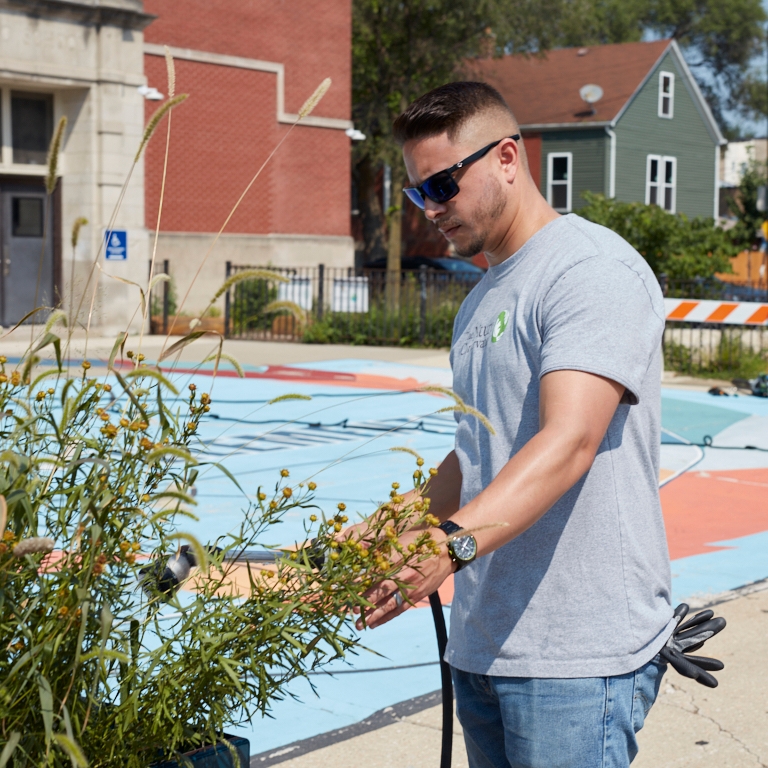
Latinos Progresando also hosted a stewardship course through Openlands, where local community members learned how to prune and care for the trees.
“For a lot of our tree keepers, it really adds this feeling of accountability and connection to the community,” Nubia says. “You're living here, and you’re helping care for this shared space, this shared resource.”
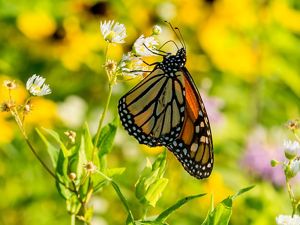
Every spring, monarch butterflies leave their mountain forest homes in Mexico and travel thousands of miles to their summer habitats throughout the United States and Canada. For some with Mexican heritage, this remarkable migration is symbolically powerful. In a way, it can be a reminder of their own family’s journey, but for others, like Joel, it can represent a direct connection to their heritage.
“I grew up in Little Village, not far from Marshall Square, and like other children of immigrants, when I go back to where my parents grew up in Mexico, I’m reminded of how much we were connected with our landscapes and our food,” Joel says. “Then, when I come back to my neighborhood in Chicago, the built environment can make it feel as if I'm a lot less connected to it. Increasing our access to nature by providing more greenspace helps restore some of that connection."
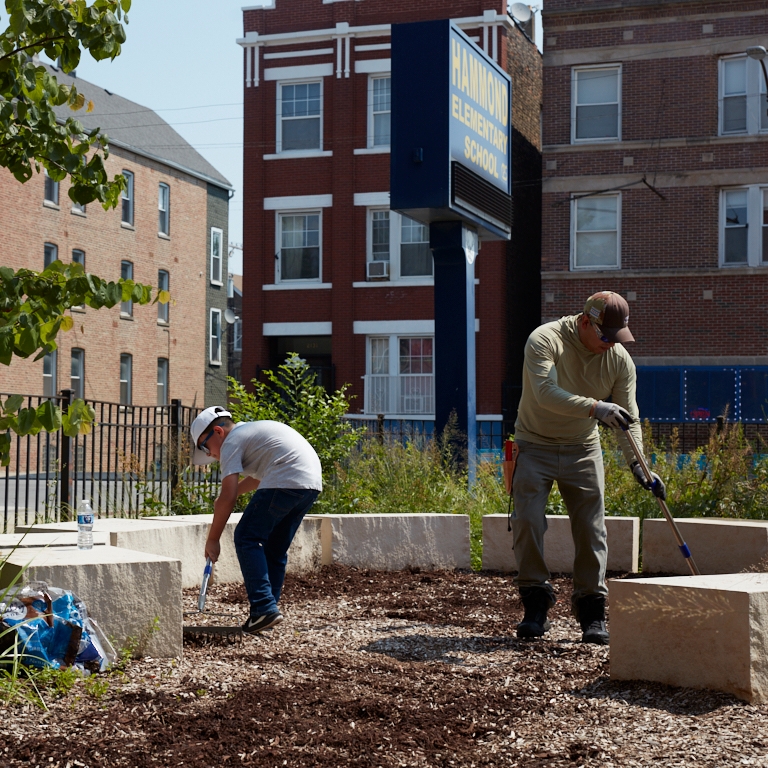
As part of their aim to improve the health, well-being and safety of Marshall Sqaure, Latinos Progresando and partners led an effort to transform the blacktop courtyard of Hammond Elementary School to a shared, vibrant greenspace. As part of this project, community volunteers were trained to caretake the new gardens.
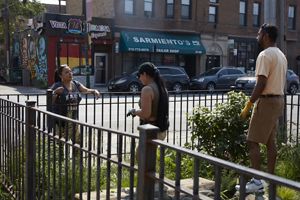
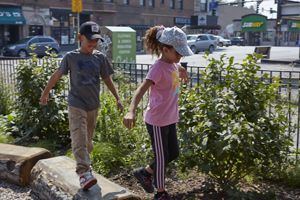
A Place for Play and Learning: The new, regreened Hammond Elementary courtyard features spaces surrounded by native plants where students can play and participate in nature-based learning. © Latinos Progresando
Regreening Hammond Elementary: Marshall Square community members, Latinos Progresando and TNC planted more than 500 native, pollinator-friendly plants in the new nature-based courtyard for the school. © Sara Pooley
Building Community: As resident volunteers work within regreening projects, they connect with other community members, spreading the word about their work and how others can get involved. © Sara Pooley
Supporting Nature and Culture: The native gardens at Hammond Elementary are designed to attract monarch butterflies, which hold deep cultural significance for some people with Mexican heritage. © Charles Larry
A Greener School: The new Hammond Elementary greenspace gives students a natural playspace and opportunities for nature-based learning, while also serving as a community space. © Sara Pooley
In partnership with TNC and the Marshall Square Resource Network, a coalition of more than 60 neighborhood and city-wide partners, Latinos Progresando led an effort to improve the walkability and safety of California Avenue, one of the largest streets in the area, by turning the blacktop of Hammond Elementary school into a shared, healthy greenspace.
“At the time, the schoolyard was an empty concrete slab,” Nubia says. “There was no place to sit. There was no place for shade. There was maybe one basketball hoop.”
Plans for the schoolyard restoration project were developed through a robust community engagement process that included focus groups, neighborhood surveys and design workshops with the school’s staff and students.


“We really want to empower the community to feel a lot of pride and accomplishment in contributing to their space,” Nubia says. “Nature is a huge part of social and emotional learning, but spaces like this are more important than just the services they provide. We want to support the dignity of the community by creating a really aesthetically pleasing environment for everyone to enjoy.”
Vibrant pollinator gardens full of native plants were installed throughout the yard, as well as natural seating areas, playgrounds and sports equipment, and a mural created by local artists, all of which support social and emotional benefits for students. After the school day is over, the yard is opened to the public and serves as a neighborhood park. What’s more, similar to the tree keeper program, Latinos Progresando works with TNC to train parents and other volunteers to help care for the gardens.
“Helping the community re-connect with nature through these kinds of regreening projects is very meaningful to me,” Joel says. “This community very closely resembles my own, so it feels like I'm talking to my neighbors and my aunts and uncles and cousins, and it’s been really inspiring to see how they have embraced these initiatives.”
“Our partnership with TNC has been so valuable because we’re able to connect expertise with the community for the most benefit,” Nubia says. “It’s enabled so much progress, and I hope it inspires more groups to think about how they can bring their synergies together.”
Should you ever visit the Hammond Elementary School greenspace, you should check out the popular milkweed garden—you just might see a monarch butterfly, flitting about and thriving.

In cities throughout the Midwest, The Nature Conservancy supports efforts that use nature and natural infrastructure to improve climate resiliency and human health. We often partner with community-based organizations, such as Latinos Progresando, to improve access and reduce barriers to nature-based solutions.
Below are some frequently asked questions and tips on how to support a thriving tree canopy for healthier neighborhoods in Chicago and beyond.
If you have space on your own property, you can plant a tree on your own, and this is a great contribution to a city’s tree canopy. Remember to first ‘check before you dig’ by calling 811 to screen for underground utilities.
You can also join existing planned tree planting events. For example, in Chicago, you can sign up for planting events throughout the city hosted by the Chicago Regional Trees Initiative.
Like in rural forests, a diversity of trees in cities provides natural resistance to the spread of tree pests and pathogens and supports native wildlife. Many tree species do well in cities, but it is important to avoid planting invasive tree species, which do not support overall ecosystem health. Illinois has many resources to help you find and select beneficial tree species for your home and neighborhood.
Improving the tree canopy is one of the best things you can do for air quality in cities. In addition to planting new trees, caring for the mature trees that are already in your neighborhood by watering, trimming, and mulching are great ways to protect the tree canopy and maximize the benefits for years to come.
City governments usually take responsibility for planting trees in public spaces, such as the parkways between the street and private homes and businesses. In Chicago, you can request a tree be planted in front of your home using the 311 system. Prior to planting, the City will send a forester to evaluate the site before selecting a suitable tree species for the environment.
Many cities have teams or organizations that help care for mature trees in public spaces. If you have a newly planted tree near your home, consider giving it supplemental water, which is particularly beneficial during periods of hot, dry weather. On private property it is often the landowner’s responsibility to care for their trees, so connecting with local conservation organizations is a good way to find resources.
In Chicago, the Bureau of Forestry provides tree trimming to maintain healthy trees throughout the city, and the City government often manages watering and maintenance for newly planted public trees in their first several years.
From schoolyards to backyards, TNC is working with partners throughout Illinois and the Midwest to help cities become greener and healthier.


