


Rethinking Tennessee Dams
Many of Tennessee's dams don't fulfill their original purpose, and even cause harm. Find out what we're doing about it.

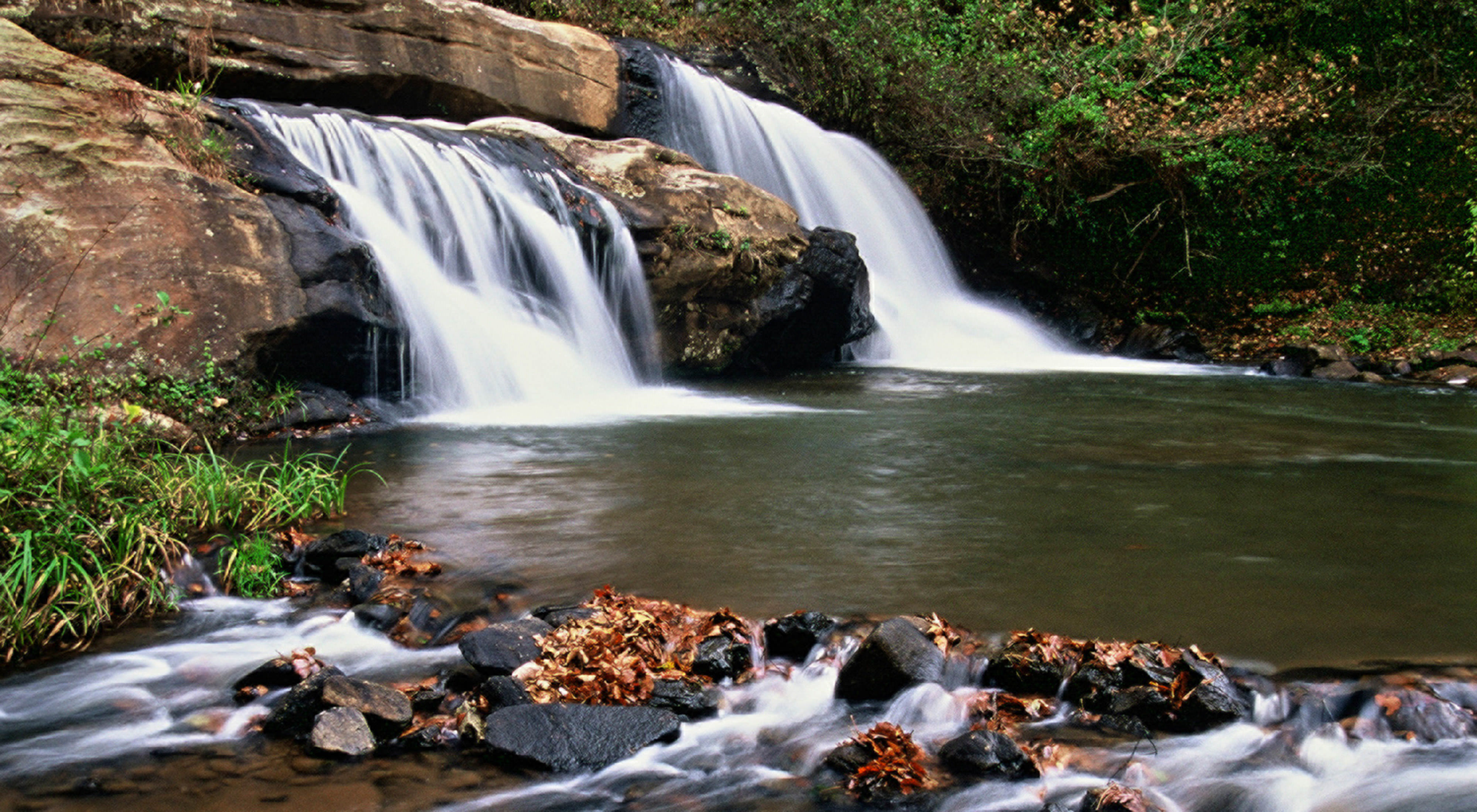
Mills River The Mills River in Henderson County a few months before Hurricane Helene hit the state. © Lucie Law
See the aftermath, early recovery work, and the remarkable wildlife rescue operations.
Read the StoryIn late September 2024, Hurricane Helene barrelled through the southern United States, unleashing historic rains, powerful winds and widespread devastation. Although Helene made landfall along Florida’s Big Bend, it quickly moved inland before stalling in the Southern Appalachians.
In many ways, the natural landscape is altered permanently. The wind, floods and landslides reshaped forest canopy structure, moved sediment and woody material, and changed the conditions that will guide future forest and stream evolution.
Hurricane Helene was catastrophic, it was devastating, and it was tragic. It's important to respond to this moment in a meaningful way, so bringing the resources, the capacity and the expertise TNC has, to focus on recovery, is of personal importance to me, as well as to the organization.
Today, the landscape is still recovering, but TNC and partners are on the ground, working together toward a shared restoration vision for healthier, more resilient forests, waterways and communities. For TNC, this work reflects a simple reality: The recovery of the region’s ecosystems and human well-being are intertwined.
Hurricane Helene slowly carved a path through the mountains of northern Georgia, South Carolina, North Carolina, Virginia and Tennessee, dumping more than 30 inches of rain in some areas and impacting both communities and cherished outdoor spaces beloved by people near and far. Overnight, some entire mountainsides collapsed, hundred-year-old trees fell and serene streams transformed into raging rivers that swept away roads and homes.
In North Carolina alone, more than 100 people lost their lives.
The Blue Ridge Mountains near Abingdon, Virginia, were among the hardest-hit areas, impacting the Virginia Creeper Trail, Mt. Rogers, where outdoor recreation and local economies are closely intertwined.
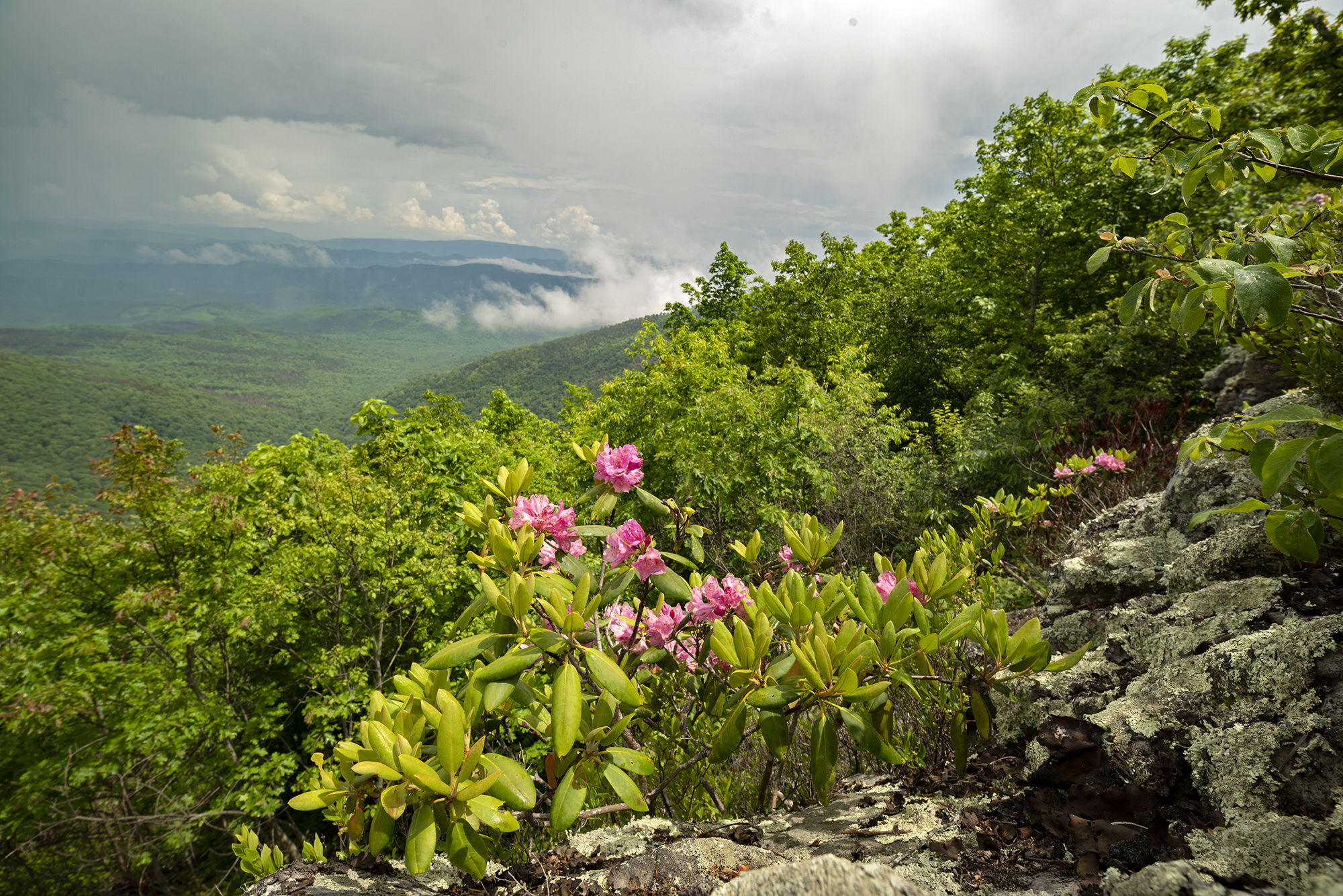
In Tennessee, Hurricane Helene brought record flooding, impacting communities and natural landscapes across East Tennessee.
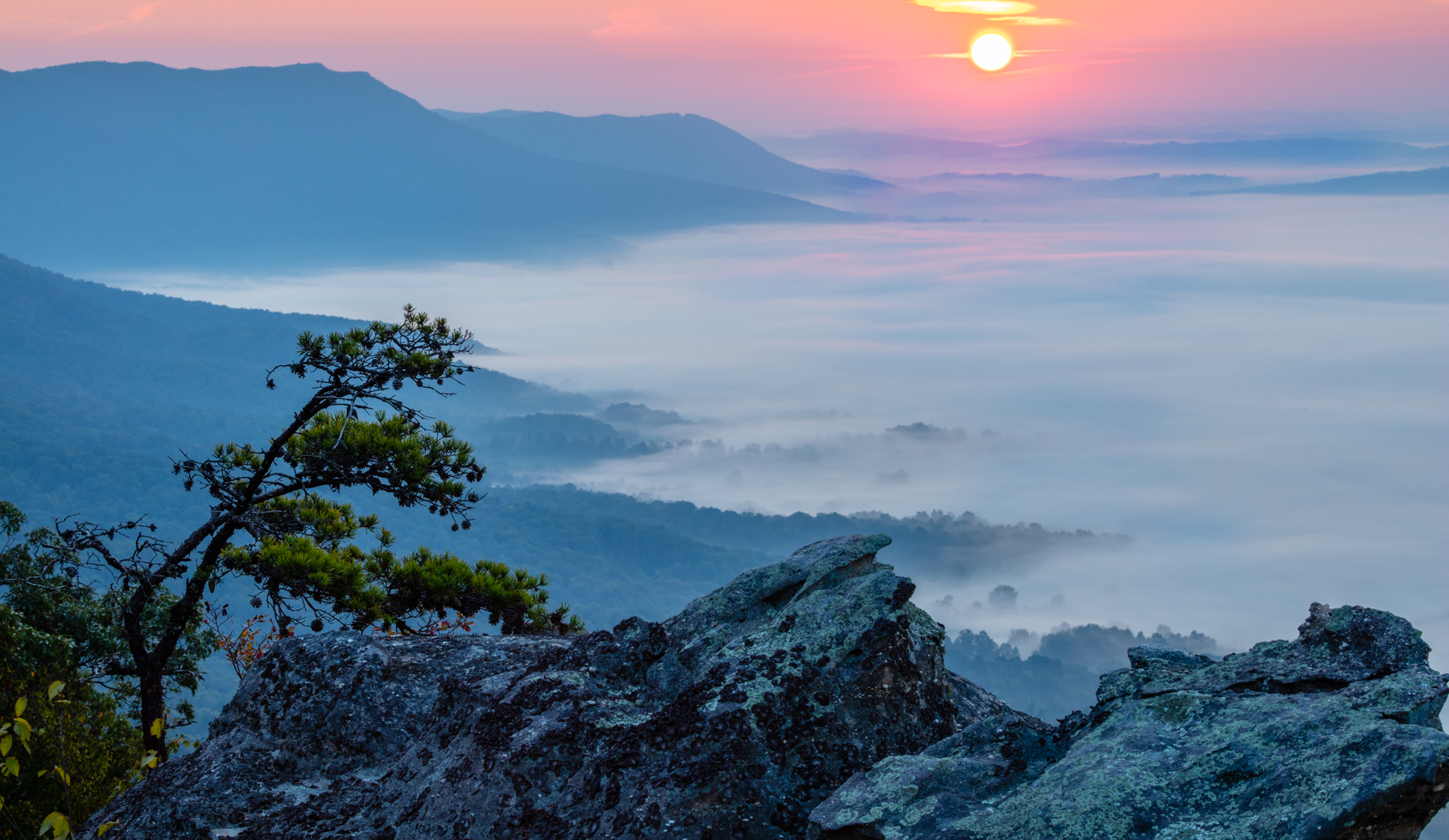
Many areas where TNC works in western North Carolina, around Asheville and Hickory Nut Gorge, experienced catastrophic flooding and tree blowdown from Hurricane Helene.
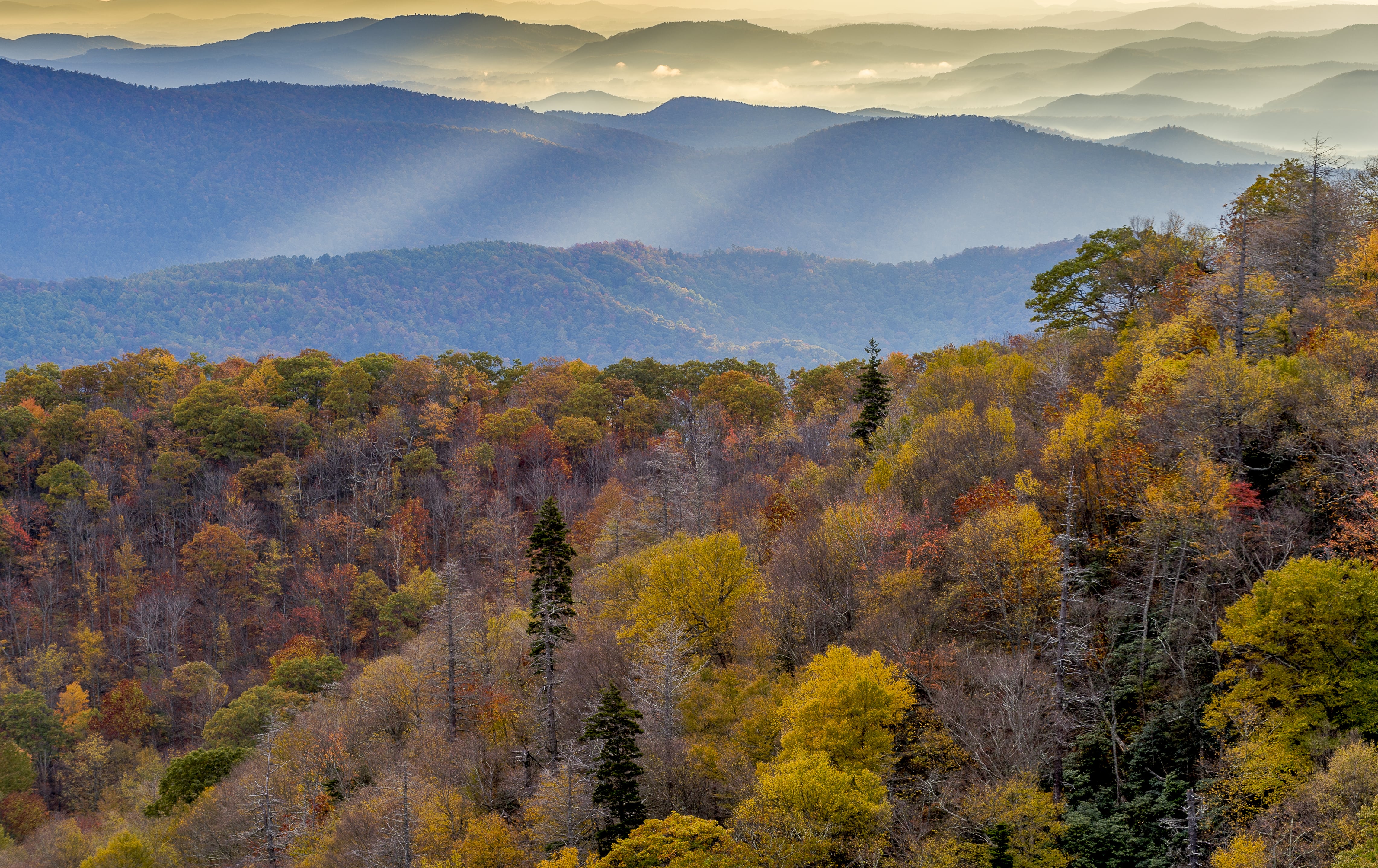
In South Carolina, Hurricane Helene made the most impact on the Upstate region, causing widespread damage across several counties.
In Georgia, Hurricane Helene caused tree and habitat destruction and agricultural and economic losses across the Southeast.

 RETURN
Hurricane Helene left a lasting impact on natural areas and communities across the South. TNC and partners are helping to restore landscapes, habitats and wildlife to recover some of the region's most affected areas.
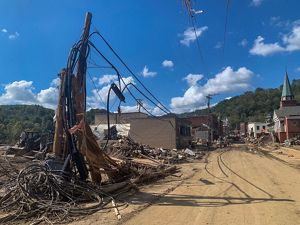


Hurricane Aftermath | N.C.: South Main Street in Marshall, NC, four days after Helene hit. The French Broad river crested 27 feet higher than normal after the storm. © Eric Seeger | TNC
Bat Cave Preserve: Kimberly Lughart, a Henderson County Rescue Squad captain, led a team on an assessment of Bat Cave Preserve, December 2024. © Kimberly Lughart | TNC
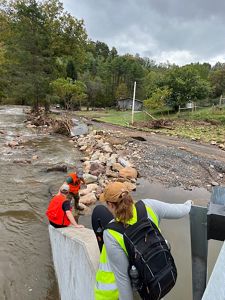
Assessing the Damage: An assessment crew finds a way across the Rocky Broad River to Bat Cave Preserve after the pedestrian bridge washed away in Hurricane Helene. © Kimberly Lughart
Measuring the Impact: An assessment crew navigates large boulders and the washed out road to evaluate damage and guide restoration efforts along the river. © TNC
In the immediate aftermath of the hurricane, well over 800,000 acres of forestland suffered various degrees of damage, from entire hillsides of fallen trees to scattered pockets of snapped and uprooted timber, raising concerns about future wildfires.
Recovery for forests in this region means replanting the native hardwoods that provide habitat for wildlife and diverse understory plants along this critical corridor, as well as preventing fast-growing invasive species from taking hold in storm-damaged areas, which often exploit openings in the forest to outcompete slower growing native trees and plants.
Earlier this year, TNC and partners completed the first major reforestation project by planting 4,000 red spruce seedlings at Roan Mountain in North Carolina. This initial planting supports habitat for wildlife species listed federally as endangered or threatened, such as the Carolina northern flying squirrel and spruce-fir moss spider.
In addition, we are conducting reforestation assessments within national forests across the region, including surveying for non-native invasive species, laying out various silvicultural treatments and collecting forest stand data.
This labor-intensive work is already touching down in Virginia’s Mount Rogers National Recreation Area. So far, TNC’s four-person crew has completed 27 acres of timber stand improvements and treated non-native invasive species along a mile of roadside.
To guide what comes next, TNC developed maps and tracking tools that evaluate Helene’s impacts and give forest managers the information needed to determine the best course of action for recovery. We’re now working with forest and district leadership to develop contracts supporting recovery for both the George Washington and Jefferson National Forest in Virginia and Pisgah National Forest in North Carolina, with work planned to begin in spring 2027. Together, these recovery projects are being conducted with a view toward ecological conditions that will shape our future forests for many generations to come.


The health of the region’s forests is closely tied to the health of its streams and wetlands and to the drinking water that communities depend on.
TNC is working with the USDA Forest Service to prioritize 11 watersheds in western North Carolina for aquatic restoration over the next decade. This work is fundamental to restoring streams and wetlands for native aquatic plants and animals, as well as for protecting the region’s drinking water for more than 100,000 residents.
This initiative also includes removing an obsolete dam on the North Mills River so native fish and other animals can return to a stretch of river that’s been cut off from downstream waters for decades. Further benefitting both nature and people, TNC and our partners—along with local engineering design firms—will restore native streamside vegetation and replace undersized culverts to help prevent local roads from flooding.
North Carolina will also coordinate with the NC Wildlife Resources Commission, Trout Unlimited, the National Forest Foundation, the Appalachian Trail Conservancy and other partners on recovery work.
“Hurricane Helene’s impact on Western North Carolina’s watersheds and aquatic habitats is undeniable; from rerouted rivers to debris‑clogged waterways, recovery requires an all‑hands effort. The stream restoration work The Nature Conservancy is undertaking now will strengthen the long‑term resiliency of vulnerable watersheds and safeguard critical water resources.”
James Melonas, Forest Supervisor for the National Forests in North Carolina


Across more than a dozen watersheds between North Carolina and Virginia, these efforts will improve more than 300 river miles by reconnecting streams and stabilizing eroded banks, reducing flood risk and sedimentation on roads, restoring floodplain wetlands and helping protect quality.
In the South Fork Holston watershed of Southwest Virginia, restoration work is being planned for Dickey Creek, a major tributary. Two undersized road-stream crossings at Hurricane Creek and Comers Creek are under contract for design, and design-build requests for proposals are being developed for two more undersized crossings at Cressy Creek.
Along the popular Virginia Creeper Trail, which the storm badly damaged, teams are surveying conditions along a 20-mile reconstruction segment and preparing bid requests for invasive species treatment. A low-head dam is also being evaluated for potential removal.


Helene’s devastation produced a buildup of hazardous fuel—the excess woody material on the ground or in the forest canopy—that can increase the risk of uncontrolled wildfires for communities and nature alike. Addressing this risk has been a critical part of restoring ecological conditions for species that are adapted to fire. Controlled burns are one of the most important tools for this work, helping to reduce leaf litter and other flammable dead vegetation and restoring ecological conditions for species that are adapted to fire.
Our forests evolved with fire, and controlled burns are one of our best tools for restoring and maintaining their health. Recovery work will take years, but every acre treated, every burn and every restoration project with our partners helps move our forests to a more resilient future.
That’s good for wildlife, good for water and good for the people who call the region home, said Smyth. No single organization can do this complex work alone. TNC has worked with the Forest Service in western North Carolina since 2015 and in Virginia since 2008 on controlled burns, providing a track record that has made the two organizations natural, trusted partners for this essential work following Hurricane Helene. In North Carolina’s Pisgah National Forest, TNC and partners are assessing wind-damaged forests in priority burn units hit hardest by the storm. More than 1,600 acres are now prepared for the next round of controlled burns across western North Carolina.
In Virginia, recovery work will span the Clinch Valley and Allegheny Highlands, where TNC has had teams embedded for more than 20 years. Staff will collect spatial data on damaged forests across the Eastern Divide Ranger District, Mount Rogers National Recreation Area and Clinch ranger districts to identify high-priority treatment areas for controlled burns across more than 4,000 acres. Staff also gather data from forest composition plots to better understand how fire supports a healthy, resilient forest.
On the ground in Virginia, TNC hired four fuel crews to support prescribed fire across George Washington and Jefferson National Forests. During the spring 2026 burn season, the crews helped prepare and implement 17 burn units totaling nearly 27,000 acres. They spent more than a month on burn operations between early March and mid-April and the rest of their time clearing dead trees along fire lines, putting in hose lays to prepare for burns and manually building handlines, or narrow paths that are cleared to keep fire contained. All crews will work through April 2027.


The massive scale of Helene’s damage requires collaboration at an equally large scale, which is why TNC is working with the Forest Service, state agencies and myriad other partners. A grant from the Forest Service has enabled TNC to serve as a “force multiplier,” helping coordinate a landscape-level approach to restoration that wouldn’t otherwise be possible.
TNC also partnered with North Carolina Emergency Management, a division of the NC Department of Public Safety, to secure $4 million as matching funds for the grant, pairing state with federal funds for this critical work. Funds for the matching award are appropriated by the North Carolina General Assembly for disaster relief.
Such partnerships make it possible to address multiple aspects of recovery at once, from wildfire risk and forest restoration to watershed health and drinking water protection.
“The scale of Hurricane Helene’s impacts made it clear that no single agency could tackle recovery alone. Here in Virginia, our partnership with The Nature Conservancy and many other dedicated organizations has been essential in restoring damaged forests, rebuilding resilient landscapes and supporting the communities that depend on them. Together, we’re not just repairing what was lost—we’re strengthening our ecosystems so they can better withstand whatever challenges come next.”
Troy Morris, Deputy Forest Supervisor for the George Washington and Jefferson National Forests
Hurricane Helene caused historic levels of damage in just a few days. Restoring the forests and waterways it damaged will take much longer. But thanks to the ongoing commitment of our partners—along with public and private funding support—we’ve made real progress over the past two years since disaster struck our Southern Appalachians.
Get conservation stories, updates and ways to support delivered to your inbox. Get a preview of a Nature News email.

Read powerful stories of how people are protecting nature across the South—and see how you can make a difference too.


