
Abstract picture of a river.
Red River Rio Tinto Huelva © Javier Pedro Fernandez Ferreras/TNC Photo Contest 2022

Science-based. Practical. Nonpartisan.

The Nature Conservancy helps create, implement and defend policies related to conservation and climate action around the world. Our nonpartisan policy solutions are drawn from what we have learned from projects on the ground—guided by partners and grounded in science.

Two cowboys on a ranch
Cowboys on Parker Ranch Bill and son Tom Parker sold their ranch's development rights to TNC in 2008. Parker Ranch and two other holdings are part of 270,000 acres now protected. © Ian Shive
A forest next to deforested land
São Félix do Xingu, Brazil An aerial view showing deforestation for cattle ranching at São Félix do Xingu, a municipality in the Brazilian Amazon, that has one of the highest rates of deforestation in the country. Understanding that conversion to agriculture and cattle ranching is the greatest threat to the Amazon rainforest, the Conservancy works in strategic municipalities of the Brazilian Amazon such as São Félix do Xingu to implement strategies to control deforestation and promote the responsible production of soy and beef among farmers and ranchers. São Félix do Xingu is also one of the focal areas for the Conservancy's work on demonstrating how REDD programs can work on the ground. © Haroldo Palo Jr.
A whale and her calf swim through a kelp bed
Northward Migration A gray whale leads her calf through the kelp beds of Big Sur along the California coast. © Douglas Croft/TNC Photo Contest 2021
Two cowboys on a ranch
Cowboys on Parker Ranch Bill and son Tom Parker sold their ranch's development rights to TNC in 2008. Parker Ranch and two other holdings are part of 270,000 acres now protected. © Ian Shive

Policy in Practice

Farm Bill

The Farm Bill is America’s largest investment in the voluntary conservation, restoration and management of America’s private lands—ranches, forests and farms. When we protect these landscapes, we conserve wildlife habitat, provide people with healthy food, improve water quality and so much more.

A forest next to deforested land
São Félix do Xingu, Brazil An aerial view showing deforestation for cattle ranching at São Félix do Xingu, a municipality in the Brazilian Amazon, that has one of the highest rates of deforestation in the country. Understanding that conversion to agriculture and cattle ranching is the greatest threat to the Amazon rainforest, the Conservancy works in strategic municipalities of the Brazilian Amazon such as São Félix do Xingu to implement strategies to control deforestation and promote the responsible production of soy and beef among farmers and ranchers. São Félix do Xingu is also one of the focal areas for the Conservancy's work on demonstrating how REDD programs can work on the ground. © Haroldo Palo Jr.

Policy in Practice

EU Deforestation Regulation (EUDR)

The EU’s deforestation regulation (EUDR) ensures that seven commodity products—soy, beef, palm oil, wood, cocoa, coffee and rubber, all of which are major drivers of deforestation—will no longer be sold in the EU if sourced from areas affected by deforestation or forest degradation practices.

A whale and her calf swim through a kelp bed
Northward Migration A gray whale leads her calf through the kelp beds of Big Sur along the California coast. © Douglas Croft/TNC Photo Contest 2021

Policy in Practice

High Seas Treaty

The High Seas Treaty establishes a comprehensive legal framework to safeguard marine biodiversity in areas beyond national jurisdiction. These vast ocean areas are home to an estimated ten million species and serve as critical migratory corridors for whales, tuna, and other marine life.

Speak Up for Nature.


Together, we can protect nature and ensure that our planet thrives. But a nature-positive future is only possible if we all step up to the challenge.

Explore Our Policy Priorities

Click the tiles to learn more about our top conservation policy priorities.

Download

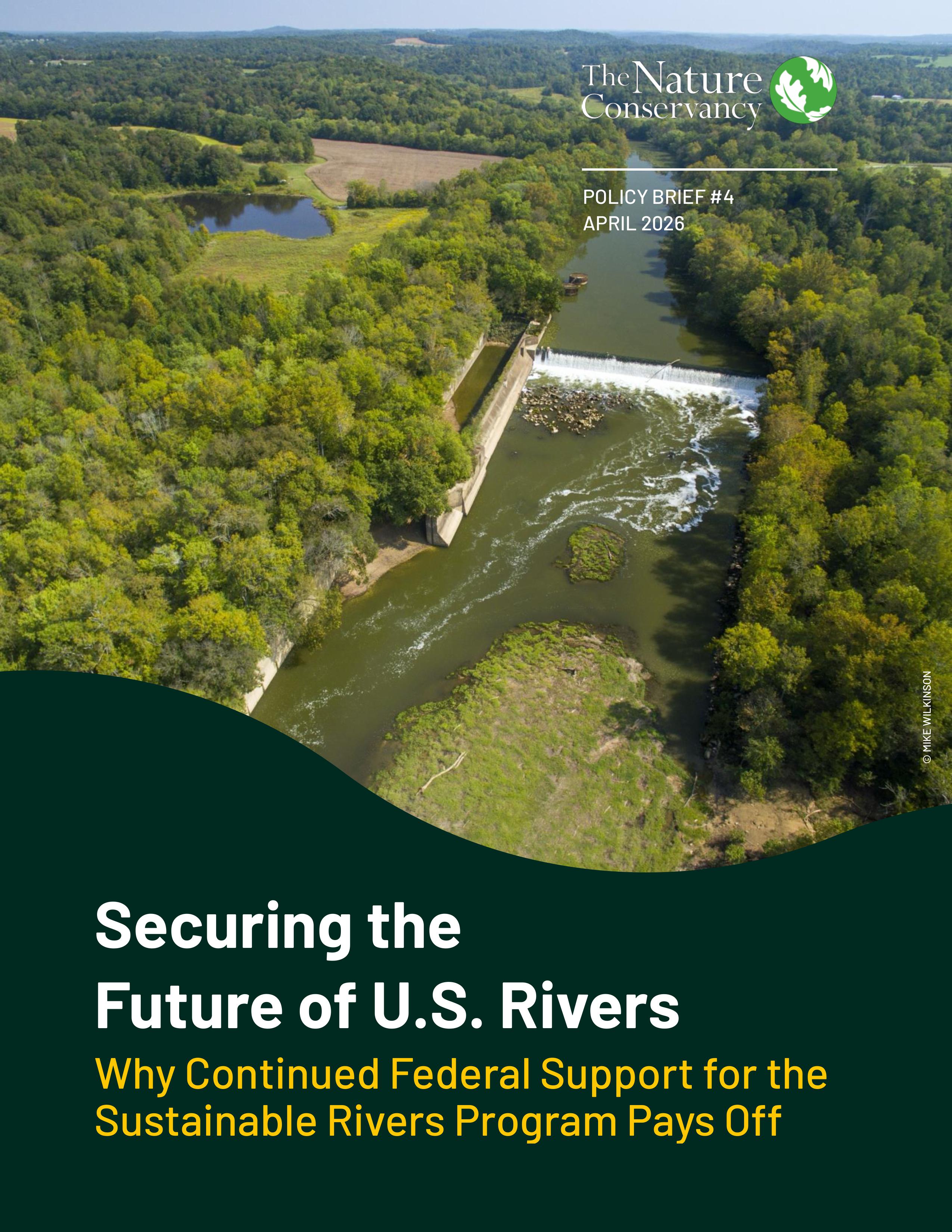
Securing the Future of U.S. Rivers

This policy brief outlines how the Sustainable Rivers Program delivers measurable ecological and economic benefits.

Download
Aerial view of lakeshore.
Independence Lake Preserve Aerial view of Independence Lake Preserve in Nevada © Chip Carroon

Latest Policy Resources

View and download our latest research and solutions to tackling the dual crises of climate change and biodiversity loss.

  • Cover image for EU DCF policy brief.

    The Resilience Dividend

    This policy brief examines how agriculture-driven deforestation and conversion of natural ecosystems create risks to European food and economic security aspirations, undermining its supply chain resilience. Explore the findings

  • Cover image for Nature-based Solutions policy brief.

    Protecting health and biodiversity through nature-based solutions

    This brief highlights how nature-based solutions can address health challenges while also advancing climate and biodiversity goals. Read the brief

  • Cover image for Nature's Dividends report.

    Nature’s Dividends Report

    This report outlines how conservation is a cost-effective way to grow the economy, protect public safety and reduce healthcare costs in the U.S. Explore the report