

What do healthy farms, reliable water supplies, thriving grasslands and resilient communities have in common? They all depend on healthy land.
Healthy land is the foundation for food security, water security, biodiversity and economic resilience. But as droughts become more frequent and severe, productive landscapes are degraded, and communities face increasing pressure on water and natural resources, the health of these ecosystems can no longer be taken for granted.
That is why governments from around the world are gathering in Ulaanbaatar, Mongolia for the United Nations Convention to Combat Desertification’s (UNCCD) 17th Conference of the Parties (COP17). Held every two years, the UNCCD COP is an opportunity for countries to advance practical solutions and the policies, partnerships and financing needed to deliver them at scale.


As governments gather in Mongolia, several priorities will be discussed in these global negotiations:
Building resilience to drought. Helping communities and ecosystems prepare for future shocks through healthier landscapes, stronger water management and proactive planning.
Elevating rangelands and pastoralism. Supporting the landscapes, livelihoods and biodiversity that depend on healthy rangelands.
Scaling regenerative agriculture and healthy soils. Strengthening food security, ecosystem health and resilience through more sustainable farming systems.
Expanding nature-based solutions. Working with nature to reduce drought risk, improve water security, and support healthy ecosystems and communities.
Mobilizing finance for long-term impact. Unlocking the investment needed to scale proven solutions and sustain results over time.
Download
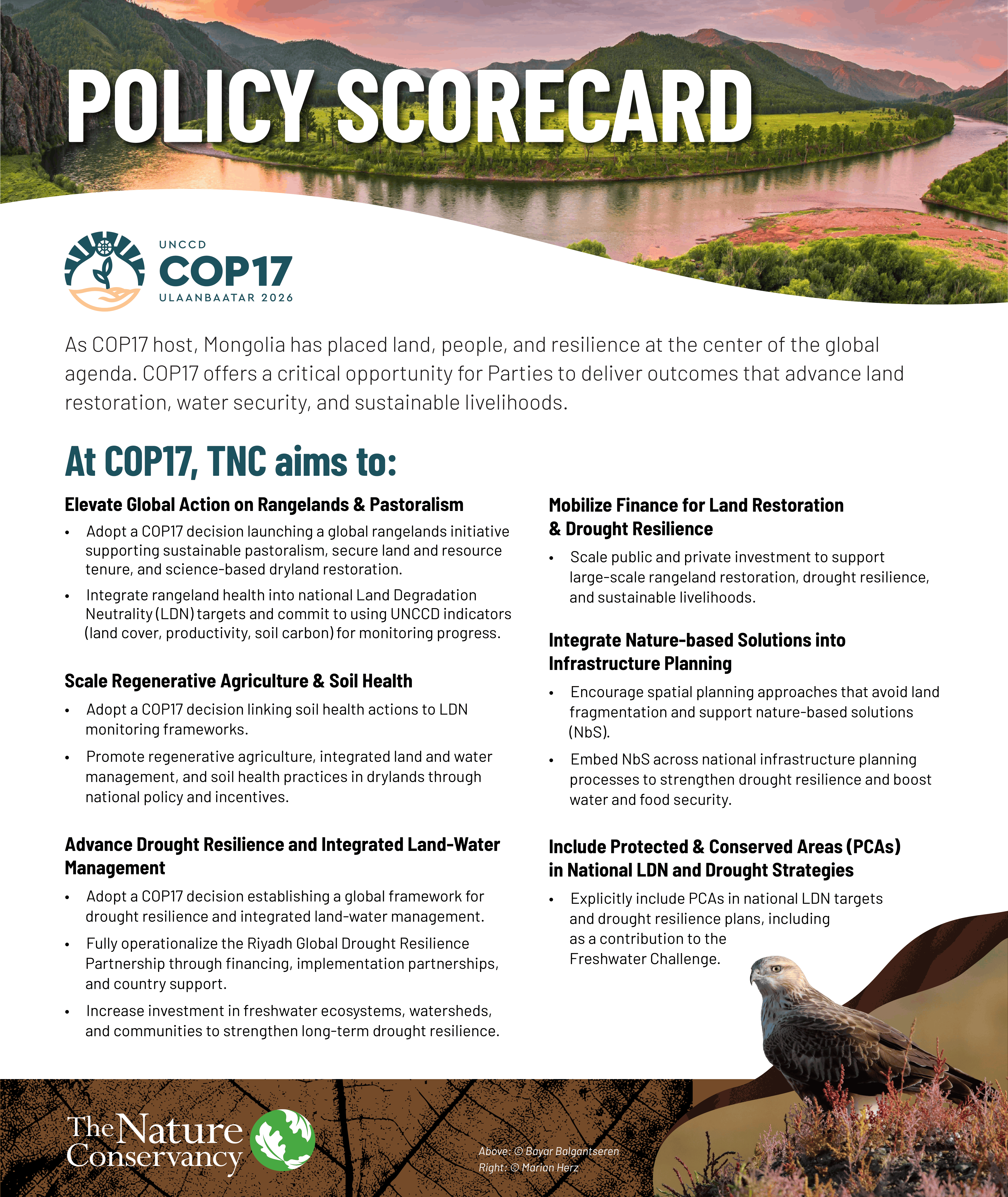
Learn about what policy advancements TNC will be advocating for at the UNCCD COP17 negotiations
DownloadScaling What Works
As countries look for solutions to drought and land degradation, many of the most valuable lessons are not new. Indigenous Peoples, local communities, farmers, herders and other land stewards have long developed approaches that support both people and nature. Today, these foundations are being strengthened through partnerships, science and investment that are helping communities adapt to growing environmental pressures.

We can already see what is possible when these approaches are supported and expanded. In Argentina's Patagonia region, the ESTEPPA Program works with ranching communities to advance regenerative grazing practices that support healthy grasslands, biodiversity and rural livelihoods. By combining local knowledge with science and practical tools, the program is helping demonstrate how working landscapes can remain productive while strengthening the health and resilience of the ecosystems that sustain them.
Similarly, in South Africa, the Greater Cape Town Water Fund is helping restore critical landscapes that supply water to the city, demonstrating how nature-based solutions can improve water security while reducing long-term costs. The initiative highlights the value of investing in healthy ecosystems before drought becomes a crisis.
Together, these examples point to a broader lesson. The challenge is not a lack of solutions. It is creating the conditions that allow successful approaches to be sustained, adapted and scaled. That includes finance.
Restoring landscapes, strengthening resilience, and supporting sustainable livelihoods require coordinated plans for advancement. But they also require investment to implement those plans. Public and private finance both have a role to play in helping communities, governments, and local partners implement proven solutions and sustain them over time. Without the resources needed to expand what works, progress will remain limited even when effective approaches are already known.
From Commitment to Implementation
Explore the Playbook on Innovative Financing for Land Restoration and Drought Resilience
Learn MoreRecognizing this challenge, The Nature Conservancy partnered with the UNCCD Secretariat and others to develop the Innovative Financing for Land Restoration and Drought Resilience Implementation Playbook, which showcases real-world examples of blended finance, carbon finance, conservation trust funds and other approaches helping communities and governments scale restoration efforts around the world. It shows that solutions exist, and so do the financing models needed to support them.
The Significance of Mongolia as Host for the Conference
Mongolia is a fitting host for COP17. Home to vast grasslands and herding communities whose livelihoods depend on healthy land, the country illustrates both the challenges and opportunities facing dryland landscapes worldwide. Its experience demonstrates the importance of supporting local stewardship while investing in long-term resilience.
Healthy land supports food and water security, livelihoods, biodiversity and economic resilience. COP17 offers an opportunity to advance the partnerships, policies and investment needed to scale proven solutions and strengthen resilience for future generations.
The Nature Conservancy in Mongolia
Mongolia’s grasslands are one of the planet’s most critical conservation priorities—a last-chance ecosystem that must be saved for a sustainable future. Dive deeper into TNC's work in Mongolia.

Related Stories

Eternal Mongolia: The New Plan to Protect 30% of Mongolian Land
Mongolia has long had some of the most ambitious conservation goals in the world. Now it has a plan to achieve those goals and the funding to match.

Mongolia’s Amazing Grasslands
Conserving Mongolia’s at-risk grasslands is critical to the nation’s future and way of life.

Herder Communities in Mongolia
In Mongolia, nature is a way of life. The Nature Conservancy is helping herders care for their land while providing opportunities for additional income.