


Natural Climate Solutions
Natural climate solutions offer immediate and cost-effective ways to tackle the climate crisis—while also supporting healthy, thriving communities and ecosystems.
The Tropical Forest Forever Facility rewards both past and ongoing conservation, helping countries build the next generation of climate solutions.


The Tropical Forest Forever Facility is a financial mechanism set up to help countries that have demonstrated relatively low and declining deforestation keep protecting their forests well in the long term. New analysis using data from Naturebase shows that finance for these countries could also unlock substantial opportunities for climate change mitigation through forest restoration, improved forest management, and addressing root causes of land-sector emissions.
Get our latest research, perspectives and solutions to today’s sustainability challenges.
Sign UpThe countries best positioned to receive finance from TFFF for keeping tropical forests standing have been historically successful in avoiding deforestation. Because climate mitigation needs to be additional to historic baselines— that is, it needs to be on top of what would have happened without any intervention—this means there will be relatively little opportunity to mitigate additional emissions from avoided forest loss in these countries going forward. But that does not mean they have no climate potential. It just means their opportunity profile is different.
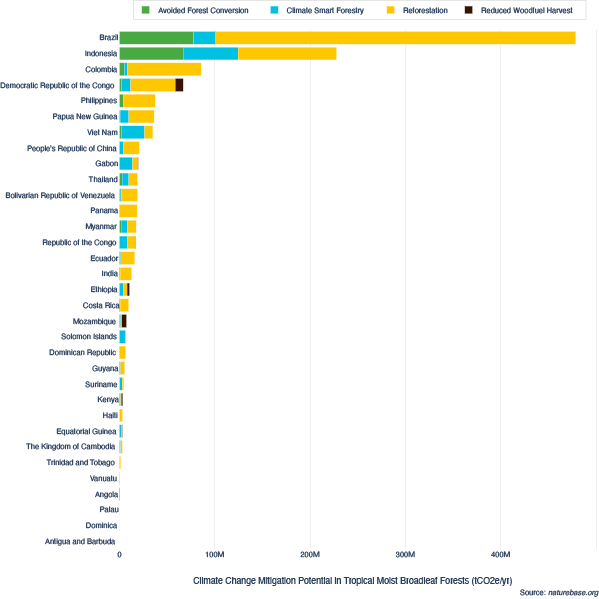
This chart shows that the best strategy for climate mitigation outcomes in tropical forest countries come from several different pathways.
DownloadAnd it’s exactly the reason why TFFF financing is such an important complement to other financing instruments. We need forest finance to reward both past and ongoing conservation while helping countries build the next generation of climate solutions. TFFF funding could help countries invest in the next set of improvements, such as restoring damaged forests, managing forests better, and addressing the underlying causes of emissions from land use.
Looking across countries expected to meet TFFF eligibility criteria for deforestation rate and trend, it becomes clear that the best strategy for climate mitigation outcomes will come from several different pathways for each country.



Importantly, investments in restoration and improved forest management do more than generate climate mitigation benefits today. Successful restoration expands the total forest area and can help reduce future pressure on remaining natural forests. Over time, these gains may also strengthen countries' ability to maintain the long-term forest health and forest conservation performance that create eligibility for future TFFF payments.
TFFF finance could do more than reward countries for the forests they have kept standing. Used strategically, it could also help countries protect those successes while investing in the future of land-sector climate mitigation: restoring degraded forests, improving the management of working forests and addressing the economic pressures that drive forest loss.
Our analysis suggests that those opportunities are not uniform across countries. The strongest national strategies will recognize these differences and build portfolios grounded in local priorities, rights and ecological conditions. The next step is to pair global screening and opportunity assessment with country-led planning, bringing together governments, Indigenous Peoples and Local Communities, scientists and practitioners to determine which opportunities are both ambitious and achievable.
Sign up to receive our Global Insights newsletter and other select content for thought leaders who believe that, together, we can build a better future for people and the planet. We address the sustainability issues of the moment and explore potential solutions—all in a five-minute read or less.

Combined with cutting fossil fuels and accelerating renewable energy, natural climate solutions offer immediate and cost-effective ways to tackle the climate crisis—while also addressing biodiversity loss and supporting human health and livelihoods.
Dr. Judith Ament is a Global Forest Natural Climate Solutions Technical Specialist at The Nature Conservancy.
More About Dr. Judith Ament


