
interstitialRedirectModalTitle

interstitialRedirectModalMessage

Places We Protect

Merwin Preserve at Spunky Bottoms

Illinois

A rainbow emerges over a natural area.
Spunky Bottoms A rainbow forms over restored wetlands at TNC's Spunky Bottoms preserve. © Tharran Hobson/The Nature Conservancy

The restored wetlands at Spunky Bottoms serve as a living laboratory and a shining model of wetland stewardship benefiting people and wildlife.

Overview

Description

Along the Illinois River in Brown County, you’ll find the Merwin Preserve at Spunky Bottoms—a 1,300-acre preserve that contains crucial wetland habitats that were once abundant throughout the Illinois River valley but have declined significantly throughout the past century. 

This haven of biodiversity supports rare and endangered species, like the decurrent false aster (Boltonia decurrens), a federally threatened daisy-like flower that once thrived along the Illinois River. Shorebirds like black-necked stilts, lesser yellowlegs and pectoral sandpipers wade among thousands of American lotus that bloom every summer, and native fish, including paddlefish and gar, journey here to spawn. River otters race each other, and the air is filled with chirps from one of the largest populations of cricket frogs in Illinois. Beyond the wetlands are vast bottomland forests and airy oak-hickory forests, where you may be lucky enough to spot wood ducks, barred owls, bobcats and more. 

Why Spunky Bottoms Matters 

Spunky Bottoms serves as a model for The Nature Conservancy’s (TNC) on-the-ground stewardship activities in a river system that has been fundamentally altered. The research and wetland management conducted here will inform and inspire new ways to help biodiversity thrive while benefiting the well-being of local communities, helping improve freshwater ecosystems throughout the Illinois River basin—and the world.

Access

Limited Access

Access to the preserve is restricted. Plans for reopening will be announced soon. 

Hours

sunrise to sunset

Highlights

Spunky Bottoms is home to rare plants, wildlife and migratory birds. For additional information or permission to visit the area, contact TNC's Illinois River Program office in Lewistown, Illinois, at 309-547-2730.

Explore our work in Illinois

Visit

  • Wetlands 

    Wetlands are areas where water is present at or near the surface of the soil some or all of the year. As some of the most productive ecosystems in the world, wetlands are, in essence, “biological supermarkets” that produce immense amounts of food and attract and sustain countless numbers of animal species. Types of wetlands found at Spunky Bottoms are:

    • Emergent marsh
    • Seasonal or moist-soil wetlands
    • Submersed aquatic vegetation

    Oak-hickory forest

    Oak-hickory forests are open woodland areas dependent on fire. Indigenous fire management practices have influenced and maintained these vital habitats for thousands of years. Key tree species include white oak, northern red oak, black oak and chestnut oak, as well as pignut hickory, shagbark hickory and bitternut hickory. These forests often support a rich herbaceous understory, including flowering dogwood, blueberry, mountain laurel and maple-leaf viburnum, and support many wildlife species, including deer, turkey and bobcat. 

    Bottomland forest

    Found along rivers and streams, bottomland forests are some of the lowest and wettest hardwood ecosystems in the country. Common tree species include oaks, pecan, silver maple, cottonwood, willow, green ash and understory plants include spicebush and pawpaw. They’re home to many species, including deer, beaver, wood ducks and barred owls. They have a high tolerance for flooding and provide important breeding and nursery habitat for a variety of fish and wildlife species. 

    Birds

    Visitors are likely to encounter wood ducks, mallards, pintails, widgeons and Canada geese. You might also see Eastern bluebird, orioles and migrating warblers. Shore and wading birds found here include the black-necked stilts, lesser yellowlegs, pectoral sandpipers, herons and egrets. The Illinois River is an increasingly important migratory flyway for the American white pelican, and various hawks and the bald eagle can be seen as well.

    Aquatic species

    Spunky Bottoms continues to support native fish populations, including the paddlefish and gar, which are vital to restoring native fisheries that support local economies.

    In addition, while their populations have declined, local mussels are still a major species in the region, and there is an important mussel bed in the Illinois River immediately adjacent to Spunky Bottoms.

    Other animals 

    Keep an eye out for the river otter, muskrat, beaver, mink, raccoon, bog lemming and short-tailed weasel, as well as the prairie king and western ribbon snakes, and the green, plains leopard and cricket frogs.

  • This preserve is temporarily closed to public access at this time. We appreciate your patience while access is suspended. TNC will update information here when recreational opportunities return.

  • Check out our Illinois Volunteer Page to see what volunteer events are available across the state. To volunteer at Spunky Bottoms, please contact:

    Illinois River Program Office at Emiquon

    11304 N. Prairie Road
    Lewistown, IL 61542
    309-547-2730

Support Our Work in Illinois

You can help us do important conservation work at Spunky Bottoms and beyond.

Donate Now

History

The Illinois River was once one of North America’s most ecologically and economically significant river systems, providing crucial habitats for wildlife and supporting the well-being of local communities. Then—to make way for farming, communities and industry—people constructed dams and levees and drained floodplains, which are low-lying areas near rivers. These well-intended changes brought unintended consequences that altered our freshwater ecosystems on a massive scale. 

As a result, the connections between the Illinois River and roughly half of its historic floodplains have been severely altered. Nearly 90% of the wetlands in Illinois have disappeared, and many of the remaining wetlands are severely degraded. These effects had a devastating effect on local wildlife, threatening migratory birds and contributing to the collapse of the local fisheries and mussel communities. Nearby communities continue to face an increased risk of severe weather damage, like floods, without wetlands to protect them, and outdoor recreation industries suffer. 

Working with partners, TNC identified restoration of functional floodplain habitat as a key strategy for conserving the biological diversity of the Illinois River. Due to severity of the changes, habitat restoration efforts are not enough to address these consequences. Continuing on-the-ground stewardship activities, also known as active management techniques, must be implemented to restore ecological function and ensure wetlands, like Spunky Bottoms, can survive and thrive long-term.

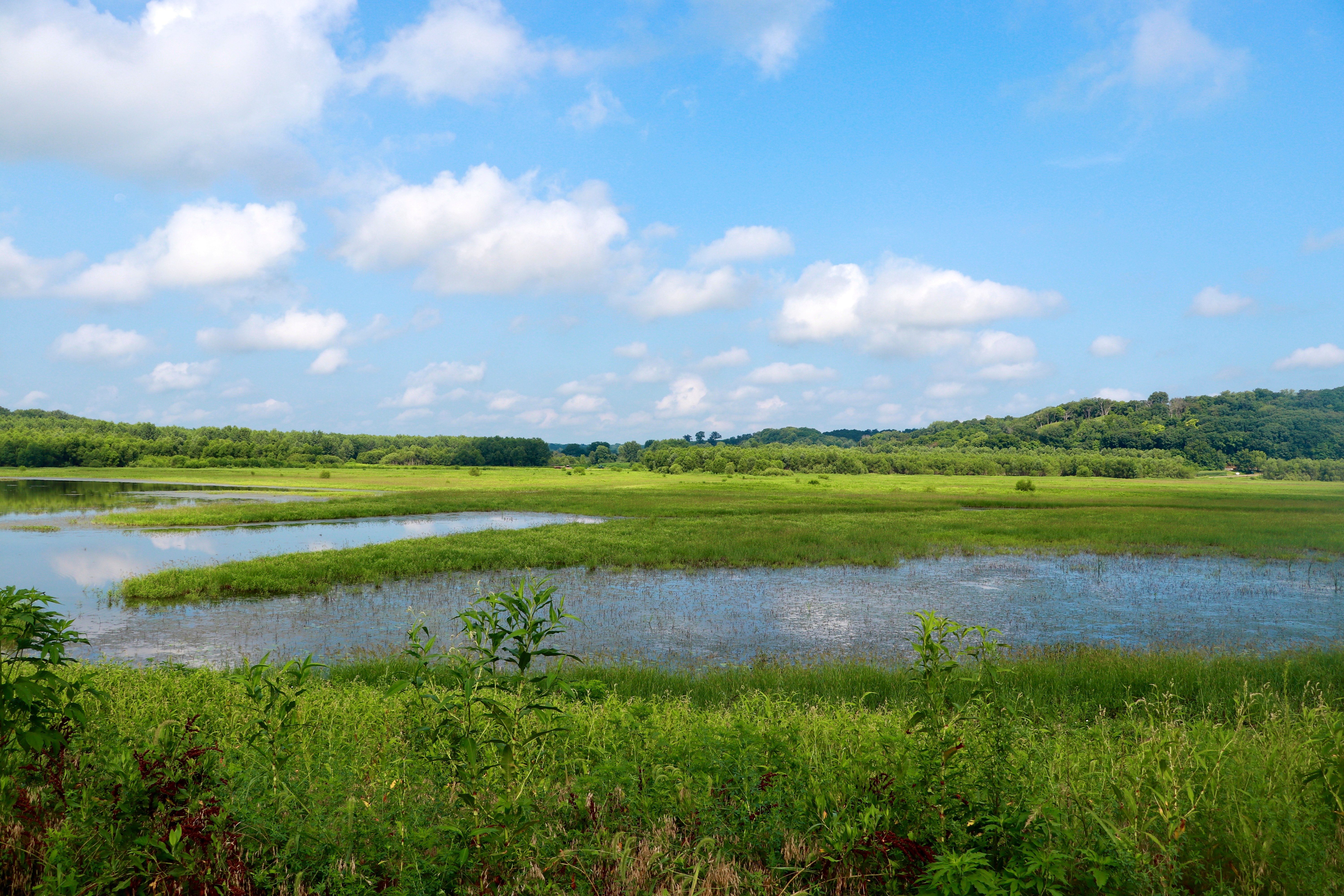
White clouds and a blue sky frame a shallow wetland.
Spunky Bottoms Spunky Bottoms in 2025 while the managed water control structure was under construction. © Ollie Hartung/TNC

Current Conservation Work

Research

Spunky Bottoms serves as a living laboratory where we can study best practices for reconnecting healthy wetlands in a river system that has been fundamentally altered and is experiencing more frequent and larger flooding events. The valuable insights we gain from our research projects here guide our management decisions and will support goals and methods for other floodplain restoration and management efforts in the region and beyond. This “adaptive management” strategy involves using the information we collect to adjust our methods to better support our ecological goals for Spunky Bottoms, as well as other wetland sites throughout the region and beyond. 

Restoration

TNC has planted more than 7,500 trees in the bottomland hardwood forest areas. These low hardwood ecosystems tolerate flooding well and can store excess water during major storms. We also manage invasive species through manual removal and prescribed fire applications. Today, less than ten percent of the plant species found at Spunky Bottoms are invasive. 

We are currently working to reconnect the waters of Spunky Bottoms with the Illinois River. A managed connection with the river will allow access for migratory aquatic species, including paddlefish and gar, while improving the protection of the backwater areas from excessive sedimentation, unnatural water level fluctuations and damaging non-native species.

Wetland management

In 2026, TNC finished installing an advanced water management system, which uses a targeted combination of methods that manage the flow of water, fish and materials like sediment in and out of the preserve to mimic natural floodplain cycles. This pioneering approach allows for restoration and management efforts to be far more precise while still being cost-effective, making it an ideal template for wetland managers to adapt and use for their sites. 

At a minimum, it may influence thousands of acres of wetland management within the Illinois River Valley, and we hope it will inform and inspire many more floodplain management efforts throughout the world, helping to restore and protect these vital ecosystems.

A Rare Flower Makes a Comeback

The decurrent false aster has been federally threatened since 1988. Now, conservationists from TNC and the U.S. Fish & Wildlife Service are restoring its natural habitat at our Spunky Bottoms and Emiquon preserves.

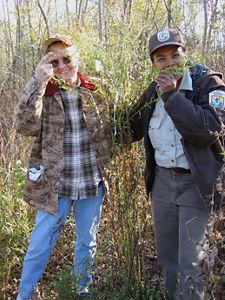
Two women stand in tall grasses in a natural area.
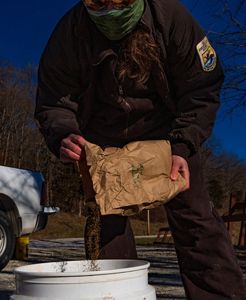
A woman prepares the seeds for seeding at a nature preserve.
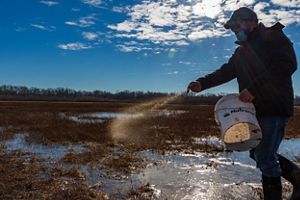
A person spreads seeds across wetland grasses at a nature preserve.
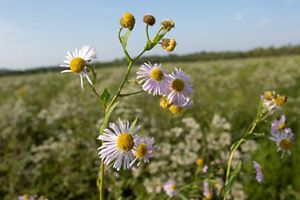
A close up photograph features delecate white flowers growing in a field.

One of our new conservation focuses at both Emiquon and Spunky Bottoms has been recovering a nearly lost species of flora that primarily only grows in Illinois: the decurrent false aster (Boltonia decurrens), a federally threatened plant species that once thrived along the Illinois River. The rare, daisy-like flower was only recognized as its own species in 1985. As more Illinois river floodplains were converted to farmland, the aster’s habitat was lost and so were populations of this native species. It was added to the threatened species list only a few years later in 1988 and is now protected under the Endangered Species Act.

Botanist, researcher, educator and author Dr. Marian Smith became the recognized authority on the life history, management, and recovery of the decurrent false aster and championed conservation for the plant until her passing. She worked closely with private lands biologists for USFWS’s Partners for Fish and Wildlife Program in Illinois, including Gwen Kolb, to restore the large decurrent false aster populations that haven't been seen since the early 20th century. The work is continued by Dr. Smith's former student Dr. Paige Mettler-Cherry, who is currently the director of operations and strategic initiatives at The National Great Rivers Research and Education Center, as well as other USFWS Partners program biologists. 

Guided by the extensive research from Dr. Smith, conservationists at Emiquon and Spunky Bottoms began working towards promoting the regrowth of the decurrent false aster in 2020 by recreating the conditions from the time it was thriving. With the help of the USFWS Partners program, TNC has removed invasive woody species growing in the flower's natural habitat, then reintroduced decurrent false aster seeds into its new habitat. We continue to use techniques that mimic the river's old natural flood cycle to promote its growth.

In 2025, a substantial population of decurrent false aster was discovered at Spunky Bottoms, providing hope that it’s on its way to returning to its former glory. 

Find More Places We Protect

The Nature Conservancy owns nearly 1,500 preserves covering more than 2.5 million acres across all 50 states. These lands protect wildlife and natural systems, serve as living laboratories for innovative science and connect people to the natural world.

See the Complete Map