
Allegheny Highlands Program
Appalachian Forests, Wildlife Corridors and Climate‑Resilient Lands

- Phone: 540-627-6085
-
Follow


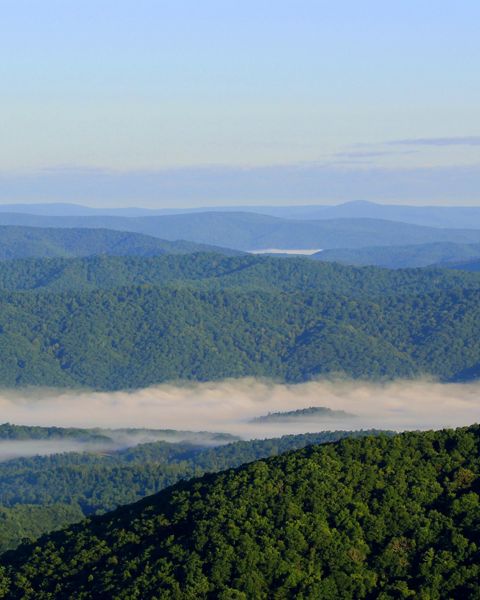
A sea of forested ridges stretches to the horizon—an unexpected expanse of intact habitat in a well‑traveled part of America. Long before TNC began its work here, Native American nations were the original stewards of these mountains, caring for and shaping the Appalachian landscape for millennia. Our own story in the region began in 2002 with the protection of Warm Springs Preserve, a 9,000‑acre property that remains one of the largest and most ecologically significant forests in the Central Appalachians. Its protection helped stitch together hundreds of thousands of acres of conserved lands, forming a vital wildlife corridor at the heart of the Allegheny Highlands.
From that foundation, our work has expanded across the Appalachian region in Virginia. We’ve built strong relationships with the U.S. Forest Service and local partners, growing from a single landmark acquisition into a collaborative, cross‑boundary conservation program. Today, our strategy centers on three pillars—protection, restoration and improved management—to ensure these mountains remain a natural stronghold as extreme weather events become more frequent. Together, we’re supporting and strengthening the ecological and community resilience of the Allegheny Highlands and the broader Appalachian landscape.
Our Work

Land Protection
The Appalachians are one of the world’s most biologically and carbon rich landscapes—home to extraordinary diversity in plants, wildlife and habitats. Growing pressures—from development and mining to agriculture, unsustainable forestry and habitat fragmentation—threaten the region’s ecological, economic and community well‑being. Rising temperatures and more extreme weather are also reshaping habitats, pushing many species to find refuge along the Appalachian range.
As nature shifts, TNC is working across state boundaries and alongside local partners in Virginia to protect this vital landscape. By focusing on strategic land protection and safeguarding migratory pathways and areas of high biodiversity, we’re building a resilient, connected network.

Prescribed Fire
We are using prescribed fire, also known as controlled burns, to manage and restore our Appalachian forests in Virginia. As the climate changes, prescribed fires help create the conditions native species need—new generations of oak and pine, open sunlit woodlands, and rich patches of grasses and wildflowers that support remarkable plant diversity.
We work in partnership with the U.S. Forest Service to expand our impact and capacity. We are also part of the Fire Learning Network, which allows us to expand the fire culture, expertise and science.

Freshwater
In partnership with the U.S. Forest Service, we are developing watershed restoration action plans that pinpoint where ecological function can be improved—and outline projects to get us there.
Aquatic connectivity is a key focus of this work. Together with partners, TNC is replacing undersized culverts and other barriers that prevent fish and aquatic wildlife from moving freely up and downstream. Reconnecting these waterways not only restores habitat—it also supports the fish populations that local communities and economies rely on.

Science and Research
With a science-based approach, our team delivers the data, analysis and collaborative guidance needed to keep biodiversity in mind for every conservation decision. From assessing emerging threats—like spongy moth defoliation in a rapidly changing forest—to sharing information with partners, science and research are the basis of our work.
The Appalachian Mountains are one of the world’s most biologically and carbon-rich landscapes—home to extraordinary diversity in plants, wildlife and habitats. As climate change reshapes ecosystems, species are moving northward and upslope in search of refuge—and the Appalachians serve as a critical highway for this migration. For wildlife to move safely, the forest itself must be healthy, diverse and connected. Yet decades of fire suppression, unsustainable logging, mining and other pressures have left many Appalachian forests degraded and less resilient, limiting their ability to store carbon, support biodiversity and buffer nearby communities from flooding, drought and increasing wildfire risk.
Across Virginia’s Allegheny Highlands and the broader region, TNC is restoring these forests so they can reach their full ecological and community‑serving potential. By reintroducing natural processes like prescribed fire, thinning overly dense stands and promoting climate‑adapted species such as oaks, hickories and fire‑dependent yellow‑pine species, we’re rebuilding the age and structural diversity that resilient forests require. These efforts strengthen habitat for wildlife, improve water quality and strengthen the forest's ability to resist extreme weather events.
Together, we’re finding a way for the Appalachians to remain a thriving refuge—for the species that depend on them today and the generations yet to come.


Warm Springs Mountain
Three public trails offer an introduction to one of the most ecologically significant forests in the Central Appalachians.

History in the Rings
A tree’s rings can tell a much deeper story than just the number of years it has lived.
Program Milestones
Accomplishments
Our mission is ambitious, which is why our program continues to grow and evolve.

More than 9,000 acres of critical native forest acquired on Warm Springs Mountain, marking TNC's largest single land purchase to date in Virginia.

Central Appalachians Fire Learning Network (FLN) formed.

Largest collaborative burn ever conducted between USFS and TNC in the country.

Warm Springs Mountain Preserve’s 10 year anniversary.

Ribbon cutting ceremony to celebrate final payment for Warm Springs Mountain Preserve and the unveiling of a new trailhead at the Dan Ingalls Overlook.

10 years of avian monitoring completed in the Allegheny Highlands.

Nearly 2,000 acres of land in Highland County placed under permanent conservation easement by landowner Fitz Gary, preserving biodiversity and vital habitat corridors.

A generous gift by Truman Semans of his family’s historic Hobby Horse Farm in Bath County elevates adjoining Warm Springs Mountain Preserve into a flagship preserve for the Appalachians.

Start of new aquatic program in partnership with the U.S. Forest Service.
Allegheny Highlands Team
Our world faces complex conservation challenges. Meet the people who are working on creative, lasting solutions in the Central Appalachians and beyond.
Media inquiries: Ann Nallo, Virginia Marketing Director, ann.nallo@tnc.org

Blair Smyth, Allegheny Highlands Program Director
Blair leads our Allegheny Highlands Program. His responsibilities include overseeing TNC’s Allegheny Highlands preserves—such as Warm Springs Mountain—guiding conservation real estate transactions, and collaborating with federal and state partners to expand forest and aquatic restoration across public lands in western Virginia.

Laurel Schablein, Allegheny Highlands Program Manager
Laurel oversees plans for the management of TNC preserves, including consideration for rare species like the golden-winged warbler, collaborative land management, community engagement and public access. Laurel also helps to asses whether our controlled burns are meeting our ecological goals and leads our regional Fire Learning Network.

Eric Homan, Restoration Technician
Eric works to restore and maintain healthy forests across the Allegheny Highlands, using fire as a tool to promote ecosystem diversity, connectivity and resilience. He works closely with partners from state and federal agencies to achieve these goals across property lines.

Zack Mondry, Western Virginia Freshwater Recovery Director
Zack is leading the watershed recovery and resilience work in the aftermath of Hurricane Helene to better prepare for future events. Zack is a professional surface water hydrologist with a background in geology. He began working for the U.S. Forest Service in the ’90s and first came to the Southeast 20 years ago for work with the State of North Carolina. Give him a call—he's always interested to talk watershed!

Jean Lorber, Forest Ecologist
Jean uses his forestry and forest ecology background on projects ranging from land protection to conservation planning. Currently, he provides scientific and analytical capacity to the Allegheny Highlands Program, focused on Appalachian forest restoration.

Holly Lafferty, Freshwater Restoration Specialist
Holly joined the Allegheny Highlands Program in 2024 after working with TNC Virginia’s Aquatic Resources Trust Fund for four years. Her role is to work with partners to create and implement watershed restoration action plans in key locations along Virginia’s Appalachian Mountains.

Tyler Fisk, Allegheny Highlands Land Protection Manager
Tyler leads land protection and conservation real estate efforts across the Allegheny Highlands. He partners with landowners, state agencies, local land trusts, corporations and conservation organizations to conserve resilient lands and waters throughout the Appalachian region by securing and assisting in conservation easements, fee acquisitions and other innovative conservation tools. Tyler also contributes to our protection planning efforts across the Appalachians in Virginia with conservation partners to achieve landscape-scale connectivity.

Zoe McGee, Program Coordinator
Zoe joined the Allegheny Highlands team in 2021 after working two seasons as the Dave Tice Science Technician. Her role encompasses many areas of the program's work, including prescribed fire and leading the Heart of the Appalachians forest structure and composition monitoring program, as well as efforts to integrate the 600-acre Hobby Horse Farm property, donated to TNC in 2022.

Caleb Haynes, Restoration Technician
Caleb works to restore forests on Warm Springs Mountain Preserve and surrounding partner lands, primarily through the use of prescribed fire.

Jennifer Lamb, Contracts Specialist
Jen supports the Allegheny Highlands and Asheville-based Southern Blue Ridge teams by managing all aspects of the contract lifecycle for Hurricane Helene recovery–related agreements.
Meet All Our Team
TNC works across Virginia to protect iconic landscapes and restore the biodiversity that makes our state unique.

Partners and Research
If you are interested in conducting research in Warm Springs Mountain Preserve, please contact Laurel Schablein, Allegheny Highlands Program Manager, lschablein@tnc.org.
Warm Springs Mountain is a keystone tract that helps stitch together one of the largest undeveloped landscapes on the East Coast, offering opportunities to practice conservation at a remarkable scale. A 13-mile border in common with the George Washington National Forest allows for collaboration and resource sharing.
KEY PARTNERS


Warm Springs Mountain Preserve also provides a living laboratory where new science is developed to gain insight about the plants and animals of the Central Appalachians region.
Key Academic Partners
The Allegheny Highlands program has collaborated with VCU on avian studies to track the migration of golden-winged warblers and cerulean warblers as well as developing proposals for land management studies for the benefit of golden-winged warblers and other wildlife.
We also work closely with faculty and students from Virginia Tech to facilitate research and provide access to the 10,000-acre preserve.
Recent and ongoing research has included studies to determine the distribution and habitat use of eastern spotted skunks in western Virginia; a comprehensive bat research and monitoring program on Warm Springs Mountain Preserve and the adjacent George Washington National Forest (funded by the national Joint Fire Science Program); estimating population abundance and determining habitat use and movement patterns of coyotes (Canis latrans) in the Warm Springs Mountain Preserve and surrounding National Forest, state and private lands in Bath County; and studying the predation and scavenging behavior of bobcats, bears and coyotes on white-tailed deer and the implications of that behavior on white-tailed deer populations.
Volunteer with Us!
Support the Allegheny Highlands Program with your eyes, ears and muscles! We offer a variety of volunteer opportunities across the state and at the Allegheny Highlands.
Virginia’s Preserve Volunteer Community plays a crucial role in helping us care for and monitor public preserves across the state—including Warm Springs Mountain Preserve.
Want to get involved? There are plenty of ways to volunteer based on your interests, skills and schedule. Whether you love hiking, restoration work or simply giving back to nature, there’s a place for you in our community.
Community Members: become involved with a preserve without committing time to stewardship work. Receive periodic updates about the preserve and special events.
Preserve Stewards: visit a preserve at least four times a year to assess trail and preserve conditions and perform basic trail maintenance by removing fallen branches and overgrown vegetation.
Preserve Leaders: demonstrated commitment to the preserve and willingness to take on additional responsibilities like managing communication and scheduling, leading workdays and guiding naturalist hikes.
Please contact the Virginia Volunteer Program by emailing vapreservestewards@tnc.org to receive further information.
Get Our Volunteer Email
Stay up to date with all our volunteer opportunities in your area and throughout Virginia. Subscribe to our monthly e-newsletter.

Learn About Our Work

Trailblazers: Women in Fire
Female fire professionals are blazing new career trails while harnessing the power of fire to restore forests.

Fire, Management and Monitoring
Learn how the Allegheny Highlands Program uses fire to maintain biological diversity in an ecosystem critical to climate change migration.

Making Connections in the Allegheny Highlands
A partnership protecting nearly 2,000 acres of land will connect diverse habitat thanks to the vision and generosity of landowner Fitz Gary.
We Can't Save Nature Without You
Sign up to receive monthly conservation news and updates from Virginia. Get a preview of Virginia's Nature News email
