
Great Salt Lake: The Nature Conservancy’s Role as a Conservation Leader
Protecting Great Salt Lake Through Science, Policy and Collaborative Leadership

Today, The Nature Conservancy (TNC) is working with partners on coordinated, strategic and practical interventions to protect freshwater flows to Great Salt Lake and enhance water quality in its vital wetland ecosystems. As the Lake and Utah face growing challenges, this work reflects TNC’s role as a trusted, science-driven conservation leader at a critical moment for the Lake’s future.

That leadership is rooted in a long-standing commitment. In 1984, TNC took a pioneering step by acquiring 1,192 acres along the eastern shore of Great Salt Lake, becoming the first private conservation organization to protect critical migratory bird habitat in the area. This landmark action safeguarded vital wetlands and established TNC’s Utah chapter, marking the beginning of our enduring engagement with the Lake.
Building on decades of science, habitat protection, policy leadership and public education, TNC continues to advance practical solutions that benefit Great Salt Lake today and position it for the future. Our conservation work in the Great Salt Lake watershed is part of TNC’s ambitious global goal to protect sustainable freshwater sources for people and nature.
TNC’s Conservation Work
TNC’s Great Salt Lake leadership focuses on three areas:

1. Transforming Policy & Securing Water
TNC is nonpartisan, science-driven and collaborative. We work with policymakers on both sides of the aisle and a broad range of stakeholders to advance public policies that protect nature and improve the well-being of Utah communities. We also collaborate closely with the government entities responsible for managing Great Salt Lake, including the Department of Natural Resources and the Office of the Great Salt Lake Commissioner. TNC’s Utah State Director, Elizabeth Kitchens, serves on the Great Salt Lake Advisory Council.
TNC works with Utah leaders to advance legislation that strengthens Lake management, supports research and modernizes water laws to optimize water use and protect water quality and quantity. Today, we are focused on testing and implementing voluntary water market solutions and flexible instream flow provisions that benefit Great Salt Lake.

TNC is proud to be part of the Great Salt Lake Watershed Enhancement Trust, established in 2022 through the passage of HB 410, which authorized $40 million in state funds to address Lake health and elevation. TNC and the National Audubon Society were selected by the state to co-manage the Trust, representing an unprecedented effort to enhance water quantity and quality for the Lake and its wetlands while protecting and restoring critical habitat.
Working in coordination with the State, the Trust has facilitated, provided transaction costs and contributed funding to water transactions that will deliver approximately 72,485 acre-feet of water to the Lake on a diversion basis in 2025. The Trust has also supported projects restoring 19,000 acres of Lake wetlands.

Great Salt Lake Watershed Enhacement Trust
Learn more about the Great Salt Lake Watershed Enhancement Trust.
2. Preserving & Restoring Habitat
TNC has preserved more than 12,000 acres of wetlands and uplands at Great Salt Lake. Today, we manage 10,000 acres across several preserves, including 4,531 acres at our marquee Great Salt Lake Shorelands Preserve—an oasis for migratory birds that also serves as a buffer against rapid development in Davis County.
Across all of our protected properties, TNC actively manages habitat with the goal of supporting the larger Lake ecosystem. This work continues to evolve as conditions change. Here are a few examples:
Enhancing and Creating New Wetlands
TNC has enhanced or created more than 400 acres of wetlands on our properties, benefitting birds such as white-faced ibis, long-billed curlews and great blue herons. In 2023, TNC collaborated with Equinox Engineering to create 40 new acres of wetlands by building a control structure that diverts stormwater runoff into the preserve. The project cleans incoming runoff and creates a new open freshwater marsh that supports a wide range of wildlife.


Fighting Invasives
TNC uses innovative methods to combat invasive phragmites—a plant that threatens the Lake ecosystem—by deploying specialized equipment such as the Marsh Master, an amphibious machine used to remove dense stands of the plant. We also work with local ranchers to implement targeted cattle grazing, an approach that helps promote the return of native vegetation.


Preventing Pollution
In partnership with Kaysville City, TNC built three wildlife-friendly wetland basins with trash collection systems that filter stormwater and improve water quality.
TNC preserve managers also collaborate with private, state and federal wetland managers to share best practices related to water control, herbicide use, equipment deployment and fire management.
“When TNC started buying land along the Lake’s eastern shore in 1984, we were thinking far ahead,” says Chris Brown, TNC Utah’s director of stewardship. “Today, as we face expanding development, climate change impacts and water shortages, providing protected and stable wildlife habitat is more important than ever.”

Experience the preserve
Plan a visit and learn more about TNC’s Great Salt Lake Shorelands Preserve.
3. Educating & Inspiring People
The future of Great Salt Lake depends on whether enough people understand its value and stay engaged over time. TNC continues to expand programs and partnerships that connect people to the Lake and build lasting support for its protection.
At Great Salt Lake Shorelands Preserve, visitors can explore a visitor center with a boardwalk, observation tower, educational displays and a bilingual audio tour. Open year-round and free to the public, the preserve is also home to the Wings & Water Wetlands Education Program, which has introduced more than 25,000 Utah fourth-graders to the Lake’s ecosystem. Building on that foundation, TNC’s Nature Lab program recently created a virtual field trip, bringing lessons from Wings & Water to students around the world.
Inspiring the next generation
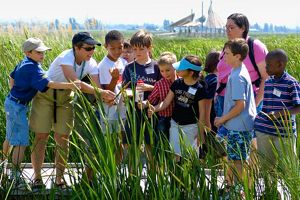


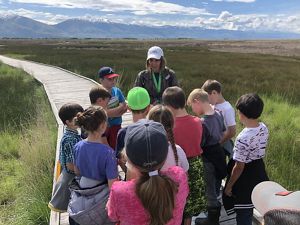
Wings and Water Educational Tour: Educational tour of the Great Salt Lake Shorelands Preserve. © Charles Uibel
City Nature Challenge: A girl participates in the City Nature Challenge at the Great Salt Lake Shorelands Preserve. © Andrea Nelson/TNC
Exploring the Great Salt Lake: The Nature Conservancy’s 4,500-acre Great Salt Lake Shorelands Preserve protects habitat and helps students and visitors learn about the lake ecosystem. © Charles Uibel
Wings & Water: Wings and Water students learning about Great Salt Lake wetlands. © Andrea Nelson/TNC
Our preserves also serve as living laboratories, supporting research by scientists and universities focused on avian habitat, invasive species treatments and groundwater systems. This research helps inform future management while creating opportunities for learning and discovery.
Each spring, thousands tune into TNC’s live kestrel cam for an up-close look at nesting falcons, offering a window into the Lake’s biodiversity. TNC also partners with communities across Utah to support birding celebrations, volunteer projects, wildlife tours and outreach events that help people stay connected to Great Salt Lake and invested in its future.

Virtual Field Trip
Watch the Nature Lab video, excellent for people of all ages.
Looking Ahead: TNC’s Commitment
For decades, TNC has helped lead efforts to protect Great Salt Lake by safeguarding critical wetlands, engaging broad-based coalitions, advancing key policy changes and educating thousands of young Utahns. Today, building on that foundation, TNC remains focused on achieving lasting, meaningful results for the Lake through collaborative leadership and the continued implementation of bold yet practical solutions.
For decades, TNC has led the scientific and community-based approaches needed to protect Great Salt Lake. This is an all-hands-on-deck effort. Each one of us have a role to play in protecting this unique and precious ecosystem, which matters so much to our future.

TNC’s Great Salt Lake Milestones
1984
TNC purchases 1,192 acres of wetlands and uplands at Great Salt Lake.


TNC participated in the formation of the Great Salt Lake Alliance – a group promoting cooperation among groups working on the sustainability of the Great Salt Lake ecosystem.
2004
TNC celebrates the public opening of the Great Salt Lake Shorelands Preserve – which spanned 45 tracts of land and 4,500 acres – and includes a visitor boardwalk and exhibits.


TNC restores a key 1-mile stretch of Kay’s Creek—the major source of water for more than 10,000 acres of wetlands and critical bird habitat near the Great Salt Lake.

TNC launches its award-winning Wings & Water Wetlands Education program for Utah students.
2010
TNC supports the creation of the Great Salt Lake Advisory Council by the Utah Legislature.


TNC takes over management of the 2,098-acre Legacy Nature Preserve, which the Utah Department of Transportation established through mitigation efforts.

TNC launches free, bilingual audio tour at its Great Salt Lake Shorelands Preserve.

TNC teams up with the City of Kaysville to collect stormwater run-off and use wetlands as a natural water filtration system at Great Salt Lake Shorelands Preserve.
2021
TNC helps to facilitate the purchase and protection of Fremont Island thanks to a generous donor.

TNC supports the passage of a suite of historic bills to improve water management for Great Salt Lake and other waterways. Since 2022, UT has continued to make major policy reform for Great Salt Lake.

State of Utah names TNC and National Audubon Society as co-managers of the Great Salt Lake Watershed Enhancement Trust.

TNC launches a new project at the Great Salt Lake Shorelands Preserve to divert stormwater into the preserve, cleaning the water and creating vital new wetlands to benefit water birds.

TNC and Audubon release a 5-year plan for the Great Salt Lake Watershed Enhancement Trust.
Help us help the Great Salt Lake
Your support drives our work forward, ensuring thriving nature and healthy communities.
Continue learning

Colorado River Basin
The Nature Conservancy is working to protect the Colorado River Basin, which provides water, food, recreation and energy for more than 40 million people.

Sagebrush Sea
The Nature Conservancy is working across Colorado, Utah, Wyoming, Montana, Idaho, Nevada and Oregon to protect this iconic western landscape, one of the largest natural systems in North America.

Western Dry Forests
Discover how we’re catalyzing restoration across the western U.S.