



Hurricane Helene: One Year Later
It’s been one year since Hurricane Helene tore through western North Carolina. The Nature Conservancy continues to work with several partners to restore damaged or at risk public lands and waters.

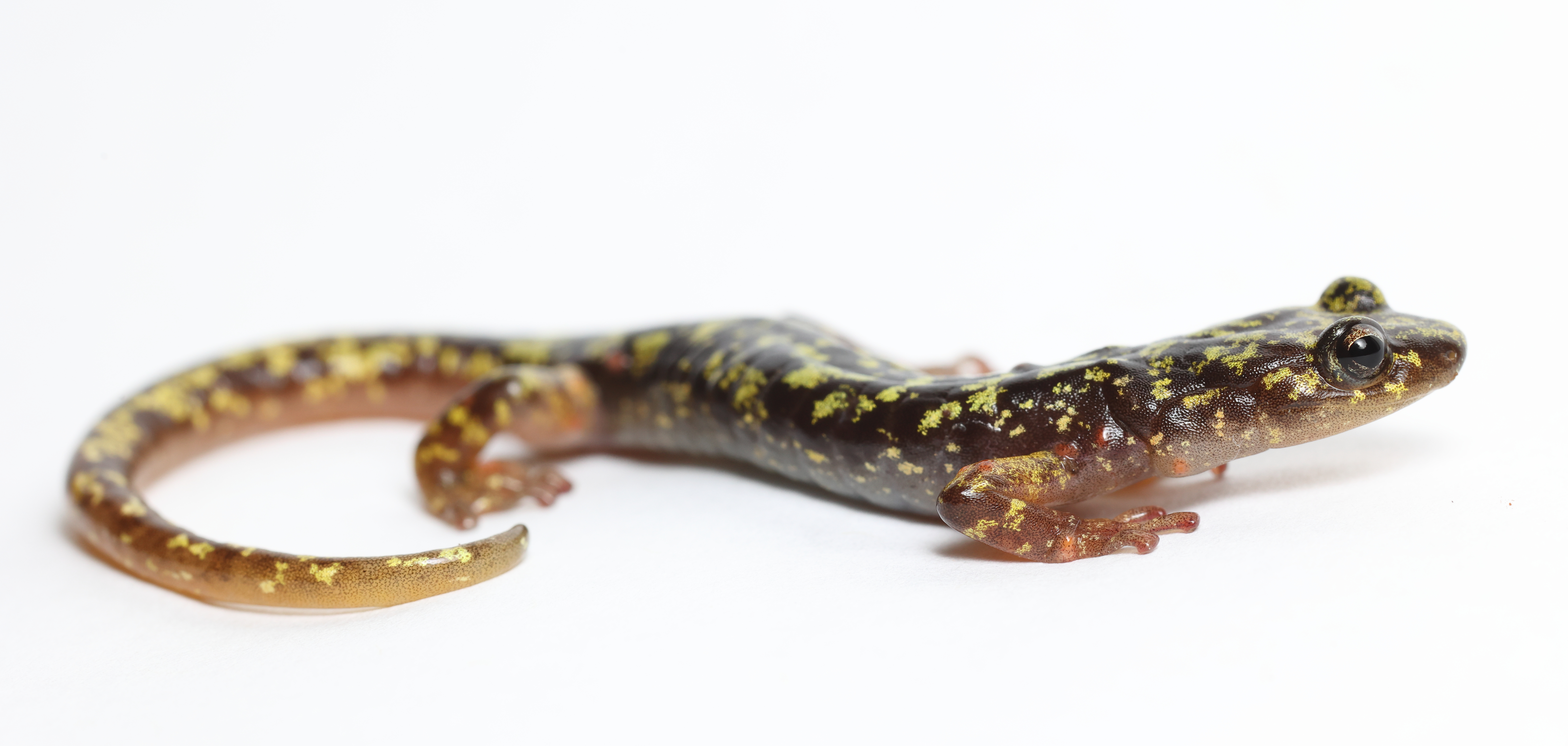
HNG Green Salamader The Hickory Nut Gorge Green Salamander, a rare specie, only found in Western North Carolina. © Sophia Torres
In the shadowed cliffs of the Hickory Nut Gorge in North Carolina’s mountains lives a creature found nowhere else on Earth: the Hickory Nut Gorge green salamander. Before Hurricane Helene ripped through the area in September 2024, there were just an estimated 200 to 500 individuals in existence. Now, after extensive flooding in the gorge that caused mudslides, downed trees, and altered the entire ecosystem, its population numbers are unknown, though experts suspect it suffered significant losses. Today, a team of conservationists made up of individuals from The Nature Conservancy (TNC), the Amphibian and Reptile Conservancy (ARC), the North Carolina Wildlife Resources Commission (NCWRC), and the North Carolina Zoo is racing against time to rescue this species from extinction through a captive breeding program.
In addition to their picky habitat requirements and specific lifestyle, their habitat range is very small, and their populations are fragmented. One of the biggest populations lived in TNC’s Bat Cave Preserve, southwest of Asheville, which contained both the large rocks with deep crevices and the lush forest they needed to thrive.
Hickory Nut Gorge green salamanders are lungless and breathe through their skin, which is why they need their skin to be moist at all times.
The cracks in big rocks under a shaded area provided by a full forest canopy are their ideal habitat.
They mainly eat ants and beetles, which they get by climbing up trees.

 Return
Nearly 40 trillion gallons of water—enough to sustain every person in the United States for 133 days—were unleashed on western North Carolina by Hurricane Helene. The storm triggered a massive landslide at Bat Cave Preserve. A GIS analysis of tree‑canopy change before and after the storm shows that 30% of the preserve experienced severe deforestation, while the remaining 70% sustained moderate damage. These conditions are especially harmful to the green salamander, as the loss of canopy eliminates food sources and exposes the forest floor to direct sunlight, causing the salamanders to dry out.


TNC protected Bat Cave Preserve in 1981 because of its remarkable ecological features. The preserve lies on a north-facing slope composed of numerous valleys known as coves. These “rich coves,” sustained by abundant moisture, provide ideal habitat for diverse plant life, including ephemeral wildflowers that make the preserve so unique. It also contains extensive rock outcrops, which serve as habitat for many salamander species. The preserve gets its name from its bat caves—the largest, non-water-formed caves in North America — which provide winter hibernation sites for three to four bat species, including the endangered Indiana bat.
Together, we can bring the Hickory Nut Gorge Green Salamander back from the brink.
All these features made the preserve rich in plants and animals, and visitors often described it as “magical.” Unfortunately, after Hurricane Helene, the site is unrecognizable to those who had visited before the storm. The pedestrian bridge across the Broad River that allowed access to the preserve was washed away, making it difficult for our staff to fully assess the damage and develop a recovery plan. Initial findings show that, aside from the loss of tree canopy, there is aggressive growth of invasive species, such as kudzu. Our immediate goals are to rebuild access to the preserve to conduct thorough assessments, begin invasive species removal, and start native tree planting. Even though the landscape will never look exactly as it once did, this is a once-in-a-lifetime opportunity to steward the land and help it recover into something new.
The Hickory Nut Gorge green salamander rescue mission begins bright and early with a dedicated team of biologists and land stewards from ARC, NCWRC, and TNC. The team gathers at the spot where the bridge to cross the Broad River once stood. Four volunteers from the Henderson County Rescue Squad join the mission, equipped with rappel gear to help navigate the boulders and cross the cold waters of the Broad River. Once on the other side, the team changes into sturdy hiking boots, long sleeves, and gloves to protect against poison ivy. Together, they hike up the massive landslide, climbing over downed trees and debris until they reach three sites with rock outcrops where salamanders have been spotted in the past.

Thank you to the Henderson County Rescue Squad and the Bat Cave Fire Department for volunteering on this rescue mission. Their support helped keep our team safe, and their caving and rappelling expertise was essential in this rescue mission.
“That area and the caves are near and dear to my heart, so I was absolutely on board for the duration of the project! It’s very humbling and so gratifying to be a small part of such an important species preservation project.” - Kim Lughart, Henderson County Rescue Squad.
Each team member carries a flashlight and carefully searches the rock’s crevices. Some crawl down to examine the lower sections, while Jenn White from the rescue team uses rappel gear to reach the upper portions, meticulously checking every crevice in hopes of catching a shiny flicker of light reflecting off their green, vibrant spots on the small two- to four-inch salamander.
The team has a goal of capturing 25 salamanders that would be a good fit for a captive breeding program. During the first rescue mission, the team found 15 salamanders. The following missions were unsuccessful, and the team feared the remaining salamanders had died during an excessively hot summer. However, the final mission in mid-October renewed hope for the species, as the team successfully collected the last 10 salamanders to reach its goal of 25. This number was considered ideal to ensure the most genetic diversity for the breeding program at the NC Zoo.


After each recovery mission in the field, NC Zoo staff stayed in close communication with the team on the ground to coordinate salamander pick‑ups. Following carefully planned protocols, they worked to minimize stress on the animals during transport until they arrived safely at the zoo. For the first several months, each salamander lived under strict quarantine, where staff monitored them closely to ensure they carried no pathogens that could threaten their survival. Once cleared, the salamanders moved into a dedicated conservation room designed exclusively for their care and recovery.
Inside that room, the zoo recreated the salamanders’ natural habitat using years of environmental data collected by partners in the gorge. Staff built climate‑controlled systems that mimic the temperature, humidity, and moisture levels these salamanders experience in the wild. They even collected rocks, leaves, and tree bark from the site so the animals can feel at home. As Dustin Smith, curator of reptiles and amphibians, explained, “we’ve created individual systems that these salamanders are experiencing to closely mimic as much as possible what they would have experienced in the wild. These setups are still evolving as we learn more.” This careful simulation—paired with attentive feeding, monitoring, and daily care—gives the salamanders the best possible chance to thrive and eventually breed.


Now acclimated for several months, the salamanders are eating well, gaining weight, and displaying natural behaviors. As spring approaches, the team hopes to see early signs of breeding. Given the stress these animals endured—from the hurricane to their relocation—Smith notes that it is unlikely they will see hatchlings this season. Still, optimism remains: one female is already showing eggs and has been paired with a male. If eggs are laid, staff will monitor them passively to avoid disturbing the females, watching for the first tiny hatchlings by early summer.
This program is unique. Because the Hickory Nut Gorge green salamander exists nowhere else on Earth, the zoo and its partners are learning and adapting in real time—but they are encouraged by the strong foundation built. The long‑term goal is to release new populations back into the wild, a step that will come in a few years. While the zoo refines the breeding program, TNC is focused on restoring the healthy forest conditions the species needs to survive. As Smith shared, “I’m very optimistic with the steps that have already been taken… maybe we can give the whole species and its populations a boost so that if this happens or something similar happens again, they’re more resilient.”
Subscribe to our monthly e-newsletter to get the best nature stories, news, and opportunities to get involved.
Keep learning about our conservation work across North Carolina and beyond.


