


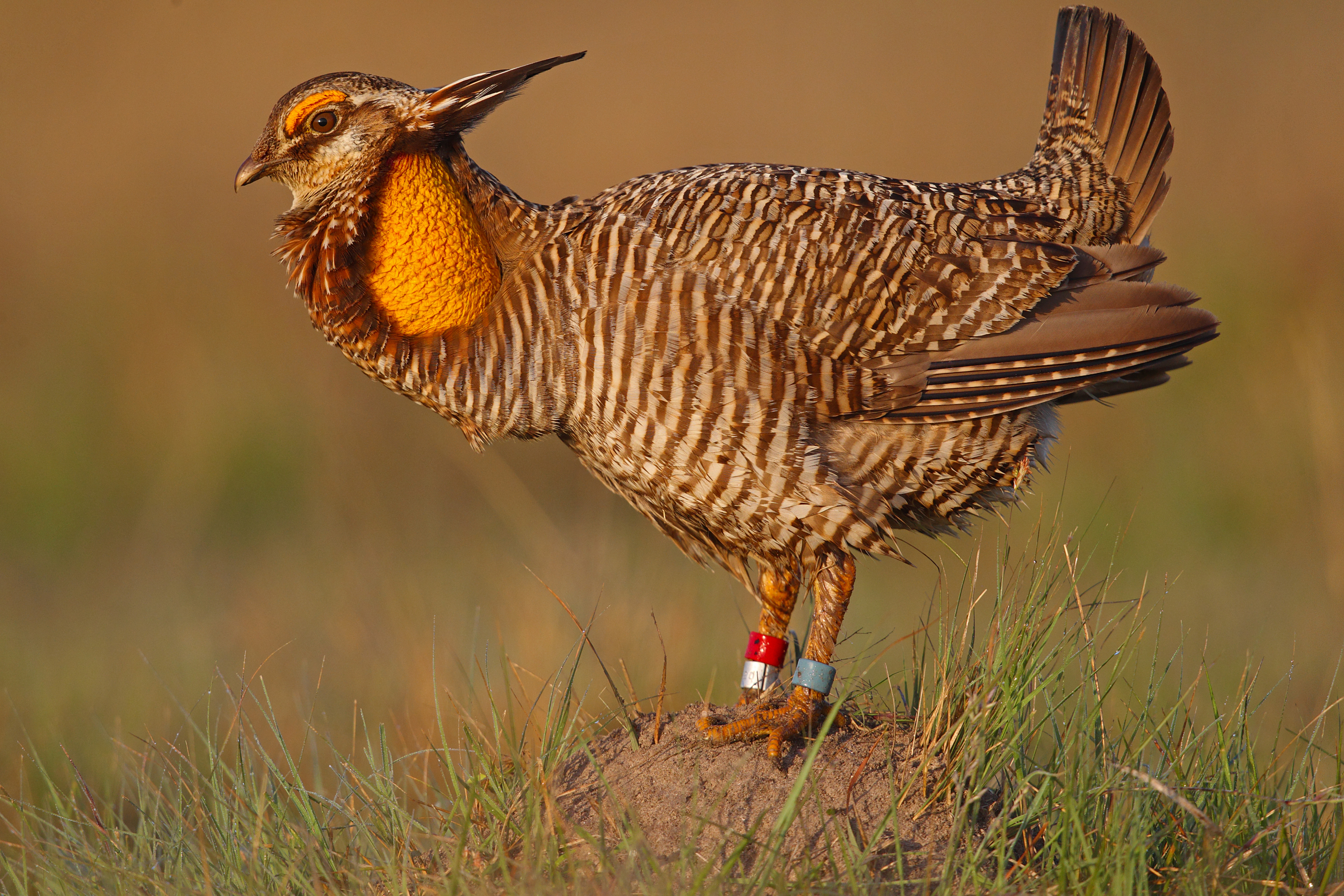
MISSOURI A greater prairie-chicken “booms” at Dunn Ranch Prairie. © Danny Brown

The greater prairie-chicken is one of the most distinctive birds of the tallgrass prairie. Their striking barred feathers, upright neck plumes and bright yellow eyebrows make them unmistakable, but it is their spring courtship display that has earned them fame across the Great Plains.
Meet the Greater Prairie-Chicken
Appearance
These birds are known for their bold brown-and-white barred feathers. Males stand out with bright yellow eyebrows and orange throat sacs that inflate during the breeding season.
The "greater" in their name distinguishes them from the slightly smaller and lighter colored lesser prairie-chicken.
Booming Courtship
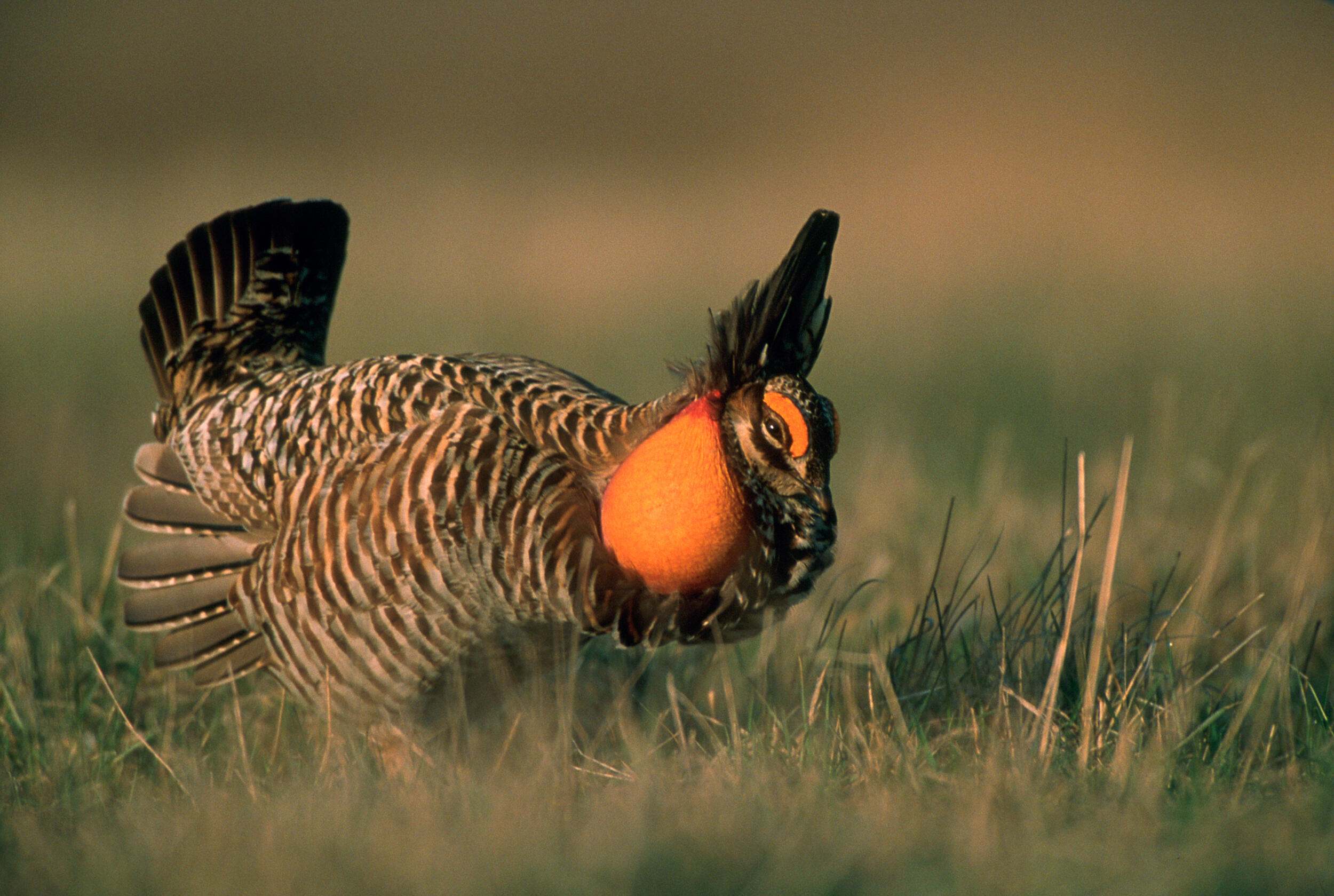
Each spring, males gather on open areas called leks and create a deep, resonating boom by inflating their orange air sacs. Males perform dances, foot-stomping and short leaps to attract mates. Their booming calls can be heard more than a mile away across the prairie.
Habitat
Greater prairie-chickens depend on large, open expanses of tallgrass prairie. At Dunn Ranch Prairie, restored native grasses and wildflowers provide the cover, food and space they need to nest, feed and gather on traditional booming grounds.

Greater Prairie-Chicken Facts
- Scientific name: Tympanuchus cupido
- Population: Estimated 360,000
- Ideal habitat: Tall and mixed-grass prairies with cover for nesting
- Range: Population can be spotted in some northern regions of North and South Dakota, central Nebraska, southern regions of Colorado and Kansas, and in miscellaneous areas of surrounding states like Missouri.
Greater prairie-chickens are birds of wide-open prairie. They rely on tall grasses to hide their nests, shorter grasses to stay aware of predators, and wildflowers that support the insects their chicks need. These habitats form naturally where fire, grazing and weather shape the land, and in places where that prairie character remains, the birds continue to thrive.
This connection between bird and habitat is what makes their story in Missouri so significant. Missouri once held vast prairies, and greater prairie-chickens were a familiar part of those ecosystems.
As tallgrass prairie was plowed for cropland and divided by fences and roads, the structure of the landscape changed. Habitat patches grew smaller and more isolated, leaving little room for a species that depends on large, connected grasslands. Over time, the birds declined sharply. By 2012, only three prairie-chickens were known to remain in the state.
How Dunn Ranch Supports the Prairie-Chicken’s Return
Recognizing how close Missouri was to losing the species entirely, conservation partners began a coordinated effort to rebuild the landscape the birds require. The Nature Conservancy and the Missouri Department of Conservation (MDC) focused on restoring and managing high-quality prairie large enough to support leks, nesting cover and brood-rearing habitat. Restoring these natural processes was essential, but habitat alone would not be enough. Missouri’s remaining prairie-chickens needed reinforcement from outside populations to establish a stable foothold.
This led to one of the most important steps in the recovery effort. From 2013 to 2017, TNC, MDC and the Iowa Department of Natural Resources partnered to relocate prairie-chickens from Nebraska to Dunn Ranch Prairie in northern Missouri. This area, part of the Great River Grasslands, contains some of the best remaining tallgrass prairie in the state. Its mix of open views, diverse native plants and restored habitat offered a rare opportunity to give the species a new start.
Explore Dunn Ranch Prairie
Dunn Ranch Prairie boasts breathtaking views of expansive grasslands, a thriving bison herd, hundreds of vibrant wildflower species and more than 100 species of birds.
Learn MoreRestoration work at Dunn Ranch had been underway long before the first prairie-chickens returned to the area. TNC invested years in planting diverse native seed mixes, reestablishing fire through prescribed burns and removing invasive woody plants that encroach on open grasslands. These efforts helped rebuild the structure and diversity of the historic prairie, creating nesting cover, brood-rearing habitat and open spaces for leks. By the time reintroduction became necessary, Dunn Ranch Prairie had the ecological foundation the birds required.
Bison play an important role in creating the habitat that prairie-chickens rely on at Dunn Ranch. Unlike cattle, which tend to graze evenly across a pasture, bison move in a more variable pattern. They graze intensively in small areas, creating short “grazing lawns,” then travel long distances before feeding again. This roaming behavior produces a natural patchwork of short, medium and tall vegetation across the prairie. For prairie-chickens, this mosaic is especially valuable. Short, open patches provide ideal sites for booming, while nearby taller grasses offer protective cover. Mixed-height vegetation throughout the prairie creates warm, insect-rich areas where chicks can feed. Because bison naturally maintain this variety, their reintroduction at Dunn Ranch was paired with prairie-chicken restoration to ensure both species could benefit from the same habitat conditions.
Today, Dunn Ranch supports one of the last remaining prairie-chicken populations in the state. The birds are still vulnerable, but the prairie’s restored structure and ongoing habitat management continue to provide the conditions needed for their survival.
Live from Dunn Ranch Prairie
Experience the magic of spring on the prairie with our Dunn Ranch livestream. Watch bison roam, birds return and wildflowers emerge—and if you’re lucky, you might even catch a glimpse of booming prairie-chickens displaying at dawn! This real‑time window into the prairie offers a peaceful, ever‑changing glimpse of one of Missouri’s most vibrant natural spaces.
Dunn Ranch Prairie Live!
Courtship on the Prairie
Greater prairie-chickens are best known for their elaborate mating rituals. Every spring, males gather together on traditional breeding grounds known as “leks” or “booming grounds” where each male defends a small territory.
Before sunrise, males begin to take their positions. What follows is a complex performance that is part vocalization, part dance and part show of strength. A male starts by raising the long, pointed feathers on the sides of his neck. These feathers frame the bright orange air sacs that inflate as he prepares to boom. With his wings lowered and tail feathers fanned, he fills the prairie with a deep, resonating call. The sound rolls across the grassland and can travel more than a mile in calm conditions.
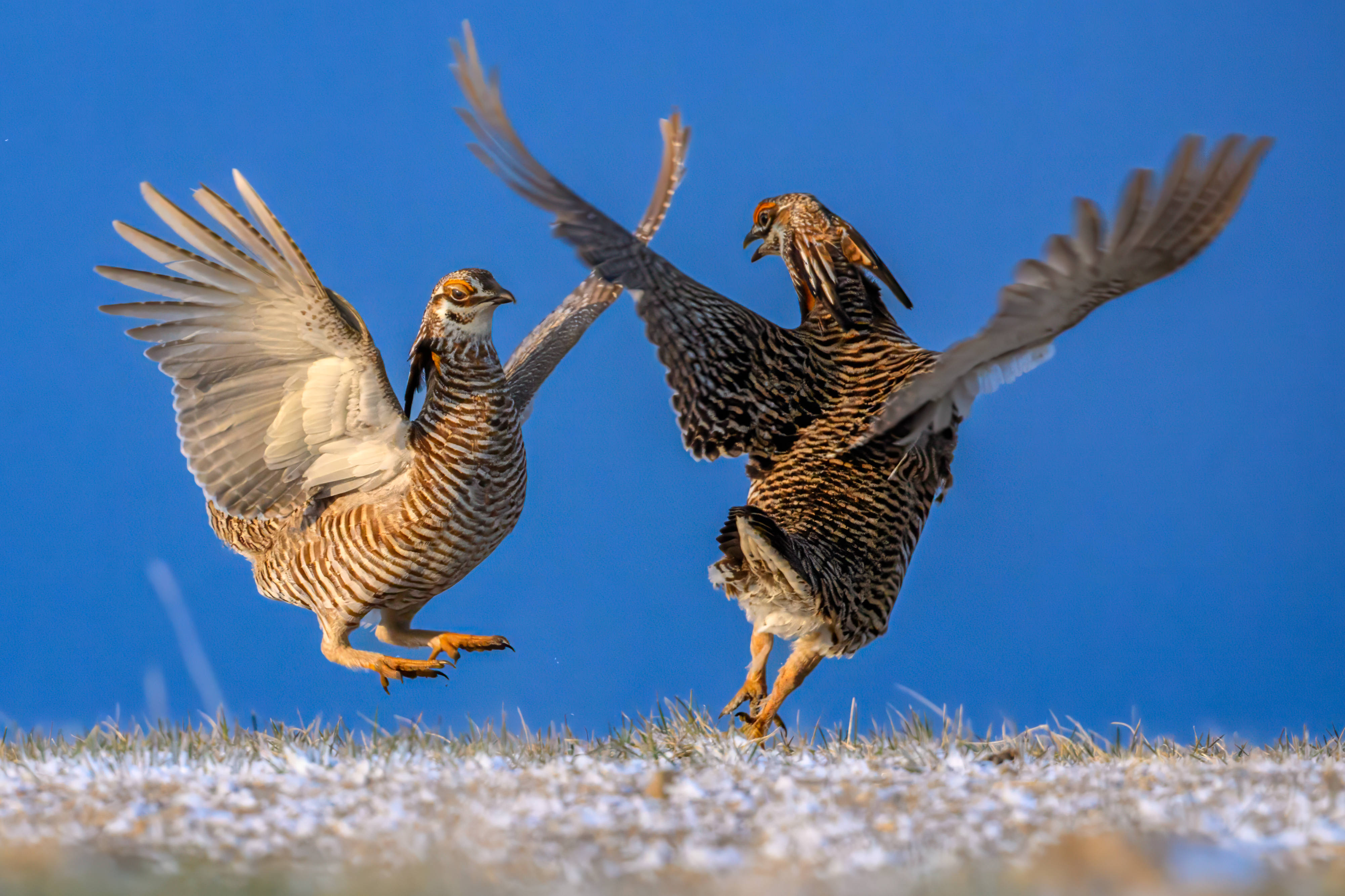
The booming is only one part of the display. Males stamp their feet rapidly in a motion so fast it creates a blur in the early light. They pivot in half circles, rush toward rivals and sometimes leap into the air in brief confrontations that settle dominance on the lek. Each movement, sound and posture communicates strength and stamina. Females arrive quietly, often watching from the edges of the lek before selecting the males whose performances they find most compelling.
After mating, the females leave the lek to build nests in tall, undisturbed grasses nearby. The display continues for several weeks, with males returning daily to defend their small territories and repeat their booming performances. For many observers, the combination of sound, motion and the wide-open prairie setting makes the courtship display a defining experience of the tallgrass ecosystem.


Sign up for Nature News.
Sign up to receive monthly conservation news and updates from Missouri.
Other Prairie Species

American Bison
Learn how The Nature Conservancy is protecting the once nearly extinct American bison across 12 preserves in the central United States.

Sage Grouse
At one time the bird picked its way through sagebrush in 13 states and three Canadian provinces and numbered as many as 16 million. Today approximately 200,000 birds remain.

Black-footed Ferret
Previously believed to have been extinct, a small population of black-footed ferrets were found in Wyoming in 1981. TNC has been working to restore their numbers ever since.