
interstitialRedirectModalTitle

interstitialRedirectModalMessage

Emerald Edge Stories

Rooted in Healing and Connection

Nearly 60 participants of the 2025 EEN Gathering pose for a group photo on a sunny day at Point Haynisisoos Park.
Leaders of Tribes Nations and communities across the Southeast Alaska, British Columbia, Oregon and Washington gather at the of the Spring 2025 Emerald Edge Network Gathering. © Viv Buck

So often, conservation success is determined by acres of land protected or number of trees planted. In the Emerald Edge, we acknowledge that conservation also relies on something much harder to measure—the ability to connect, heal relationships and share land and knowledge. Through Emerald Edge Network gatherings where we center Indigenous-led conservation, we uplift the importance of healing and connection as intrinsic to realizing conservation outcomes.

What is the Emerald Edge Network?

Established in 2017, the Emerald Edge Network connects hundreds of Indigenous, community and conservation leaders across the Emerald Edge. This 100-million-acre coastal temperate rainforest spans from Oregon to Southeast Alaska. Participants are invited to semi-annual gatherings, capacity-building workshops, idea-sharing groups and healing conversations. The Emerald Edge Network is hosted by the Nature Conservancy and its Canadian affiliate, Nature United.

Black sands and pebbles on the beach shores of Quinault ancestral lands.
Emerald Edge Network Gathering participants walk the black sand beaches of the ancestral lands of the Quinault Indian Nation. © Alanna Diggs/TNC

In late April 2025, the Emerald Edge Network gathered on the homelands of the Quinault Indian Nation in Ocean Shores, Washington. For the first time in the Network’s seven-year history, the Quinault co-hosted the event with The Nature Conservancy, welcoming over 60 participants from 14 First Nations and Tribes as well as partner organizations across Southeast Alaska, British Columbia, Washington, and Oregon. As he appreciated the constellation of leaders in the room, one Bob Whitener of the Squaxin Island Tribe reflected, “What an honor it is to be among people who make change happen. We are the people in our communities who stand up.”
Held by the ancestral lands of the Quinault, we were reminded of the deep interdependence between people and place. Towering Douglas firs, salmon-bearing rivers, and volcanic black sand set the tone for reciprocal care for land, for culture and for each other. Quinault leaders and community members guided us through learning journeys and shared stories that revealed the strength of place-based memory.

Quote: Bob Whitener

“What an honor it is to be among people who make change happen. We are the people in our communities who stand up.”

Squaxin Island Tribe
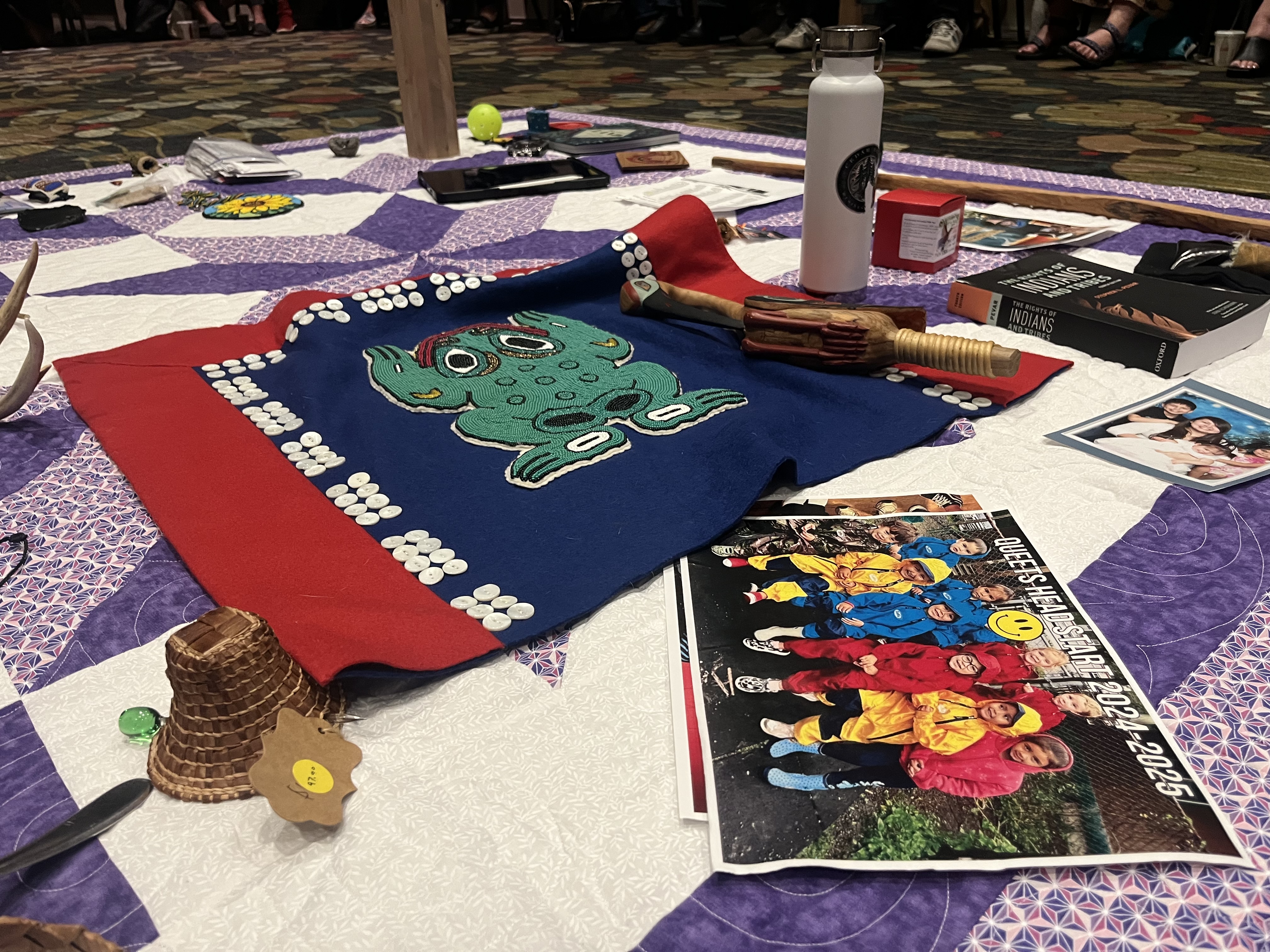
Water bottle, banner, weaving and other items laying on a purple quilt gifted by the Haudenosaunee Confederacy.
Emerald Edge Network Participants place meaningful items on a quilt at the center of the Opening Circle of the Emerald Edge Network Gathering in Ocean Shores. © Alanna Diggs/TNC

The Opening Circle

The Opening Circle was our first invitation into the kind of wisdom that would carry us through the week. Each person introduced themselves and placed a personal item on a quilt gifted to Emerald Edge Network Director Mariana Velez by the Haudenosaunee Confederacy in a 2023 global Gathering that oriented The Nature Conservancy’s approach to standing in Right Relations with our Indigenous partners. The quilt became a living tapestry of our shared purpose—feathers, geodes, tea, photos and stories passed down through generations. Each one is a thread in the larger fabric of Indigenous-led stewardship and community care across the largest remaining coastal temperate rainforest in the world.

Yes, it took a long time. We were sleepy from travel, and the introductions stretched on like a slow tide. But no one rushed. No one interrupted. And in that slowness, something rare happened: we listened, learned and began to see each other not just as colleagues or collaborators, but as people carrying stories, responsibilities and resonant hopes.

In conservation, we often skip this part. We leap into strategy, metrics and deliverable—forgetting that the work we do is only as strong as the relationships that hold it. It reminded us of a motto we adopted from our partners from the Sustainable Southeast Partnership: “move at the speed of trust.” The Opening Circle was not a formality — it was the foundation for richer exchange between leaders, filled with laughter, tears and the quiet power of being seen.

After the Opening Circle, we split into smaller groups to embark on learning journeys across Quinault territory. These were not field trips—they were invitations. These experiences deepened our understanding of what it means to care for land and people in tandem.

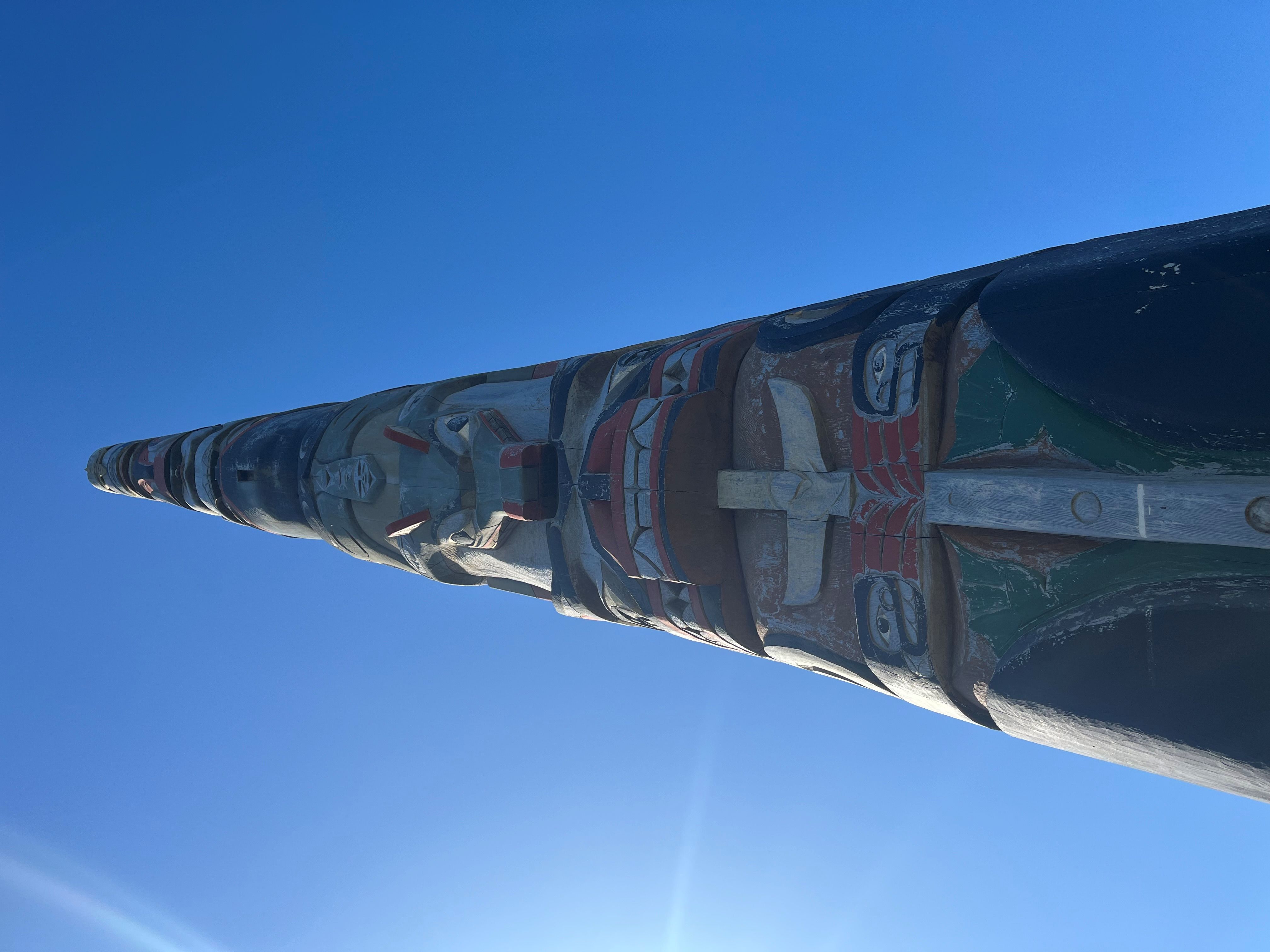
Bottom-up view of a Quinault Indian Nation red cedar totem pole on a cloudless, sunny day.
Emerald Edge Network A totem pole carved from an 800-year-old western red cedar tree stands 70 feet tall at Point Haynisisoos Park. © Alanna Diggs/TNC

Healing Whole People, Healing Whole Communities

Our journey to the Quinault Wellness Center began with a conversation about the complexity of running the facility, designed not just as a sustainable business but as a lifeline. One of its guiding principles, “to bring whole people back to whole communities,” came to life as we toured the center—mouths agape at the stunning facility, which offers state-of-the-art medical and dental care, impressive design, and an excellent counselor-to-patient ratio.

We learned that the first thing patients receive is not paperwork, but a warm smile and a cup of coffee—an act that sets the standard of care for the community. The Quinault Wellness Center addresses substance use and wellness needs across the county, not just for Quinault members. It’s a true beacon for whole community care and the living acknowledgment that environmental health cannot happen without human healing. Conservation work only sticks when people are whole.

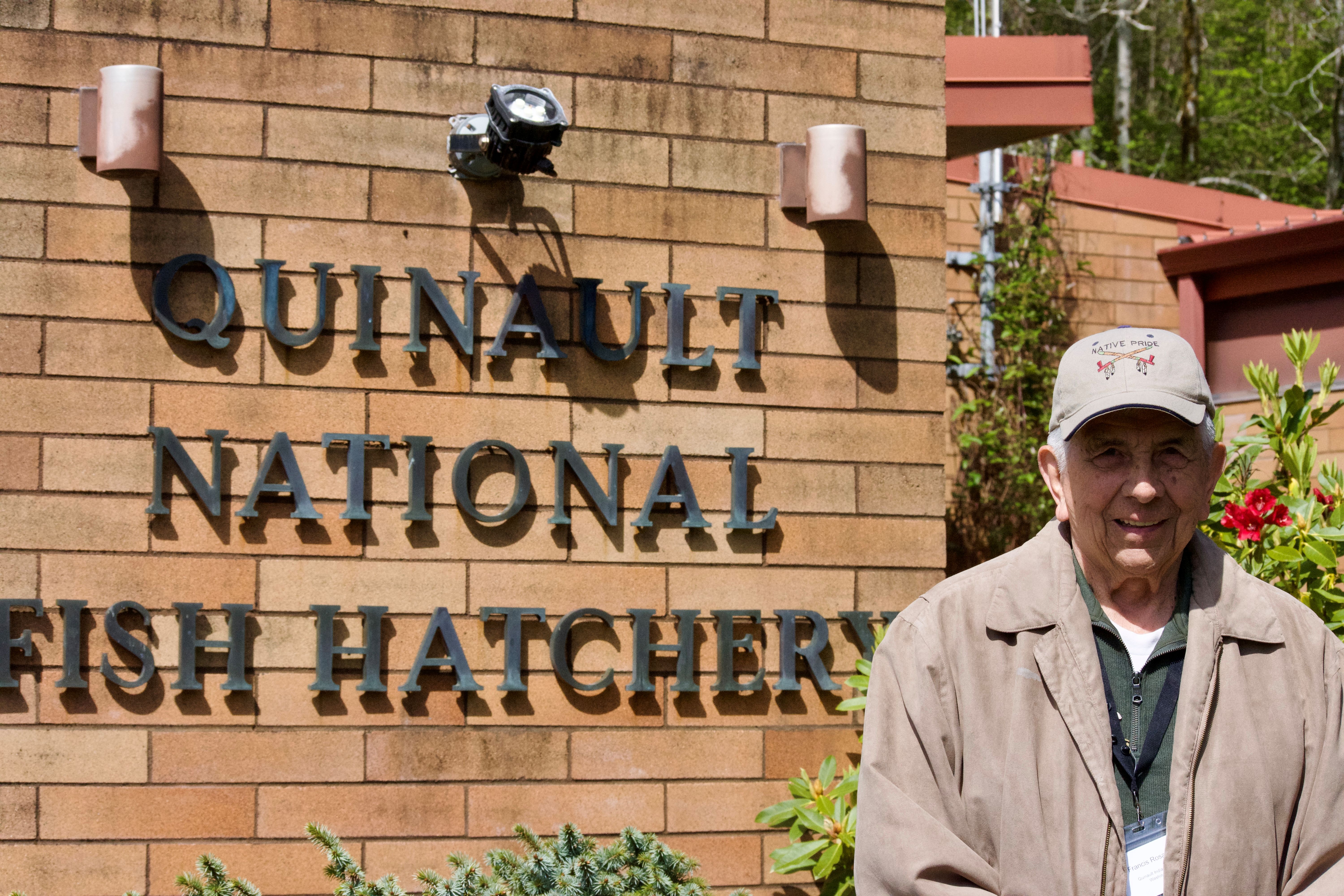
Elder Francis Rosander in front of Quinault National Fish Hatchery signage on the side of a brick building.
Emerald Edge Network Quinault Elder Francis Rosander stands in front of his former place of work after sharing memories of his time hatching fish at the Quinault National Fish Hatchery. © Viv Buck

Generational Wisdom at the Fish Hatchery

Our journeys continued at the Quinault National Fish Hatchery, where we witnessed knowledge passing intergenerationally, like a torch guiding the community. While we were met by fish hatchery staff who shared their salmon expertise, the open dialogue allowed for an Elder at the gathering to share stories of his time working there decades ago, before the facility grew into what it is today, contributing critically to the restoration of salmon runs in the region. His wisdom was a welcome surprise, and his return to the hatchery, much like a salmon’s return to its natal stream, reminded us of the cycles of nature—development and rebirth.

The hatchery is a place of restoration, not just for fish but for memory. It reminded us that progress in conservation is not linear. Sometimes it’s the act of coming back, again and again, to the places that shaped us. Like the salmon that return to their birthplace to spawn, the Elder’s story was a living metaphor for the work of stewardship and reclamation. This Gathering allowed for an Elder to teach a younger conservation-focused generation about the history of their work—highlighting, yet again, that healing and conservation are inextricably linked.

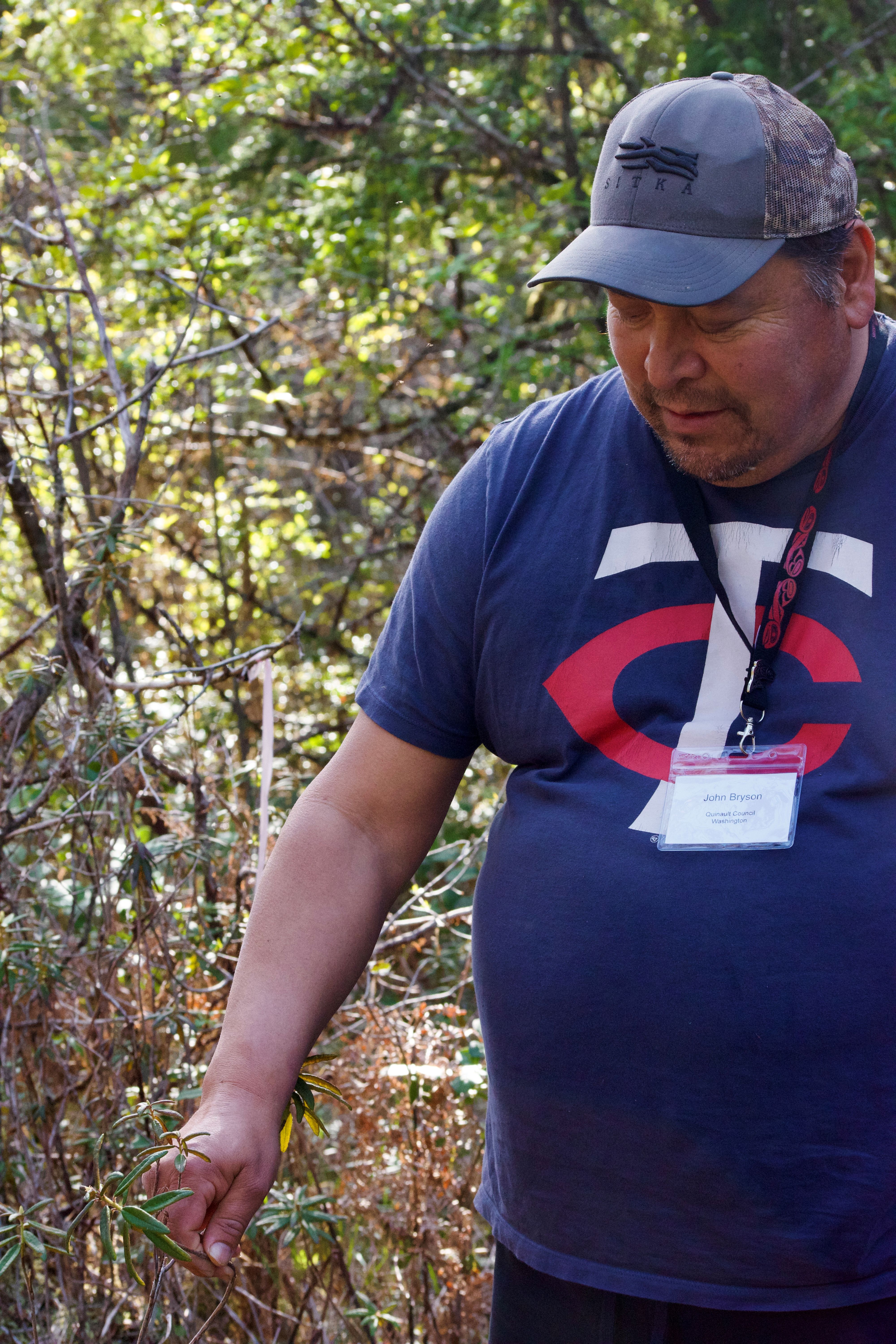
Quinault Tribal Councilman John Bryson touching Labrador Tea plant in a prairie.
Emerald Edge Network Quinault Tribal Councilman John Bryson explains the value of prairies and wetlands and their First Foods such as Labrador Tea. © Viv Buck

Rare Prairies, Inextricable Links

From the hatchery, we made a surprise stop at a treasured location. Guided by Councilman John Bryson, we walked single file through a forest, dodging branches and stepping over roots as Councilman Bryson explained the value of prairies and wetlands and their First Foods, like Labrador Tea. When the trees gave way, we gasped at the quiet, golden green expanse before us. During our debrief, Elders compared notes on the plants they saw and the seasons they gather them, noting subtle regional differences and climate-driven shifts.

Across the 100 million acres of the Emerald Edge, we saw undeniable proof: this is one connected ecoregion, stitched together by plants, tradition and shared responsibility. We bore witness to how culture and land are inextricably linked as one and the same. One participant noted, “There is something that opens up in you when you’re working on land and speaking up for it—something so healing that now I’ll always ally myself with anyone who stands up for the homelands of their ancestors.”

Prairies are increasingly rare across North America, and the Emerald Edge is home to some of the rarest among them. Their disappearance is accelerating, largely due to the loss of traditional stewardship.

Since time immemorial, the Quinault people, our co-hosts of the Gathering, have stewarded lands and waters in the southern Emerald Edge, but federal allotment policies fragmented their reservation and disrupted communal lifeways. In response, the Nation began a decades-long journey to reclaim what was lost, steadily increasing Tribal ownership from just 7% to 35% over the past several decades.

Land return is both a legal process and a healing process. As one Elder noted, “land return is bringing history home.”

As we carried these reflections with us, we prepared to close the circle, returning to the same space where we began—now changed by what we had seen, shared and learned.

: Tlingit First Nation members playing a drum and singing with palms facing up.
Emerald Edge Network Louis Brady and Isabella Jackson from the Herring Protectors of Southeast Alaska lead a gratitude song alongside other Tlingit participants from Alaska and British Columbia. © Viv Buck

Closing Circle

Throughout the week, 12 Elders from across the Emerald Edge shared teachings that echoed in tight-knit car rides, open spaces and quiet moments: the importance of tension in weaving, the courage to be gentle, the power of joy in connection. One participant reminded us, “These spaces of coming together are a form of resistance that give us the strength to keep fighting.”

As the gathering closed, participants were invited to thank the Quinault for their hospitality in whatever way felt right. What followed was a wave of heartfelt offerings—gifts, gestures of deep respect and songs sung with voices heavy under the weight of gratitude. A gesture we often overlook, receiving is just as sacred and necessary as giving.

Tlingit leaders from Southeast Alaska wrapped participants in ceremonial robes while Inland Tlingit relatives from the Taku River in British Columbia joined in a gratitude song, their voices rising together. From Yakutat, an eagle feather adorned with beadwork from a Lower Similkameen Indian Band Elder was gifted—threads of connection woven in real time across borders and waters.

These acts of gratitude marked the renewal of ties that had long been dormant, and the beginning of new ones. In the informal moments, too, the jokes on the bus, the sunset reflections—we found something essential. Healing isn’t separate from conservation. It’s the foundation that makes it possible.

An aerial view of a large, green forest bordered by a large body of water.
Clayoquot Sound, Vancouver Island. TNC is working to protect the majestic Emerald Edge. © Bryan Evans