
Amazon Forgotten Fishes
Celebrating Amazonian fish biodiversity and its vital relationship with people and rivers.


Download
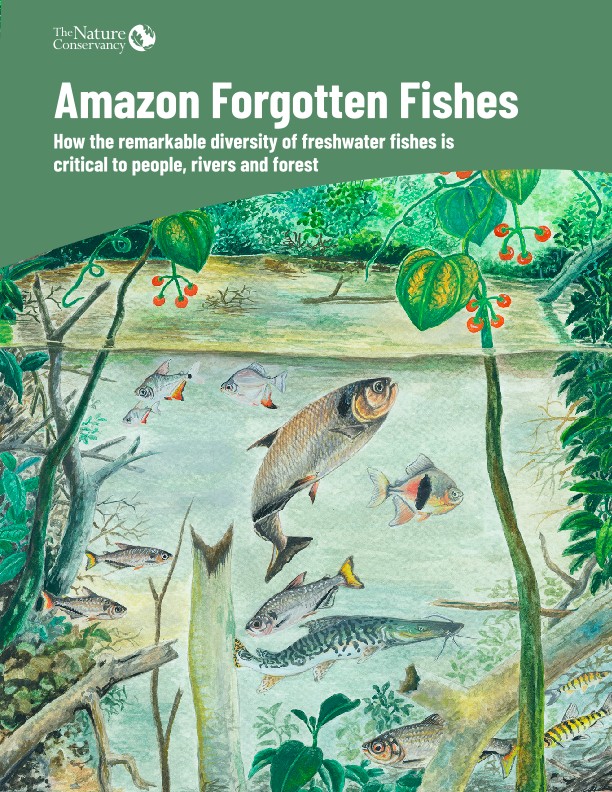
Download the full report or explore the executive summary
Download Executive SummaryIn other languages
- Full Report - Spanish (.pdf)
- Full Report - Portuguese (.pdf)
- Executive Summary - Spanish (.pdf)
- Executive Summary - Portuguese (.pdf)
More than 2,700 fish species have been documented in the Amazon Basin, and scientific exploration continues to reveal new species every year. Nearly two-thirds of these fish—around 1,700 species—are endemic, meaning they are found nowhere else on Earth.
The extraordinary diversity of fishes in this region surpasses our imagination. Some are giants, inspiring stories that blur the line between myth and reality, such as the arapaima, which can grow longer than a human being and must surface to breathe, or the migratory catfish that travel thousands of kilometers from the Andes to the Atlantic Ocean.
Other species are tiny and luminous, some are armed with razor-sharp teeth, while others generate electricity. There are also blind species that live beneath the forest floor, masters of camouflage that drift with the currents like fallen leaves, and brightly colored fish that resemble living jewels in forest streams and floodplains. All are connected by water and the intricate network of rivers and wetlands that sustain them.
Indigenous Peoples' Relationship with Fish
The Amazon is home to approximately 511 Indigenous Peoples living throughout the basin. Conserving the region’s “forgotten fishes” is inseparable from protecting the communities that inhabit it and their territories. Safeguarding cultural practices, traditional ecological knowledge, and territorial rights is essential to protecting the fish and freshwater ecosystems on which we all depend.

Amazonian fish continue to be overlooked, despite their importance to ecosystems, cultures, and food security. This report advocates for their inclusion in public policy and conservation agendas.
Rivers
Invisible network of life
Up to 30% of the Amazon Basin is made up of rivers, lakes, floodplains, wetlands, and seasonally flooded forests. Together, these interconnected freshwater ecosystems form the largest and most complex river basin in the world—home to the planet’s greatest diversity of freshwater fish—and serve as the ecological, cultural, and economic foundation of the region.
Despite their essential role, freshwater ecosystems have long remained overlooked in conservation, development, and climate strategies.
Amazonian rivers rise and fall with the seasons.
- December – May: Floodwaters typically peak.
- June - November: Water levels recede.
These annual floods fertilize floodplain soils, connect habitats, disperse seeds, and support fish reproduction.
This cycle is essential to the lives of Amazonian communities, shaping how they approach fishing, agriculture, and transportation. At the same time, it brings risks at both extremes, through floods and droughts.


There are three main types of water in the basin:
- Whitewater rivers, which are nutrient-rich;
- Blackwater rivers, which are nutrient-poor, acidic, and rich in dissolved organic matter; and
- Clearwater rivers, which have an intermediate pH, are highly transparent, contain little to no sediment, and have very low nutrient levels.
Together, these water types create contrasting ecological conditions that shape fish diversity, productivity, and migration patterns.


Biodiversity
The Amazon has the greatest freshwater fish diversity on Earth
Fish species across the Amazon Basin are not only extraordinarily diverse, but their composition is also unique. Approximately two-thirds (65%) are endemic to the Amazon, meaning they are found nowhere else in the world.
More than 2,700 remarkable species have been recorded throughout the Amazon Basin, representing about 15% of all known freshwater fish species globally. Dozens more are added every year as scientific exploration continues to uncover new species.
More than 100 fish species undertake long-distance migrations, with catfish and characins accounting for most of these movements. The Dorado catfish (Brachyplatystoma rousseauxii), for example, performs the longest freshwater migration in the world, traveling approximately 11,600 kilometers (7,200 miles) between the Andean Amazon and the Atlantic Ocean and back again.
Amazing Fish of the Amazon
Forgotten No More
Discover some of the unique inhabitants of the waters that nourish the Amazon basin.


Perhaps the largest fruit eater and seed disperser in the aquatic world, crucial for forest regeneration.

They travel more than 11,000 km from the Andes to the Atlantic.

An Amazonian legend that can reach up to 3 meters in length and weigh as much as 200 kg (440 lbs)! It is one of the main sources of protein for Amazonian communities.

They can deliver shocks of up to 860 volts, the highest bioelectric output recorded in the animal kingdom.

Their armored bodies and powerful suction mouths make them masters of fast flowing waters.

Its disguise is a sophisticated predatory tactic used to catch small fish swimming among the “fallen leaves” in the river.

This nearly transparent fish feeds on blood and, despite its tiny size, inspires outsized fear.

This fish is so unique that researchers created an entirely new family (Tarumaniidae) in 2017 to describe it.
The Amazon and its global biodiversity
-
2,700+
fish species roam its waters.
-
15%
of global fish species inhabit the Amazon basin.
-
65%
of Amazonian fish are endemic.
-
144
of these species are threatened.
Amazon fish biodiversity is as remarkable as it is overlooked. Despite their immense importance, we still know relatively little about many of these species. Fish are a key indicator of the health of the basin and the connectivity of its freshwater ecosystems. They play essential roles in nutrient cycling, seed dispersal, and sustaining local communities that depend on them for food security and livelihoods.
Communities
In Indigenous cosmology, no creature is forgotten

The conservation of the Amazon’s “forgotten fishes” is closely linked to the protection of Indigenous Peoples, local communities, and their territories.


The Amazon River Basin is home to approximately 511 Indigenous Peoples, who serve as stewards and defenders of nature.
These Indigenous nations possess sophisticated knowledge systems that are deeply intertwined with the natural world. Here, freshwater ecosystems are essential to life. Many communities identify themselves as “water peoples” and have established their villages along rivers and lakes, which provide both sustenance and transportation.
Fish play a vital role in the diets of these societies. However, the consumption of fish and other forest animals is governed by complex cultural and spiritual norms. Not all species are considered edible, and even those that are may not be suitable for everyone or permitted at all times.
The conservation of the Amazon’s “forgotten fishes” is closely tied to the protection of Indigenous Peoples and their territories. Biocultural conservation is essential: safeguarding Indigenous cultural practices, traditional ecological knowledge, and territorial rights is inseparable from protecting fish populations and the freshwater ecosystems on which we all depend.
Fishing
The Amazon: between small-scale and commercial fisheries
Over the past five decades, local communities across the Amazon have taken the lead in managing their fisheries, demonstrating that conservation and human well-being can go hand in hand.
With the exception of the industrial piramutaba fishery in the Brazilian Amazon estuary, nearly all fishing activity across the region is conducted on a small scale by riverine populations and Indigenous communities that depend directly on fish for food, livelihoods, and income.
At least 15 different fishing methods have been documented throughout the basin, most which are traditional and environmentally sustainable. Among the most widely used are gillnets, whose mesh size can be adjusted to selectively target specific species—particularly effective in slow-moving rivers and floodplain lakes—and multifilament nylon seine nets, which are deployed to encircle schools of fish in deeper waters and along sandy beaches.


The annual cycles of rising and falling water levels in Amazonian rivers directly shape where, when, and how local fishers operate. As water levels change, fishers move between floodplains and the main channels of rivers and lakes, adapting their strategies to seasonal conditions.
Women play central roles in these fisheries—not only as fishers, but also as traders, processors, and household managers—helping ensure that the benefits of fishing support families and communities alike.
Commercial fish production in the Amazon Basin is dominated by a few species and fishing grounds, though there are clear regional differences in catch composition. The dataset shows that only 30 fish species account for approximately 90% of total landings.
Threats
Factors threatening Amazonian fish

When a species is weakened by one threat, it becomes more vulnerable to the impacts of others.
Of the 2,700 species that inhabit the Amazon Basin, 82 are classified as Critically Endangered (CR), Endangered (EN), or Vulnerable (VU), and 144 species are listed on the International Union for Conservation of Nature (IUCN) Red List of Threatened Species. However, the actual number is likely much higher, as most species have not yet been assessed under IUCN criteria.

Amazonian fish habitats are under increasing pressure on multiple fronts. Human activities such as dam construction, wetland drainage, river channelization, and water diversions can dramatically transform the underwater world, destroying the areas that fish depend on for feeding, breeding, and migration.
Deforestation driven by agriculture, urban expansion, mining, and infrastructure development has significantly altered the Amazon’s wetlands and river systems. Recent basin-wide mapping indicates that approximately 7.4 million hectares of wetlands had already been deforested by 2020.
While the challenges facing the Amazon’s remarkable fish are undeniably immense, there is also real hope for the future. The key to their survival—and to maintaining the vital services they provide to millions of people—lies in restoring and protecting the freshwater ecosystems on which they depend.
A story that reflects the consequences...
Traditionally, the Kichwa People of Ongota celebrated with the jandia fish as a central symbol of their festivities. However, due to urban pollution, the species is no longer found in the region, and the community must now purchase it from other areas in order to continue this ancestral celebration.
Recommendations
The health of the Amazon basin depends on cross-border cooperation

The fate of Amazonian fish depends on our ability to understand the basin as an interconnected and constantly flowing system.
The Emergency Recovery Plan, developed by 25 authors from 14 organizations, highlights the global freshwater biodiversity crisis and outlines six priority actions to guide policy aimed at reversing biodiversity loss.
Recommendations from experts
Priority Actions
-
Manage the Amazon at the basin scale to reduce the impacts of dams and other physical barriers, balancing ecosystem conservation with the region’s energy demands.
-
Conservation initiatives benefit not only ecosystems but also Indigenous Peoples and local communities by preserving access to fisheries, clean water, and transportation.
-
Incorporate the knowledge of local fishers and Indigenous Peoples in fisheries management strategies to ensure they are effective, culturally appropriate, and sustainable for the Amazon.
-
Achieving this requires recognizing the specific needs of freshwater ecosystems, their interconnected nature, and the importance of transboundary conservation efforts.
-
Strengthen regulations governing fish trade and monitoring systems while actively engaging local communities in surveillance and management efforts to protect and restore affected ecosystems.
-
Integrate science and technology with the traditional knowledge of Indigenous Peoples and local communities, who have safeguarded these aquatic ecosystems for generations.
Technical Committee

Guillermo Estupiñán
Wildlife Conservation Society
"Fish connect rivers and forests, disperse seeds, recycle nutrients, and sustain ecological processes that are essential to the health and resilience of the Amazon."

Pedro Jiménez-Prado
The Nature Conservancy
"The Amazon is home to the greatest diversity of freshwater fish on the planet, a unique natural heritage whose full extent we are still discovering."

Vanessa Rodríguez Flores
Instituto del Bien Común
"For millions of people, especially Indigenous Peoples and local communities, fish are much more than food: they are culture, identity, and a source of well-being."

Silvia López-Casas
Wildlife Conservation Society
"Amazonian fish are threatened not only by overfishing, but also by multiple human pressures that degrade aquatic ecosystems and reduce their capacity to recover. Conserving them requires urgent, coordinated, and multidimensional action."
These regional and local strategies, combined with the engagement of governments, civil society, and local and international organizations, can amplify the impact of the Emergency Recovery Plan and position the Amazon as a global model for the conservation and sustainable use of freshwater resources.
The fate of Amazonian fish depends on our ability to understand the basin as an interconnected and constantly flowing system. The responsibility for safeguarding its biodiversity belongs to all of us. The first step we can take toward protecting these species is to recognize them—and remember them.
Download
A first-of-its-kind basin-wide assessment highlighting dazzling freshwater biodiversity and the urgent need to protect it
DownloadInstitutions that contributed to the report. A wide range of global and local organizations contributed to "The Amazon’s Forgotten Fishes.

Global Insights.
Check out our latest thinking and real-world solutions to some of the most complex challenges facing people and the planet today.
Related Stories

Amazon in Peril
Shifting weather patterns are disrupting life across Amazonia. And a new report suggests it could get worse.

The Rhythm of the Rivers: Navigating the Amazon Basin in a World Shaped by Climate Change
Climate change is altering the reliable river patterns Indigenous communities have long relied on. Across the Amazon Basin, they are finding ways to adapt.

Removing Barriers to Reconnect Rivers
Clean, healthy rivers not only support fish and wildlife, they can provide inexpensive, no-carbon energy, along with jobs and recreational opportunities.