
Living soils that feed the world
Producing food while regenerating Latin America’s strategic landscapes.

El Hatico, a knowledge hub
El Hatico Natural Reserve is one of the region’s leading regenerative farms. With measurable results demonstrating the benefits of regenerative practices, it serves as a hub for exchange and learning. The experiences of El Hatico are documented in the free virtual course by TNC and FOLU, as part of the Future Landscapes project. Join here (Spanish).
The Molina family has long understood the value of listening and learning from nature: its cycles, its rhythms, its power of regeneration, and the importance of maintaining balance. Today, El Hatico is not only a cattle ranching and a regenerative sugarcane production farm, but also a natural reserve that preserves one of the last remnants of tropical dry forest in the Valle del Cauca. It’s located in southwestern Colombia, a highly deforested area and one of Colombia’s main sugarcane-producing regions.
This family’s connection with nature is a legacy of nine generations, which led them to question how to do things differently in the early 1990s.


How can we produce healthy food while also conserving the aquifers and bringing back the forest that once thrived on these lands? Can we bring life back to the soil to create the landscapes of the future?
The answer is yes: it is possible. And it is also possible to reduce costs, improve working conditions for employees, strengthen the farm’s resilience and adaptation to climate change, and bring biodiversity back.

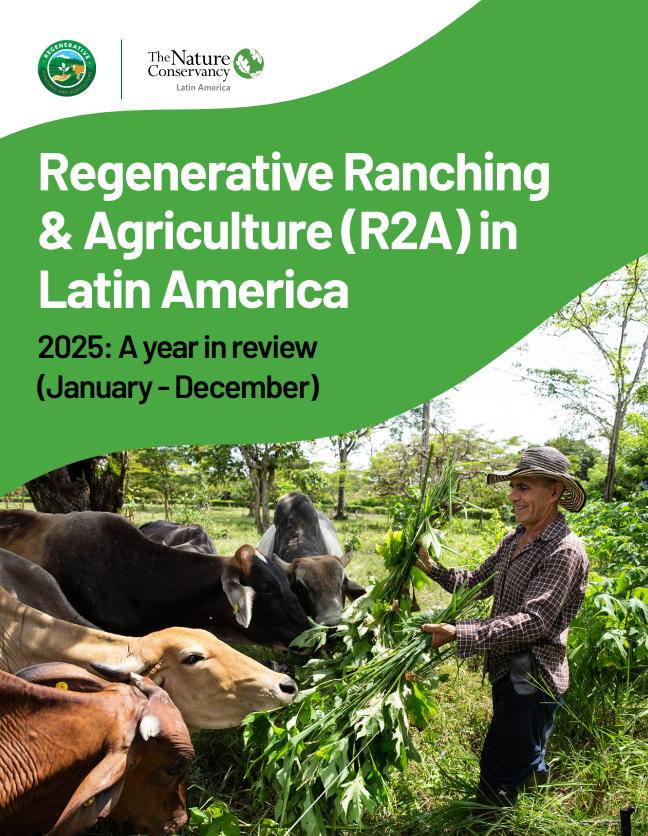
We moved from an extensive livestock model to an intensive silvopastoral system that allows an interesting interaction between trees, shrubs, and pasture, creating a sustainable system that's more autonomous in terms of fertilization and lower water requirements.


The result: happy, healthy cows resting under the cool shade of tree canopies and more efficient economic activity. The numbers speak for themselves: although today they dedicate 130 hectares to livestock, one third the land they used in 1950, El Hatico Natural Reserve now supports 1.6 times more cattle, produces 62 times more milk per hectare, and employs 3.8 times more people.

Producing food while protecting nature
In the Latin American landscapes that feed the world, producers have begun the transition toward a new way of producing food: one in which nature regeneration, freshwater protection, community well-being, and the way we relate to what we eat are at the heart of production systems. The Molina family is one example among many, and examples are growing across the region.

A field without a tree is a desert. The forest protects me from the winds, from erosion, helps water not run off so quickly, and prevents flooding.
In Argentina’s Gran Chaco, José Namtz has eliminated the use of plow discs that break up the soil and replaced them with direct sowing, crop rotation between planting seasons, and using cover crops to avoid leaving the soil exposed between harvests. Healthy soils have meant long-term economic sustainability for his business. Implementing alternatives that curb deforestation and the effects of agricultural expansion has allowed him to better adapt to increasingly extreme climate events in South America’s second-largest forest.
Don José is one of the producers with whom TNC and Nestlé Purina have been working to strengthen production systems in northern Argentina, combining technical knowledge, management decisions, and sustained work across 16,472 hectares in the provinces of Chaco and Santiago del Estero, of which 62% already implements regenerative practices.
Future Landscapes
Through Ecosystem-based Adaptation (EbA), the Future Landscapes project seeks to transform agricultural systems into regenerative landscapes. To support and scale these processes, the Regenerative Ranching and Agriculture Conceptual Framework was created. Learn more about Future Landscapes here.
*This project is supported by the International Climate Initiative (IKI) of the German Federal Government. Within the Federal Government, IKI is affiliated with the Federal Ministry for the Environment, Climate Action, Nature Conservation and Nuclear Safety (BMUKN). Some selected individual projects are also the responsibility of the Federal Foreign Office (AA). www.international-climate-initiative.com
Regeneration, a collaborative effort
Regeneration requires a wide diversity of actors. Through the Regenerative Ranching and Agriculture (R2A) strategy, TNC has been working with local producers, researchers, entrepreneurs, companies, investors, academia, governments, and consumers with the aim of achieving our 2030 goal of transforming food production and improving land management across 32 million hectares in Latin America. This includes strategic landscapes such as the Gran Chaco, Orinoquía, Maya Forest, Amazon, Cerrado, Patagonia, Atlantic Forest, and Magdalena region.
To achieve this, the R2A strategy focuses on strengthening and scaling the region’s existing regenerative ranching and agriculture experiences in a systemic, agile, and exponential way. R2A seeks to consolidate solutions that transform production systems and curb the negative impacts of conventional agriculture on ecosystems and communities.

Latin America is at a decisive moment. As the world’s largest food exporter and the most biodiverse region on the planet, how food is produced here will determine not only regional development, but also global food security, climate stability and the health of the planet.
Latin America, the largest food exporter
-
48%
of Latin America’s territory is dedicated to food production
-
70%
of habitat loss in the region is due to food production
-
50%
of GHG emissions are caused by production practices
Source: European Space Agency Land Cover – ESA Climate Change Initiative (CCI)
Regeneration goes beyond borders

Restoring degraded ecosystems and strengthening socio-environmental and economic bonds transcend geographic boundaries and disciplines.
In Brazil’s Cerrado, John Deere, Walmart Foundation, Zoetis Foundation, Corteva, AGCO, and TNC are developing a project that demonstrates that when producers have access to qualified technical assistance to restore degraded pastures and enable the environmental adaptation of their farms, the results are reflected in tangible increases in productivity, farm resilience, and capacity to meet environmental and market demands.
In less than 24 months, livestock carrying capacity increased 38.2% (from 1.71 to 2.36 animals per hectare) on monitored farms. In other dairy operations, average production rose from 5.68 to 7.75 liters per cow per day, while in soybean production, productivity increased by 17%.
We strongly believe that the environment and agriculture go hand in hand. We see the prosperity of families who adopted these changes, reflected in increased production, financial returns, and a greater understanding of environmental harmony, one of the company’s priorities.
In Brazil, technical assistance is still the exception. According to the most recent Agricultural Census, only 20.1% of rural producers reported receiving technical advice.
This experience has made it possible to structure institutional agreements tailored to local realities, defining the appropriate service frequency and identifying low-cost management practices. The results demonstrate the potential of applying models like this at scale, connecting technical assistance, management, environmental compliance, and access to public policies and financing. The goal for 2030 is for these lessons to reach 5,000 producers through strategic partnerships.
The Laranjal Farm, in Nova Xavantina, is one of the project’s success stories. After three years of technical support, productivity increased by 27%. Pastures, previously about 70% degraded, were transformed through systems integrating agriculture, livestock, and forestry. Production was diversified from solely dairy to systems that include eucalyptus, papaya, banana, as well as millet, sorghum, and corn for animal feed, an additional source of income. This project demonstrates that regenerative practices strengthen climate resilience, reduce costs, and enhance the financial stability of communities.
Scaling Regeneration in Latin America


Scaling the adoption of new ways of sustainably producing food at the landscape level takes a collective effort. Livestock producers in Mexico, Guatemala, and Belize have embraced this approach, taking important steps toward a transition that goes beyond national borders and is envisioned at the scale of the entire Maya Forest.
With support from the Latin America Conservation Council (LACC) and TNC, they developed a shared agenda focused on identifying best practices, costs, financing, traceability, value chain strengthening, and market access for sustainable cattle ranching.
One of the key achievements was the establishment of a Trinational Sustainable Livestock Roundtable, aimed at improving livelihoods while promoting the restoration of ranching landscapes and the conservation of biodiversity across the Maya Forest.
The project supported a network of producer hubs and demonstration farms, enabling the transfer of knowledge on implementing practices for the transition to sustainable cattle ranching and generating evidence to support scaling efforts. In collaboration with livestock associations and unions, public institutions, and partner organizations, the project trained technicians and producers, facilitated access to forest incentives and financing options, and developed planning tools that supported the adoption of silvopastoral systems.

Through a shared vision and mission among all parties, we believe it is possible to achieve both profitability and sustainability.

By being part of an association, we support and strengthen each other in managing resources for the technical capacity of youth, women, and producers in general, in areas related to sustainable livestock production.

Being part of the Sustainable Livestock Project marked a turning point for me. I have gained confidence, expanded my knowledge—and this is just the beginning.
In the face of climate disruptions, biodiversity loss, and social challenges across the region, the transition from traditional production systems to regenerative ones—centered on nature-based solutions and the protection of life—has become increasingly urgent.
Latin America is moving toward regeneration, not only in the way food is produced, but also in how ecosystems are protected for social and economic well-being. Understanding the paths our food takes is part of regeneration.
“The risk is no longer in changing, but in staying the same.”
The story continues…
Subscribe to our monthly newsletter
News, stories and practical advice on sustainability and conservation.

Related stories

Future Landscapes: Transforming the Agricultural Sector in Latin America
Scaling up regenerative production systems through ecosystem-based adaptation practices and measures.

Tag the herd, protect the Amazon
By tracking every cow, the Pará Sustainable Cattle Program shows how cattle traceability in Brazil can play a key role in protecting the Amazon—and encourage sustainable development as well.

Regenerating the Gran Chaco
A regenerative food system can help restore depleted soils in South America’s second-largest forest, creating positive change for communities, economies and wildlife.