

Mapping Reforestation Opportunities in the U.S.
New science is revealing vast opportunities to restore forest cover for climate, people and wildlife.



I've stopped weeding out the tree seedlings that routinely pop up in the garden beds behind my Maryland home. Instead, I let red buds and oaks stretch towards the sky. It was not laziness, but the birth of my second daughter that triggered the decision.
My day job is to worry about providing the best science for tackling climate change and my all-the-time job is to worry about my daughters’ future. During a time when many of us felt pretty helpless in the face of a challenging news cycle, turning my postage stamp yard into a mini urban reforestation project represented something I could do. I could let those tree seedlings grow, pulling carbon dioxide from the atmosphere and helping to constrain our climate crisis so that my daughters, and all of our children, can inherit a world where both people and nature can thrive.
Restoring Forests as a Natural Climate Solution
Forests represent a powerful opportunity to pull carbon dioxide out of the atmosphere, helping to cool our planet while also providing clean air, clean water and habitat for wildlife. We are increasingly seeing reforestation commitments from nations, corporations and individuals that are united by a desire to create a better future.
The science around reforestation as a climate solution is rapidly advancing—from a seminal study in 2017 that documented the high mitigation potential of global reforestation, to increasingly refined estimates of just how much carbon those forests might capture. But a key question remained—where on earth are we going to put all those trees?
The climate cooling power of reforestation depends heavily on how much new forest area we can gain. The greater the footprint of new forest, the greater the amount of carbon dioxide we can pull from the atmosphere. But we can’t just put trees any old place where forests used to be. Some of those places are cities and productive croplands.

The Reforestation Hub
The Reforestation Hub reveals where, how and why reforestation makes sense.

Developed by The Nature Conservancy and American Forests, the Reforestation Hub is a free, web-based mapping tool that brings together the best available science to identify feasible reforestation opportunities across the contiguous United States. Rather than prescribing a single solution, the Hub provides a clear, accessible way to explore where reforestation makes sense, how much carbon it could capture and how those opportunities vary from place to place.
The Hub allows users to examine questions such as where forests historically occurred, how land is owned and used today and where restoring trees could help reduce flood risk, cool urban neighborhoods, improve water quality or support wildlife as the climate changes.
Explore the Reforestation Hub
Discover how the Reforestation Hub makes it easy to support and scale reforestation efforts.
Explore the HubNew Updates to the Reforestation Hub
In March 2026, the Reforestation Hub released a new update with several improvements that make it easier to use and understand. The update offers clearer and more accurate estimates of climate benefits, postfire reforestation data with the ability to search by specific burn scars and a simpler method for removing places that already have a lot of tree cover. Users are also now able to explore reforestation opportunities in new ways, such as by wildfire areas, congressional districts and ecoregions.
On top of that, the new update will add helpful map layers showing things like sawmills, tree nurseries and reforestation partners, along with a new dashboard that makes it easier to work together, save progress and export files.
Vast Opportunities to Restore Forests and Capture Carbon
The Reforestation Hub identifies up to 169 million acres of total opportunity for reforestation, an area the size of California and Washington put together, which could capture up to 311.3 million metric tonnes of carbon dioxide each year. We also estimate that about half of the mitigation (and a third of the area) is possible at $20 per metric ton of carbon dioxide or less, putting these within reach of prices on the voluntary and compliance carbon markets.
However, our main goal was not to put out a big number. It was to help people make the reforestation choices that best suit their community, state and county.
Want to find the places with the greatest carbon capture per acre? The places that are lowest cost? The places on public lands? The Reforestation Hub answers these questions, and many more. In particular, the Hub lets you explore the results and visualize the outcome for every single county in the contiguous United States.



Reforestation on Private Lands
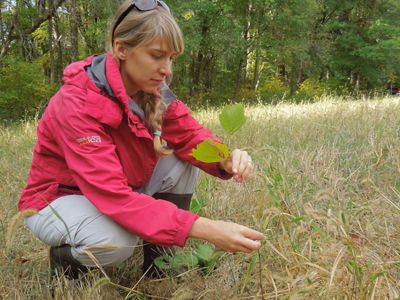
Private landowners have a critical role to play in this effort to restore our forests. The Hub shows that 85% of the opportunity areas for reforestation in the contiguous US are on privately owned land. Planting trees on these lands could capture 276 million tonnes of carbon dioxide per year.
While letting forests regrow on their own can be a cheap and effective reforestation strategy, it may not always work. Sites that are highly degraded or far from seed sources, for example, may struggle to recover on their own. Planting trees can help to kickstart or speed recovery and can help establish the right species for current and future conditions.
Policies that lower the cost and barrier of reforestation for private landowners will help us seize this important opportunity to restore forests and capture carbon. And supporting reforestation is an investment in the future.
After all, there is something deeply satisfying about planting a tree, knowing that future generations will be able to clamber in the leaf boughs.
Hope for a Better Future
We have about a decade remaining to avoid the worst effects of climate change, but we are already feeling the negative consequences of rising temperatures associated with increasing flood risk and more severe wildfires. Some days this feels pretty overwhelming, but the last few years have taught us that there are challenges we need to face, and can address, when we pull together to find solutions.
Planting a tree is not the sole solution. We are absolutely going to need revolutions in our energy sector and massive reductions in greenhouse gas emissions. We need to keep forests as forests, improve our management of existing forests and pursue the many promising options within our agricultural sector, grasslands and wetlands. And new trees, with their air, water and shade benefits, are also part of the solution.
Planting a tree, or simply letting seedlings grow in our own backyards, represents something we can do now to reignite our hope for a better future.
Reforestation Stories
Restoring Shortleaf Pines in Arkansas Once a dominant species across the Ozarks, the shortleaf pine has faced decades of decline due to land‑use changes, wildfire suppression, and habitat loss. Today, local partners, conservation groups, and state agencies are joining forces to restore this iconic native tree.
7:40
Explore Further

Forests Can Absorb Carbon More Quickly Than Previously Thought
Letting forests regrow on their own could be a secret weapon to fighting climate change.

Nature’s Make or Break Potential for Climate Change
This study shows we’ve been underestimating nature’s role in tackling climate change.

Plant a Billion
Our goal is to plant 1 billion trees to help restore our global forests. It’s a big number, but we know we can do it with your help.
Susan Cook-Patton is Director of Science and Strategy Integration for TNC's Global Natural Climate Solutions team.
More About Susan Cook-Patton