


Media Contacts
-
Chelsea Bowers
Media Relations Manager
The Nature Conservancy
Phone: 804-728-0588
Email: Chelsea.bowers@tnc.org
WILMINGTON – People who live in and near longleaf pine forests from the Sandhills to the Coast will soon start seeing smoke as The Nature Conservancy (TNC) and its conservation partners conduct controlled burns (also known as prescribed fires) to restore the forest.
Longleaf pine forests are adapted to frequent, low-intensity fires. These fires knock back shrubs and other vegetation—allowing plants such as Venus flytraps to thrive on the forest floor. Some plants need fire for their very existence; wiregrass won’t produce seed unless it is exposed to fire. Fire improves habitat for animals such as turkey, whitetail deer, and bobwhite quails. Controlled burns also reduce ticks and remove vegetation that can fuel large damaging wildfires.
Most controlled burns are conducted January through May, although some burning will continue through the summer months and into the fall. TNC crews burn on TNC preserves and help conservation partners with burns on other properties. Other land trusts, local prescribed burn associations, and government organizations also burn longleaf forest in the region.
Before and After
Longleaf forests are adapted to fire, and they bounce back after a burn healthier and stronger. The picture shows two burns done at Calloway Forest Preserve, a little less than one month apart. The objectives of the burns were to reduce fuel, restore native groundcover and improve habitat for threatened species, such as the red-cockaded woodpecker and Bachman’s sparrow.
One Month After a Burn
One Day After a Burn
This unit was burned on April 4, 2025, and the photo was taken the next day during the fire crew's regular monitoring after a controlled burn.

 Return
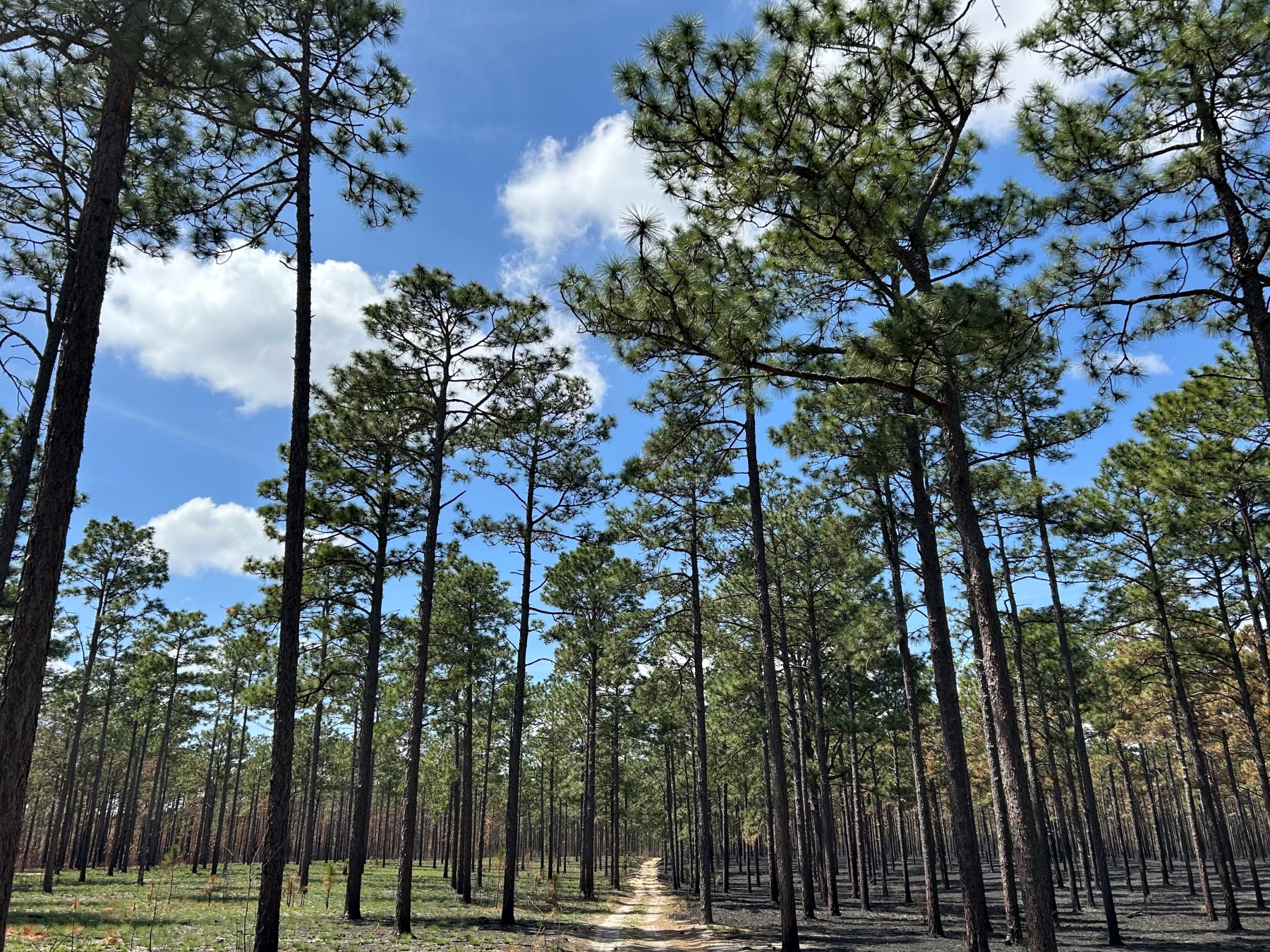
Before European colonists arrived, Indigenous People managed the forest with fire. Centuries ago, longleaf pine blanketed 90 million acres from what is now southern Virginia to eastern Texas. As Europeans colonized the region, they exploited longleaf pine—harvesting it to build boats and tapping it for its resin. In the 20th century, fire suppression and coastal development also took a toll on longleaf pine forest, until it was eventually reduced to just 3 million acres. Today, TNC and its conservation partners are restoring longleaf pine; there are now 5.2 million acres of longleaf forest in the Southeast.
Controlled burns are carefully planned to maximize ecological benefits while minimizing any nuisances such as smoke. Practitioners aim to burn each burn unit every two to five years for optimal forest health. Each burn has a specific plan that lays out goals, conditions under which a burn will occur, and how the burn will be conducted. Experts monitor the weather and only make a final call to burn at the last minute if all conditions are favorable.
This will be TNC’s third season utilizing a fire ignition drone, an innovative tool that has significantly improved crew safety. By igniting the interior of the burn unit from the air, the drone allows firefighters to remain on the fire’s perimeter, where conditions are cooler and safer. In 2025, TNC used the fire ignition drone on 17 burns from April to August.
The Nature Conservancy is a global conservation organization dedicated to conserving the lands and waters on which all life depends. Guided by science, we create innovative, on-the-ground solutions to our world’s toughest challenges so that nature and people can thrive together. We are tackling climate change, conserving lands, waters and oceans at an unprecedented scale, providing food and water sustainably and helping make cities more resilient. The Nature Conservancy is working to make a lasting difference around the world in 83 countries and territories (39 by direct conservation impact and 44 through partners) through a collaborative approach that engages local communities, governments, the private sector, and other partners. For more news, visit our newsroom or follow The Nature Conservancy on LinkedIn.