interstitialRedirectModalTitle

interstitialRedirectModalMessage

Places We Protect

Peachtree Rock Heritage Preserve

South Carolina

An immense rock in a forest clearing.
Peachtree Rock Peachtree Rock in Peachtree Rock Preserve © Harold E. Malde

One of the best hiking spots in South Carolina Midlands.

Overview

Description

A Prehistoric Playground

Where South Carolina’s coastal plain, sandhills and piedmont meet.

Trails traverse through layered sandstone formations, riddled with the fossils of ancient marine creatures. Native longleaf pines tower overhead. Near the preserve’s entrance, a waterfall cascades into a small, serene pool.

Rich in culture, history, unusual geology, plants and wildlife, Peachtree Rock Heritage Preserve is a fun day trip from Columbia that offers easy to moderate hikes for the whole family.

Access

OPEN TO THE PUBLIC

Highlights

Rich in culture, history and unusual geology.

Size

460 acres

Electric Vehicle Charging

None

Explore our work in this region

Life at Peachtree Rock

Many different animals live amidst the undergrowth at the preserve, including northern red salamanders, skinks and several species of beetles. In the forest surrounding the trail, the chirping of birds and a flash of wings may reveal a chickadee, titmouse, cardinal, yellow-billed cuckoo or federally threatened red-cockaded woodpecker.

Wildlife thrive in the preserve’s diverse plant communities. Longleaf pine ecosystems include turkey oaks and sparkleberry bushes. Wetland areas are home to mountain laurel, crane-fly orchid, ferns and maple-leafed viburnum.

An illustration features black and white bird perched on gray pine bark.
Red-cockaded woodpecker An artist's sketch depicts a red-cockaded woodpecker visiting a tree. © Zoe Keller

Big news: Peachtree Preserve visitor discovered a family of red-cockaded woodpeckers

TNC is working with the South Carolina Department of Natural Resources to help establish a healthy population of red-cockaded woodpeckers, including installing artificial cavities for them to live and nest in and monitoring and researching the current population of woodpeckers here. These efforts aim to increase the preserve’s potential as a dispersal site as birds move throughout the nearby landscape, including  family units in Aiken and Fort Jackson.

Plants of Peachtree Rock

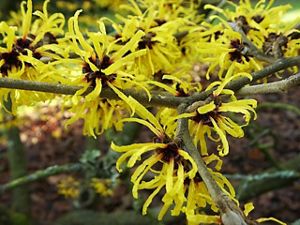
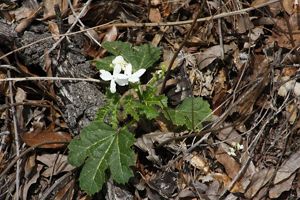
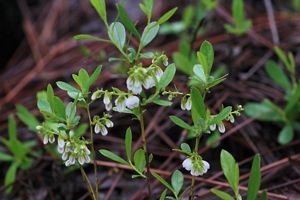
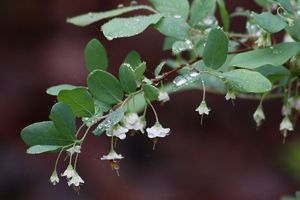
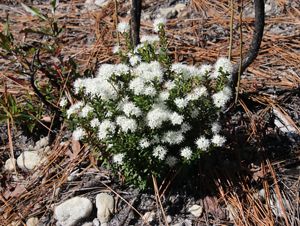
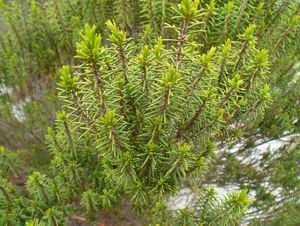
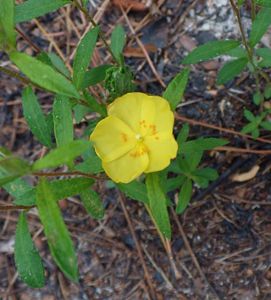
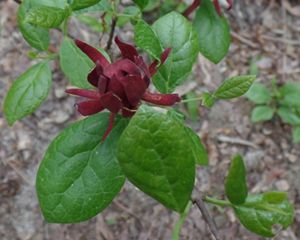
These are just a few plants you might see during your visit.

Yellow petals emerge from a witch hazel plant.
A white flower emerges from a plant blooming on a forest floor.
A green plant has petite white blooms.
Small white flowers emerge from a green plant.
A plant with white flowers grows among pine needles covering the forest floor.
A big green rosemary plant grows among sandy soils.
A yellow flower emerges from a small green plant.
A dark red bloom emerges from a green plant.
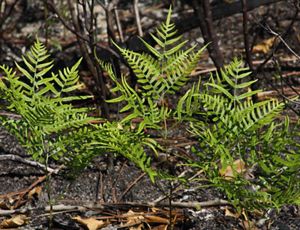
Big green fern branches grow in a forest.
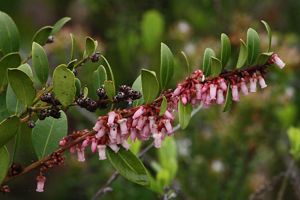
Blueberries dry up on a woody branch.

Preserve History

With the chapter’s founding in 1977, Peachtree Rock Heritage Preserve was TNC in South Carolina’s first land protection project.

The “big rock” for which Peachtree Rock Heritage Preserve was named took the shape of an inverted pyramid, balanced on its tip. This unusual silhouette was created when the waters of the Atlantic Ocean receded long ago. The lower layers of the rock eroded more quickly, creating a wide top and narrow base. Erosion, storms and visitors carving into the rock gradually wore away at that fragile pedestal.

On December 7, 2013, a hiker observed that Peachtree Rock had toppled. The sandstone’s crumbly nature made it impossible to hold up the rock artificially, so the decision was made to leave it on its side. The Nature Conservancy and South Carolina Department of Natural Resources (SC-DNR) continue to monitor its position and stability.

While the big rock has fallen, a similar formation affectionately known as “Little Peachtree Rock” still stands just off the trail near the back of the preserve. Contrary to its name, this rock is still larger than a full-sized van.


The Nature Conservancy's Impact

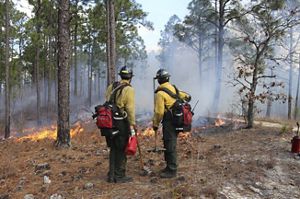
TNC in South Carolina is restoring and managing this important ecosystem, including supporting native plant and wildlife communities with prescribed fire. With the return of fire, we've seen the longleaf pine forests bounce back, including the plants and wildlife that depend on them.

Learn more about TNC in South Carolina
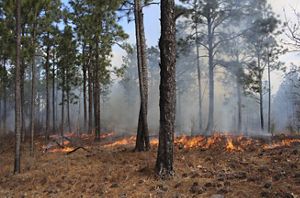
Tall, thin pines stand over a slow orange flame, engulfed in thick smoke.
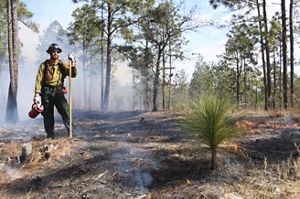
A prescribed fire professional stands next to a young longleaf.
Two prescribed fire professionals plan a controlled burn.
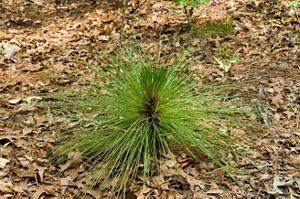
Grass stage longleaf pine at Peachtree Rock Heritage Preserve.
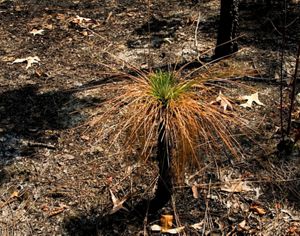
Young longleaf pine after a prescribed fire.

Visit the Preserve

  • Preserve Guidelines:

    • Please do not touch or climb on Peachtree Rock.

    • Wear walking shoes or hiking boots.

    • Animals are permitted only if they are on a leash.

  • Find the trail map here.

    • Blue Trail: 2.4 miles, featuring Peachtree Rock, the waterfall and Little Peachtree rock

    • Green Trail: 1.4 miles

    • Red Trail: 0.3 miles

    • Orange Trail: 1.6 miles

    • Yellow Trail: 0.1 miles

    • Black Trail: 1.8 miles

Trail Map A trail map for TNC's Peachtree Rock Nature Preserve helps visitors navigate the area. © SC Trails Program

Peachtree Rock Wildlife

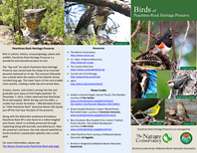
  • The Midlands Master Naturalists created a bird brochure for TNC's Peachtree Rock Heritage Preserve in South Carolina.

    Bird Brochure

    The Midlands Master Naturalists created a bird brochure for TNC's Peachtree Rock Heritage Preserve.

    Download
  • The Midlands Master Naturalists created a bird checklist for TNC's Peachtree Rock Heritage Preserve in South Carolina.

    Bird List

    The Midlands Master Naturalists created a bird list for TNC's Peachtree Rock Heritage Preserve.

    Download
  • The Midlands Master Naturalists created a plant list for TNC's Peachtree Rock Heritage Preserve in South Carolina.

    Plant List

    The Midlands Master Naturalists created a plant list for TNC's Peachtree Rock Heritage Preserve.

    Download

Support Peachtree Rock

Peachtree Rock is a Heritage Preserve co-managed by TNC and SC-DNR to nurture its on-site native longleaf pine forests. In 2007, we replaced 74 acres of non-native slash pine with longleaf pine seedlings that have been nurtured through controlled burning to remove dense underbrush and encourage longleaf germination and growth.