


Climate Strong Communities
Amid the challenges of a warming planet, we can find strength in nature—and in each other.

South Carolina’s Salt Marshes The Chelsea Plantation waterfrontage acts as a critical saltwater marsh migration corridor that will help the area adapt to future ecosystem changes. © Holstein Appraisals
Today, climate change throws life-threatening, non-stop challenges at us. But the situation isn’t hopeless, and we’re not helpless.
When we grow our connections with the people and nature around us, we become more resilient than ever. By protecting and restoring natural habitats, communities can adapt to and mitigate the impacts of coastal hazards, all the while supporting important plants and wildlife.
TNC in South Carolina is taking a multi-faceted approach to strengthening our communities in the face of rising seas and stronger storms. This includes both protecting remaining Lowcountry properties from development and harnessing the power of nature to strengthen shorelines.


Jasper County, SC, is the third fastest growing county in the nation. With this growth comes rapid development. But as nearby residents experienced the loss of their stunning salt marshes and wild lands, they mobilized to save the 2,700-acre Chelsea Plantation.
Groups like Keep Chelsea Rural went door-to-door with flyers against developing the property and even put up billboards in support of their rural community. Then, TNC’s incredible donors stepped up to help fund this acquisition.
This 2,700-acre property secures more than seven miles of frontage along Hazzard Creek, which drains into the Broad River and is part of Port Royal Sound watershed.
Chelsea’s fate was one of this region’s major tipping points for the future of its wildlife habitat, historical character and water quality...We weren’t willing to leave it to chance.

TNC in South Carolina is working with partners to expand an existing corridor between the Ashepoo-Combahee-Edisto River Basin (ACE Basin) and protected properties along the Savannah River on the Georgia border. The protection of the Chelsea, Gregorie Neck and Buckfield properties is part of a yearslong partner effort to protect remaining Lowcountry lands and equip communities for future ecosystem changes.

The 4,400-acre Gregorie Neck property is flanked by deep water access on the Coosawhatchie and Tulifiny Rivers and bisected by Interstate 95, making it a highly sought out site for development. But, to preserve the region’s nature and wildlife, TNC purchased the property and will be permanently protecting it with a conservation easement through the Open Space Trust. The property was divided into several parcels and available for sale to conservation buyers—and forever protected with perpetual conservation easements.
Buckfield protects more than 7,300 acres in coastal South Carolina’s Hampton and Jasper counties. The property links ecologically significant landscapes to create a 12,000-acre stretch of protected land in this fast-growing region. TNC acquired 3,654 acres, marking a bold first step in the permanent protection of Buckfield, while Open Space Institute acquired the remaining 3,672 acres to join its previously secured 5,000-acre Slater property. These lands were purchased by the South Carolina Department of Natural Resources (SCDNR) and became the Coosawhatchie Heritage Preserve and Wildlife Management Area.


The same natural features that give us great fishing and recreation can also stabilize our shores.
Oyster reefs not only play a part in keeping water at bay, but also keep sand in. In addition to reducing or reversing erosion by trapping sediment, oyster reefs have many benefits:
TNC South Carolina is restoring oyster reefs as a barrier against rising sea levels and stronger storms. Known as living shorelines, green infrastructure projects like restoring oyster reefs give coastal communities a chance to heal themselves—naturally.


When you give to The Nature Conservancy in South Carolina, you help protect our lands and waters for generations to come.
Give NowIn July 2023, The Nature Conservancy in South Carolina was awarded $6.8 million from NOAA’s Transformational Habitat Restoration and Coastal Resilience Grant. The funds will support a four-year project to implement a program titled Transforming the Scale and Equity of Living Shorelines in South Carolina.
The program consists of three tasks:
The Marine Corps Air Station Beaufort recognizes the close interconnectivity of their resilience and adaptive capacity within this tri-command area. TNC has partnered with the base to boost resilience, as well as to promote activities outside their direct vicinity to reduce vulnerabilities to climate change, protect critical infrastructure and help
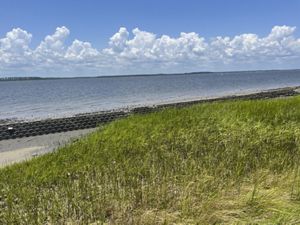
Completed oyster restoration: A completed living shoreline, comprised of Oyster Castle pieces, along coast of Laurel Bay at Marine Corps Air Station, Beaufort SC. © Nichole Pehl/TNC
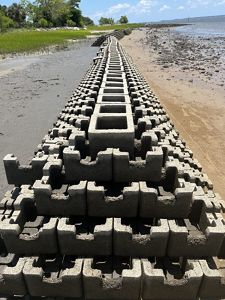
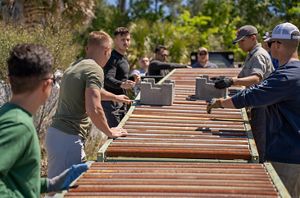
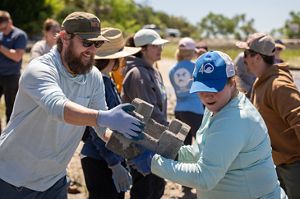
Oyster castles, Beaufort SC: Oyster Castles® are interlocking, concrete blocks that are installed along a shoreline with bags of clam and oyster shells. © Nichole Pehl/TNC
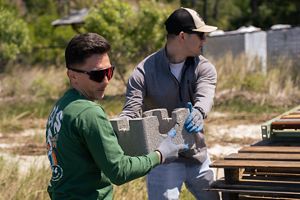
Living shoreline build, SC: 2025 Volunteers help restore an oyster reef at Marine Corp Airforce Base, Beaufort County, SC © Kyle Baskin
Kyle Baskin: Volunteers help restore an oyster reef at Marine Corp Airforce Base, Beaufort County, SC. © Kyle Baskin
Living shoreline build, SC: 2025 Volunteers help restore an oyster reef at Marine Corp Airforce Base, Beaufort County, SC © Kyle Baskin
Volunteers, conservation organizations and government entities have worked for 20 years building living shorelines one bag and one block at a time. Those efforts are making a real difference, but we need to significantly scale up our work to keep pace with more intense storms and rising sea levels.
The South Atlantic Salt Marsh Initiative is a collaborative partnership to enhance the long-term abundance, health and resilience of the approximately 1 million acres of salt marshes within the South Atlantic states.
The Nature Conservancy leads South Carolina's implementation team, joining the following partners to create a state-specific plan — a pathway to protection, restoration and marsh migration.
Audubon South Carolina
Gullah/Geechee Sea Island Coalition
Manomet Conservation Sciences
National Oceanic and Atmospheric Administration
The Pew Charitable Trusts
South Carolina Department of Natural Resources SCIT Steering Committee Organizations
South Carolina Environmental Law Project
South Atlantic Salt Marsh Initiative
The SASMI Implementation Roadmap offers solutions that benefit the communities, military installations, and fish and wildlife that depend on South Atlantic salt marshes.


The Nature-Based Exchange aims to foster the widespread and practical application of natural and nature-based solutions (NNBS) throughout South Carolina to address climate change, biodiversity loss, water management and social inequalities. A collaborative effort led by The Nature Conservancy, the initiative focuses on promoting equity, community engagement and environmental resilience to increase NNBS awareness, access and development.
These connections make land protection possible. Together, we go much farther, faster than we could alone. As we work to strengthen South Carolina in the face of climate change—including saving lands from development and stabilizing eroding coasts—we must work as a community, for our communities.


