


Water is the lifeblood of all living things and in the arid West, it is an especially cherished commodity. In Wyoming, The Nature Conservancy has made keeping our natural water systems healthy a top priority.
The Colorado River has key headwaters in Wyoming, and the state’s forested mountains hold much of the snowpack that feeds into those headwaters streams and rivers. These waters provide habitat and sustenance for a wide range of animals downstream. The river also supports some of the nation’s most productive agricultural lands, as well as millions of people who live in the Colorado River watershed.

Upper Green River
The Upper Green River is Wyoming’s version of Africa’s Serengeti plains—a natural bottleneck where wildlife funnel through ancient migratory pathways. In the lower 48’s longest big-game migration, pronghorn and mule deer travel from summer ranges in the Greater Yellowstone Ecosystem’s mountain highlands to winter stomping grounds in the Upper Green’s sagebrush-covered valley.
The region is the northernmost headwaters of the Colorado River, a seven-state basin that serves more than 40 million people with freshwater but struggles with a significant decline in natural river flows due to overwhelming user demand and shifts in climate.
Nestled between the Wind River, Gros Ventre and Wyoming ranges, the Upper Green River region is a nearly one-million-acre stronghold for sage-grouse, the West’s signature native game bird.
The open vistas of this mountain-to-high-desert ecosystem are rapidly dwindling. Humans are clogging historic migratory paths and diminishing wildlife habitat with an expanding web of roads, oil and gas wells, pipelines, housing developments and fences.

Plants and Wildlife
The heart of the Upper Green River features vast stretches of mountain big sagebrush and its more compact cousin, Wyoming sagebrush. Transition areas between sagebrush and grassy wetlands provide habitat for over two dozen rare or endangered plant species. Uncommon glacial “potholes” in the mountainous regions have developed special soils that also support rare plants.
The Upper Green River’s streamside and wetland areas are the most extensive in Wyoming, providing habitat for the endangered Colorado cutthroat trout and breeding sites for five bird species of special concern, including reintroduced trumpeter swans. The valley’s sagebrush lands support the largest population of sage-grouse in the state, along with big-game species such as mule deer (the second-largest herd in Wyoming can be found here), pronghorn and elk.
Conservation Actions
Escalating levels of human activity, such as energy and home development and the roads and other structures that follow, threaten to block ancient migratory pathways, severing the routes big-game animals have used for millennia. If these species are to maintain healthy populations, they must have access to the valley’s critical winter range. Several species, especially sage-grouse and mule deer, show signs of sensitivity to human disturbances that could worsen with additional human activity.
TNC is working with private landowners, agencies and other non-profit organizations to protect critical migration routes and the quality of habitat that migrating big game depend on. Through conservation easements, fence conversions and habitat restoration and preservation, TNC is maintaining vital pathways for wildlife to use in perpetuity.
TNC is also working with the University of Wyoming, landowners and other partners to develop creative solutions to keep agriculture, streamside habitat and fish populations thriving in the face of ongoing drought and potential water shortages in the upper Colorado River Basin. By demonstrating how water users can continue to function even as water supply decreases, we can help Wyoming cope with a drier future.
Sublette County Conservation District
Wet Meadow Restoration
In the arid Upper Colorado River Basin, water conservation work is never easy. But for Sublette County Conservation District’s Kamryn Kozisek, a new skid-steer funded in part by TNC has made the work of hauling thousands of rocks a little less back-breaking.
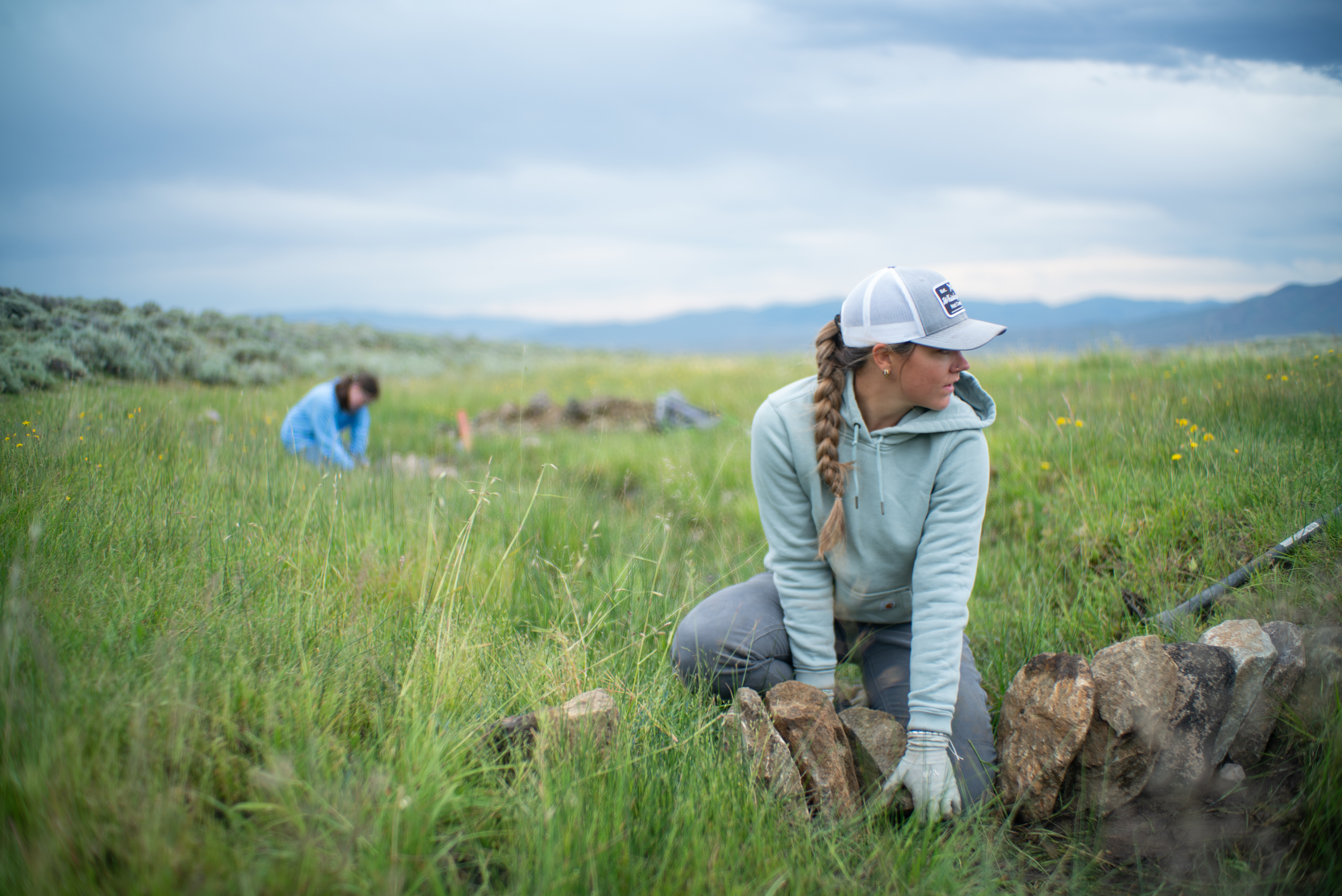
Putting the skid-steer to work alongside a new dump trailer and plenty of muscle, Kozisek and her partners have completed almost 350 wet meadow structures in the Pinedale area since 2024. Another 450 are currently in the works.
These rocky structures trap water in low spots throughout the sagebrush scrubland, slowing runoff and erosion while allowing water to replenish underground aquifers. On the surface, the wet meadows provide wildlife with access to all-important water and nourishing native grasses. Oases like this can spell the difference between life and death for sage-grouse, mule deer and other wildlife in this dry southern portion of the Greater Yellowstone Ecosystem.
The wet meadows are part of a large-scale effort to use nature itself to improve wildlife habitat, reduce flooding and protect groundwater throughout the Colorado River Basin. A similarly simple-to-build structure, called a beaver dam analog, slows water flow in streams by using branches and sticks to mimic a beaver dam. Kozisek and her team have already constructed more than 30 of those. Last year, TNC and the Bureau of Land Management forged a seven-state agreement that is expected to deliver $2 million in federal funds for the project in Wyoming, which TNC will then put to work on the ground through a partnership with the Sublette County Conservation District. Kozisek’s end goal is thousands of wet meadow and beaver dam analog structures completed in Wyoming by 2030. While each individual structure has a small footprint, together they will work like a vast series of sponges, soaking up vital water during the short spring runoff season, holding it in natural pools and wetlands into the summer, and delivering it back into streams well into the fall—a period that is becoming increasingly unpredictable as winter snows arrive later in the year and rain patterns change.
People and wildlife are already benefiting from this work. When combined with related efforts across other Colorado River Basin states, these projects impact roughly 40 million people who depend on water from the Basin. For hunting and outdoor tourism, healthier wildlife populations are an obvious boon. But the wet habitats also benefit ranchers, whose livestock have better access to water and healthier forage.
By protecting groundwater and stream flow, the structures help keep water available to irrigate crops downstream. And that keeps fruits and vegetables flowing from one of America’s most productive agricultural regions to supermarkets around the country. By applying global expertise to efforts in local communities, TNC is unique in its ability to tackle large-scale challenges like keeping water available in the Colorado River Basin.
Forests and Rivers
TNC is addressing Wyoming's need for reliable water supplies by studying how different approaches to forest thinning—the process of selectively cutting down some trees in a forest—impact a forest's ability to hold water as snow. The research, in collaboration with donors, the USDA Agricultural Research Service, the University of Wyoming and the Medicine Bow-Routt National Forest, may help forests provide more water for people and nature downstream.
Stay updated with this work and more.
You Might Also Like

Wyoming’s Green Reach
Wyoming’s forests are crucial for water storage, wildlife habitat and recreation. However, they face threats from severe wildfires due to hotter, drier conditions.

Sagebrush Sea
The Nature Conservancy is working across Colorado, Utah, Wyoming, Montana, Idaho, Nevada and Oregon to protect this iconic western landscape, one of the largest natural systems in North America.

Wyoming’s Sagebrush Sea
The Cowboy State is key to saving one of the most vulnerable natural landscapes on Earth.