

Returning Fire to Ohio's Lands
While fire is often viewed as a destructive force, scientists say the correct use of wildland fire can save money, protect lives and improve wildlife habitat.

On a chilly spring morning, firefighters from The Nature Conservancy (TNC) in Ohio and Michigan, as well as the U.S. Fish and Wildlife Service - Partners for Fish and Wildlife Program (PFW) geared up for a 905-acre prescribed fire among the rolling hills of The Wilds.
Managed by the Columbus Zoo and Aquarium, The Wilds is located in Southeastern Ohio and focuses on conservation of threatened and endangered species, as well as ecological recovery and restoration.
In the past, The Wilds has used prescribed fire to maintain habitats, but with a small team and limited equipment, the organization has been unable to accomplish a burn at this scale before.
A prescribed fire, also referred to as a controlled burn, is used by conservation organizations as a land management and restoration tool. These fires help manage invasives and undesirable woody shrubs, which improves habitat for wildlife. After a prescribed fire, greenery emerges from landscapes—including native plants that attract birds, pollinators and other wildlife.
Prescribed fire safety
TNC and PFW crews took time before, during and after the burn to mitigate potential safety risks that could cause a fire to spread or push heavy smoke into populated areas.


This particular 905-acre area contains a mix of cool and warm season grassland habitats.
“The predominant benefit from this fire is the thinning of non-native cool season grasses and the setback of invasive shrubs. The fire promotes the prairie species that The Wilds have established including native warm season grasses and forbs,” says Ryan Morr, fish and wildlife biologist, U.S. Fish and Wildlife Service – Partners for Fish and Wildlife Program.
In this case, the grasslands need fire to help manage three main nonnatives—autumn olive, bush honeysuckle and nonnative cool season grasses. And by eliminating these, grassland bird species will benefit—including Henslow’s Sparrow, Grasshopper Sparrow, Savannah Sparrow, Eastern Meadowlark, Bobolinks and American Woodcock.


A large-scale prescribed fire like this one doesn’t happen in a day—it requires months of planning, as well as strong partnerships.
Morr, a fish and wildlife biologist with PFW, helped lead this project. He started conversations for this burn over three years ago with The Wilds and TNC in Ohio.
The prescribed burn project is a result of a voluntary landowner agreement with PFW and The Wilds, which will focus on restoring fire to the landscape across grassland and forest ecosystems.
“This prescribed fire was the beginning of a career-long project and partnership that will benefit our wildlife into the future,” says Morr.
The Wilds was grateful to share resources with PFW and TNC to ensure the large-scale burn could take place.
“This partnership allows The Wilds to carry out prescribed burns on a much larger scale. We gained access to expertise, equipment and personnel—making the process safer and more effective. For us, this means better habitat management, improved ecosystem health and the ability to sustain the grassland habitats that wildlife relies on,” says Liza Butler, restoration ecology associate at The Wilds, who was a key leader for this prescribed burn.

“Conservation partnerships like these are really a force multiplier for conservation. We can accomplish more together than all our organizations can accomplish separately."
Get nature’s best stories delivered monthly to your inbox with our Nature News.
Not only did the partnership benefit habitat, but it will also have reverberating effects on fire management across the state. PFW is hopeful this new fire partnership with TNC, formalized in the Ohio Private Lands Prescribed Fire Cooperative between the two organizations, will benefit people and nature for years to come.
“Restoring fire as a reliable management tool on private lands is not only transformational for conservation in Ohio but also game‑changing at a national scale. The ability of PFW and TNC, two organizations with deep and respected national reach, to lead this effort is one of the most meaningful contributions of my 22‑year conservation career,” says Brent Sodergren, State Coordinator for the U.S. Fish and Wildlife Service – Partners for Fish and Wildlife Program in Ohio and Indiana.
For TNC, bringing these resources together allows for fire management opportunities that didn’t exist here before.
“Conservation partnerships like these are really a force multiplier for conservation. We can accomplish more together than all our organizations can accomplish separately,” says Tom Rooney, Sustainable Forestry Director for TNC in Ohio.
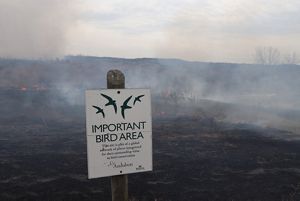
Important Bird Area: A sign from the Audubon Society denoting the area as a bird conservation area at The Wilds prescribed burn in March 2026. © Marlee Stollar/TNC
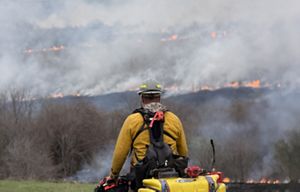
Monitoring the Fire: Jeff Finn monitors the prescribed fire at The Wilds in March 2026. © Jack Thacker
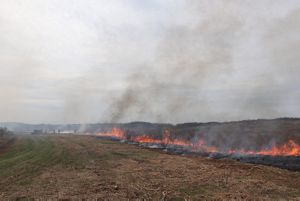
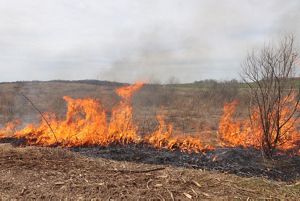
Fire line The Wilds: The early stages of prescribed fire at The Wilds. The wetline and the fire break are containing the fire. © Marlee Stollar/TNC
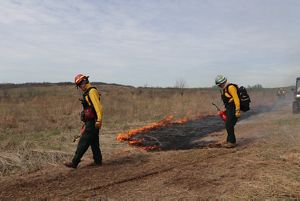
Test Fire: Two TNC firefighters set the test fire at The Wilds prescribed fire. © Marlee Stollar/TNC
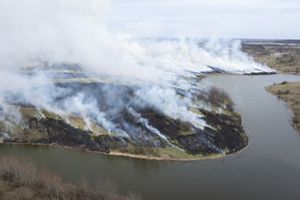
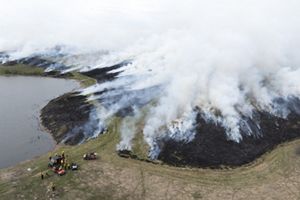
Wilds Prescribed Fire: Aerial image of the prescribed fire at The Wilds in March 2026. © Columbus Zoo and Aquarium/Grahm S. Jones
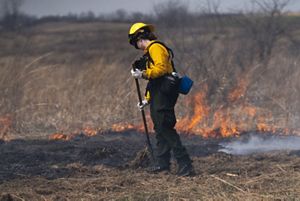
Maintaining the fire line: Fire fighter maintains the fire line at the test fire. © Grahm S. Jones, Columbus Zoo and Aquarium
Fire line: In the early stages of The Wilds Prescribed Fire, a fire line emerges from the test fire. © Marlee Stollar/TNC
Aerial of Prescribed Burn: At The Wilds prescribed fire, the lake was used as a fire break. © Grahm S. Jones, Columbus Zoo and Aquarium
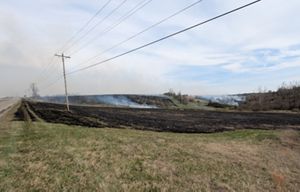
Post Burn: The Wilds open grasslands after the prescribed burn. © Tom Rooney/TNC
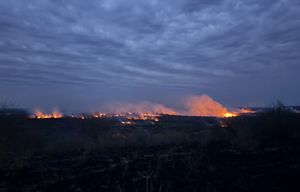
Nighttime Prescribed Fire : The Wilds prescribed fire lasted until the evening. © Jack Thacker
Brian Winters joined TNC as prescribed fire manager for Ohio and Michigan in the fall of 2024—expanding TNC’s capacity for fire management across the state. Winters, who has over 30 years of experience in fire management, led The Wilds project as the burn boss—the person who oversees the fire and crew.
Winters’ leadership at the prescribed fire created a unique opportunity for Tom Shuman, fire program administrator at Ohio Department of Natural Resources Division of Forestry. Shuman needed someone at Winter’s level to supervise his training to advance to the next level—Prescribed Burn Boss Type 2 (RXB2) through the National Wildfire Coordinating Group.
After successfully completing the fire at The Wilds, Winters will sign off on this position and recommend Shuman is certified by the Ohio Department of Natural Resources Division of Forestry.
Shuman is slated to be the only current individual in Ohio state government to have the RXB2 designation.
"At TNC in Ohio, we're really trying to do two things with our fire program—safely burn more acres for conservation outcomes and build capacity for prescribed fire within the state. When Tom Shuman is certified, he will be able to advance other people within his own organization, and elsewhere in Ohio, to grow their expertise and qualifications,” says Rooney.

I started in fire management 32 years ago at St. Marks National Wildlife Refuge with USFWS. Since then, I have worked as a full-time firefighter, prescribed fire specialist and fire management officer. With my current role at TNC, I look forward to expanding fire management across Ohio and Michigan.
TNC and PFW crews took time before, during and after the burn to mitigate potential safety risks that could cause a fire to spread or push heavy smoke into populated areas. Below you can find some steps the crews took to ensure a safe, controlled burn took place.
Two weeks in advance, Morr, Winters and Butler worked with local traffic control, fire departments and other county officials to ensure the burn could occur safely.
Prior to the prescribed fire taking place, a briefing is held to share weather conditions, the plans of where and when fires will be lit, ignition sequences, holding concerns and other safety measures.
Also in advance, PFW staff created fire breaks around the perimeter where the fire would be taking place. Fire breaks are the boundaries of the fire and are used to contain the fire within the determined boundaries.
“The first step is mowing the fire break, or if you have woody vegetation in it, you have to grind that first. Then, you have to disc it to bring up some mineral soil. Even with doing all of this, portions of the breaks will still burn if you don't put down some water. So, that is why we put down a wet line with UTVs,” says Winters.


Adjacent to the fire breaks, a test fire is the first step before anything else takes place. Water is sprayed in the fire break to help prevent fire from going beyond that point, which is called a wet line. The test fire helps determine if it is safe to burn that day, and if the fire behavior will help meet objectives.
The fire begins with the test fire; if that goes well, it becomes the backing fire. This creates a fire break, which will stop the last and largest fire of the day—the head fire—from leaving the boundaries of the prescribed fire.
Water is sprayed in the fire break to create the wet line, which helps prevent fire from progressing outside the fire unit.
Weather is a key component to whether a fire can take place or not. For this burn, Winters contacted fire weather forecasters at the National Weather Service beforehand to ensure conditions were favorable that day.
“They produce a spot fire weather forecast for us that is specific to the burn site. They also model our smoke to tell us where it will be going. There wasn't a lot of smoke sensitive areas out there, but I did want to make sure it wasn't going straight to Columbus,” says Winters.
With the weather forecast, Winters doesn’t just consider smoke, but also the wind and humidity.
“You don’t want the humidity too low or winds to be too high because it can create fire behavior that we may not be able to control. So, there's a prescription we have in plan for weather, and we have to be within that prescription for the fire to occur,” says Winters.
To learn more about this work and the role our partners play, visit here.
Take a deeper dive into prescribed fire and how TNC is using it in the Midwest and beyond.
.jpg?crop=222%2C0%2C3556%2C2667&wid=900&hei=675&scl=3.951111111111111)


