
Louisiana's Iconic Trees
Many tree species are deeply connected to Louisiana’s history, culture and identity.

Longleaf pine, bald cypress and live oak trees have a few things in common. They thrive in Louisiana’s hot, humid climate. They are resilient in the face of hurricanes and floods. And, if their basic needs are met, they can live for centuries.
The Nature Conservancy is proud to safeguard and expand the habitats at our system of 21 preserves in Louisiana to ensure they can continue to filter air and water, secure soils, welcome diverse wildlife and provide a buffer from severe weather. Here we highlight three of Louisiana’s most iconic tree species and give a nod to some honorable mentions.
 Longleaf Pines

America's Longleaf Restoration Initiative
Welcoming Back Longleafs
Longleaf pines (Pinus palustris), a symbol of the south, have the ability to live for more than 300 years, if we let them. Ecologists are also beginning to suspect that the open understory serving as a foundation for this ecosystem boasts a similar lifespan.
Hundreds of years ago, longleaf pines blanketed much of the southeastern United States. During the late 19th and early 20th centuries, timber logging stripped away longleaf-dominated woodlands from an estimated 8.5 million acres to a fraction of that today. The voracious logging happened in tandem with suppressing natural fires from occurring in the landscape, which together eliminated old growth trees and prevented any restoration of the forest.
Party in the Pines
Several species rely on longleaf pine habitat.
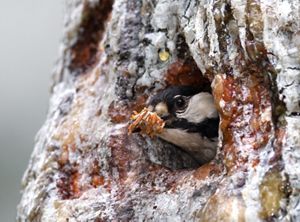
Red-cockaded Woodpecker: Federally threatened red-cockaded woodpeckers (Picoides borealis) rely exclusively on longleaf pine trees for survival. © Gary Flanagan
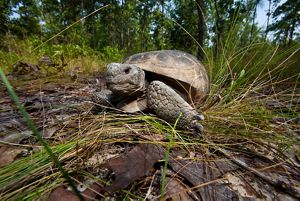
Gopher Tortoise: The federally threatened gopher tortoise (Gopherus polyphemus) is rare in Louisiana and restricted to locations in the eastern part of the state. © Karine Aigner
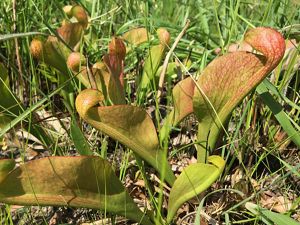
Parrot Pitcher Plant: The parrot pitcher plant (Sarracenia psittacina) is a carnivorous plant that thrives in fire-dependent longleaf pine savannas in the Southeastern U.S. © Will deGravelles/The Nature Conservancy
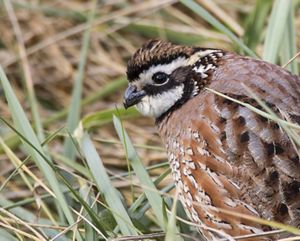
Northern Bobwhite Quail: The northern bobwhite quail (Colinus virginianus) is a ground-dwelling bird that prefers areas where woodlands and prairies converge. © Rick Conner
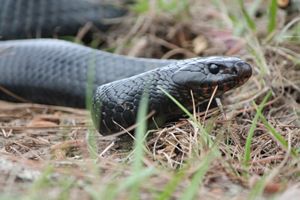
Eastern Indigo Snake: The eastern indigo snake (Drymarchon couperi) is a top predator in the southeastern U.S. longleaf pine system, and often shares burrows with gopher tortoises. © Michelle Hoffman

For longleaf pines, fire is key. It removes competing hardwood species, recycles nutrients, and triggers flowering and the release of seeds of understory plants. While fire burns off portions of foundational grasses above ground, their root systems live on – perhaps for centuries – to resprout again and again. Without fire, longleaf forests are greatly diminished and convert to other, less diverse forest types. These are reasons why TNC uses fire as a conservation tool at the following six Louisiana nature preserves to restore longleaf pine savanna and woodlands in ways they once occurred across the landscape:
- Talisheek Preserve
- Abita Creek Flatwood Preserve (open to public)
- Lake Ramsay Preserve (open to public)
- CC Road Savanna Preserve
- Persimmon Gully Preserve
- Ft. Polk Buffer Preserve
Together, these preserves total 7,401 acres dedicated to supporting these native trees in Louisiana. At each of these preserves, TNC is removing invasive, non-native trees and other vegetation, managing prescribed burns that mimic historic frequency and patterns, and planting new trees to add resilience to the native forest.


Betting on Bald Cypress
Think of Louisiana and a postcard image of bayous and bald cypress trees (Taxodium distichum) dripping with Spanish moss likely springs to mind. The massive buttressing and unique, highly sturdy root system make these trees well suited to Louisiana’s weather patterns and cycles of extended flooding and drought. Native across the U.S. coastal plains — from Delaware to Florida and west to Texas — bald cypresses represent some of the largest and oldest living trees in the nation. Some in Louisiana are more than 1,000 years old.
Bald cypress trees are also among a very few conifers that shed their needles once a year. They thrive when surrounded by water but are highly resistant to drought. In most natural settings they produce “knees,” conical woody appendages that originate in their roots to eventually emerge in the surrounding swamp. While many have theories about these knees, there is not a scientific consensus on their true purpose.

Bald cypresses are resistant to rot, insects and extreme heat, which make them resilient in nature. Those qualities, though, also have made cypress wood sought after for everything from furniture and fences to boats and bridges. The trees are vital to Louisiana’s wetland ecosystems, but threatened due to historical logging and, more recently, to saltwater intrusion and a changing climate. Interestingly, they have also shown themselves to be among the most resilient trees for planting in noisy, hot and harsh urban environments.
Although these trees are not rare in Louisiana, old bald cypress are uncommon, and many cypress swamps are declining because of altered hydrology. TNC is working with partners to restore natural hydrology in places like the Atchafalaya River Basin and to protect whole stands of uncommonly old, healthy and properly functioning cypress swamps at places like Cypress Island Preserve in St. Martin Parish and Bayou Cocodrie Preserve in Evangeline Parish. TNC has also worked with partners to protect vast acreages of cypress swamps now open to the public at places like Cat Island National Wildlife Refuge – and it is seeking opportunities to do more of this work.

Leaving a Live Oak Legacy
Live oaks (Quercus virginiana) aren’t just large, long-lived trees. These iconic southern trees represent legacies that reach across generations, carrying stories and memories within sprawling limbs and a massive canopy that can spread double the height of the tree. Though they do shed and replace their leaves in the spring, their name is a nod to the fact that these oaks appear “alive” and full of leaves all year long, unlike other species that are leafless throughout the winter.
Their short, stout form lends itself to significant resilience to wind, meaning even during hurricanes and short floods, Louisiana’s live oaks almost always remain standing. That strength wasn’t lost on early settlers who discovered that the trees’ hard, close-grained wood was ideal for shipbuilding.

Over the past century, live oaks have experienced significant decline across their range, including in Louisiana, due to habitat loss, invasive pests, diseases, and permanent or drastic changes to hydrology and saltwater intrusion. At the Cypress Island Preserve and across Louisiana, TNC is working to protect and restore habitat for live oaks where they historically thrived.
Honorable Mentions
Click the tiles to learn about other iconic trees TNC works to protect at our Louisiana preserves.

White Oak
White oak trees (Quercus alba) can be found at several TNC preserve, including at the Mary Ann Brown Preserve and Summerfield Springs preserves. These trees can live to 500 years and is the wood exclusively used to make bourbon barrels

Southern Magnolia
The Southern magnolia (magnolia grandiflora) is a native, evergreen tree and the state flower of Louisiana. Known for large, fragrant white blooms in spring and glossy green leaves, these iconic trees thrive throughout the state in various landscapes, but in their natural setting occur on sloping forests and mesic soils and can reach 80 - 100 feet tall, growing slowly in deep shade until a canopy gap allows them to reach dominance.

Green Ash
Green Ash trees (Fraxinus pennsylvanica) native in Louisiana, commonly found in moist bottomland forests, streamside areas and wet habitats. They grow to be 50–70 feet tall, with a diamond-patterned bark and dark green leaves that turn yellow in fall. These trees Their wood is highly valuable, but they are under deep threat from the non-native, invasive emerald ash borer, now known to occur in a handful parishes in north-central Louisiana.
Latest News
Learn about our latest efforts to conserve Louisiana's most iconic trees.
July 16, 2026
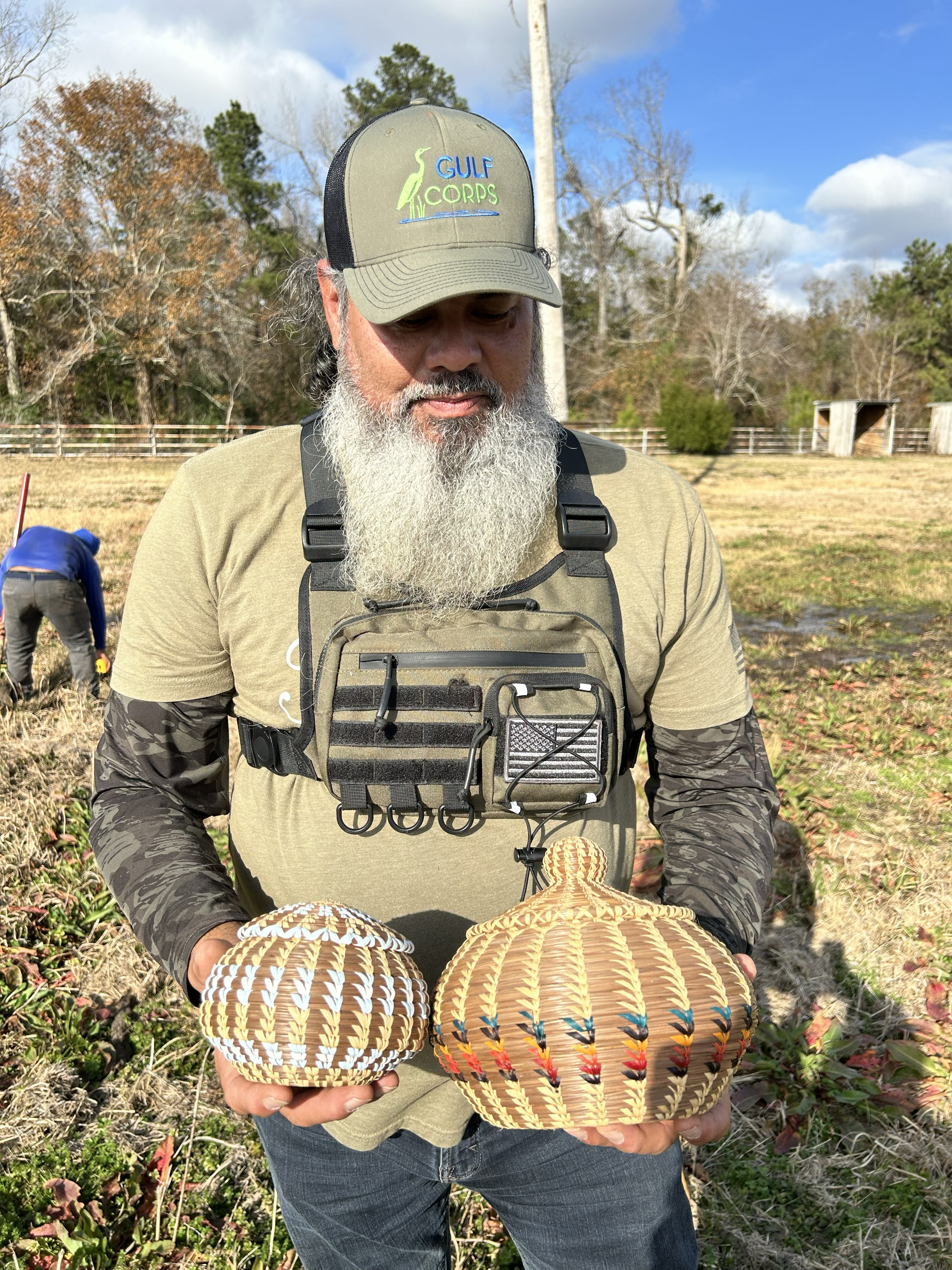
TNC partners with the Coushatta Tribe of Louisiana on maintaining longleaf pine stands on tribal lands in Allen Parish.
The Nature Conservancy works as a partner with the Coushatta Tribe of Louisiana to assist them in maintaining two emerging longleaf pine stands on tribal lands in Allen Parish, LA. In 2008, the tribe reforested 80 acres with native longleaf to ensure a local needle source for tribal basket makers. The Coushatta are renowned for their skill at making woven pine needle baskets, a tradition that has been passed on from one generation to the next. Longleaf pine needles are significantly longer, thicker and waxier than loblolly or slash pine (typically used in regional industrial forestry) and thus are superior for this basket weaving.
Healthy longleaf savannas are among the most diverse ecosystems in North America, due in part to the great richness of grasses and flowering forbs in the understory. Across the Southeast, an estimated 900 different plant species are unique to these ecosystems, and understories typically harbor 150 to 300 species of groundcover plants per acre. Longleaf stands require periodic fire to promote growth and flowering of these herbaceous species, as well as to help resist encroachment by woody plants.
In the fall of 2025, TNC and the Coushatta undertook the removal of woody brush and trees not native to longleaf forests paving the way for a prescribed fire treatment just completed this past June. The restoration work is made possible with support from the National Fish and Wildlife Foundation and TNC’s Plant a Billion Trees program.
Coushatta Natural Resources Manager Gardner Rose said he is pleased with the results and optimistic about the future. “We’ve been unable to burn the stands regularly, and woody plants like saltbush and sweetgum moved in, replacing bluestem and other grasses that helped carry fire. Removing them and returning fire puts us back on track and will allow those desirable understory species a chance to return.”
Longleaf pine savannas and woodlands once dominated the southeastern United States, covering more than 90 million acres across the Coastal Plain, from southern Virginia, to Florida, to East Texas. In addition to its long needles, the longleaf pine tree is known for its large cones and fire-resistant properties. While about 95 percent of the historical longleaf pine acres are gone, there are now about five million acres of longleaf pine ecosystem today.
Support This Work in Louisiana
More Louisiana Stories

Louisiana Treesilience
The Nature Conservancy is building tree canopy in Louisiana communities hit hardest by recent hurricanes.

Louisiana Longleaf Pine Cone Count
The Nature Conservancy conducts an assessment of Louisiana's longleaf pine cone seed crop.

Louisiana Places We Protect
Learn about the places The Nature Conservancy protects in Louisiana.