
End-of-Year Conservation Wins in Kentucky
2025 Impact Report

From the Director and Board Chair
Lessons From 50 Years
2025 is a special year for The Nature Conservancy in Kentucky. Fifty years ago, a small but dedicated group of volunteers founded our Kentucky chapter, bringing to the Bluegrass State an increasingly successful model for conservation—a science-based, nonpartisan, collaborative approach focused on delivering tangible, lasting results. Five decades later, The Nature Conservancy is thriving in Kentucky, across the United States, and in more than 80 countries around the world. We are immensely proud to be part of this organization, and we are immensely grateful to the staff, trustees, supporters, partners, and community leaders who have contributed so much to our success.
One of the things you learn working at The Nature Conservancy or serving on our board is that the mission and the organization are much bigger than any one of us. Thousands were part of the journey before we joined, and many thousands more will come after we have passed on.
TNC’s sustained and growing impact depends on staying nimble and adapting in a rapidly changing world, and staying true to our values and collaborative approach. No single reason accounts for our success, but striking that balance between adaptability and core consistency comes as close as any.
Fifty years in and looking confidently—despite so many headwinds—into the future, we offer three additional reasons for our success in Kentucky.
One, we recognize that TNC gets a lot more done when we work together as an integrated organization. What we do in Kentucky matters to the world, and what happens in the world matters to Kentucky.
Two, we embrace partnership. Every significant success we have achieved has involved partners. Kentucky is not always an easy place for conservation, and we must work even more closely with partners in the coming years.
Three, we set (and achieve!) ambitious goals while remaining grounded in people and place. One of our great strengths is that we deliver results you can walk around on. We all need to push for bigger results globally, but we cannot forget that many of our fiercest advocates fell in love with nature in their backyard woods.
As we celebrate 50 years, we know we are in a critical decade for the planet. The investments, policies, and decisions we make today will determine our trajectory far into the future. And we do have a choice. A future with a livable climate, healthy communities, and thriving nature is still possible.
The Nature Conservancy, in Kentucky and around the world, has the ambition and vision, coupled with the strategies and hard work, to deliver just such a future.
Thank you for your continued investment in our work and mission. Here’s to the next 50 years!
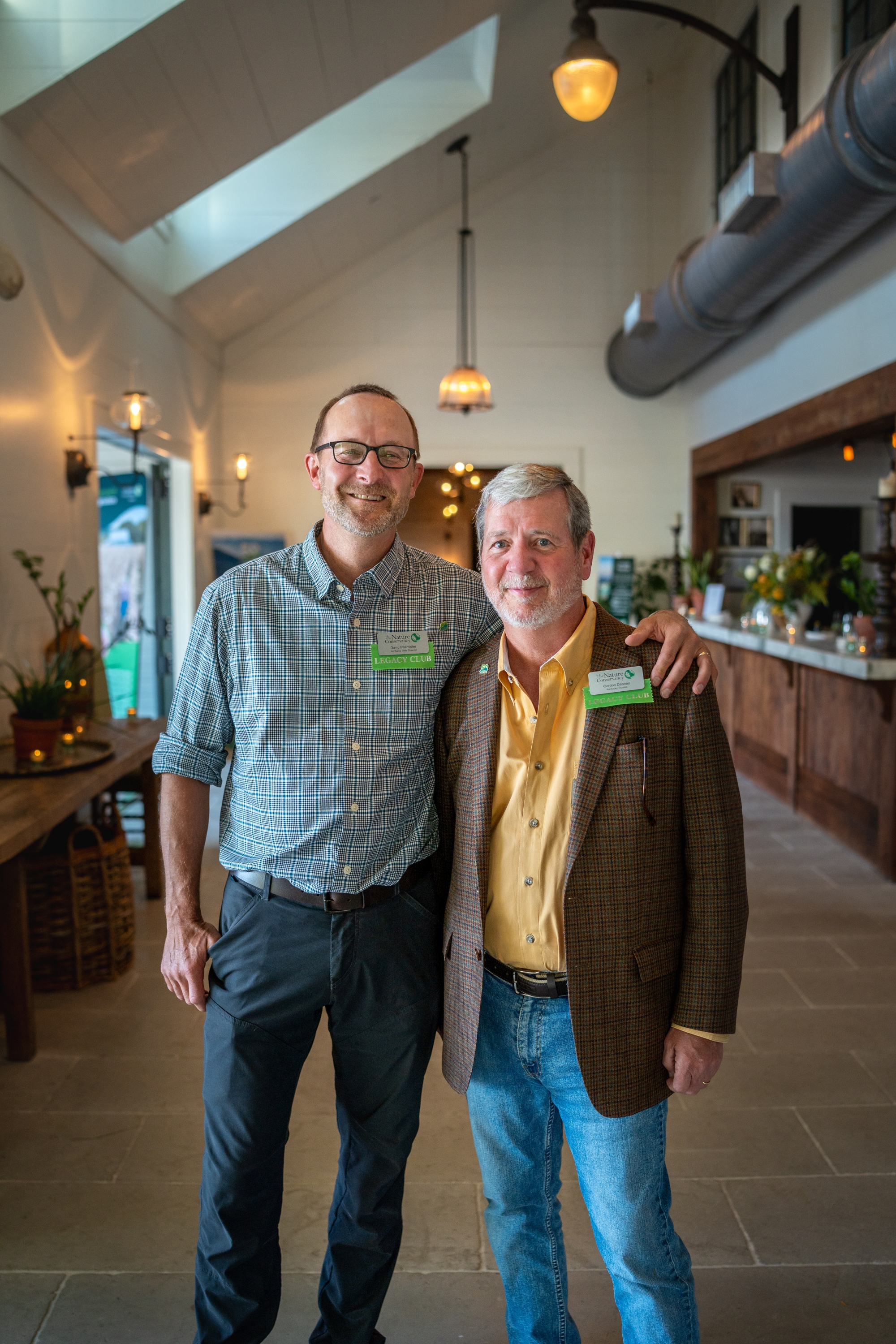
- David Phemister, Kentucky State Director, and Gordon Dabney, Kentucky Board of Trustees Chair.

2025 Impact Report
Learn all about Kentucky's 2025 conservation wins.

LAND
New Land Acquisition Expands Protected Corridor in the Appalachian Mountains
Step onto a hiking trail, cast for brook trout in a clear stream or awake to morning fog blanketing the valleys, and you will understand why The Nature Conservancy is so focused on protecting the Appalachian Mountains. They are both breathtakingly beautiful and incredibly important for people and nature. While so valuable, much of the region remains unprotected. But the Kentucky program recently added an important piece to this conservation puzzle.
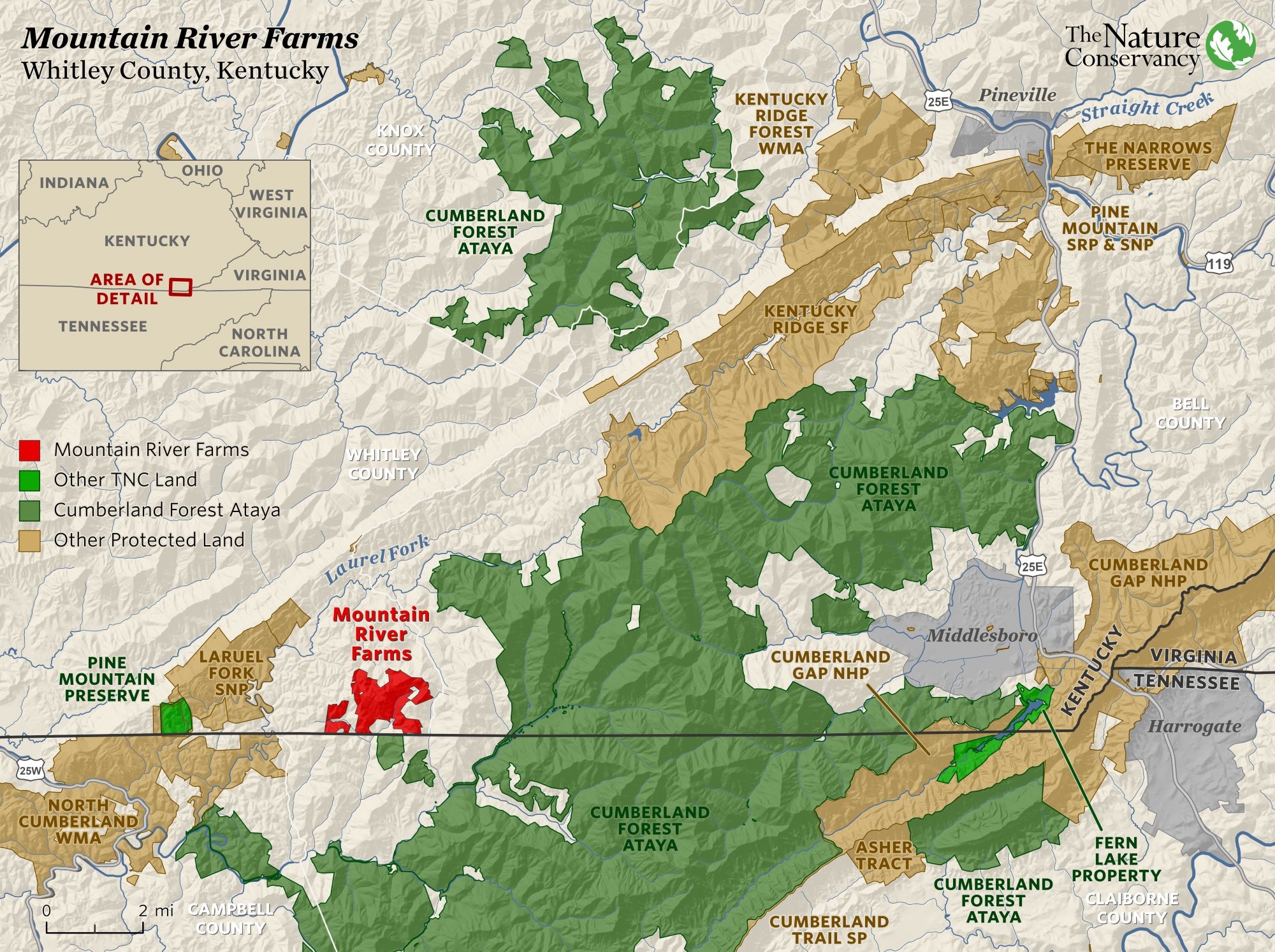
Mountain River Farms, a 1,075-acre parcel in Whitley County, lies near other protected lands. TNC acquired the property for its own conservation significance and its important location within a prioritized conservation corridor through the Appalachians—one of the most diverse, connected, and resilient landscapes in the world. TNC is working with partners to protect a corridor throughout the Appalachians’ 2,000-mile expanse from Alabama to Canada to help wildlife adapt to climate change and open new opportunities for public recreation and economic benefits.
Protecting a property with high conservation value
Mountain River Farms lies within TNC’s Pine to Cumberland Mountain focus area, a critical stronghold that we value for its natural diversity, resiliency, and forest connectivity. The property also contains 6.2 stream miles, including the headwaters of Buffalo Creek.
“Buffalo Creek is classified as a high-quality stream and designated as ’special use waters,’ a statewide classification based on environmental importance,” says Chris Garland, Appalachians program director for Kentucky. “We’ve seen an abundance of deer, turkey, and woodcock, along with elk and bear sign, so this property boasts diverse and abundant wildlife.”
One of the reasons Mountain River Farms stood out for TNC was its proximity to other protected lands, including the Cumberland Forest Project. This innovative collaboration across 253,000 acres—100,000 acres in Kentucky and Tennessee— brings together impact investment, sustainable forestry, and permanent public recreation easements. Nearby nature preserves and wildlife management areas add to this growing network of protected lands.
“Any time we can build on protection and expand connectivity, that promotes wildlife movement and resilient habitats,” Garland says. “Larger and more connected habitat management efforts also provide larger benefits to the public, as they have more opportunities for outdoor recreation and connecting with nature.”
A future in public hands
The Nature Conservancy aims to transfer this property to a longtime partner, the Kentucky Department of Fish and Wildlife Resources, to ensure public access and ongoing wildlife and habitat management, as well as provide public recreation and associated economic opportunities in an area that needs investment. According to Ben Robinson, the department’s wildlife division director, public land in eastern Kentucky is a top priority for his team.
“It allows us access to better manage our elk herd,” Robinson says. “This area is not currently open to the public for hunting or wildlife watching, but in the future, Kentuckians and visitors will be able to enjoy those opportunities. And by acquiring Mountain River Farms, we’re getting close to connecting to the much larger Cumberland Forest Wildlife Management Area—that benefits all of us.”
As with many places in Kentucky’s Appalachian Mountains, some areas on Mountain River Farms have been mined, and reclamation is still underway. Garland notes that the recent timing of reclamation activities provides Kentucky Fish and Wildlife with more options to manage the area for different habitat types. Robinson says future habitat management will likely include controlled burning and invasive species removal.
Acquiring and then transferring Mountain River Farms to Kentucky Fish and Wildlife advances the Kentucky program’s current goals of protecting 92,000 acres (we are at 56,275 and counting) and transferring at least 10,000 acres into public ownership for sustainable, place-based economic opportunity. As the Appalachian coal industry has declined, outdoor recreation has emerged as an important component of the region’s economic diversification.
This will be good for the communities both in Kentucky and Tennessee,” Garland says. “This land has never been open to the public. Once it’s open, it will be open forever.”
For Robinson, the upcoming transfer of Mountain River Farms is another step in a longstanding beneficial partnership with TNC.
“We’re really excited about this property, and most of all the continued partnership,” Robinson says. “Together we have already protected tens of thousands of acres, creating the kinds of opportunities for present and future generations that would not have been possible alone. We look forward to many more accomplishments with TNC in the future."
WATER
Bringing Streams Back to Life
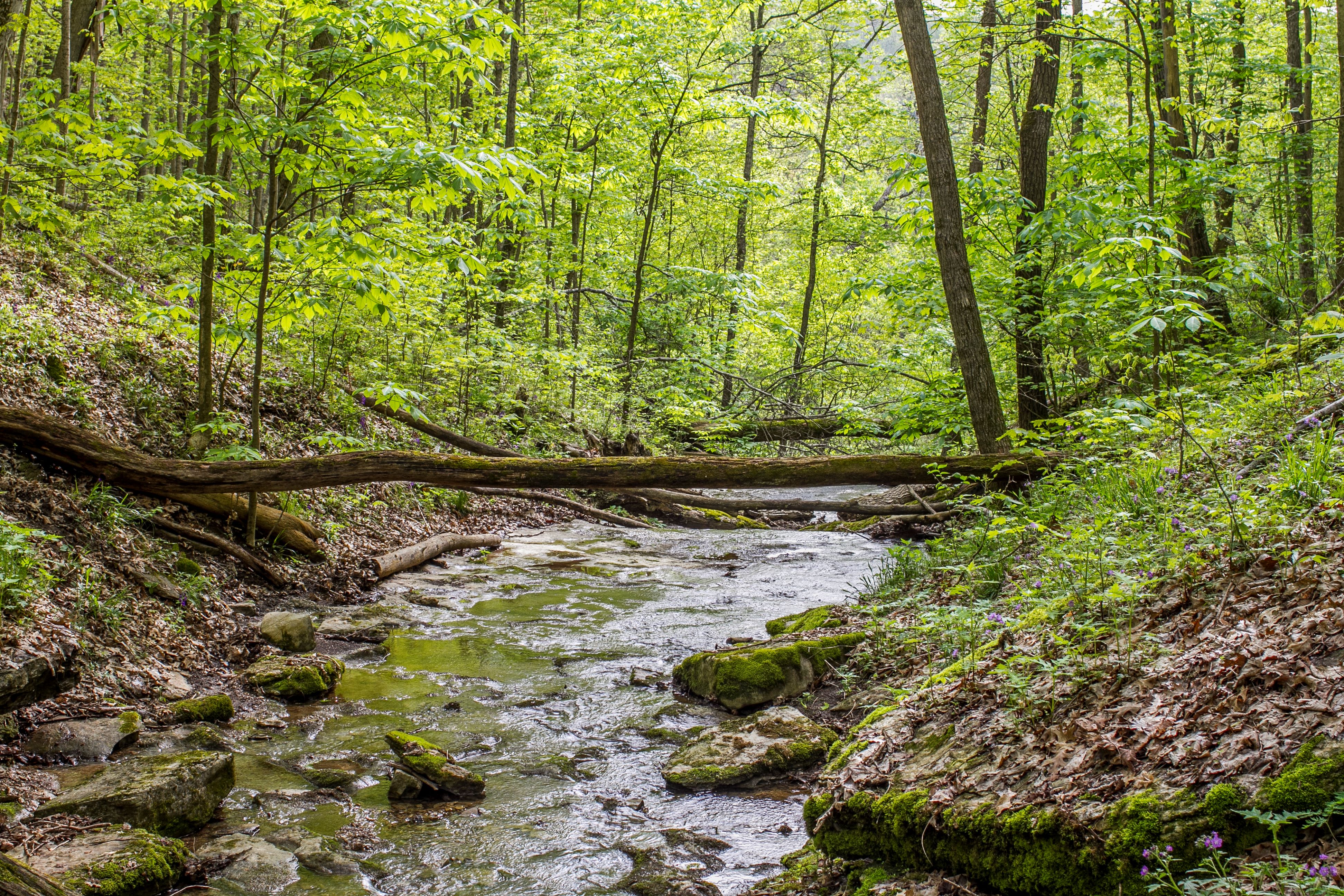
A freshwater revitalization is underway on a 348-acre property in Scott County. The Nature Conservancy and restoration professionals are returning more natural conditions to streams that were straightened and rerouted generations ago. These streams lie within the Eagle Creek watershed, which boasts significant populations of mussels but struggles with excess sedimentation. Restoring the streams will lessen sedimentation going into Eagle Creek, enhancing habitat and water quality for mussels and other aquatic life.
“It was a pretty standard agricultural process in the early to mid-1900s to straighten a stream and move it to the side of a field so you had more room for agriculture,” says Richard Clausen, mitigation program manager for TNC in Kentucky. “This property is no longer used for agriculture, so this was a chance to bring back a meandering stream.”
Re-creating these natural curves and reconnecting the streams to their floodplain will reduce scour and bank erosion, which can be particularly damaging during floods.
“When this stream floods in the future, much of its energy will spread out onto its floodplain instead of scouring its banks,” Clausen says. “That reduces erosion and deposits of sediment downstream, giving mussels the cleaner water they need.
Mussels are an important indicator species. Healthy, thriving populations indicate clean water and habitat suitable not only for mussels but also for many other aquatic animals.
The Nature Conservancy partnered with Resource Environmental Solutions (RES) to perform the work, which includes restoring 15,044 linear feet of stream. Bringing back the meandering pattern to the straightened streams was an important step to improve water quality. So was planting trees.
“In addition to channel work, we’re also planting about 6,000 trees, which will eventually establish a riparian corridor along the streams,” says Kiersten Fuchs, senior project manager with RES. “That will provide habitat for macroinvertebrates such as dragonflies, mayflies, water striders, and crayfish. Trees also provide shade and lower water temperatures. And increasing water quality on this site provides benefits downstream, too.”
RES will also remove invasive species at the site, such as bush honeysuckle, multiflora rose and lespedeza. Finally, they will perform “live staking” along the streams, implanting roots into the bank to increase stability.
Funding for projects like this restoration is provided through federal and state stream mitigation programs. To compensate for impacts to rivers and streams elsewhere, improvements are made to other waterways—often in areas of greater conservation value where nature will benefit most from restoration.
“The state is divided into 10 regions for mitigation, and this site is in the area that services Louisville and Northern Kentucky,” Clausen says. “This region is experiencing extensive development with large impacts to streams, making it extremely important to provide high-quality restoration projects for lost aquatic habitat. We’re excited about accomplishing more restoration projects like this in the future.
Get More Stories
Continue reading about our conservation wins.
Agriculture
Pouring a More Sustainable Bourbon
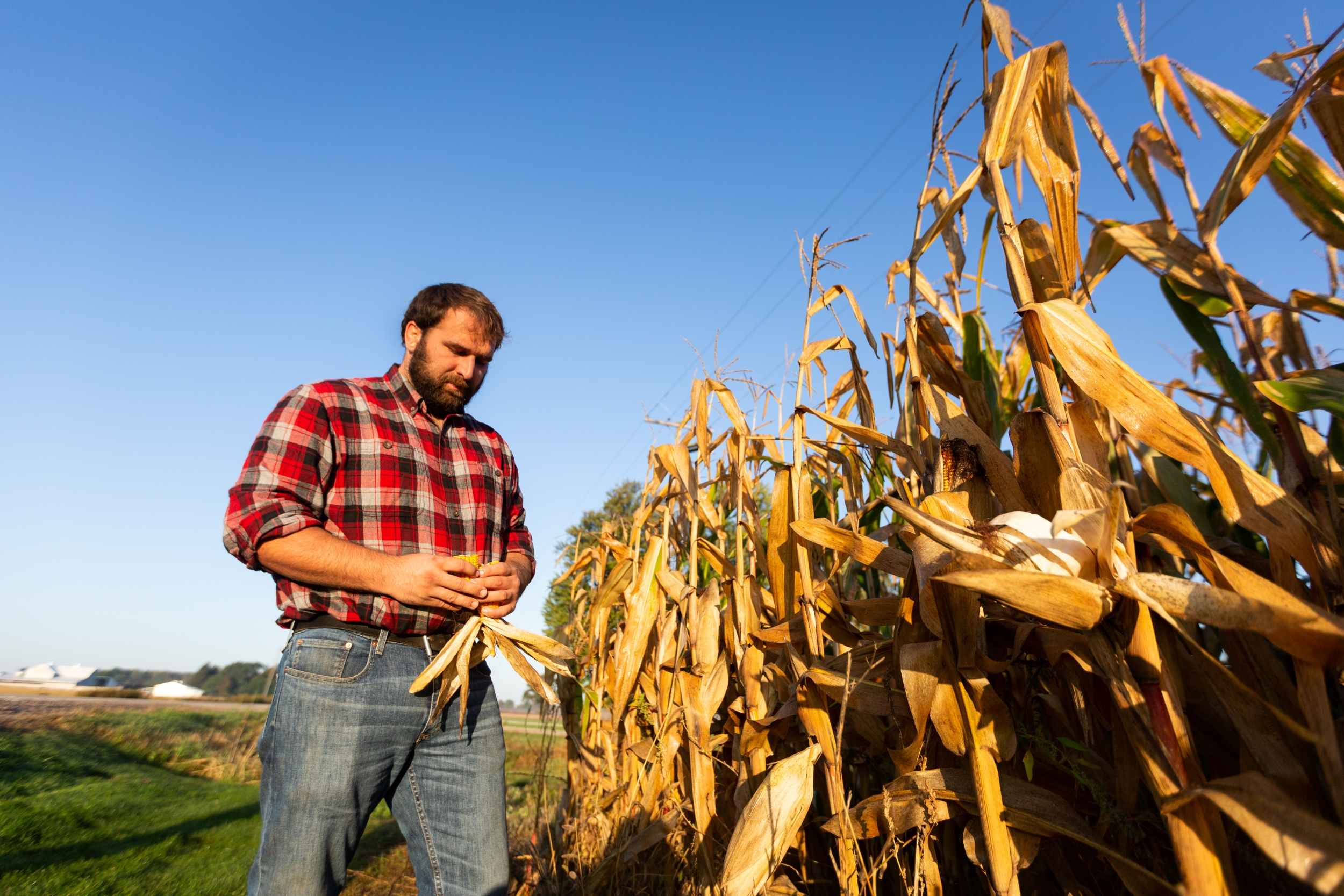
Bourbon remains a significant part of Kentucky’s heritage and economy. Bourbon distilleries with ambitious sustainability goals are now exploring how they can not only produce a quality product, but also support conservation and climate efforts in the Bluegrass State.
Seeking to build a bourbon legacy that makes future generations proud, one major distillery has approached The Nature Conservancy for help. The result is a detailed analysis and accompanying white paper that explores key barriers and opportunities for increasing the sustainability of Kentucky corn used in bourbon production. The paper offers recommendations that can bring the industry closer to its sustainability goals by partnering with the farmers who supply its grain.
“Corn is a big component of the bourbon industry’s greenhouse gas footprint,” says Zach Luttrell, TNC’s director of agriculture for Kentucky and Tennessee. “The steps these companies can take to reduce that footprint are the same steps that help keep our soil in place.”
TNC worked with universities, industry associations, and large and small distillers, conducting more than two dozen interviews while also analyzing the literature from past studies.
“It was important to get all the existing information into one place,” says Luttrell. “The extent of meta-analysis we did, combined with interviews and expertise around decarbonization and addressing barriers to regenerative agriculture, hasn’t been available to the bourbon industry in this way.”
Bourbon is a global spirit, but the corn that goes into it is sourced from a small geography—mostly around Elizabethtown, Lexington, and Louisville. Companies use the same farmers to source their corn—and this presents an opportunity.
“This white paper really makes the case for companies to work in sync with one another,” Luttrell says. “The challenge is too big for any one company to take on. But if the industry collaborates, that will yield much greater efficiencies toward shared solutions.”
Collaboration may come in the form of novel incentives and support systems that help farmers plant cover crops, which keep living roots in the ground year-round, helping to prevent erosion and capturing carbon in the soil. This practice costs farmers money and time during the busy harvest season. But with farmers and the industry working together to pilot and scale new solutions to these kinds of barriers, bourbon can be the catalyst for unique win-win opportunities.
Some important steps are already in motion within the industry. For Luttrell, the most important thing is to build momentum.
“Our TNC Kentucky team proves that local action drives global change,” adds Gabriella Scolio, agriculture decarbonization specialist for TNC. “By working hand-in-hand with the bourbon industry, we’re not only delivering conservation impact at home but also shaping how TNC engages with companies worldwide."
Milestone
Kentucky Celebrates 50 Years of Conservation
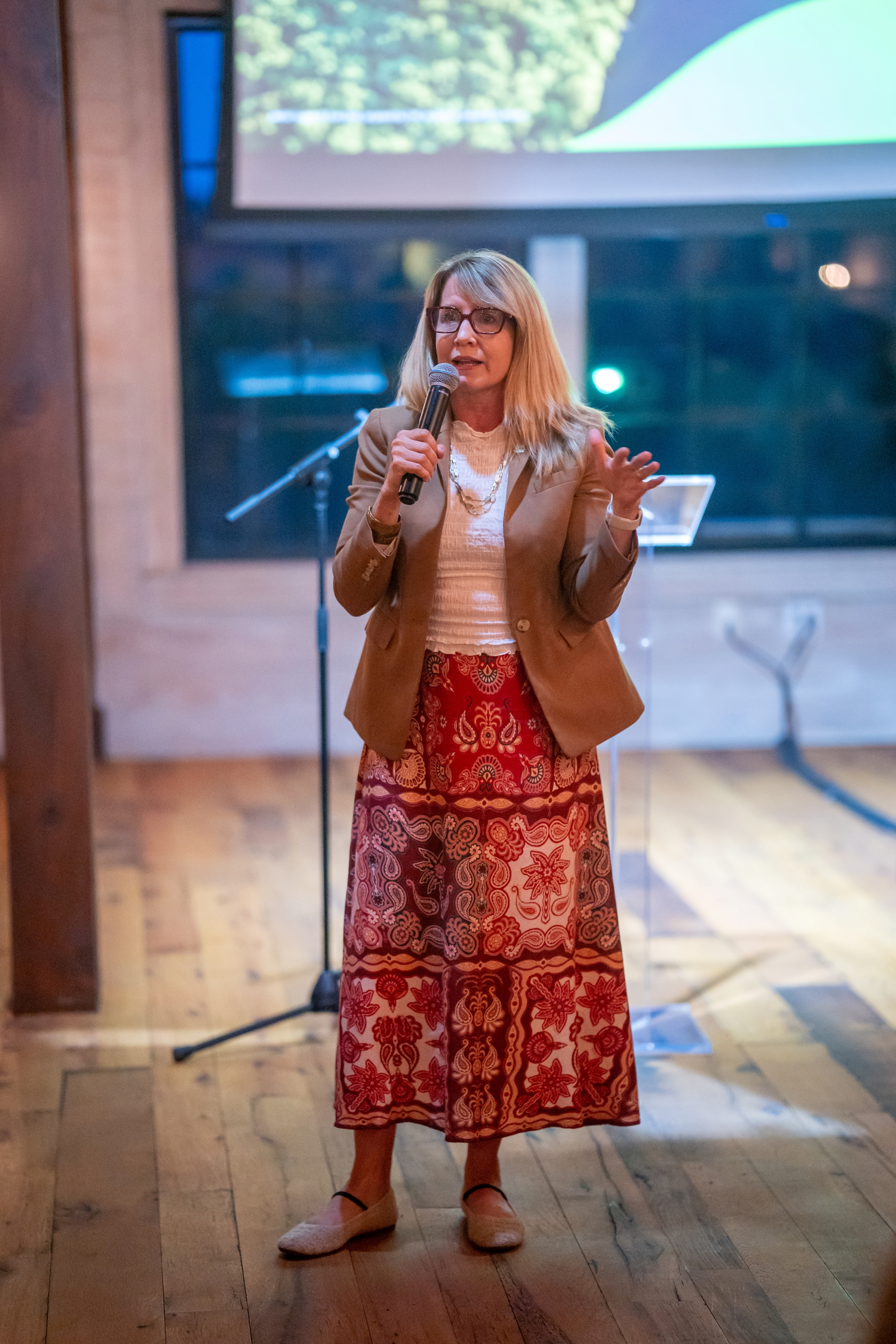
The Nature Conservancy in Kentucky turned 50 in 2025, and we celebrated this historic milestone on a perfect late summer evening at Ashbourne Farms in LaGrange. More than 220 donors, partners, board members, staff, and family joined us for a wonderful night honoring half a century of conservation accomplishments. Attendees enjoyed locally sourced cuisine, great music by The Local Honeys, and grateful remarks from several speakers. Stuart Brown, a TNC global board member, and Nature Conservancy CEO Jennifer Morris also attended the celebration, along with many community leaders and longtime supporters.
“This night and our entire 50th anniversary are an opportunity to celebrate, look forward, and thank the trustees, donors, partners, and community leaders instrumental to our success,” says David Phemister, Kentucky state director. “More than anything, I am grateful."
The Kentucky chapter began in 1975 and has since protected more than 155,000 acres of land, reconnected 200 free-flowing miles of the Green River, and restored nearly 20,000 acres of floodplain wetlands. We have planted tens of thousands of trees to reforest former mine lands in eastern Kentucky, secured the largest conservation easement in state history, and played a key role in the groundbreaking Green Heart Louisville Project.
“I am so impressed with what this program has accomplished and how it does its work,” says Brown, who grew up in Kentucky. “My wife, Joanna, and I are proud to be supporters."
Beyond any single conservation project, however, the Kentucky program has exemplified commitment, innovation, and partnership throughout its first 50 years. This combination has brought many groups together with the shared goal of conserving Kentucky’s breathtaking natural resources for future generations.
“From its first protection project at Boone County Cliffs to Cumberland Forest, The Nature Conservancy in Kentucky has delivered real results and shown a deep commitment to nature and people,” says Morris. “I am grateful to this program’s supporters and partners, I am honored to help celebrate 50 years, and I see a bright future for TNC in Kentucky. Congratulations.”
We Can’t Save Nature Without You
Sign up to receive monthly conservation news and updates from Kentucky. Get a preview of Kentucky's Nature News email.

Make a Difference
We are grateful for the ongoing support of all our donors. Make a donation that will have an immediate impact on nature in Kentucky.
Related Articles

The Largest Conservation Easement in Kentucky
The 54,560-acre Cumberland Forest Wildlife Management Area receives permanent protection and features public recreation access.

Middlesboro Community Center Powered by Solar Energy
New solar panels, installed in partnership with TNC in Kentucky, will eliminate most of Middlesboro Community Center’s energy costs, reduce carbon emissions.

BrightNight, Rivian and The Nature Conservancy Unite to Transform Starfire Coal Mine into Kentucky’s Largest Renewable Power Project
CEOs announce innovative renewable energy project built on a coal mine that will honor Kentucky’s legacy as an energy producer while benefiting climate, conservation and local communities.