



The southern rim of Lake Michigan in northwest Indiana is a healthy, resilient and ecologically connected coastal site that provides critical habitat for plant and animal diversity with equitable benefits for humans and wildlife.
The Nature Conservancy’s Southern Lake Michigan Rim project works with residents and partners to improve this biologically rich area and to enhance the connections between people and industry with nature. The Region (as it’s fondly called by many) has globally rare habitats such as dune and swale and the Indiana Dunes, all amazingly juxtapositioned against intense development intersected by railroads and roadways.

January 2026
Low Fall Sandhill Crane Counts Striking at Jasper-Pulaski FWA
This article originally appeared in the Times of Northwest Indiana.
The numbers hit me hard. No, not employment, consumer confidence index or voter turnout numbers in Indiana (all down from previous years). It was the December counts of sandhill cranes at Jasper-Pulaski Fish and Wildlife Area (J-P).
During fall migration, Indiana Department of Natural Resources staff at J-P wake up at the crack of dawn once weekly to count the number of cranes. From the first week of October through the last week of December, I receive automated updates indicating that new counts have been posted, and I routinely check them several times each year.
The presence of sandhill cranes is always a novelty to me. When I was growing up in Munster, I don’t ever recall hearing their distinct “kar-r-r-r-o-o-o” bugle-like calls or seeing them flying overhead. Since that time, their numbers have rebounded thanks to conservation efforts, habitat restoration and changes in hunting regulations.
I believe they have also become more accustomed to incompatible development and disturbances caused by humans (but probably not humans themselves). A few years ago, when we vacationed on the Keweenaw Peninsula of Michigan, I was able to watch a colt and its parents casually wander around the neighborhood each day going from feeding station to feeding station. I felt so proud to know that their nesting site was most likely at a nearby protected area (Bete Gris Wetlands Preserve) owned by The Nature Conservancy, where I work.
That experience endeared me even more to these tall, gray, elegant creatures with crimson crowns. So, when the mid-December numbers were posted, I was gobsmacked.
The count was 219, compared to 11,713 in 2024 and 20,158 in 2023! Of course, my first thought was to go to the worst—a decline in population.
A bit of research supports that supposition. In the publication "Status and Harvests of Sandhill Cranes 2025 Mid-continent, Rocky Mountain, Lower Colorado River Valley and Eastern Populations," produced by the U.S. Fish and Wildlife Service, it was reported that the 2024 estimated eastern population of 91,485 birds was 17% less than the previous year. I’m now wondering what the 2025 estimates will look like.
Several possible explanations exist
What could be the cause of population decline? I have no scientific evidence, but I do recall reading several posts on Indiana birding sites on Facebook last winter where people reported seeing hundreds of sandhill cranes dead, most likely from avian flu. In an article in the IndyStar newspaper dated Feb. 28, 2025, Eli Fleace, an avian health biologist with the DNR, indicated that reports of dead sandhill cranes began rolling in last January, and, at that time, DNR “had estimated that roughly 1,500 had died across the state.”
I’m certainly not an expert on birds, so I decided to consult one of my impassioned, fellow TNC staff members, Katey Powell, who is not only an expert birder, but also works and lives in the J-P FWA area. She believes there are several factors that may help explain the severe drop in numbers there.
According to Powell, migration timing was different this year. Although November, to me, seemed sort of brutal, overall, we had a relatively warm fall, delaying freezes and northerly winds that would typically trigger mass migration from north of here. That would certainly help explain some of the early fall counts being low, but what about more recent counts?
Sandhill cranes typically huddle together each night in shallow wetlands, safe from marauding predators like coyotes. Powell also believes that water level changes in wetlands in her area may have also shifted migration patterns or smaller groups stopped and left on days in which a count did not happen. This past year, especially last fall, J-P has been either abnormally dry or suffered from a moderate drought, according to the U.S. Drought Monitor website. Somehow word got around to other migrating cranes that they needed to find better conditions.
So, where did they go instead? With freezing conditions in mid-December, it’s possible the cranes just bypassed the area, and flew south to far-southern Indiana, Kentucky and Tennessee for the remainder of the winter. Reports on Facebook indicate that some may already be poised to head back and are biding their time at Goose Pond near Linton, Indiana (a great spot to see birds any time of the year).
While sandhill cranes bring a sense of awe, their migration timing and shifting routes may be telling a subtle story about how the land is transforming, either through climate change or the destruction of wetlands. Avian flu will also continue to be a concern.
All hope is not lost
On the positive side, population recovery since the species was nearly extirpated from Indiana in the early 20th century has been remarkable. Let’s hope that the number of cranes visiting J-P will rebound in 2026, soon to be heralded by their v-shaped flying formation and distinct call starting in February.
Note: if you find dead sandhill cranes or wildlife, please do not call the Department of Natural Resources. Instead, file a report with the DNR, with the understanding that not all reports can be investigated.
December 2025
Revitalization and Quality-of-Life Improvements Influenced by GLRI Funding
This article originally appeared in the Times of Northwest Indiana.
My husband and I are bicycle enthusiasts. As a result, sometimes our vacation destinations are selected based on bike trail availability, and Duluth, Minnesota is a city that really stands out. Our last visit there had us riding from the north end of the city almost to Irving Park on the city’s far south side, much of the time enjoying views of Lake Superior and the mouth of the St. Louis River.
Whether it’s Lake Superior or Lake Michigan, something about riding along the shoreline reinforces just how special our Great Lakes are to us and the planet. Both lakes have a commanding presence with an almost infinite horizon line. The beauty is captivating, even more so when you consider all the Great Lakes contain 21% of the world’s fresh water. For me, though, the ride was even more interesting because I was aware that some time ago the view—and environment—would have been much different than today.
Duluth and NWI are Great Lakes areas of concern
Both Duluth and Northwest Indiana were shaped by major industries, especially steelmaking, driving their economies and, at the same time, eventual issues with legacy pollution. As a result, both areas are designated as Great Lakes Areas of Concern (AOCs) as part of a treaty between the U.S. and Canada, where, according to EPA, “significant impairment of beneficial uses has occurred as a result of human activities at a local level.”
The Duluth shoreline was littered with industrial debris, and the river was described as a “cesspool of floating logs, oil slicks and dead fish.” The lakefront, port and estuary of the St. Louis River not only looked awful, but the bottom sediment was heavily polluted with mercury, PCBs, dioxins, heavy metals, E. coli from municipal sewage and more. Sound familiar? The Grand Calumet River is famous for these same legacy pollutants—with cattle hides from late-19th century tanneries replacing the log debris.
The good news is that Duluth’s clean-up and restoration is now more than 80% complete (by my calculations), and, in comparison, similar efforts in the Grand Calumet River AOC are more than 60% complete. What made that possible? The Great Lakes Restoration Initiative (GLRI), which was created by Congress in 2010.
Since that time, GLRI has proven to be an effective funding source and has spurred collaboration between 16 federal agencies, including the Environmental Protection Agency (EPA), U.S. Forest Service and U.S. Fish and Wildlife Service, as well as state agencies, municipalities, private funders and nonprofits, to address significant environmental and habitat restoration concerns throughout the Great Lakes (not just AOCs).
From an economic perspective, the return on investment for every federal dollar invested in GLRI projects is returned more than four times over. Research coordinated by the Great Lakes Commission and Council on Great Lakes Industries and led by the University of Michigan’s Research Seminar in Quantitative Economics also found that GLRI projects completed have resulted in improved quality of life and a resurgence of outdoor recreation in cleaned up and restored areas.
That is where the bike trail in Duluth comes into play, as well as ongoing efforts to build the Marquette Trail near the Grand Calumet River. GLRI funding does not generally fund trail development, but as the Duluth area was cleaned up, community leaders and active transportation enthusiasts—and also paddlers—were able to see beyond the degradation and envision the turnaround of an area that was once in decline.
I’m happy to report that we are doing the same here, and it’s not all related to bike trails. In the next year or so, community leaders, nonprofits and governmental agencies will begin working together to craft a future vision and plan on how the Grand Calumet River AOC will be “activated” for recreation after the AOC overcomes all its 12 current impairments. The effort is being led by the Rivers, Trails and Conservation Assistance Program of the National Park Service. Be on the lookout for public meetings where your voice can be heard.
Future funding and advancements at risk
One potential roadblock could bring all AOC revitalization to a halt or slow it down: the GLRI must be reauthorized before 2026 ends. The GLRI Act of 2025 (S.B. 528) has wide bipartisan support. Currently, the bill rests within the U.S. Senate’s Committee on Environment and Public Works. If it is advanced from committee, it will then need to be approved by the Senate and ultimately signed by the president.
Let’s keep Grand Calumet River area restoration and quality-of-life improvements, like bike trails, on track by getting GLRI re-authorized!
November 2025
Tree Plantings Expand Crucial Canopy Cover in Northwest Indiana
This article originally appeared in the Times of Northwest Indiana.
I’ve been up to my eyeballs lately trying to get 100 trees planted in several parks in the City of Gary. It sounds like it would be easy—everyone loves trees—but there is more to it than meets the eye. I’m not complaining, but it’s been a whirlwind of activity; all geared toward tree-planting events scheduled in November at Marquette and Brunswick Parks in Gary.
It all started five years ago when The Nature Conservancy (TNC) helped develop and deliver an urban forestry plan and tree inventory for parks to the City of Gary, supported by funding, in part, from the Indiana Department of Natural Resources' (IDNR) Lake Michigan Coastal Program. After several administration changes, especially in the Gary Department of Parks and Recreation, the plan finally got traction when TNC received funding from the IDNR’s Community & Urban Forestry Program to plant 100 native trees and remove at least 30 trees deemed hazardous in the tree inventory in 2024.
See Dune & Swale Habitat
Visit IvanhoeWorking with partners, like Friends of Marquette Park and the Student Conservation Association (SCA), we settled on planting 18 trees at Brunswick Park and 82 trees around Marquette Park. A reforestation plan helped guide tree species selection and placement based on factors such as soil type and grow space. I’m especially excited about the jack pines that are being planted at Marquette Park as it is considered a rare species in Indiana—a relic of the glaciers that once covered the area found in small, scattered stands in the adjacent Indiana Dunes. We also included some showy eastern redbuds and cucumber magnolias that will look magnificent in the spring.
Tree Benefits are Multifold
Trees are more than showpieces. They provide multiple benefits to both humans and wildlife. Referring to the plan again, we carefully selected trees to pump and infiltrate stormwater in and around parking lots and roadways, helping the city reduce stormwater that can flood neighborhoods or overwhelm sewer systems. Most of the trees, however, are being planted to help offset higher temperatures found in cities, known as the urban heat island effect. As families gather around playgrounds or people walk or bike through the parks, it will be great to have some more shade.
More pics from the tree planting
Thanks to the Student Conservation Association students and volunteers who met at Brunswick Park in Gary, Indiana, for a day of planting native trees!
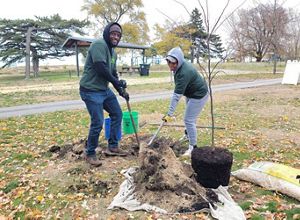
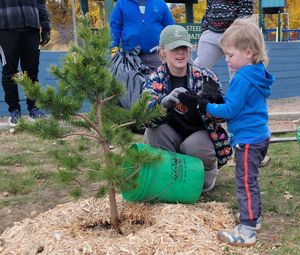
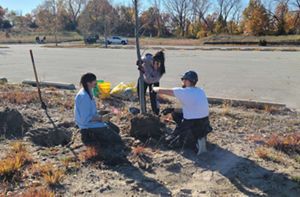

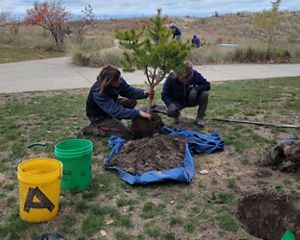
Gary tree planting: Tree planting in Brunswick Park in Gary, Indiana, in November 2025. © Susan MiHalo/TNC
Gary tree planting: Tree planting in Brunswick Park in Gary, Indiana, in November 2025. © Susan MiHalo/TNC
Gary tree planting: Tree planting in Brunswick Park in Gary, Indiana, in November 2025. © Susan MiHalo/TNC
Gary tree planting: Tree planting in Brunswick Park in Gary, Indiana, in November 2025. © Susan MiHalo/TNC
Gary tree planting: Tree planting in Brunswick Park in Gary, Indiana, in November 2025. © Susan MiHalo/TNC
The next step was for me and Leo Sawyers (Northwest SCA's community program manager) to place flags across the sites so that 811 could be called on to make sure we weren’t digging in a dangerous spot. Leo is SCA’s thoughtful and dedicated leader of a crew that has helped teach hundreds of northwest Indiana residents how to plant and maintain trees. I met him through CommuniTree, a multi-organizational, collaborative urban forestry partnership that engages in grant and donor-funded tree plantings in northwest Indiana.
The collective impact of CommuniTree’s work has been astounding. Since its inception in 2017, nearly 14,000 trees have been installed, enhancing tree canopies in municipalities across the area. This fall alone, trees have been planted in East Chicago, Hammond and now Gary. Jen Birchfield, a natural resource planner for the Northwestern Indiana Regional Planning Commission, currently coordinating CommuniTree’s efforts (also the president of the Michigan City Tree Board) informed me that 500 alone are in the process of being planted there.
Don’t Overlook Maintenance
Once all these trees are in the ground, they are required to be maintained for two growing seasons. Personally, I think this part of the process frequently gets overlooked over time. I’ve seen so many new trees suffering, especially as I visit parks and bike through the region. That is where the SCA will again be of service. Starting next spring, they will monitor the weather and diligently water and re-mulch the trees in Gary through the growing season to ensure their viability. We will host two more public events in 2026 and 2027 to share our maintenance knowledge with others.
Regardless of who owns all these regional trees, they are all considered part of the “urban forest” of northwest Indiana. In addition to the many benefits already mentioned, trees also filter water before it enters the groundwater and improve air quality by soaking up pollutants like ozone and carbon dioxide, filtering particulate matter that can settle in our lungs, reducing greenhouse gas emissions and releasing oxygen into the atmosphere.
This is where you come in. Do you have space for trees in your yard or parkway? Before growing season is upon us again, consider how you can also add to our collective tree canopy by planting a tree, especially ones that are native and well-suited to growing conditions here (as opposed to invasive species like ornamental pears). For guidance, check out a list available through IDNR. Happy tree planting!
Let Nature Take Root in Your Inbox
Get the latest news, photos and opportunities near you, delivered monthly. Get a preview of our Nature News email.

October 2025
Dune and Swale Habitat—a Rare, Great Lakes Phenomenon
This article originally appeared in the Times of Northwest Indiana.
When I was in high school in Munster, I was privileged to be part of a class called “Project Biology.” It was a defining time for me because it’s where I learned about ecological succession and that there is more to the Indiana Dunes than the beach. As part of the class, we traveled about 20 miles to the dunes and did systematic ecological sampling along a line to learn how the vegetation and ecosystems change as you leave the waterline.
The main attraction for many in the class was a trip to the Florida Keys to snorkel and gather information for a year-end term paper comparing similarities and differences between the two areas. I don’t recall if the term “biodiversity” was part of our curriculum, but I’m sure the concept was presented to us in some sort of fashion.
See Dune & Swale Habitat
Visit IvanhoeMeanwhile, little did we know (I’m not even sure our amazing teachers John Eddington and Art Haverstock even knew) that just a few miles away, up near the Grand Calumet River in East Chicago, Hammond and Gary, was an area with globally rare habitat and incredible biodiversity—the dune and swale complex of northern Lake County.
Prior to European development, dune and swale habitat—or ridge and swale, as preferred by geologists—encompassed an estimated 70 square miles in far northwest Indiana and a few miles across the Illinois border. While not as dramatic looking as the high dunes further east, dune and swale habitat has its own appeal: a rhythmic landscape featuring undulating ridges that gently grade down to low, wet areas, both running parallel to one another. The wetlands, some deeper than others, are greatly influenced by water levels in Lake Michigan as well as localized hydrological impacts caused by human alterations to the landscape.
Collectively, they support an incredible cast of species such as sedges and rushes, shy American bitterns, frogs that sound like crickets (cricket frogs) and endangered Blanding’s turtles. More than 700 species of plants also inhabit the area, such as spiranthes orchids and the state-threatened purple bladderwort. A carnivorous species, bladderwort flowers (there are also yellow ones in the area) stick up above inundated swales while hiding submerged stems dotted with tiny bladder-like traps that suck in unsuspecting prey like water fleas.
On the edge of the wetland areas, one might find, depending on the time of the year and weather conditions, unusual species such as yellow and pink lady-slipper orchids and fringed and bottle gentians in early fall, beckoning bumblebees to jump in and pollinate them. The sandy ridges are crowned with another rare habitat, either oak or jack pine savannas, where spaces between the trees allow sun-loving prairie plants to take hold and flourish.
Other Awesome Dune and Swale Sites in the Great Lakes
It's estimated that there are only about 17,000 acres remaining of dune and swale habitat on the planet—all located on the Great Lakes, hence its rareness and the reason we should be awed by it. Being somewhat of a fan, I’ve traveled to several other dune and swale sites, including the remote Bete Gris Wetlands Preserve owned by The Nature Conservancy (TNC) in the Upper Peninsula of Michigan and the Ridges Sanctuary in Door County, Wisconsin, owned by the Ridges Sanctuary Land Trust. There, the ridges are occupied by boreal conifer species such as black spruce and deciduous tamaracks that provide a brilliant color display this time of the year.
If you enjoy looking at maps like I do, you can also find examples of dune and swale in Michigan’s thumb area and west of Mackinaw City; Presque Isle, Pennsylvania; Point Pelee National Park in Ontario; and the Erie Sand Barrens State Nature Preserve near Sandusky, Ohio. All dune and swale sites share a common history in that they were created by irregular high and low cycles of the lakes, with each ridge having been formed at a different point in time, some as far back as 3,800 years ago and as little as 250 years ago.
Some of Indiana’s dune and swale sites were documented by botanists like H.S. Peppoon in the 1920s, and the father of ecology, Henry Chandler Cowles, was known to hop off the train near Clark Road at the Pine Junction rail stop to study the area. In the late 1970s, which is when I was in high school, many of the sites preserved today, such as Seidner Dune & Swale and Gibson Woods Nature Preserves in Hammond, were privately owned by railroads or chemical companies. Thank goodness entities like the Indiana Department of Natural Resources, Shirley Heinze Land Trust, TNC, U.S. Fish and Wildlife Service and the passionate people who worked or work for them understood just how precious they were and strove to protect them for future generations to study.
More From Indiana

Protecting Indiana Wetlands
Indiana's disappearing wetlands are threatened, and The Nature Conservancy wants to protect these important habitats. Learn why wetlands are important and what TNC is doing to save them.

Accelerating Renewable Energy
TNC is providing science-based guidelines for companies and communities in Indiana to engage in the right conversation around renewable energy development.

Low Head Dam Removal
For the last two years The Nature Conservancy has been leading a team to remove two low head dams from Big Indian Creek in southcentral Indiana.