

Nature Adventures in Indiana
From Indiana to Honduras: Following Our Kankakee Sands Birds with Motus


I am lucky that almost every day I get to stand out among the many hundreds of species of native plants in the prairies and wetlands of Kankakee Sands in northwestern Indiana. That rich habitat also draws in a remarkable variety of birds—something you can see and hear almost immediately when you step into the landscape.
In fact, more than 250 bird species have been documented here, thanks to the scale and diversity of habitats across the property—some nesting, others stopping briefly during their long migrations.
Most of these birds are not here year-round. They pass through in spring and fall, staying for only a few months. This raises important questions: Where do they go when they leave? Do the same individuals return each year? How far do they travel?
For a long time, we didn’t have clear answers—but now we have the tools to begin finding them.
My Journey into Birding
These are questions and answers that I’ve come to appreciate only in the past several years. When I first started my career in conservation, it never occurred to me to look up from the plant work happening all around me and have a conversation with a dickcissel.

Where do the birds go when they leave Kankakee Sands? Do the same individuals return each year? How far do they travel?
Back then, I had a narrow focus on restoring islands of prairie and wetland habitat with little regard to birds moving about in far-flung places thousands of miles from the local landscapes I was focused on. Instead, most conversations centered on local genotype seed mixes and strategies at the front lines of the next wave of invasive plant species. I tended to think of birding as something separate from that work, more of a pastime than a conservation tool—at least from where I stood at the time.
That limited view changed when, several years ago, I picked up a book about bird migration.
I had a lot to learn when I began reading Kenn Kaufman’s book, “A Season on the Wind: Inside the World of Spring Migration.” Exploring the spatial connections in Kenn’s book was too tantalizing for someone who studied biogeography in college and was twice a states-and-capitals champion in middle school. Kaufman’s book provided me with a synoptic spark connecting land and air for perhaps the first time. Bird migration is not something I was taught as a youth, and I wasn’t lucky enough to live near a birding hotspot to learn these things by accident. The birds I knew best were those on my grandma’s clock that sang at the top of each hour or whatever I saw out my bus window on the way to school, oblivious to the diverse traffic in the sky. Kenn’s book really gave me a foundation for a new curiosity.
Since reading Kaufman’s book, I’ve been fortunate to learn from and call many birders friends and mentors.
Tracking the Birds at Kankakee Sands
Bird conservation has always been a key part of our work at The Nature Conservancy’s (TNC) Kankakee Sands in Newton County, Indiana, where I have worked since 2020. However, I knew we were missing big parts of the conservation story for birds at our preserve. This spring, after extensive planning, I coordinated the installation of TNC's first Motus tower in Indiana at Kankakee Sands.
What Is Motus?
In 2014, Birds Canada launched the Motus Network. Motus is Latin for “movement,” and it builds on traditional bird banding by using small radio transmitters attached to birds. When paired with a tower and antennas tuned to the right frequencies, these birds can be detected over a several-mile radius without needing to recapture them, as each tag broadcasts a unique signal that is picked up by the tower. Since its launch, Motus towers have been set up across wide swaths of the globe. If a bird passes enough of these towers, you can map its annual migration route in detail.
For conservationists, this is a game-changer. Motus reveals where birds travel, when they move and what challenges they may face along the way. The Motus network reinforces what we already know: nature operates on a global scale, and local habitats like Kankakee Sands are just one piece of a much larger journey.
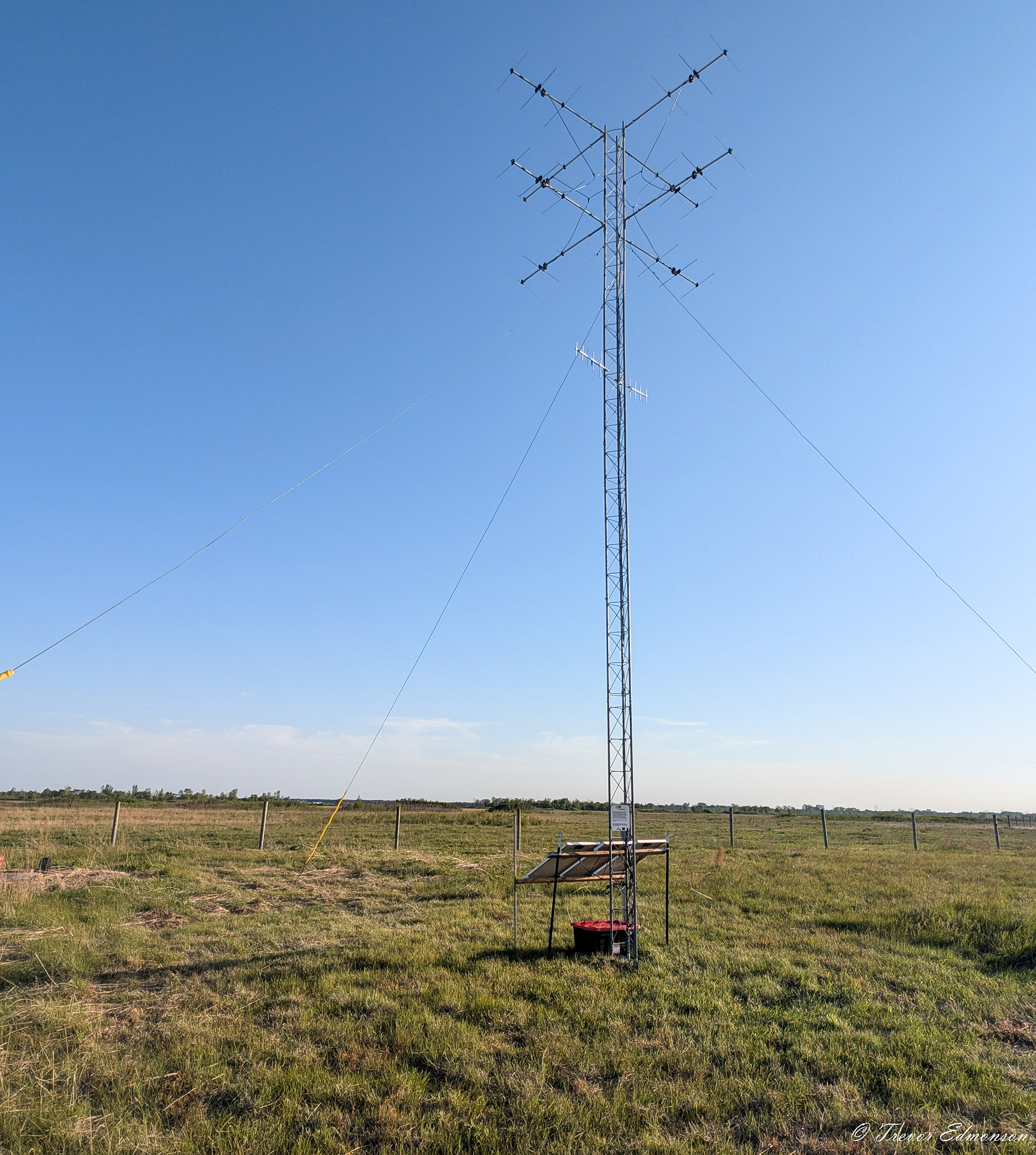
Kankakee Sands Motus Tower
Building the tower required technical expertise, and we were fortunate to partner with the Ward Lab of Ornithology at the University of Illinois. Their team manages and studies a network of towers across the Midwest and conducts bird-tagging research—making them the perfect collaborators.
The project was made possible with support from our Indiana Board, in honor of former Director of Conservation Matt Williams, whose passion for birds continues to inspire us. Additional support came from the Sam Shine Foundation and Indiana Audubon.
Within the first week, we recorded our first two detections. Within three weeks, that number had grown to five. For a new station, this was incredibly encouraging—some towers have long gaps without having a tagged bird fly by.
One of those first detections was an eastern whip-poor-will. This individual had been tagged in southern Ontario in June 2025. It later traveled to Veracruz, Mexico, for the winter before heading north again this spring, passing through Texas and arriving at Kankakee Sands on May 4.

Just a few days later, on May 8, a wood thrush was detected. This bird had been tagged in Honduras and migrated north across the Gulf of Mexico to the Texas coast, then continued through Missouri before reaching our preserve.

Very few people would think to connect Honduras, central Mexico and Newton County, Indiana—but birds like these do every year.
The Motus network allows us to draw those connections, mapping migration routes and revealing how landscapes across continents are linked through the lives of individual birds. It transforms local conservation into a truly global perspective.
In the months and years ahead, our tower will continue to detect new birds—and new stories. Each signal adds to our understanding of migration and reinforces a powerful truth:
Everything is connected—and with every new detection, that picture becomes a little clearer.
Follow along on the Motus/Kankakee Sands webpage.

May 2026
A Hike in Observology
I recently read a book with my kids called The Observologist - A Handbook for Mounting Very Small Scientific Expeditions by Giselle Clarkson. The book emphasizes noticing the small details we often walk right by. I love the idea of observology because, in today’s fast-paced world, it asks us to slow down and cultivate focused curiosity using all our senses. These moments can feel rare, but with deliberate intention, they’re available—and nature is the perfect canvas for practicing this mindset.

I love the idea of observology because, in today’s fast-paced world, it asks us to slow down and cultivate focused curiosity using all our senses.
That mindset came in handy on a recent hike I was leading at our Oppenheim Woods preserve in Kosciusko County, Indiana. It was a chilly, windy morning, and not much was moving. We could have speed-walked the trail and kept discoveries to a minimum, but instead we became “Observologists.” We slowed down, investigating micro-movements, the undersides of leaves, and the forest debris underfoot. Once we dialed in our approach, every next step offered something new to see. We admired the golden tips of beech buds, the internal workings of pawpaw flowers, and the way trilliums shift color in a gradient from white to pink—each one worthy of curious attention.
About halfway around the loop, the sun broke through, and insect life emerged to catch the warmth. I’d brought my camera outfitted with a macro lens specifically to look for bugs, so this was perfect. We started with crane flies and an orchard orbweaver, then came across a wonderful nomad bee as it warmed up for the day.
Finding the dark-spotted palthis moth felt like the embodiment of what it means to be an observologist—and of the art of noticing.

Just down the trail from there, I gasped and called the others over: I’d found a moth. I had to point it out with my finger hovering just inches above it because, at a casual glance, it looked like a piece of leaf debris. But after taking a few photos, zooming in revealed the intricacies of the dark-spotted palthis moth. Finding it felt like the embodiment of what it means to be an observologist—and of the art of noticing.
We left that 65-acre preserve feeling like we’d been immersed in a different world. Our world is full of hurry. But if you slow down and look closely, there’s an expedition waiting on the next trail.
More from Indiana

Indiana Nature Notes for October
Nature Notes articles are inspired by the many different plant and animal species found at Kankakee Sands in Newton County, Indiana.

Northwest Indiana Nature
TNC’s Susan MiHalo writes about nature in northwest Indiana—the benefits it brings to us as well as our impacts upon it.

Protecting Indiana's Water
Without sound water policy, Indiana’s economic future is down the drain.