


Florida Manatee: Gentle Giants Need Support
Why healthy waterways are critical for manatees and what we're doing to protect them.
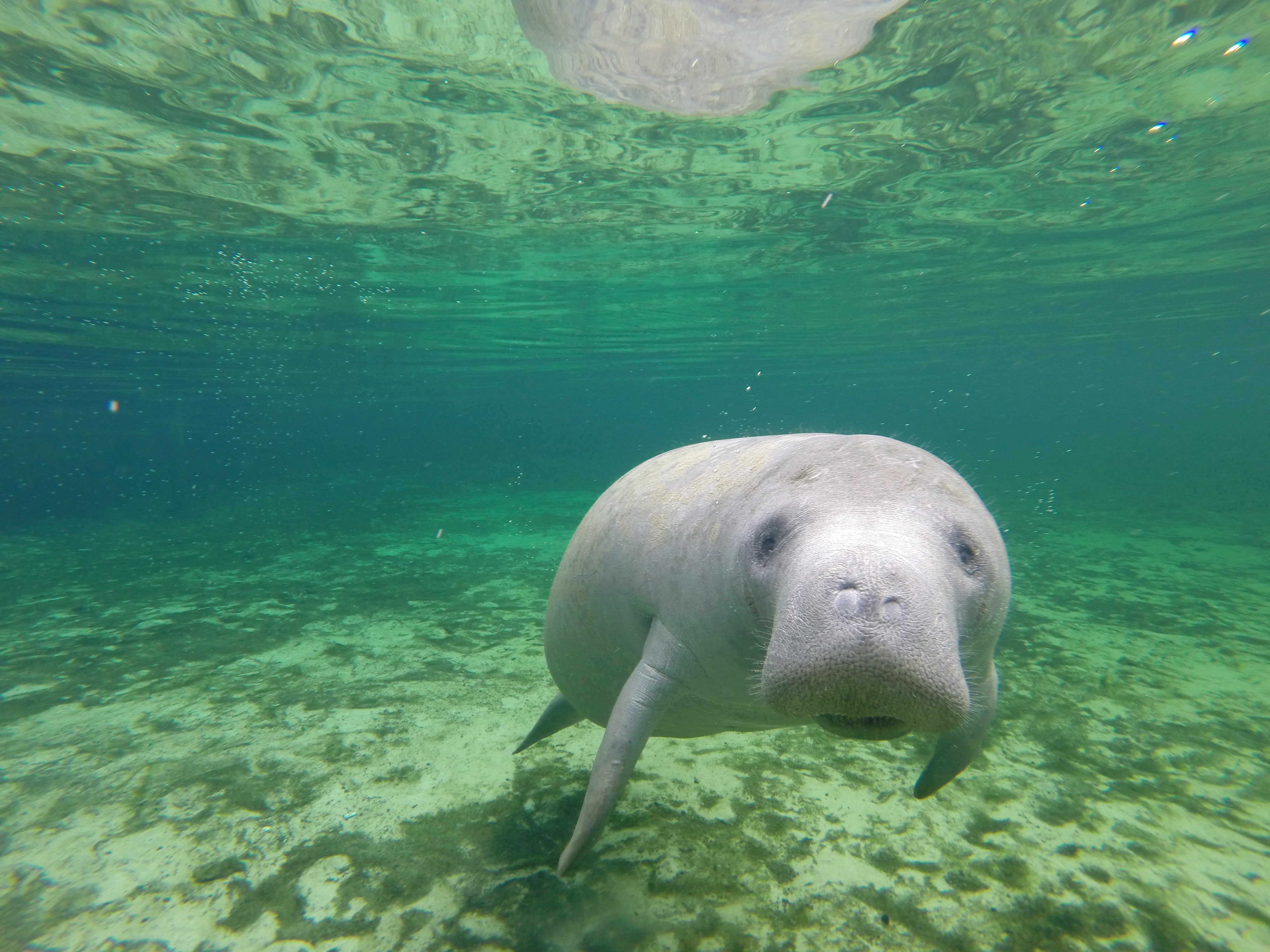
The manatee is a Florida icon, but it faces several serious challenges, especially the need for healthy, connected habitats.
The West Indian manatee ranges from Florida through coastal Texas and south to the Caribbean and Central and South America. In warmer months, they may travel up the Atlantic coast into Georgia and the Carolinas. The Florida manatee is a subspecies of the West Indian manatee, with populations concentrated in Florida waters.
Despite their size, they have relatively little body fat, so in cooler months, they migrate to warm waters, often in a large group called an aggregation. Manatees give birth every 2-5 years and calves will stay with their mothers for up to two years.
In 2017, manatees were downlisted from endangered to threatened by the U.S. Fish and Wildlife Service, but they are not out of danger.
Manatees Face Challenges: We Work to Help
Florida manatees face a number of threats to their survival. Fortunately, we're working with scientists and partners on solutions that will help them thrive. Here are a few of the biggest challenges facing the Florida manatee.
Challenge: Water quality in the Indian River Lagoon
As herbivores, manatees depend on sufficient expanses of healthy seagrass beds and other aquatic vegetation to survive. But manatees have lost much of their habitat due to degraded water quality in estuaries like the Indian River Lagoon.
Largely originating from household, commercial and agricultural fertilizers and waste, these pollutants are carried by rainwater across urban landscapes to stormwater ponds, which function as temporary “pollution holding tanks.” Unfortunately, holding times have been significantly reduced by more frequent, intense storms, causing these ponds to overflow and release pollutants into streams, rivers and estuaries. Additionally, the water in these ponds and in the subsequent runoff contains higher pollutant levels from rapidly growing cities. As a result, more and more pollutants are entering Florida’s waterways—devastating habitat and threatening marine life like Florida manatees.
Solution: TNC's Runoff to Resilience pilot project creates a system that networks stormwater ponds with automated controls that respond instantly to rainfall, runoff and upstream water flow to improve water quality. One that integrates real-time data and actively manages water flows, reducing pollutant levels so that much cleaner water enters Florida’s waterways.
TNC’s Runoff to Resilience pilot project is a foundational step toward achieving this future vision. The pilot is developing the building blocks to improve water quality across the state, starting with the iconic Indian River Lagoon, one of the most biodiverse estuaries in North America.

How Can Technology Help Manatees?
TNC's Runoff to Resilience pilot project creates a system that networks stormwater ponds with automated controls that respond instantly to rainfall, runoff and upstream water flow to improve water quality, helping improve the seagrass beds that manatees rely on for survival.

Challenge: Sufficient food sources
Manatees depend on sufficient expanses of healthy seagrass beds and other aquatic vegetation to survive. Yet seagrass beds are dying in many estuaries throughout Florida due to degraded water quality in estuaries. It's a heartbreaking fact that manatees are dying from starvation, especially in the Indian River Lagoon along Florida's east coast.
Solution: TNC is working with federal, state and local governments on policies and funding to address immediate actions that improve water quality and manatee recovery efforts at the federal and state agencies.
Challenge: Dependable access to warm water
Since manatees don't have as much body fat as you might think, they need to spend time in warm waters. Many manatees gather in Florida’s springs during the cooler months, attracted by the consistent water temperatures in the 70s.
Solution: TNC has teamed up with the Warm Mineral Springs Working Group to provide a safe, warm-water refuge in Sarasota County, free from boats that can be dangerous for manatees.

Challenge: Unrestricted, connected waterways
Obstructions or restrictions, like sediment buildup, create a life-threatening issue for manatees. To help manatees survive for future generations and increase their population, it’s essential that their freshwater and marine habitats be reconnected, and remain connected.
Solution: In partnership with the state, manatee access to warm-water habitat is being improved. We are working to remove excessive sediment, restore natural creek depths and improve the banks to reduce erosion and sedimentation in Warm Mineral Springs and Salt Creek for more than 100 Florida manatees that find refuge here during cold spells.

Facts About Florida Manatees
- Diet: seagrasses and aquatic vegetation
- Habitat: coastal areas, springs, rivers
- Size: 10 feet long and 1,200 pounds
- Lifespan: 60 years
- Nickname: sea cow
- Conservation status: threatened
Support Our Work
Help us continue our conservation work in Florida to protect wildlife like manatees and the critical habitats they need.
More Water Stories

Restoring Florida's Gulf Coast
Estuaries, bays and lagoons are dynamic systems that harbor unique plants and animals and support the health of our greater marine environment.

Promoting Sustainable Snapper and Grouper Fisheries
We’re working with recreational fisherman to achieve our long-term goal of healthy and sustainable snapper and grouper fish stocks in Florida by 2045.

Why Are Mangroves Important?
Mangrove forests protect Florida's coast from storm surges & erosion, and provide space for wildlife & recreation. We're restoring mangroves for all to enjoy.