
The Nature Conservancy protects 4,625 acres in Horry County
TNC plans to add three properties to the Waccamaw River Heritage Preserve, and a fourth to the Little Pee Dee Heritage Preserve.

Media Contacts
-
Jennifer Howard
Steward Terra Communications
Phone: 843-709-4192
Email: jen@stewardterra.com
Horry County residents and visitors will soon have more than 4,600 new acres of places to hike, fish, paddle, hunt and enjoy the outdoors. The Nature Conservancy in South Carolina (TNC-SC) announced the acquisition of four former timber properties totaling 4,625 acres. TNC-SC plans to add the properties to the South Carolina Department of Natural Resources’ (SCDNR’s) Heritage Preserve program, pending state approval.
“We’re proud to protect these forested areas that improve wildlife habitat, water quality and our quality of life," says Dale Threatt-Taylor, executive director for TNC-SC. “It’s always a good day when we can open more South Carolina land to future public access.”
Three of the properties – totaling 4,025 acres – are planned to be added to SCDNR’s Waccamaw River Heritage Preserve, increasing the preserve’s size by nearly 60 percent. TNC previously has helped protect more than 3,500 of the preserve’s existing 7,000 acres, through several land protection projects dating back to 1993. The new parcels are nestled like puzzle pieces between existing preserve boundaries and will help build a forested buffer on both sides of the Waccamaw River.
The fourth property totals 600 acres and will form the backbone of a future 6,000-acre acquisition at Gunter’s Island that will be incorporated into SCDNR’s Little Pee Dee Heritage Preserve program. Its protection secures 3.8 miles of creek frontage on Cold Water Branch, Palmetto Swamp and other unnamed creeks and streams that feed into the nearby Pee Dee River.


In addition to future public access, protection of these four properties:
- Increases and improves wildlife habitat for black bear, migratory songbirds, wood ducks, barred owls, otters, racoons, barrel owls, turtles and more.
- Filters stormwater runoff and helps keep water clean in the Waccamaw and Pee Dee rivers.
- Preserves intact floodplains that store floodwaters during heavy rain events and help protect communities downriver. A 2020 study funded by TNC-SC showed the value of intact floodplains on the Black, Waccamaw and Pee Dee Rivers to be upwards of $70 million each year in protection to structures. It also showed that the impact of a 5-year storm with current floodplain floodwater storage would be equivalent to damage from a 200-year storm without these intact floodplains.
- Sequesters approximately 6,300 metric tons of carbon per year by letting old-growth bottomland hardwood forests grow without being cut.
The purchase is part of the larger Atlantic Conservation Coalition (ACC), a four-state partnership of state agencies and nonprofits working together to protect and restore vital coastal habitats, peatlands and forests across the eastern United States. Funded by the U.S. Environmental Protection Agency (EPA), the ACC includes five coalition members and 18 partner organizations committed to advancing nature-based solutions through on-the-ground action. The coalition members include state agencies from Maryland, North Carolina, South Carolina, Virginia, as well as the four corresponding state programs from TNC.
Increasing Public Access in Horry County
"We’re proud to protect these forested areas that improve wildlife habitat, water quality and our quality of life." – Dale Threatt-Taylor, TNC's executive director in South Carolina
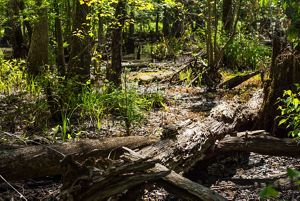
Timber Property: TNC acquired former timber property for addition to the South Carolina Department of Natural Resources’ (SCDNR’s) Heritage Preserve program. © Kris Meade
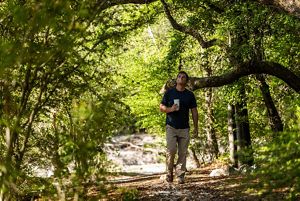
Preserve Trail: A man walks through the woods at the Waccamaw River Heritage Preserve. © Kris Meade
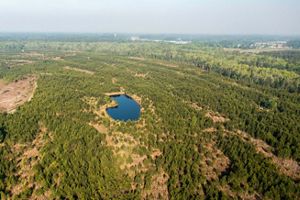
Heart-shaped Pond: An aerial photograph features a heart-shaped pond included in a property that will be added to the Waccamaw River Heritage Preserve. © Kris Meade
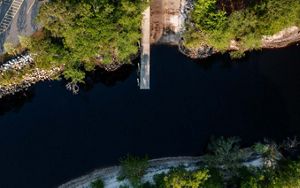
Boat Dock: An aerial photograph features a boat dock extending into dark water at the Waccamaw River Heritage Preserve. © Kris Meade
This project has been funded wholly or in part by the United States Environmental Protection Agency under assistance agreement 3D25824 to the North Carolina Department of Natural and Cultural Resources. The contents of this document do not necessarily reflect the views and policies of the Environmental Protection Agency, nor does the Environmental Protection Agency endorse trade names or recommend the use of commercial products mentioned in this document, as well as any images, video, text, or other content created by generative artificial intelligence tools, nor does any such content necessarily reflect the views and policies of the Environmental Protection Agency.
The Nature Conservancy is a global conservation organization dedicated to conserving the lands and waters on which all life depends. Guided by science, we create innovative, on-the-ground solutions to our world’s toughest challenges so that nature and people can thrive together. We are tackling climate change, conserving lands, waters and oceans at an unprecedented scale, providing food and water sustainably and helping make cities more resilient. The Nature Conservancy is working to make a lasting difference around the world in 83 countries and territories (39 by direct conservation impact and 44 through partners) through a collaborative approach that engages local communities, governments, the private sector, and other partners. For more news, visit our newsroom or follow The Nature Conservancy on LinkedIn.