
The Nature Conservancy and UCLA Partner to Save California Oaks with Cutting-Edge Genetic Analysis

Media Contacts
-
Marlene Cardozo
Media Contact
The Nature Conservancy
Email: marlene.cardozo@tnc.org
Key Takeaways
- Precision Conservation: UCLA scientists—in collaboration with The Nature Conservancy (TNC)—are using cutting-edge whole-genome sequencing to identify oak populations most naturally resistant to—and most threatened by—climate change to inform conservation efforts.
- Data-Driven Restoration: Three recent studies provide valuable data to inform large-scale restoration programs, moving acorns from climate-adapted trees to areas where they are most likely to survive in future conditions.
- Supporting California’s 30x30 Goals: The research provides a rigorous, science-driven roadmap to help California reach its goal of conserving 30% of its lands and coastal waters by 2030, specifically targeting critical oak woodlands.
Researchers at UCLA, in partnership with The Nature Conservancy (TNC), have pioneered a new conservation approach that uses cutting-edge gene sequencing to save oak trees, and which could become a template for conservation efforts for other vital species in California and around the world.
Climate change, habitat conversion and incompatible land management threaten the continued survival of oaks, which provide critical habitat for thousands of plant and animal species, support local economies, and play a vital role in pulling carbon out of the atmosphere.
In three new papers, researchers from UCLA’s Sork Lab and TNC analyze the entire genetic code of hundreds of trees, which can live more than 500 years, to more accurately determine which are best adapted to survive in a rapidly changing climate.
“We’re now putting this science into practice across California,” said Scott Butterfield, Land Program Lead Scientist for TNC. “By using genomic data to guide restoration at our TNC Preserves, we can test whether trees predicted to be more climate-resilient actually perform better on the ground. That kind of real-world validation is essential to scaling solutions that will sustain oak woodlands and the biodiversity they support into the future.”
These studies represent a unique bridge between academic research and applied conservation that promises to super charge efforts to conserve hundreds of thousands of acres of critical habitat.
“Genomics is the missing link between laboratory science and effective land management. By mapping the patterns of genetic variation underlying how different populations respond to heat and drought, my research team provides the scientific framework for the strategic movement of climate-resilient seeds to new areas,” said Victoria Sork, Distinguished Professor in the Department of Ecology and Evolutionary Biology at UCLA. “The work we do at UCLA gives land managers critical genetic information about foundational species that inform conservation and land use decisions across our diverse landscapes and ecosystems.”
Co-authoring two of these studies with Sork is Ryan Buck, an evolutionary biologist working in Sork Labs. Their research builds on support from the National Science Foundation as well as the UCLA La Kretz Center for California Conservation Science, which leads the California Conservation Genomics Project (CCGP), a state-funded initiative generating comprehensive genomic data to protect biodiversity. The UCLA La Kretz Center is an endowed research unit within the UCLA Institute of the Environment and Sustainability.
California’s oak trees are essential to the state’s ecosystems, and efforts to conserve them for future generations leave little room for error. Most oak woodlands support only a single tree species, which means that the loss of just one species from any area likely means loss of the entire oak ecosystem.
The UCLA and TNC effort lays the foundation for data-driven management strategies to protect those most climate resilient oak populations and to plant acorns in areas where they are most suited to thrive.
By using genomic data to guide restoration at our TNC Preserves, we can test whether trees predicted to be more climate-resilient actually perform better on the ground.
A Roadmap for Future Forests
Researchers found that conservation efforts can significantly reduce the risk of future forest failure if managers use acorns from trees that have adapted to the future climate of a specific site. This is especially important when restoring areas that have been burned by fires.
"This groundbreaking effort by UCLA and The Nature Conservancy has tremendous potential for the future of reforestation efforts; this research can assist forest landowners, like the many CAL FIRE serves, by helping to identify and provide suitable seed sources that are forecasted to be adapted to a changing climate in a given locale, improving long-term sustainable productivity of properties in need of restoration,” said Jimi Scheid, Deputy Chief of Reforestation Services for CAL FIRE.
Moving acorns from low-elevation warm areas to higher, cooler elevations, like TNC is doing with blue oaks at their Frank and Joan Randall Preserve in the Tehachapi Mountains, or from climate-adapted island oak species to restore former agricultural areas at TNC’s Santa Cruz Island Preserve, could help sustain these populations for generations to come.
By integrating these genetic insights into TNC’s more than 400,000-acre grassland and oak woodland estate, while building partnerships with other large public and private land holders, including the University of California reserve system and State of California ecological reserve system, the team is creating a science-based strategy to sustain California’s foundational forests and meet the state’s climate resilience objectives.
Together with grasslands, oaks represent the largest percentage of unprotected ecosystems in California’s ambitious 30x30 conservation goals, which aim to conserve 30% of its lands and coastal waters by 2030.

High-Tech Genetic Insights Meet On-The-Ground Restoration Efforts
The research utilized whole-genome sequence data from hundreds of oaks to determine their adaptedness: the degree to which they can survive and reproduce in future climates.
While the central coast of California contains highly resilient coast live oaks, including at TNC’s Jack and Laura Dangermond Preserve, the northernmost and southernmost populations are predicted to be at higher risk of maladaptation to climate change.
Both genomic and ecological models predict that blue oaks along the Sierra Nevada basin—the eastern edge of California—will be more susceptible to future climate shifts, including at TNC’s Frank and Joan Randall Preserve where TNC is focused on restoring at-risk populations.
Patches of more resilient blue oaks remain along the central coast, including at TNC’s Las Piletas Ranch Preserve and within the new San Andreas Corridor conservation area where TNC is focused on protecting and enhancing these resilient areas.
And at Santa Cruz Island, genomic analyses reveal great potential for using seed sources to manage, restore, and expand island oak ecosystems and to preserve the species, despite the fact that currently all localities are predicted to be maladapted under future climates.
“At the California Institute of Environmental Studies, we’re using oak genomics research from these studies to guide our restoration work on the Channel Islands,” said Mike Parker, Executive Director of the California Institute of Environmental Studies. “By selecting acorns from trees that are better adapted to future climate conditions, we’re applying the best available science to improve the long-term success of our restoration efforts.”
California Oak Trees
California’s oak trees are essential to the state’s ecosystems, and efforts to conserve them for future generations leave little room for error. Most oak woodlands support only a single tree species, which means that the loss of just one species from any area likely means loss of the entire oak ecosystem.
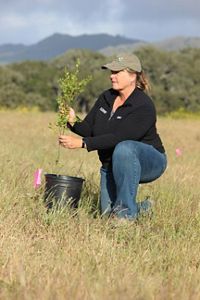
Oak Restoration: Laura Riege oak restoration work at Jack and Laura Dangermond Preserve, California © Amelia Remeta/TNC
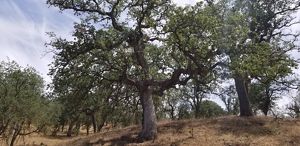
THE WORLD’S OLDEST BLUE OAK: Scientists recently found the oldest known blue oak in the world on the preserve! This tree is 567-year old. © Rachel Mason
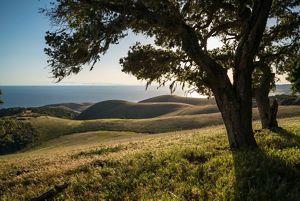
Dangermond Preserve, CA: Coast oak woodlands along a ridge overlooking rolling hills that descend to the Pacific Ocean on the Dangermond Preserve. © Bill Marr/TNC
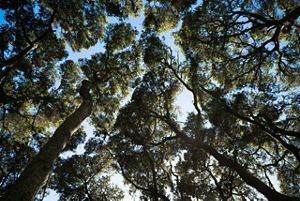
Dangermond Canopy: TNC's Dangermond Preserve, California. Oak woodlands in and near Black Brush pasture. TNC biologist Larry Serpa and photographer David Littschwager collected species here for a photographic biodiversity survey. © Bill Marr/TNC
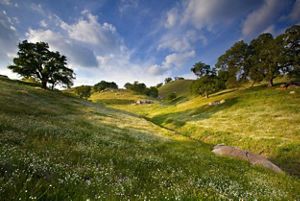
Tollhouse Ranch in Caliente: Scenic views of the rolling green hills and oak trees of the Tollhouse Ranch located in the heart of the corridor, Caliente, California. The Nature Conservancy's purchase of the Tollhouse Ranch from the Rudnick family in 2011 protected the last section of a 50-mile wildlife corridor through the Tehachapi range in California. © Ian Shive
UCLA Institute of the Environment and Sustainability
The UCLA Institute of the Environment and Sustainability (IoES) is a premier interdisciplinary hub dedicated to solving the planet’s most pressing environmental challenges. By bringing together leading experts from across disciplines—including the physical and life sciences, law, public policy and the humanities—and institutions, IoES breaks down traditional silos to foster collaborative innovation.
At the heart of IoES's mission is a commitment to turning science into action. IoES moves beyond laboratory discovery to implement real-world solutions, partnering with policymakers, industry leaders and communities to drive scalable change. Through cutting-edge research and hands-on education, IoES is defining the future of sustainability and ensuring a resilient, equitable world for generations to come.
The Nature Conservancy is a global conservation organization dedicated to conserving the lands and waters on which all life depends. Guided by science, we create innovative, on-the-ground solutions to our world’s toughest challenges so that nature and people can thrive together. We are tackling climate change, conserving lands, waters and oceans at an unprecedented scale, providing food and water sustainably and helping make cities more resilient. The Nature Conservancy is working to make a lasting difference around the world in 86 countries and territories (41 by direct conservation impact and 45 through partners) through a collaborative approach that engages local communities, governments, the private sector, and other partners. For more news, visit our newsroom or follow The Nature Conservancy on LinkedIn.