

A Starrier Night
In the past decade, our planet has rapidly lost its night sky. In response, West Texas created the largest international dark-sky reserve on Earth.
Text by Jenny Rogers| Photograph by Stephen Alvarez | Issue 2, 2026
Teznie Pugh sits at a desk surrounded by industrial-looking equipment. She turns to me. “Would you like to move the telescope?”
I’m shocked—what if I break it?—but then I carefully do exactly as Pugh, the superintendent of the University of Texas’ McDonald Observatory, tells me: maneuver a small joystick and press a foot pedal. The telescope in question—the 85-year-old Otto Struve—lurches to life and shifts into position: The 45-ton metal contraption, shaped like a laser weapon from an old sci-fi film, rotates and articulates beneath the domed roof above us.
It’s daytime, so we won’t be seeing any stars right now. But come nightfall, I’m told, the sky will glitter with them. I’ve come here to the darkest observatory in the continental United States to learn how this observatory and others are trying to preserve dark skies across West Texas.
Pugh got her start in nuclear astrophysics but built a career in the more earthbound science of caring for telescopes—a field called operational astronomy. This particular telescope was built in 1939 atop Mount Locke, one of many peaks in the Davis Mountain Range that loom over the Chihuahuan Desert of West Texas. At the time, it was the perfect place for the university to build an observatory: The nearest major city, El Paso, sits about 200 miles away. Astronomers had deep darkness, a perch 6,500 feet above sea level and thin, arid air to peer through in search of the faintest photons.


But when Pugh arrived at McDonald in 2020, she tells me, the observatory—by then much bigger than in the ’30s—was experiencing an operational threat: As development had crept into West Texas, the night had become a lot less dark. The area was on the cusp of becoming too bright for some of the research at McDonald.
Light pollution has been a problem for astronomers since the dawn of electric lights. But as lights have become cheaper, brighter and “cooler”—think the bluer lights of common LEDs instead of amber-colored incandescent lamps—the issue has grown explosively. Since 2011, the sky has brightened on average nearly 10% each year, according to a 2023 study in Science, and we’re losing the ability to see stars in response. Put another way, over the course of a human childhood, a person will lose sight of 60% of the stars they once saw in the sky.
It’s not just the loss of a starry night that’s at stake though. Animals, including humans, rely on the rhythms of day and night to function. Migratory birds use stars to establish their north-south orientation. Nocturnal mammals hunt at night under the cover of darkness. Plants adjust their growth with the seasons, responding, in part, to changes in patterns of light and darkness.
“As an astronomer there is always an underlying concern about the impacts of lighting on data,” Pugh says about her experience advocating to preserve dark skies. “But the issues are so much broader than I’d thought.”
Pugh and her colleagues at the observatory would soon find uncommon allies in their neighbors: a host of local landowners, parks and The Nature Conservancy. Together they set out to preserve what was left of the fabled Texas night sky.

This morning I’ve driven down the mountain from the observatory to a nature preserve about 30 minutes west. Much of this region was once ranchland, and though that’s still true, many properties were sold and some were broken up in the past few decades.
In the 1990s, The Nature Conservancy in Texas was not thinking about light pollution. It had begun working to protect the “sky island” ecosystems—elevated, cooler habitats trapped high above a drier, warmer area—of the Davis Mountains. In 1997, The Nature Conservancy bought part of one of those former ranches. Today that former ranchland is part of the 33,000-acre Davis Mountains Preserve.
“About 20,000 years ago, we were in an ice age … and the plant communities looked completely different all across the landscape,” says Kaylee French, TNC’s West Texas project director. As lower elevations warmed and dried out, higher elevations stayed wetter and cooler. Plants and animals that had relied on the cooler, wetter temperatures—like the Rivoli’s hummingbird—migrated north or moved into upper elevations.
“What we have now is these plant communities and animal communities that are relic populations, that essentially are from a time gone by,” French says. That makes them both unique and vulnerable to a changing climate.
In Texas there are three sky islands: the Chisos Mountains, the Guadalupe Mountains in Guadalupe Mountains National Park, and the Davis Mountains. Together they form an archipelago of cooler habitats perched high over the desert.
The Nature Conservancy has protected 430,000 acres in West Texas, including properties it transferred to the Texas Parks and Wildlife Department to expand Big Bend Ranch State Park and Black Gap Wildlife Management Area—part of the darkest place in Texas. But for much of that protection, the organization has relied on conservation easements placed on private land.
Among those private landowners is Carl Ryan. In 1972, the estate lawyer bought a patch of former ranch-land deep in Madera Canyon and, in an effort to avoid any future development on the property, he and his wife, Suzi Davidoff, donated a conservation easement to TNC in 1997.
“Our goals were exactly The Nature Conservancy’s goals,” Ryan says of the decision. “We don’t want our land subdivided, developed or trashed in any way. It’s a special place.”
Ryan’s family, like so many others in the region, first trekked out here searching for respite from the summer heat. As a Houston kid in the 1950s, Ryan remembers camping near the entrance road to the McDonald Observatory. And one night during his college years, when he worked as a ranch hand in the area, “I went outside and it was like the sky was falling. The stars were shooting back and forth until the sun came up,” he says. It was a meteor shower.
“I think people need to see that kind of thing, but we’re not going to see it where we don’t have dark skies.”
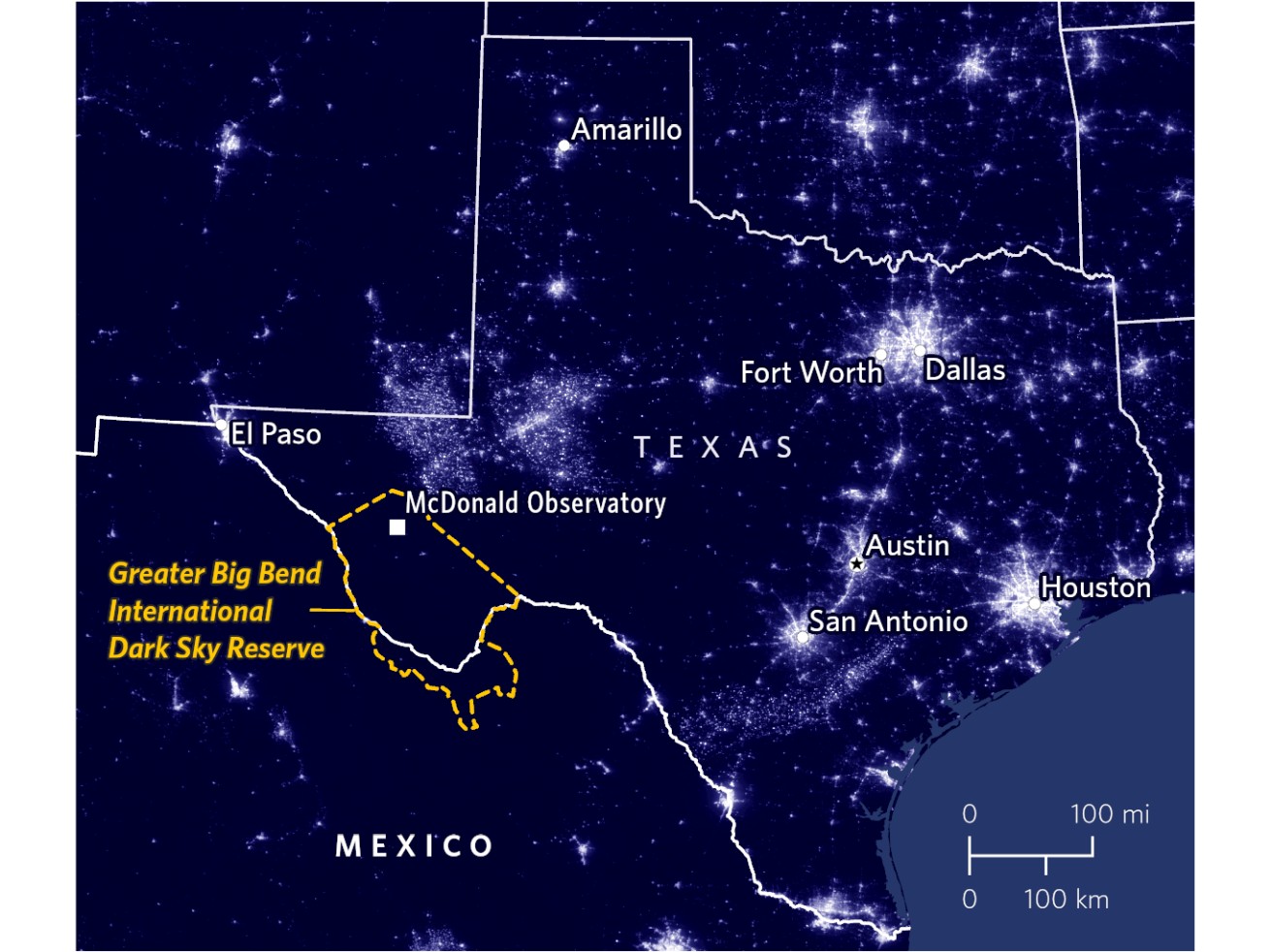

In 2018, Stephen Hummel, the Dark Skies initiative coordinator for the McDonald Observatory, formalized the observatory’s work to officially protect the region’s night sky from encroaching light pollution. There had been disparate efforts already in some state and national parks, but the McDonald Observatory wanted to get everyone on the same page: Instead of several small, protected skies, the whole region could unite behind a plan for a starrier night.
Ryan and others gathered baseline readings of light levels throughout the area, and he began reaching out to towns, parks and businesses. The Nature Conservancy, with its history of working with so many landowners, began including dark-sky lighting provisions in conservation easements. It helped, too, that protected landscapes generally didn’t emit much light.
In 2022, the organization DarkSky International certified the Greater Big Bend International Dark Sky Reserve. At 9.6 million acres—almost the size of Denali, Yellowstone and Glacier Bay national parks combined—it’s the largest International Dark Sky Reserve in the world. The Davis Mountains Preserve and the observatory are considered the core of the larger reserve, which, if you were to drive north-south from one end to the other, would take more than nine hours (including waiting to cross the U.S.-Mexico border).
Still, the work to protect the night sky is ongoing. Alpine, a small gateway town to Big Bend National Park, is the brightest spot in the reserve, but it has installed dark-sky-friendly lighting, says Chris Ruggia, a longtime resident and the town’s tourism director. So far, it’s worked. Even as the town has grown larger in response to a post-COVID tourism boom, the light readings haven’t changed.
Hummel, for his part, has focused much of his latest outreach outside of the reserve among the oil and gas industry farther north in the Permian Basin. Lights from hundreds of oil derricks, natural gas rigs and related infrastructure are the greatest contributor to light pollution in the reserve.
“We’ve been working with the oil and gas industry for the better part of a decade, lending best practices,” Hummel says.
“The goal is really to change the industry and show that there are just better, or more efficient, ways of lighting that preserve the environment and their safety and security. It’s one light at a time, but we’re starting to turn a corner.”
Reduce Your Light Pollution
Keeping the night sky dark doesn’t mean turning off all lights. Instead, the McDonald Observatory and DarkSky International advocate for “nightsky-friendly” lighting practices. Here’s how you can help.
-
Advocate for Dark Skies
Become an advocate for limiting light pollution in your community. Organizations like DarkSky International offer guidance and local networking opportunities for people who want to preserve night skies. Help Limit Light Pollution
At TNC’s Davis Mountains Preserve, I’m riding in a side-by-side four-wheeler with Kaylee French as she shows me the area—the ponderosa pines they’re protecting, the prescribed burns they’ve conducted to prevent major wildfires in the area. High on a ridgeline, we pause to take in the view of Mount Livermore peeking out from a cloud. It’s the highest peak in the Davis Mountains.
The preserve is a haven for researchers who study the rare relic ecosystem found in a sky island. Some have studied the natural history of fireflies.
Research into the impact of light pollution on ecosystems is still in its early stages, and the dark-sky reserve could offer a tantalizing comparison point for other research areas—acting like a control would in other experiments. For example, do fireflies operate differently here than in brighter areas? Same goes for the many mammals that hunt or feed at night during the cooler hours.
Plants and animals have evolved with the rhythms of day and night. French points to a host of succulents found in this region as an example. They open their pores—called stomata—at night to take in carbon dioxide, which is needed for photosynthesis. This desert adaptation prevents water loss during the day. But under bright enough lights, some conservationists worry, these agave, yucca and cacti may fail to recognize that it is night.
What happens to one classification of plant affects the insects that pollinate them and the animals that feed on the plants and on those pollinators, says Layla Spurlock, a former park interpreter for Big Bend Ranch State Park, which had her going out at night to take brightness readings. “I tell people everything is interconnected,” she says. “Everything relies on a balance in the system.”
Night Life Research
Davis Mountains Preserve has proven to be a hotspot for researchers looking to study bats, owls and insects, among other creatures.


Arthropod Study: Ashley Schmitz (right), who has led insect research in the Davis Mountains for five years, gathers insects with Lee Harris at a UV light station. © Stephen Alvarez
Moth: A northern giant flag moth is noted during an arthropod inventory at the Davis Mountains Preserve. © Stephen Alvarez
Bats: Krysta Demere, a biologist from the Texas Parks and Wildlife Department, releases a hoary bat after catching it in a mist net. © Stephen Alvarez
Ponderosa Pine: The Milky Way over ponderosa pine trees in the Davis Mountains Preserve. © Stephen Alvarez
For Hummel—who like Spurlock, Ryan and Pugh, all came to West Texas from places farther afield—the night is part of the draw of living here.
“There’s nothing, I think, that reliably inspires all of us as much as the night sky,” he says. “It means something different to everyone. But no culture has ever looked up and had nothing to say.”
Each year some 50,000 people come to the observatory to experience its Star Parties. Astro-tourism is part of the economic engine of the area, which has experienced a post-COVID-19 ecotourism boom. Big Bend National Park promotes stargazing with regular events.
As the night skies have brightened globally, campaigns to protect the night have gained traction. France adopted one of the most progressive dark-sky laws in the world in 2019, and the effect was immediately visible on satellite maps. In 2021, New York City passed two laws curbing light pollution related to city-owned properties, and other U.S. communities—often near national parks—have begun exploring smarter lighting.
At McDonald, light pollution has leveled off, Hummel says. The area is still on the cusp of a night too bright for some of the observatory’s research, but the rapid increase in brightness researchers documented from 2014 to 2020 has stopped. For now, the reserve is working.

As night falls on the Davis Mountains Preserve, where I’m staying for the evening, the wind picks up off the mountain ridgelines around me. I hear branches crackling in the distance—most likely deer.
Where I live near Washington, D.C., the lights are so bright I can see maybe 10 stars and planets on most nights. An 1840s-era observatory at Georgetown University closed 54 years ago, unable to study the stars through the city’s light pollution.
In the mountains, as my eyes slowly adjust, I begin to see more and more stars—a “kaleidoscope,” as Spurlock had put it to me. For a moment I fight the urge to pull out my phone to look at my constellations app. But if I pull it out, it will take another 30 minutes for my eyes to completely readjust, and I don’t want to miss anything.
Then I see it: a foggy area near the horizon line that I immediately know is the Milky Way. There’s a whoosh past my face and I realize the bats have come out for the night. It’s collectively overwhelming.
Standing here in the dark, something French said strikes me. Like climate change, light pollution requires massive partnerships to make even the smallest dent. But unlike habitat loss or temperature change or destructive storms, the night is never truly lost. To bring it back, all we ever had to do was turn down the lights.
About the Creators
Jenny Rogers is a writer and editor for Nature Conservancy magazine. She grew up in Texas and previously wrote about the 2024 solar eclipse from the state.
Stephen Alvarez is a National Geographic explorer, photographer and filmmaker. He previously covered efforts to restore bat caves for this magazine.

Magazine Stories in Your Inbox
Sign up for the Nature News email and receive conservation stories each month.
More Articles

Sea of Possibility
Along the coast of British Columbia, First Nations lead a bold effort to protect an intact marine ecosystem.

History in the Rings
A tree’s rings can tell a much deeper story than just the number of years it has lived.

Call of the Wild
Field biologist and bioacoustic researcher Maia Persche listens to the woods, recording soundscapes that can reveal insights about biodiversity and habitat management.