



Sea of Possibility
Along the coast of British Columbia, First Nations lead a bold effort to protect an intact marine ecosystem.

A tree’s rings can tell a much deeper story than just the number of years it has lived.
Text by Matt Jenkins | Photographs by Greg Kahn | Issue 2, 2026
“Maybe every five to seven years,” says Sam Lindblom. That’s how often a forest consisting of dry oak and pine in the mountains of Virginia should experience a low-severity fire—either wildfire or a controlled burn—to be healthy. Lindblom is the director of landscape conservation for The Nature Conservancy in Virginia, and he advocates for returning regular fire regimens to the landscape with the state and the USDA Forest Service to help improve biodiversity.
His recommendation is partly based on dendrochronology, the science of studying tree rings to understand the detailed history of a single tree or an entire forest system. From the 1990s through the 2010s, scientists examined burn scars found in the cross sections and cores of trees across the central and southern Appalachians. They discovered that from precolonial times through the early 1900s, fire returned to forests about every two to 19 years, depending on location. It’s believed that the fires were started by lightning or were sometimes set by Indigenous communities who were managing their forests for overgrowth or hunting needs. That information, considered with many other factors, helps Lindblom and his colleagues develop forest restoration and management plans today.
“The fire-history record has really helped us come to grips with the idea that fire was, in fact, a frequent occurrence,” says Lindblom. “It has helped us understand that fire has been occurring in these landscapes for hundreds of years.”
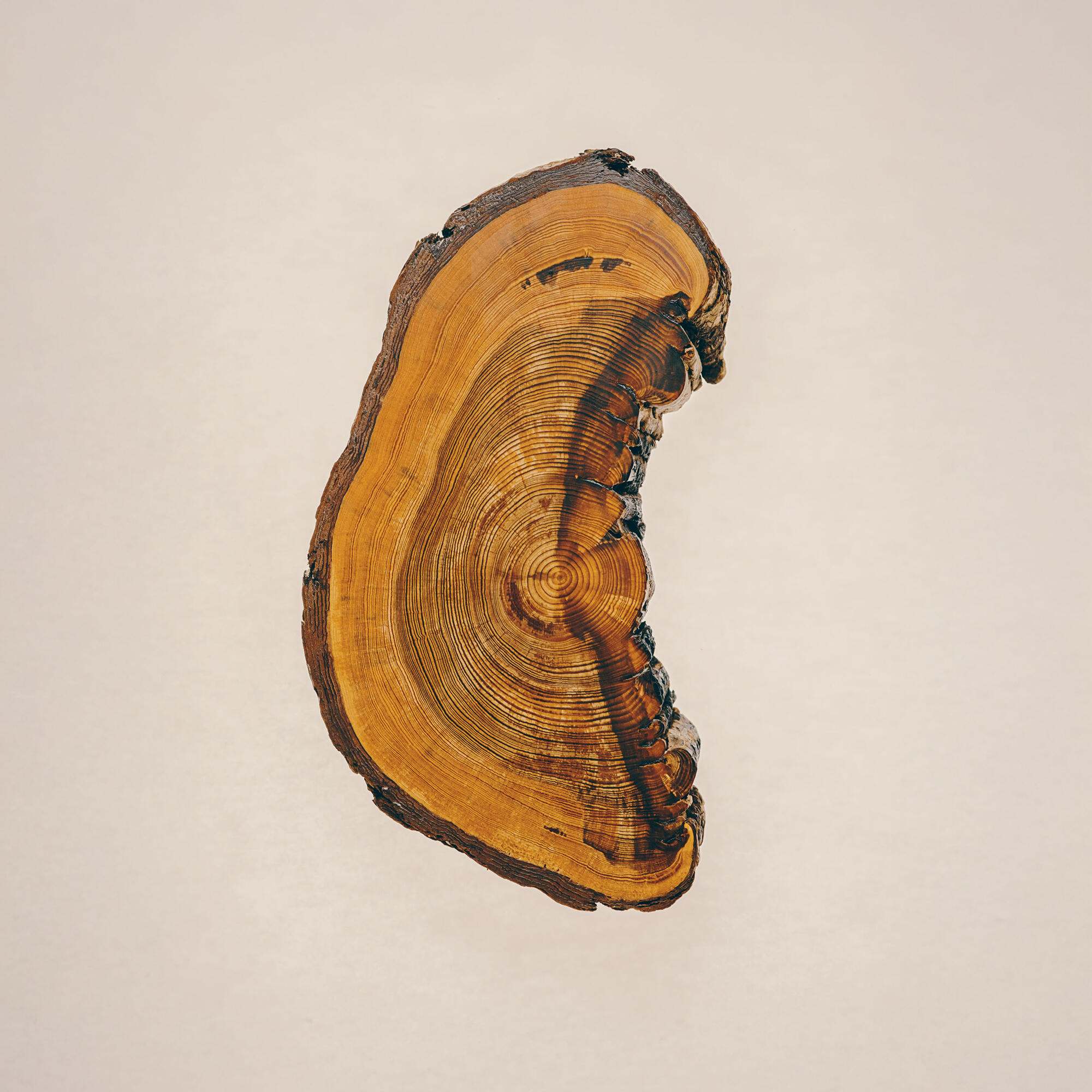
SPECIES: Table Mountain pine
LOCATION: George Washington National Forest, Virginia
APPROXIMATE AGE: 183 years (1822 to 2005)
After 1921, this tree no longer shows signs of encountering fire. That shift coincides with U.S. forestry policies that called for aggressively fighting wildfires, which often caused forests to become overgrown. Extremely narrow rings in the tree’s last 50 years show that its growth slowed due to overcrowding and competition for sunlight and nutrients.
Between 1839 and 1921 this tree was scarred by fire, on average, once every 12 years. By comparing these burns with scars from its neighboring trees, scientists have determined that this tree’s home forest in Virginia routinely experienced fires almost every four years—often between November and March.
The tree was more than 15 years old when, in 1839, it experienced the first fire intense enough to scar and damage its bark.
The tree became established as a seedling a few years after a widespread fire. Wide rings for the first years indicate healthy growth. Young pines that are established in an open forest—often created by fire or other disturbance—typically grow fast from the start to outcompete other trees for sunlight.
Trees often have these large open “cat face” burn marks on the uphill-facing side of their trunks. Wildfire flames— moving from low ground to high ground—will wrap around the trunk and create an eddy of more-intense heat on the uphill side of the tree.
Each tree ring has two main colors. The light wood is from a period of faster growth during the wetter spring months. Dark wood is created later in the season, when the tree is growing more slowly.

 Return
The science of dendrochronology coalesced around the turn of the 20th century, in large part due to the work of Andrew Ellicott Douglass, an Arizona-based astronomer who began studying tree rings with the hope of finding climate data that preceded written records. He was trying to understand if sunspots influence Earth’s climate. Along the way, Douglass started to understand how wide and narrow ring patterns matched among trees that lived in the same area.
But it was a partnership between Douglass and archaeologists working in northern New Mexico that would help launch dendrochronology as a scientific discipline. In the early 1900s, archaeologists were struggling to understand the mystery of the “great houses” at Chaco Canyon—massive stone structures built by the Ancestral Puebloan culture that had been abandoned at some point in the distant past. The roof beams of the great houses were hewn from ancient logs, and the archaeologists wondered whether Douglass might be able to use core samples drilled from the timbers to help ascertain when the buildings were constructed.
Douglass’ understanding of the patterns of tree rings deepened: In dry regions, thick rings coincided with wetter years, narrow rings meant drought, and burn scars showed the occurrences of fires. He found matching patterns in trees whose lifetimes overlapped (a process known as cross-dating), and he could determine the year a tree was felled by comparing its rings to others in the forest. For a decade, Douglass spliced together the timeline derived from tree rings in living trees with those preserved in the remains of older, dead trees. He developed a chronology that gradually extended further and further into the past. In 1929, Douglass was finally able to date a key beam in the oldest Chaco great house to 919 A.D.
Eight years later, Douglass established the Laboratory of Tree-Ring Research at the University of Arizona in Tucson, which became one of the primary centers of dendrochronological research in the United States.

As the field matured, dendrochronology has proved useful in a staggering array of practical applications. It has been used to determine when the Vikings were present in the Americas, to authenticate the provenance of rare Stradivarius violins and even to reveal the likely identity of the master violin maker under whom Antonio Stradivari apprenticed.
As it developed, dendrochronology also played a key role in understanding past climate. In the Southwest, where the arid climate preserves trees for centuries after they die, scientists have been able to extend the dendrochronological record nearly 1,300 years into the past. They realized that climate variability—and chronic drought—has been a natural, recurring feature throughout the past. In fact, the tree-ring record revealed that a great drought occurred across the entire Southwest around 1150 A.D.—forcing the Ancestral Puebloans to abandon Chaco Canyon.
By better understanding what the climate looked like in the past, scientists have also been able to show that human-caused climate change is shifting conditions away from their natural range of variability. By pairing the dendrochronological record with data derived from ice cores and climate data collected with weather instruments over the past roughly 150 years, they’ve been able to chart the relatively rapid, sustained and unprecedented rise in temperature that has come with global warming since about 1950.

But one of the most widespread uses of dendrochronology has been to better understand the presence and frequency of fire in forests across the United States over centuries of history. Fire scars in tree rings provide an exact time stamp of when fires occurred—and, taken together, reveal their severity and frequency.
That has helped catalyze a sea change in how land managers across America think about fire. Beginning in the late 1800s, many people in the United States saw fire as a malignant force in the nation’s increasingly industrialized forest, and launched aggressive firefighting efforts. In 1935, the USDA Forest Service instituted a “10 a.m. policy,” which sought to ensure that any wildfires were extinguished by the morning after they started. The policy would continue for more than 40 years.
But tree rings revealed that, over the longer sweep of time, fire had been a frequent occurrence in many forests and had differing levels of severity from what we’ve become accustomed to seeing in the 20th and 21st centuries.

That understanding has led the Forest Service and other federal and state land-management agencies to reconsider their aggressive firefighting strategies. Paradoxically, years of zero tolerance on small fires actually worsened the damage caused by wildfires later on. That’s because putting fires out before they can spread allows smaller, more combustible trees to accumulate in the forest, adding tremendous amounts of fuel to fires when they do break out.
In the Pacific Northwest, for instance, the spotted owl, a federally protected endangered species, has been on the decline since the 1980s. Early efforts to save the spotted owl focused on limiting logging in the national forests to protect habitat, but scientists have since seen how high-severity fires have big impacts on the owls’ habitat, too.
“We’re losing spotted owls,” says Kerry Metlen, the senior forest scientist for TNC in Oregon, adding that old trees, carbon and clean-running streams are at risk in Western dry forests. “We’re losing all this stuff because of these high-severity fires.” But thinning overcrowded forests and careful prescribed fires can reduce the chances of future megafires degrading large swaths of habitat.
Much of North America’s dendrochronology research happens at a handful of universities. They store core samples, tree cookies and other cuttings for current and future research projects. The University of Arizona’s Laboratory of Tree-Ring Research was established by Andrew Douglass, considered the godfather of dendrochronology.

Rows of boxes store thousands of categorized tree cores in the Tree Ring Lab at Columbia University in New York City. The cores come from forests around the world, and their data is being cross-referenced to develop an "atlas" of past weather patterns around the planet.

A slice of pine as thin as human hair has been dyed red in preparation for analysis under a microscope at University of Arizona’s Laboratory of Tree-Ring Research. This lab was established by Andrew Douglass, considered the godfather of dendrochronology.

The historical information stored inside trees goes much deeper than just the tree rings. In this microscopic view, the disruption in a tree’s cells records a Peruvian volcano eruption in 1600. The narrowness of some of the cells was likely caused by cooler temperatures following the event.
In the western United States, the effort to restore more-natural fire to the forest is now being coordinated under a partnership between the North America Fire Program and the nascent Western Dry Forests Program, launched in 2024. “The science underpinning all of that absolutely depends on dendrochronology,” says Metlen.
Now, TNC is using the insights gained through dendrochronology to better understand the relationship between forests that have been thinned to healthy densities and runoff into streams and rivers. That’s a critical issue in Arizona, an arid state that’s becoming even drier because of the growing impacts of climate change. Research there has shown that healthy forests, in which individual trees aren’t forced to compete with each other for water, are not only less prone to destructive, high-intensity fires—which can wreak havoc on water systems with massive amounts of ash and debris—but can also contribute to as much as a 20% increase in streamflow in headwater forests.
“There’s a series of co-benefits of doing the forest restoration,” says Marcos Robles, the lead scientist for TNC’s Arizona chapter. “You protect communities, you protect water supplies, and you protect habitat for species. That whole bucket of forest resilience, we could not have gotten there if we didn’t know the evidence from the dendrochronology.”

Matt Jenkins is a freelance journalist and former Nature Conservancy magazine editor who has written for The New York Times and other publications.
Greg Kahn is a Washington, D.C.-based photographer. He started creating photos that connect dendrochronology and climate change in 2019.

Sign up for the Nature News email and receive conservation stories each month.

