
interstitialRedirectModalTitle

interstitialRedirectModalMessage

Places We Protect

Waikamoi Preserve

Island of Maui

View into a dense, lush tropical forest filled with ferns and moss-covered trees in Hawaii.
Waikamoi Preserve Lush, native forest at Waikamoi Preserve, Maui, Hawai'i. © Ian Shive

Waikamoi Preserve is an important sanctuary for hundreds of native Hawaiian species.

Overview

Description

Waikamoi Preserve provides an important sanctuary for hundreds of native Hawaiian plants and animals that make up its high-elevation rainforest and alpine shrubland. It’s vast koa-ʻōhiʻa forest is the last stronghold for 63 species of rare plants, including the blue ʻōpelu, a native lobelia, as well as native ferns, herbs, shrubs and trees, some found only on Maui. Twelve different native bird species thrive here, seven of them endangered. These include the increasingly rare ʻakohekohe and kiwikiu (Maui parrotbill) and the scarlet ʻiʻiwi, the crimson ʻapapane and the bright green ʻamakihi.

TNC established a preserve at Waikamoi in 1983 to protect the freshwater source for the island and to provide a sanctuary for endangered plants, birds and hundreds of other native Hawaiian species.The preserve protects part of the 100,000-acre East Maui Watershed on Haleakalā, which provides 60 billion gallons of clean water annually to Maui's residents, businesses and agricultural community. TNC protects the native species living there by managing the invasive weeds and animals threatening their survival, allowing the forest to thrive. Today, Waikamoi Preserve harbors some of the healthiest native forest in all of Hawai‘i. On-the-ground land management, in partnership with landowners and communities, is at the heart of what we do.
Access

Limited Access

TNC leads quarterly service trips into Waikamoi Preserve.

Highlights

This vast koa-`ōhi`a forest is the last stronghold for 63 species of rare plants and 12 species of birds, seven of them endangered.

Size

8,951 acres

Explore our work in this region

Experience Waikamoi Preserve on Maui (3:01) Our Waikamoi Preserve is the source of fresh water for Maui and is an important sanctuary for hundreds of native Hawaiian species.

Quote: Koa Plauche

Even if you never see Waikamoi, everyone on Maui is connected to this place through the water it provides. But there is something profound about walking through the forest, and we hope to share this experience with the people who belong to this watershed: the keiki of Maui.

Maui Field and Outreach Coordinator 
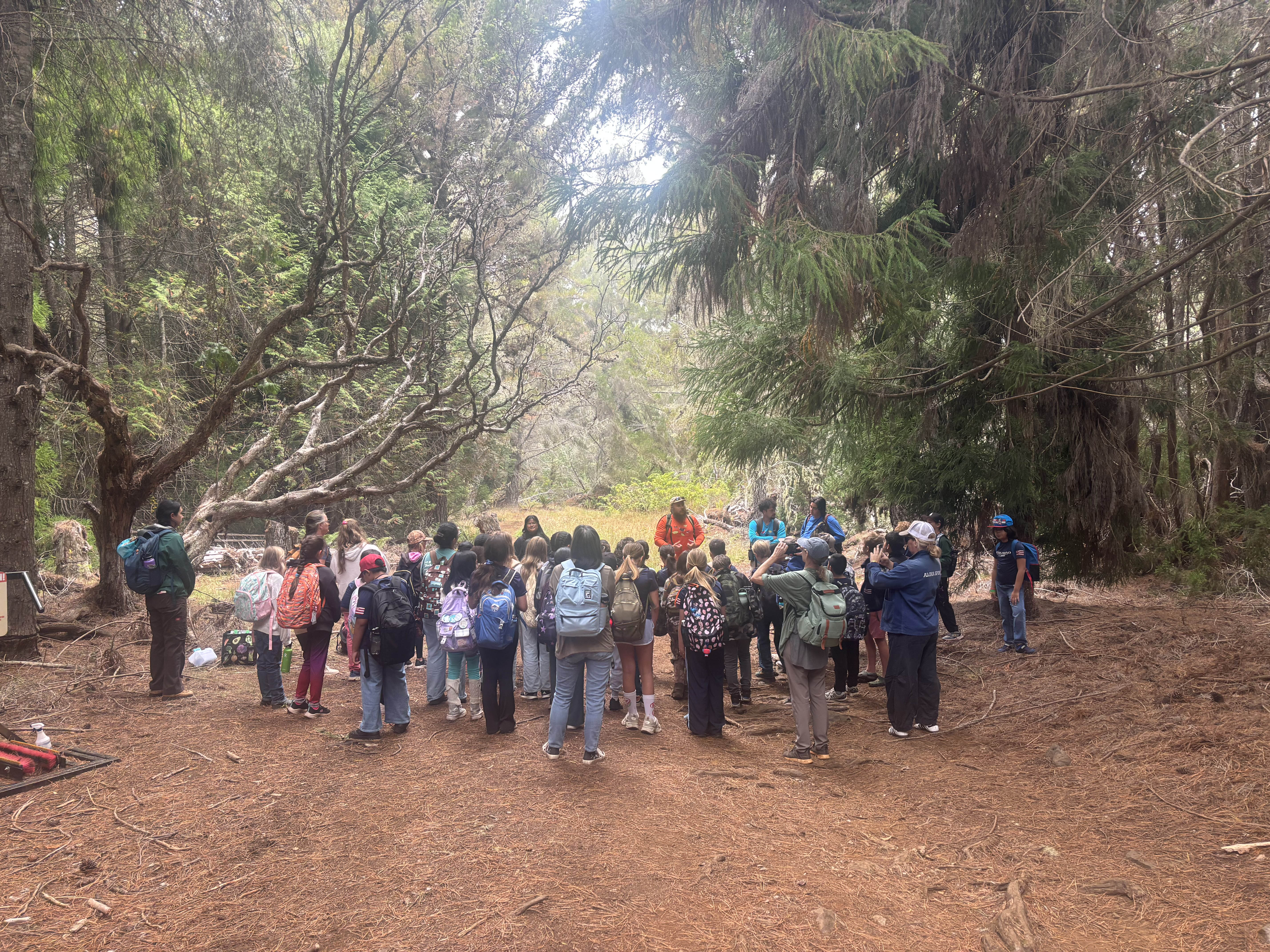
A group of children on a field trip looking away from the camera.
Waikamoi Preserve These fourth and fifth graders from Makawao Elementary School are visiting Waikamoi Preserve on Maui through a partnership with the Hawaiʻi Nature Center. © Rachael Taylor, Hawaiʻi Nature Center.

Growing a new generation of island stewards

For years the only sounds you would hear in Waikamoi Preserve were the chattering of native birds, like the scarlet ʻiʻiwi and white-rumped ʻapapane, flitting among the native ʻōhiʻa and koa trees.

Through recent partnerships with schools and nonprofits, the voices of keiki can now be heard in the forest as well as the sounds of ʻōlelo Hawaiʻi and oli (Native Hawaiian language and chant).

In 2025, the Hawaiʻi Nature Center, with the help of TNC’s Waikamoi team, began organizing field trips for Maui students, mostly from public schools, to visit the preserve. That year, Kamehameha Schools students also spent the night camping in the preserve, and this successful trip was repeated the next year. So far, more than 170 keiki have visited Waikamoi, walking among native trees and plants and learning about the important conservation work that goes on here.

“A central Hawaiian cultural understanding is that humans (kānaka) and the natural world are kin. We are all a part of nature, not separate,” says Koa Plauche, TNC’s Maui field and outreach coordinator. “We are bringing keiki into the forest so the children of Maui can develop a sense of pilina (connection to) and kuleana (responsibility) for their Island home.”

HISTORY

Waikamoi Preserve became a reality in 1983 when the Haleakalā Ranch Company granted a conservation easement to TNC over 5,230 acres. The preserve was expanded in 2014 when landowner Alexander & Baldwin conveyed a conservation easement over an additional 3,721 adjacent acres, bringing the total to 8,951 acres and making Waikamoi the largest private nature preserve in the state.

As part of the East Maui Watershed Partnership, TNC, Haleakalā Ranch and Alexander & Baldwin work together to protect this remarkable landscape. Waikamoi Preserve is managed in partnership with the State Department of Land & Natural Resources through the Natural Area Partnership Program.

Bird watchers at TNC Waikamoi Preserve on Maui.
Birders in Waikamoi Bird watchers at TNC Waikamoi Preserve on Maui. © Alison Cohan
TNC staff Roxy Sylva hiking in Waikamoi Preserve, Maui, Hawaii.
Waikamoi Preserve TNC staff Roxy Sylva hiking in Waikamoi Preserve, Maui, Hawaii. © Ian Shive
Birders in Waikamoi Bird watchers at TNC Waikamoi Preserve on Maui. © Alison Cohan
Waikamoi Preserve TNC staff Roxy Sylva hiking in Waikamoi Preserve, Maui, Hawaii. © Ian Shive

VISIT/VOLUNTEER

TNC is now leading quarterly volunteer trips into Waikamoi Preserve as an opportunity to experience this magnificent forest and help support it. Please reach out to hike_waikamoi@tnc.org to learn more and sign up.

SCIENTIFIC RESEARCH AT WAIKAMOI PRESERVE

Researchers interested in Waikamoi Preserve or other Maui preserves must fill out a research application form at least two months in advance of any planned fieldwork. Priority shall be given to applications where logistics, permits and arrangements have been thoroughly and independently planned out. Note that continuing research requests must be accompanied by any prior reports that inform us of the progress of your work in our preserves.

Researchers: Apply for access to Waikamoi Preserve for research purposes by emailing kfay@tnc.org and gael.kanakaokai@tnc.org.