Places We Protect

Bluestem Prairie

Minnesota

Closeup of large flowers with dark centers and long yellow petals in a field of tall grasses as the sun sets in the distance.
Sunset and wildflowers Various wildflowers thrive at TNC's Bluestem Prairie Preserve in Minnesota. © Richard Hamilton Smith

Bluestem Prairie offers a chance to experience one of North America's most endangered ecosystems firsthand.

Overview

Description

Bluestem Prairie Preserve offers a rare opportunity to experience the sweeping northern tallgrass prairie that once stretched across much of western Minnesota and the Dakotas. Today, it protects one of the largest and highest-quality remaining prairie landscapes in the United States.

Visitors are welcome to explore the preserve year-round. Hike the Bluestem Trail from neighboring Buffalo River State Park, wander through waves of prairie grasses and seasonal wildflowers, or bring binoculars to spot grassland birds and other wildlife that depend on this increasingly rare habitat.

Unlike many prairie landscapes that were converted to cropland, much of Bluestem Prairie has remained remarkably intact. While portions of the preserve were hayed or cultivated over the years, large areas remained native prairie, making the site a nationally significant example of northern tallgrass prairie.

The Nature Conservancy began protecting Bluestem Prairie in 1975 with the purchase of more than 1,000 acres south of the Buffalo River. Since then, additional land acquisitions have expanded the preserve and strengthened habitat for native plants and wildlife. About 1,300 acres of the preserve are designated as a state Scientific and Natural Area.

Careful stewardship helps maintain the health of this prairie ecosystem. Land managers use prescribed fire, native seed collection and targeted efforts to control invasive species such as leafy spurge, to support the native grasses and wildflowers that define the landscape.

Bluestem Prairie is also an important outdoor classroom and research site. School groups from the Fargo-Moorhead area visit to learn about prairie ecology, while colleges and universities from across the Midwest conduct research that deepens our understanding of these globally rare grasslands.

Access

OPEN TO THE PUBLIC

Size

6,943 acres

Explore our work in Minnesota

Prairie Chickens

Prairie chickens were once abundant across the Great Plains. Today, there are only about 360,000 living in small pockets of grassland like Bluestem Prairie.

Habitat loss is the main culprit for greater prairie chickens’ decline. The birds rely on large, nearly treeless grassland. Most of their original range has been converted to agriculture over the last several decades, reducing their habitat to a small fraction of what it once was. 

Watching the prairie chickens "booming" to attract a mate in early spring is a special highlight of Bluestem Prairie. At dawn, male prairie-chickens venture out to a short-grass patch in the prairie known as a “lek,” where they perform an intricate courtship display in which they hop, strut, flap their wings, fill their vibrant orange air sacs and make a low booming sound. That’s why the behavior is known as “booming.” The displaying birds may even spar with other males, all for the attention of females.

You can experience this by reserving a blind during booming season. Call TNC's Northern Tallgrass Prairie Office at 218-498-2679 to reserve.

Booming Grounds (6:26) Learn more about greater prairie chicken booming at Bluestem Prairie.

Visit

What to See: Plants

Bluestem Prairie is home to more than 313 plant species. Seven of these are designated by the State of Minnesota as species of special concern, including sticky false asphodel, small white lady's slipper, northern gentian, plains reed grass, blanket-flower and oat-grass. The western prairie fringed orchid, a federally threatened species, also grows on the preserve.

What to See: Animals

Besides the greater prairie chicken, other birds found here include upland sandpiper, sandhill crane, marbled godwit (a species of special concern), loggerhead shrike (a threatened species) and Henslow's sparrow (an endangered species). Mammals include the plains pocket mouse and the prairie vole, both species of special concern. These rodents may serve as prey for another species of special concern, the western hognose snake.

The rare regal fritillary, a species of special concern in Minnesota, can be seen at the preserve. The federally endangered poweshiek skipper has not been documented here in recent years. A multi-year research project on invertebrates conducted through North Dakota State University's entomology department has revealed that a rare beetle species, the prairie stinkbug, thrives on a portion of the preserve. This ongoing research project and similar ones are crucial to understanding the prairie's ecological systems and monitoring its needs.

Hunting

Parts of Bluestem Prairie are open for hunting. Visit our Minnesota Hunting Map for rules and regulations.

Photos from Bluestem Prairie

Bluestem Prairie is a beautiful example of native prairie in Minnesota.

Monarch butterflies gathered on a tree branch.
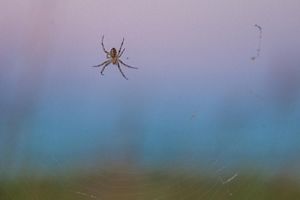
A spider on a web.
Flowers blooming in a prairie.
Two prairie chickens face each other in a prairie.
Flowers bloom in the prairie.