
Inside the Cherokee National Forest
We are working to reconnect streams, protecting rare wildlife and restore the forest.


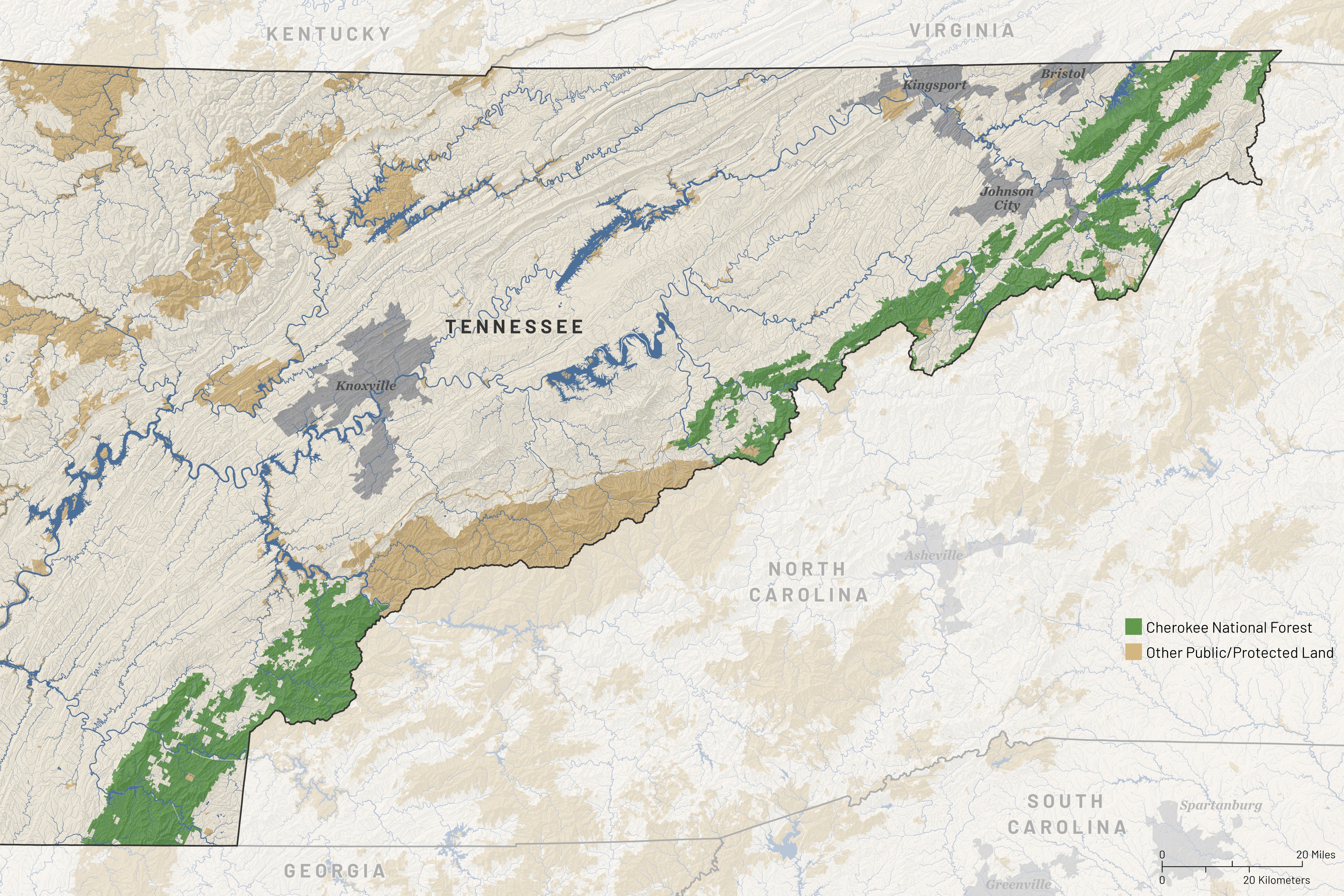
Nestled in the heart of the Appalachians in East Tennessee, the Cherokee National Forest is a living landscape where families wander along winding trails, trout seek out clean, cold streams to spawn and deer slip into quiet pockets of refuge. Often called the “Amazon of the Northern Hemisphere,” the Appalachians are one of The Nature Conservancy’s (TNC) four globally focal landscapes, recognized for their extraordinary biodiversity and the essential benefits they provide to people. The Cherokee National Forest embodies that richness, offering a place where nature thrives and communities find connection, recreation and clean drinking water.
Stretching across approximately 655,000 acres, the equivalent of nearly 495,000 football fields, the Cherokee National Forest is a publicly owned forest managed by the USDA Forest Service (USFS) through a collaborative approach. TNC's work in this landscape spans decades and includes protecting and expanding lands in and around the Cherokee National Forest through acquisitions and partnerships that support both healthy forests and freshwater systems. Over the past two decades, TNC helped establish two key partnership groups: the South Zone Collaborative Group, which focuses on the southern portion of the forest, and the Cherokee National Forest Landscape Restoration Initiative, which focuses on the northern portion. Both groups bring together representatives from the USFS, state agencies, conservation and environmental organizations, research institutions, recreation groups and the private forestry sector.

These collaborative partnerships provide input and support for forest management planning and the implementation of restoration efforts across the Cherokee National Forest. This collaborative conservation approach that began in Tennessee has become a model throughout the Appalachian region, demonstrating how diverse partners can bring rich perspectives and cohesion in forest management plans.
It all starts with one vital natural resource: water, which originates in cold, shaded, wood-rich headwaters and flows through smaller streams and wetlands in the Cherokee National Forest, eventually draining into the Tennessee River. Water connects the forest, and these small mountain streams form the foundation of the entire system. Guided by science, TNC identifies and prioritizes restoration projects across the north and south zones of the forest. Each zone has its own unique habitats and needs, but our goals remain the same: recovering rare and endangered species, restoring habitat and managing nonnative species. Together, these efforts strengthen water quality and build resilience across the entire forest.
But healthy streams are only one part of the picture. Fire has long shaped Appalachian ecosystems, and restoring its natural role is just as essential. Prescribed fire is one valuable tool TNC is using to manage the forest. It helps open the forest floor, support native plants and wildlife, and reduce the risk of severe wildfires. Piece by piece, these combined efforts reconnect and restore lands and waters—improving habitat for native fishes and reducing the threats of flooding and wildfire.
Stream Restoration in the Cherokee National Forest
Healthy Appalachian streams meander through the landscape, shaped by boulders, gravel beds and fallen trees that create pockets of calm water and bursts of gentle flow. This natural structure is essential to slow the current, allow water to spill into the floodplain and build the complex habitat upon which aquatic wildlife depends. Many streams have been altered by a history of heavy logging and the construction of dams and undersized culverts that can disrupt natural stream function and prevent fish and other aquatic species from moving freely. TNC uses many different techniques to restore habitat and reconnect waterways. In some places, that means removing barriers; in others, it means replacing outdated culverts with fish‑friendly passages so water can flow naturally and fish can reach their spawning grounds. And in certain streams, our science shows that adding large wood—yes, just like beavers—helps rebuild the habitat structure these streams have lost. On their own, these techniques make meaningful improvements; combined, they maximize watershed‑wide resilience, improve water quality and support the species and communities downstream that depend on them.
Dive into Conservation
Working with partners, we’re carrying out a variety of restoration projects throughout the Cherokee National Forest.
*Project locations are approximate and may not be shown precisely due to the scale of the map.
North Zone
The high-elevation habitats with oak and hardwood trees and cold-water streams that characterize the north zone make it the ideal habitat for an array of wildlife, including native brook, dace, migratory sucker species, rare mussels and one of the richest salamander faunas in the world.
South Zone
The lower mountains, with their oak‑ and pine‑covered ridges and warmer streams, are home to more federally endangered species than the north zone, steering our focus to the recovery of these populations.
Strategic wood loading
History of heavy logging removed much of the natural wood that once created complexity in these streams. TNC evaluates existing wood and adds strategically placed pieces to slow flow, stabilize channels, and rebuild gravel beds. These gravel beds are vital for Creek Chub, which build nests, and Tennessee Dace, which rely on those nests to reproduce. This work is completed with partners Southeastern Conservation Corps and Trout Unlimited.
Hurricane Helene
TNC is currently monitoring stream conditions after Hurricane Helene to assess habitat health and the status of sensitive species such as hellbenders. We recently documented an adult hellbender in Paint Creek for the first time in more than a decade, and a full survey is planned to help inform potential relocations and identify ideal propagation sites.
TNC is working across state lines on assessing and planning Hurricane Helene recovery efforts across NC, VA, SC, and GA.
Species propagation
TNC’s focus is on restoring habitat for sensitive species, ensuring they have the conditions needed to survive and thrive when our partners release animals through their propagation programs. Lee University and the USFS reintroduced hellbenders and Conservation Fisheries released madtoms and Citico dace at the newly restored Citico Creek site. Following these releases, TNC works with partners to monitor the site and track the animals’ survival, movement, and adaptation to their new habitat.
Dam Removal
In partnership with Trout Unlimited and the USFS, the lower Citico Creek dam was removed in 2025, reconnecting 38 miles of upstream habitat in one of Tennessee's most biodiverse watersheds. This allows fish to move freely throughout the watershed in search of food, shelter, and spawning habitat. In collaboration with the USFS and the University of Tennessee, Knoxville, TNC is monitoring the long-term impacts of the dam removal, tracking how the stream ecosystem and native species respond and recover over time.
Culvert replacement
Replacing two undersized culverts along Sina Branch Road in the Cherokee National Forest marks another step in improving fish passage in the Cookson Branch watershed. Undersized culverts often flood and trap debris, blocking fish movement. TNC and partners are installing fish‑friendly bridges that maintain road access, allow natural flow, and reconnect stream habitats so fish and wildlife can move freely.
Bridge update
An old failing bridge in the Little Citico Creek was causing flooding during high-water events. Replacing this bridge restored the creek's natural flow and reconnected important aquatic habitat. By allowing water, sediment and aquatic species to move more naturally through the watershed, the bridge helps protect water quality and supports recovery efforts for the endangered smoky madtom, one of Tennessee's rarest fish species.

 Return
Strategic wood loading
The intentional placement of large wood into degraded stream channels to mimic the role that fallen trees and beaver dams historically played in forested waterways.


Native Aquatic Species of the Cherokee National Forest
The Appalachians are home to a rare temperate rainforest, an ancient, rain-soaked ecosystem within the Cherokee National Forest. According to the USFS Southern Appalachian Man and the Biosphere Cooperative (SAMAB), more than 154 fish species, 55 amphibians and reptiles, and 43 mammals rely on these waters and forests. Among them are some of the region's rarest aquatic species, whose recovery is supported by ongoing conservation efforts.

Southern Appalachian Brook Trout
The only native trout in the Southern Appalachians. During spawning season, males turn neon orange and fire‑red, looking very handsome to attract their mates. Also, they are technically a char rather than a true trout.

Tennessee Dace
This species is endemic to the upper Tennessee River. They are nest associates, meaning they rely on the nests of other fish—especially creek chub—to successfully spawn. To support the recovery of Tennessee dace, we account for creek chub presence when prioritizing streams for dace recovery.

Hellbender
North America's largest salamander, measuring more than 2 feet long. Males guard nests under large rocks, fanning water over eggs for weeks.

Blotchside logperch
Once thought to be lost from parts of Tennessee, ongoing propagation efforts are helping the species come back. They need a stream where water moves quickly and has many pebbles, which they flip with their snout.
Get Updates from the Field
Sign up to receive monthly conservation news and updates from Tennessee.
Prescribed Fire at the Cherokee National Forest
Prescribed fire is an essential tool for restoring healthy forest conditions in the Cherokee National Forest. For thousands of years, fire shaped Appalachian ecosystems, maintaining open oak, hickory and mixed pine woodlands and supporting a rich diversity of plants and wildlife such as quail, deer and turkey. After decades of fire suppression, many areas have grown dense with leaf litter, dead wood, invasive species and closed canopies—conditions that limit habitat and increase the risk of severe wildfires. Today, TNC and the USFS use prescribed burns to clear the forest floor, bring sunlight back to the understory and encourage the growth of native plants that wildlife depend on. These burns also help reduce invasive species that often take over native plants and improve timber stand structure.


Caring for a Landscape that Cares for Us
The Cherokee National Forest is more than a place of ecological importance—it’s a landscape that sustains people as much as wildlife. Healthy forests and restored streams reduce the risk and impacts of catastrophic wildfires and flooding, protecting nearby communities while supporting clean water downstream. These same natural systems fuel local economies through tourism, outdoor recreation and jobs that depend on a thriving forest. As prescribed fire brings light back to the understory and floodplain restoration reconnects streams to the land, the forest becomes more resilient for both nature and the people who call this region home. Together with our partners, we’re ensuring that future generations can explore these mountains, enjoy their rich biodiversity and continue to benefit from all the Cherokee National Forest provides.
Cherokee National Forest Collaborative Groups
North and South Zone
- TN Dept. of Agriculture, Div. of Forestry
- US Fish and Wildlife Service
- Southern Environmental Law Center
- US Forest Service
- The Wilderness Society
- MountainTrue
- The Nature Conservancy (Convener)
- Cherokee Forest Voices
- Panther Creek Forestry, Logging interests at-large
- Tennessee Forestry Association
- Tennessee Wildlife Resources Agency
- Ruffed Grouse Society & American Woodcock Society
Learn About Conservation

Tennessee Lands
TNC is working to transform how we manage natural and working lands, inspire better land-use practices, protect habitats for imperiled species and conserve climate-resilient landscapes.

Rethinking Tennessee Dams
Many of Tennessee's dams don't fulfill their original purpose, and even cause harm. Find out what we're doing about it.

The Duck River
Discover why Tennessee’s Duck River is the most biodiverse river in North America. Learn about wildlife, recreation, drinking water and how TNC is protecting this vital resource.