

InSPIRE Research Hub
The InSPIRE project unites field research across the U.S. with actionable data on agrivoltaics and low-impact solar development, while also highlighting region-specific benefits and tradeoffs to ecosystems.

Discover how dual-use solar allows agriculture and clean energy to thrive side by side.
Agrivoltaics, also known as dual-use solar, is a practical approach to getting more from your land. Instead of choosing between farming and solar energy, you can do both. By integrating solar systems with agricultural use, landowners can generate reliable energy while continuing to grow crops, support livestock, or build healthy ecosystems.
As energy demand rises and agricultural operations face increasing pressure from heat, drought, and soil loss, agrivoltaics offers a way to strengthen both productivity and resilience—without taking land out of use.
Dual-use solar is the practice of combining solar energy production with another productive land use on the same site. This can include agricultural activities like crop production and livestock grazing, as well as conservation practices such as pollinator habitat restoration and native prairie establishment.
Agrivoltaics is the practice of using land for both agricultural production and solar energy generation. By integrating solar panels with farming activities, landowners can continue producing food, fiber, or livestock while also generating renewable energy from the same acreage.

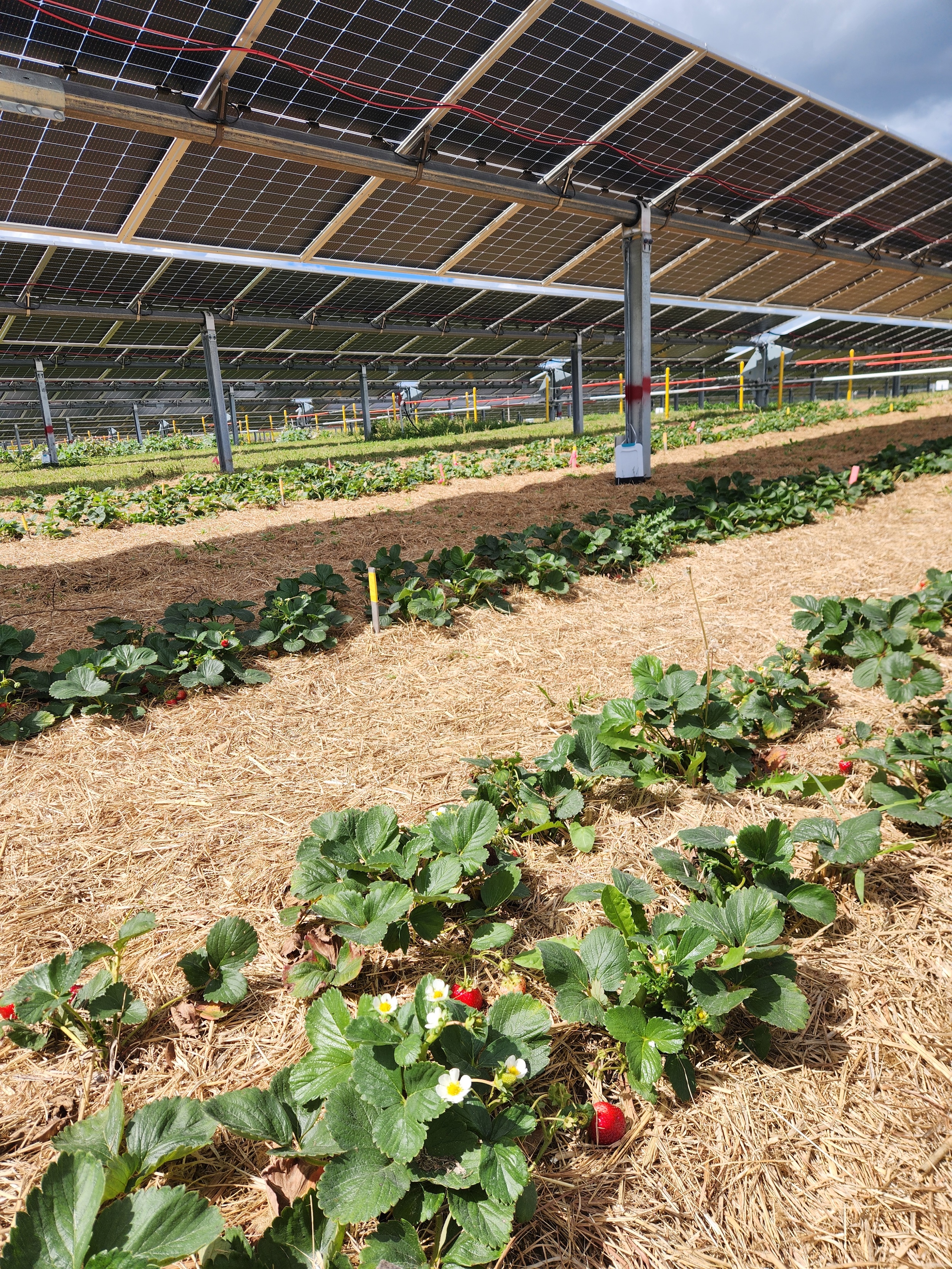
High-value crops such as berries, leafy greens, and herbs can thrive under solar arrays where partial shading reduces heat stress and water loss. Carefully designed panel layouts create a microclimate that can improve crop quality and extend growing seasons.

Dual-use solar systems can be designed with taller panels and wider spacing to accommodate large-scale commodity crops like corn or soybeans, common in Iowa. This approach preserves agricultural productivity while providing farmers with an additional income stream from energy generation.

Solar sites can double as pastureland for animals like cattle or sheep. Grazing helps manage vegetation naturally, reducing maintenance costs for the solar operator, while farmers gain access to additional forage and land use opportunities.

Solar greenhouses integrate photovoltaic panels directly into greenhouse structures, allowing crops to grow beneath semi-transparent panels. The panels help regulate temperature and reduce excessive sunlight, while generating electricity that can offset energy costs for heating, cooling, or lighting.
Ecovoltaics is the sustainable management of solar developments to achieve ecological benefits alongside energy production. It focuses on enhancing biodiversity, improving ecosystem health, and supporting conservation goals while generating clean electricity.

Solar installations can be seeded with native grasses and wildflowers that support bees, butterflies, and other pollinators. These habitats improve biodiversity, enhance soil health, and can benefit nearby crop yields by boosting pollination services.

Wildlife corridors within solar developments are designed to maintain habitat connectivity and support species movement across the landscape. These features can help reduce habitat fragmentation and provide opportunities for wildlife to access food, water, shelter, and breeding areas.

Soil management ecovoltaics combines solar energy production with targeted land stewardship practices that improve soil health and site resilience. Common approaches include establishing native vegetation, creating beneficial microclimates through solar panel design, and integrating practices such as solar grazing. Together, these strategies can reduce thermal stress, decrease soil moisture evaporation, enhance carbon sequestration, control erosion, and support long-term ecosystem health while maintaining clean energy production.

Native prairie and pollinator plantings can transform solar sites into valuable habitat for bees, butterflies, birds, and other wildlife. Establishing diverse native vegetation helps improve ecological function, supports local species, and creates more resilient landscapes.
Improving farm productivity, resilience, and land-use efficiency through the integration of agriculture and solar energy.

Dual-use solar systems can help crops better withstand environmental stressors such as drought, excessive heat, and extreme weather. By moderating growing conditions, these systems may improve crop health and support more consistent yields over time.

The shade provided by solar panels can significantly reduce evaporation from soil surfaces, helping conserve water and improve irrigation efficiency. These benefits can be especially important in regions facing increasing water scarcity.

Planting native grasses or maintaining ground cover under solar arrays helps stabilize soil and prevent erosion. Over time, these practices can improve soil health, increase organic matter and rebuild long-term agricultural productivity.

The moderated conditions created by solar panels can help buffer crops from temperature extremes, including frost and excessive heat. In some cases, these conditions may allow producers to extend planting or harvesting windows and increase overall production potential.
Generating new revenue opportunities while reducing costs and maximizing the value of working lands.

Dual-use solar allows landowners to generate revenue from both agricultural activities and energy production. This diversification can strengthen farm finances, reduce economic risk, and create new opportunities for rural communities. Instead of choosing between agriculture or solar development, farmers can generate multiple forms of value from the same acreage.

Agricultural uses such as grazing livestock or cultivating crops can reduce the need for mechanical mowing, herbicide applications, and other vegetation management practices. This can lower maintenance costs while keeping the land actively productive.

Dual-use solar systems can help reduce expenses associated with energy consumption, irrigation, vegetation management, and routine site maintenance. These efficiencies can improve the long-term economic viability of both agricultural and solar operations.

Vegetation growing beneath solar panels can help cool the surrounding environment through evapotranspiration. Lower ambient temperatures may improve panel performance and increase overall energy generation efficiency.
Dual-use solar can deliver meaningful environmental and community benefits by supporting biodiversity, improving ecosystem health, conserving natural resources, and advancing clean energy and sustainability goals.

Biodiversity and pollinator-focused ecovoltaics combines solar energy production with native vegetation and habitat restoration practices that support bees, butterflies, birds, and other wildlife. These practices help increase species diversity, strengthen pollinator populations, and improve ecosystem health while maintaining renewable energy production.

Conservation-focused solar development can improve soil health, increase organic matter, enhance carbon sequestration, and support the restoration of native ecosystems. These improvements can generate lasting environmental benefits beyond energy production.

Solar developments can create or restore habitat for a variety of species when managed with native vegetation and ecological best practices. These habitats can provide food, shelter, nesting areas, and other critical resources for wildlife.

By producing renewable energy alongside working lands, dual-use solar helps lower carbon emissions and supports the transition to a cleaner, more sustainable energy future.
Iowa is uniquely positioned to benefit from agrivoltaics thanks to its strong agricultural foundation and growing demand for reliable, affordable energy. With millions of acres dedicated to corn and soybean production, the state has a clear opportunity to integrate solar in a way that supports, rather than replaces, working farmland.
Despite common misconceptions, Iowa receives consistent solar irradiance throughout the year. Modern solar systems are designed to capture both direct and diffuse sunlight, meaning they can generate electricity efficiently even during cloudy or variable Midwestern weather conditions.
At the same time, Iowa farmers are navigating increasing challenges, including more frequent drought, rising temperatures, and ongoing soil degradation. Agrivoltaics can help address these pressures by creating beneficial microclimates under solar panels that reduce evaporation, improve soil moisture retention, and limit erosion through maintained ground cover.
By combining energy production with active land management, agrivoltaics offers a practical path forward that helps Iowa farms remain productive, resilient, and economically viable for the long term.
Agrivoltaics in Action
Scientists are exploring how agriculture, conservation and solar energy can successfully coexist at the Alliant Energy Solar farm at Iowa State University. The site serves as a real-world research facility where scientists are studying how crops and other agricultural practices perform within and around photovoltaic panels.
Researchers are examining the economic and environmental benefits of agrivoltaics for farmers, utilities, developers, and rural communities. The research is designed to identify best practices for utility-scale solar farms in the Midwest to conserve wildlife and be a source of both food and renewable energy.
Visitors can explore the farm in person through guided tours offered throughout the summer.


No. Agrivoltaics is specifically designed to keep land in production. Dual-use solar allows farming and energy generation to coexist through options like grazing, pollinator habitats, or crop production between panels. In many cases, the land remains actively managed and agriculturally productive.
Utility-scale solar typically requires about 5–7 acres per megawatt, which is relatively modest compared to other energy sources. Overall, solar occupies a very small percentage of total land use, especially when compared to urban development, roadways, and other infrastructure like housing expansion.
No. Solar is actually one of the least land-intensive ways to produce energy when considering lifetime energy output. Additionally, agrivoltaics improves efficiency by producing both electricity and agricultural value from the same land.
Yes. Multiple studies and real-world projects demonstrate that commercial-scale agriculture is compatible with solar installations. With proper system design—such as panel height and spacing—farmers can continue producing crops or grazing livestock alongside solar arrays.
Solar costs have declined significantly in recent years, making it more accessible than ever. Financing options, federal tax credits, and state incentives can further reduce upfront costs. In many cases, revenue from leases, energy savings, and incentives helps deliver a faster return on investment than many expect.
Yes. Iowa receives reliable solar irradiance year-round, making it well-suited for solar energy production. Even in cloudy regions, solar panels generate power using diffuse light, not just direct sunlight. National datasets like the NSRDB (National Solar Radiation Database) confirm consistent solar potential across the Midwest.
Solar occupies a small footprint compared to expanding residential and commercial development, which continues to be a much larger driver of land-use change. Agrivoltaics helps preserve open space and farmland while still supporting energy and economic needs.

TNC has reached an incredible milestone of more than 5,000 acres protected at Land of the Swamp White Oak Preserve.

See how TNC is uniting farmers to enhance farm resiliency and water quality in Iowa.

Learn about conservation policy in Iowa and how you can get involved by speaking up for nature.


