



Longleaf Pine Forests—A Tree for Our Time
Throughout nine states in the U.S. southeast, TNC is working together to restore and manage longleaf pine forest from Texas to Virginia.

Fire professionals, scientists and educators restore longleaf landscapes across the South.
Meet five TNC staff and partners from Florida, Georgia, South Carolina and North Carolina.
Remnants of ancient forests are all around us. You can see them in your local park, along roadsides and off the beaten path.
The longleaf pine is hard to miss. Even at a young age, its needles flop to the side from their weight. The eldest trees reach great heights, and their topmost branches widen with age. These remaining ancestors were somehow spared from the mass timbering of our nation’s early days. Millions of acres of ancient longleaf forests were timbered in the South. Lost with them are the unique plants and wildlife they harbored.
To bring those landscapes and species back in the face of continuous development, The Nature Conservancy has stepped in to restore these forests and build a more resilient future. Together, as a movement of nonprofits, government agencies and private landowners, we are working to restore 8 million acres of longleaf forests.
We all have a part to play in the longleaf pine’s future. TNC's connection and care for nature drives our partners and us to protect longleaf pine landscapes. As one Georgia land steward says, "This is home.”
TNC and our partners are restoring and conserving longleaf pine in the South, bringing back our unique forests with land acquisition, science and research, tree plantings, prescribed fire and community outreach.


Outreach Director and Partnership Coordinator for CFL Conservation Partnership: “My job is to share the message of the longleaf pine ecosystem. To share what was here and why we are working to bring it back."

Chattahoochee Fall Line (CFL) Land Steward: “There are always lessons to learn and observations to make on how the landscape around the longleaf changes. I observe the land and figure out what it wants.”

Education Programming Coordinator, Hooheh Cultural Burn & Reforestation Program and Waccamaw Siouan STEM Studio : “Restoring hooheh (longleaf) starts with a spark, one we can all carry into the future.”

Conservation Forester: “TNC is a critical connector in the movement to bring back longleaf pine to South Carolina. In partnership, we boost others’ contributions and increase impact.”

Preserve Manager, Tiger Creek Preserve: “Our volunteers know they’re growing the future. Planting longleaf pines is a legacy project."

TNC in Georgia works with the U.S. military’s Readiness and Environmental Protection Integration (REPI) program to acquire and conserve the lands that surround Fort Moore. We’ve conserved more than 36,000 acres in this area, known as the Chattahoochee Fall Line, and have two full-time employees dedicated to this priority region: LuAnn Craighton and Bryn Pipes.
Columbus, Georgia is the largest city in the Chattahoochee Fall Line, and thanks to Chattahoochee Fall Line Conservation Partnership and LuAnn Craighton, visitors from far and wide can experience this vast longleaf pine landscape right in the middle of the city.
Craighton works with partners to help get more seedlings growing across the region, including Columbus Botanical Garden, where TNC organized a volunteer event to plant 60 seedlings in 2025. The partners also plan to add native groundcover in the future, such as native wiregrass. Botanical Garden interpreters are excited to watch the trees grow, host related lunch-and-learns and engage with visitors to tell the longleaf pine’s story.
The U.S. military is a key partner in conserving longleaf pine forest in the South. By creating living buffers around these installations, TNC and our partners work to restore key longleaf habitat while insulating the military’s ability to train, test and operate at bases like Fort Benning in Georgia, Camp Shelby Training site in Mississippi and Fort Liberty in North Carolina.
To nurture the rural culture and heritage of this biodiverse region, Craighton also works with the next generation of conservation professionals, starting at local high schools.
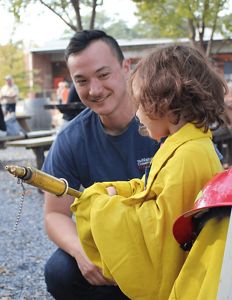
In partnership with local landowners, businesses, state agencies, the military and other community members, she partners with the Young Farmers Association to host the annual Forestry and Wildlife Expo in Buena Vista, Georgia. The event highlights careers in conservation with fire demonstrations, wildlife encounters and one-on-one conversations with industry professionals.
“For a rural community, this event reaches beyond the high school. It’s neighbors talking to neighbors,” says Craighton.


Sign up for monthly Nature News email updates.

TNC in Georgia Land Steward Bryn Pipes knows the Chattahoochee Fall Line community well. He grew up here, and the forests he explored as a child shaped his career. “I spent a lot of time in the woods and developed a passion for the plants and animals that were out there,” says Pipes.
As a hands-on caretaker of TNC’s properties in the region, he spends a lot of time among longleaf pines, observing growth and the effects of prescribed fire.
When you burn a longleaf stand, you get that instant gratification. If you keep revisiting those areas you’ve burned, it’s fascinating to watch the plant community change.
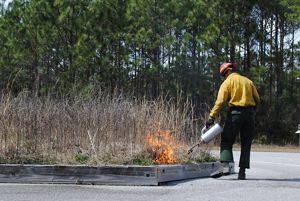
Fire is essential to longleaf pine, and so are well-trained fire professionals. TNC offers extensive training and networking opportunities for fire staff, and extends much of that training to our state and federal agency partners. Early in his career, Pipes gained experience burning military lands through Engine Academy at Camp Blanding in Florida. TNC and Florida State Parks cosponsored his Crew Boss Academy participation, where he learned the leadership skills that he passes on to other fire professionals today.
It’s this network that makes prescribed fire possible.
In Georgia, TNC crews join state, federal and nonprofit partners to form the Interagency Burn Team, a statewide group of fire professionals who can quickly and easily activate for large-scale controlled burns. TNC is also investing in fire crews through our new Chattahoochee Fall Line headquarters, an office space, workshop and crew house for seasonal fire professionals. The office is centrally located in the 36,000-acre Fall Line area, offering a location for staff and partners who often travel between southern and northern properties.

To grow, longleaf pine seed rely on open areas among other native plants like wiregrass and an open canopy so enough sunlight can shine through—both maintained through natural and prescribed fires. Fire consumes vegetation on the ground and helps support germination.

TNC partner Windy Daniels is keeping the spark of prescribed fire alive by bringing back cultural burning to the Waccamaw Siouan community in North Carolina. These cultural burns reconnect good fire with the plants, wildlife and people of the Waccamaw-Siouans' ancestral lands, as well as a tradition that spans centuries on the continent.
Fire benefits longleaf pine, called hooheh, and other plants, including Venus flytraps, a culturally significant plant for the Waccamaw Siouan. By planting the Venus flytraps, Daniels reflects that the tribal members are renewing their ancestral connections to the plants.
That connection extends to longleaf through a recent Hooheh Community Honorary Planting event. “It’s the first time all of the people in the community have come together for something like this,” reflects Daniels. “It was peaceful. You felt your ancestors around you.”
The eldest matriarch planted hooheh in a circle to grow a traditional oyoke, or meeting building. The other elders, many in their 80s and 90s, planted seeds to represent their continued care for the earth, their tribe and the seven generations of children ahead of them who would one day enjoy the shade of these trees.
The land holds stories etched in its soil, carried in its roots and preserved in the traditions of those who have called it home for generations.


As TNC in South Carolina’s conservation forester, Patrick Ma helps facilitate the Sewee Longleaf Conservation Cooperative (SLCC) that spans three counties in the Francis Marion National Forest. Within the forest, unconserved gaps remain between protected lands, a problem for land management techniques like prescribed fire. Through spatial analysis, Ma uses mapping tools to identify critical longleaf lands left to protect and how to fill those gaps. The SLCC Webmap not only shows where gaps remain, but also how large the stand is and its condition.
“When we see these inholdings on a map, we identify where we can make the most impact,” says Ma.

Using the Extant Longleaf of Significance dataset from Florida Natural Areas Inventory dataset, this map shows where longleaf is likely to exist and the condition it is in. Cooler colors indicate longleaf stands that are likely smaller, fragmented and/or missing fire for several or more fire cycles (2-3 year return intervals).
The map also includes parcel layers that represent landowners who have more than 10 acres of land within a 10-mile radius of the Francis Marion National Forest. These parcels qualify for cost-share assistance for forest management practices. Mapping and data provide a roadmap for conservation priorities, and Ma works as a connector with these landowners and government agencies. He links together funding sources that can help private landowners with prescribed fire expenses and training.
The SLCC hosts burning workshops and Longleaf Academy, a two-day workshop that covers everything from how to plant and establish longleaf seedlings, to applying herbicides and conducting safe, effective prescribed fire. With the support of TNC in South Carolina, they also host the yearly Sewee Fire Fest in Mount Pleasant, a free, family-friendly community event that brings together partners for a fun day of fire demonstrations, live music and activities.
The Sewee Longleaf Conservation Cooperative hosts Sewee Fire Fest every March. Open and free to the public, this TNC-supported education program brings together partners from across the state. This event was inspired by a nearby festival in Wilmington, NC: the Fire in the Pines Festival.
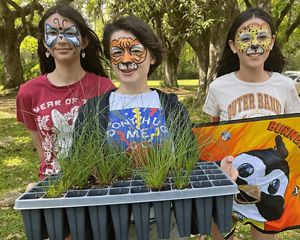
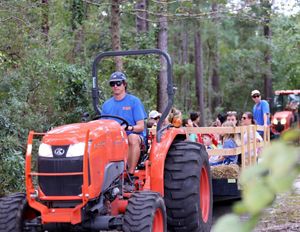

TNC in Florida’s Tiger Creek Preserve Manager, Cheryl Millett, knows the value of people power in longleaf pine planting. TNC's staff and volunteers conduct informal experiments every day. TNC preserves are living laboratories where scientists can test their theories in areas that closely resemble natural, untouched native ecosystems.
Knowing when and where to plant is part of the formula for longleaf success, as is planting the right seeds. TNC also aims to test another part of the formula: seed source.
Together We Can Plant More Trees
The Nature Conservancy’s Plant a Billion Trees campaign is a major forest restoration program that helps people and slows the connected crises of climate change and biodiversity loss.
TNC’s Venus Flatwoods Preserve's 100+ year-old longleaf pines are a lesson in longevity. This preserve in central Florida is among the southernmost stands of longleaf pine, and here the trees have been untouched for decades, a rare example of an old-growth system. These big, resilient trees are just the kind of specimen TNC and our partners would like to see across the Southeast, making it a prime location to collect seeds to be planted in other similar environments.
With the help of the Florida Fish and Wildlife Conservation Commission (FWC) Ridge Rangers program, Millett, preserve staff and volunteers ventured out to the massive old pines and used a telescoping pole to reach high enough for the perfect pinecone—one opened just enough to release seeds but yet to be eaten by squirrels and other pine seed-loving creatures.
The pinecones were then transported to an FWC greenhouse, where Lake Placid Garden Club and Ridge Rangers volunteers dried them to prepare for planting in flats at FWC’s Royce Ranch. The next step is to measure the survivability of these locally sourced seeds versus northern-sourced seeds to test the value of local adaptation.

When Tiger Creek Preserve was gifted 5,000 longleaf pine seedlings, staff and volunteers jumped into action. Preserve Manager Cheryl Millett had just two weeks to start planting, and as winter rain clouds rolled in, they planted even faster. Read the full story.


From the Indigenous People who first lived on these lands to those who work to restore them now, our fingerprints are on these landscapes. As we prepare the soil, plant new seedlings and lay down fire, these lands touch us, too.
Together, we have the people-power to bring longleaf pine forests back to the South.
People like LuAnn Craighton and Bryn Pipes, who connect with communities to catalyze conservation; Windy Daniels, who sparks youths’ interest and care for longleaf pines; Patrick Ma, who empowers private landowners to protect their own pieces of pine paradise; and Cheryl Millett, who grows passionate volunteers and staff who invest their time and talent back into the earth.
These passionate people—the educators, volunteers, land stewards and heroes behind the scenes—drive this work forward to protect and restore 8 million acres of longleaf pine ecosystems across the South.
Sign up for monthly Nature News email updates.
From prescribed fire to the wildlife who depend on southern forests, you can learn more about how The Nature Conservancy and our partners are bringing back longleaf pine landscapes.

.jpg)
