
Growing the Corridor
Staff stories on the past, present and future of land conservation in Florida and Georgia.
By Carson Mitchell Peña

Wendy Mathews wears a sterling silver panther on her necklace. We’ve met at a local café to talk about her legacy as she celebrates 30 years in conservation.
Naturally, we start from the beginning. Mathews grew up in a timber family in Southwest Missouri, no stranger to the forest and its creatures. Catching frogs and fireflies, her love for conservation began with animals. When she left home for Florida State University in Tallahassee, she fell further in love with biodiversity and immersed herself in the Big Bend’s natural wonders any time she could.
The St Mark’s National Wildlife Refuge was my stomping grounds. I was going down after class, even just a couple hours at the end of the day before it got dark. Just to run down there and bird watch or go to the lighthouse.


Pioneering landscape-scale land acquisition
With her degree in hand, Wendy began her conservation career as a volunteer with the Florida Areas Natural Inventory, which was started and managed by The Nature Conservancy in Florida. It was the early 1990s, and her job was to map field biologists’ notes, taking their physical, scribbled paper findings—sand skinks and scrub jays, for instance—and placing “dots” on a map to represent their observations. She was contributing to what would become the foundation of the Florida Wildlife Corridor.
Then, as it is now, data is the bedrock of conservation. As data advanced, TNC was able to learn more about landscapes and make ever more strategic land-buying decisions.
What is the Florida Wildlife Corridor?
The Corridor is a vast, 18-million-acre network of forests, rivers, ranches and farms that connect the Florida Everglades to the Georgia and Alabama borders. It’s made up of the lands and waters we have to save now in order to protect safe movement pathways and habitat for wildlife.


This science-based approach came in handy during the influx of conservation funding in the early 2000s. Through an agreement with the state of Florida, TNC bought land on the state’s behalf, identifying quality conservation tracts, facilitating landowner relationships and purchasing properties for public ownership. Many of these buys make up some of Florida’s beloved state parks—like Torreya State Park in north Florida and Kissimmee Prairie Preserve State Park in central Florida—and national properties too, like Everglades National Park and south Georgia’s Okefenokee Swamp National Wildlife Refuge.
As the state’s agent, every transaction informed and improved the land-buying process. This relationship helped form lasting acquisition standards that the state uses today.
Over the years, Wendy watched the maps change. Concentrated hubs of conservation lands expanded across the Panhandle, central Florida’s Lake Wales Ridge and a new focus area: the 30,000-acre Panther Dispersal Zone in southwest Florida. True to her passion for wildlife, Wendy was enraptured by the big cat that now graced her neck.


Conservation at the pace of development
Development in Florida was intensifying. The boom that started along our east and west coasts was marching toward the center of the state.
To move at the speed of development, with their big dollars and fast closing processes, we too had to pivot. TNC’s strategy shifted to not only quality lands, but quantity too. And so we waded into more uncharted waters: conservation easements with agricultural partners.
Our first cattle ranch easement closed in 2004. Others followed, and we secured our first conservation easement with a citrus grove in 2015. These places added key pieces to the patchwork quilt we were weaving.
The FNAI Florida Ecological Greenway Network data set and conservation easement models were working. By the 2010s, Florida had become a national model for conservation, touting multiple state park medals, successful funding models like P2000 and Florida Forever and continued growth and collaboration among non-profit partners and land trusts.
But, there was something missing: storytelling. That’s where the Florida Wildlife Corridor came in.
On the national stage, a main character arose. The Florida panther became a symbol for wildlife movement and what we stood to lose if we didn’t urgently protect Florida’s remaining habitats. The main audience, the lawmakers who controlled annual conservation funding, were moved to action. In 2021, the Florida Wildlife Corridor Act was signed into law following unanimous bipartisan support, encouraging and promoting investments in Florida Forever (FDEP) and Rural and Family Protection Program (FDACS). Since the act was signed, nearly 500,000 acres have been approved for conservation.

With a background in law and urban and regional planning, Lindsay joined TNC in Florida in 2017.
The future of conservation
Just as Wendy Mathews' early work with data shaped today’s frameworks, the progress we make today will shape the future of conservation for decades to come. TNC in Florida's Director of Protection, Lindsay Stevens, shared that vision with me during another coffee conversation.
“The future of conservation is land management,” says Lindsay, with a clarity that comes from her experience in closing some of TNC’s largest land deals. Her blue-green eyes are resolute and determined.


Land management funding has always been at the top of TNC’s legislative advocacy list, says Lindsay, whether we’re restoring lands on our properties or those of our partners. Returning these ecosystems to their near-original state has included reintroducing fire in longleaf pine forests, growing native grasses and trees in our preserves’ nurseries or combatting stubborn non-native invasive plant species that harm the fragile balance of Florida ecosystems. TNC also facilitates long-term, collaborative planning committees for landscape-scale restoration, such as longleaf cooperatives and Readiness and Environmental Protection Integration (REPI) Program working groups.
But, what about non-conservation lands, like those that have already been lost to residential and commercial development? Lindsay says there’s room for us to restore balance there too.

Corridor Compatible Community Design Guidelines
Co-created by TNC and a landscape architecture firm, the guidelines help developers and decision-makers center sustainable solutions in their communities. The guidelines address wildlife, water and how communities can connect with nature in their built environments.
Development hasn’t slowed, and it may never let up, with its insatiable appetite for raw land serving the estimated 1,000 people who move to Florida every day. So, we bridge the divide and work conservation into developers’ bottom line. TNC is helping change the game, influencing developers and other decision-makers to build smarter, with our water and wildlife in mind.
Lindsay and her team debuted their Corridor Compatible Community Design Guidelines at the Florida Wildlife Corridor Connect summit in 2025. At that 700-person partner event, Lindsay also shared another vision: taking the Corridor beyond the state line. She moderated a panel, Scaling Corridor Protection: A Bioregional Approach that joined Okefenokee Swamp Park’s Kim Bednarek and Deputy Director of TNC in Georgia Jason Lee.

Scaling across state lines with data and industry partnerships
For decades, TNC has helped protect key hubs at the Florida-Georgia border, including the Red Hills near Tallahassee, the Okefenokee watershed in Baker and Nassau counties and lands on the Florida side of the St. Marys river. Now, with lessons learned in Florida, our neighbors in Georgia are helping stretch the impact of the Florida Wildlife Corridor in their state.
One of those recurring successes of the corridor is data. The UF Center for Landscape Conservation has strengthened and expanded the GIS capabilities in Florida, and they are now working with Georgia to develop similar data models that complement the state’s current hub-based corridor system. TNC in Georgia’s Deputy Director Jason Lee talked to me about this evolution in data and the evolution of what’s possible along the border that our states share.
Life along the Florida-Georgia line
The Red Hills, Okefenokee Swamp, St. Marys River and Cumberland Sound.
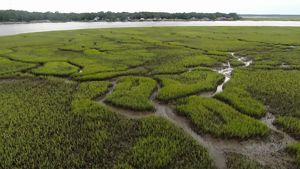

Crooked River: A marshy island formed of mud and marsh grass in the Crooked River in southeast Georgia. © Russell Mick
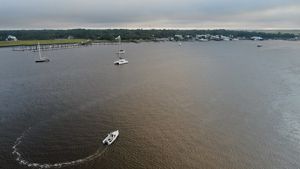
A recreation economy: The St. Marys River widens near the town that bears its name. Marshes line the banks where boats dock and move up and down the river and to the Cumberland Sound. © Russell Mick
Okefenokee Swamp: Lily pads and cypress trees are among the many plant species that thrive in the Okefenokee National Wildlife Refuge. © TimothyJ/Creative Commons
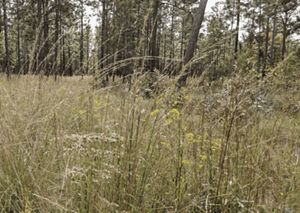
Restoration in the Red Hills : Wiregrass, goldenrod and other groundcover at a longleaf pine restoration site, Tall Timbers Research Station near Tallahassee, Florida. © Carson Peña
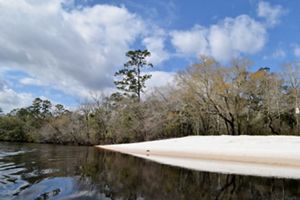
St. Marys River: Surrounded by floodplain forests of oak and pine, the blackwater river runs from the Okefenokee Swamp to the Cumberland Sound. © Carson Mitchell Peña/TNC
Jason speaks with a timbre that reflects his Georgia roots and connection to place. Hailing from the Georgia Department of Natural Resources, he’s not only versed in the processes and protocols of conservation here in the southeastern tip of his state, but he’s also been personally invested in this area all his life. This is home. St. Simons, Savannah, Athens, Augusta—he’s Georgia through and through. But he isn’t mutually exclusive in his land protection work.
“If the Florida-Georgia corridor is realized, we'll go from South Carolina all the way to South Florida,” he says. Between the St. Marys and Savannah rivers that frame the Georgia coast, Jason has been connecting hubs along other treasured rivers, the Altamaha and Satilla, and the Okefenokee Swamp, which connects directly to Florida’s Osceola National Forest.
The swamp’s black waters flow oceanward through the St. Marys and Suwannee rivers. Eastward, water travels through Georgia’s extensive tidal system, draining through green-gold marshes and into the Cumberland Sound. It’s water that connects our conserved lands here in the state’s southeast corner, and with collaboration between Florida and Georgia partners, the Florida Wildlife Corridor can find space to grow here beyond its borders.


Protecting land now is critical. We’re in a sweet spot today; it’s now or never.

A new development replaces what was once a forested area in St. Marys, Georgia. The residential community includes a golf course and is surrounded by trees and nearby river.
Like Florida, southeastern Georgia is booming with development. Jason laments some timber practices but acknowledges another shared corridor ingredient: industry partnerships. Timber was historically a major money-maker in the area, due to both the forests and the many mills scattered around the rural landscape. Like cattle ranches and citrus groves in Florida, Jason works with timber partners to protect forests with conservation easements.
“From a biodiversity standpoint, the timberlands are functioning as corridors for some species,” he says. “Keeping enough timber in these areas will help the local economies, and we'd rather have that over rooftops.”
Aligned on a clear vision for wildlife movement
In Florida’s citrus groves, biologists have documented wild turkey, racoon, alligator and bobcats, which is a similar observation in Georgia. Another surprising animal we share on our working lands: Florida panther.
“Historically they would have been here,” says Jason, and when asked a similar question, Wendy agrees. While the validity of sightings is up for debate, Jason is hopeful.
“If the population recovers—if the Florida Wildlife Corridor works—they will definitely be here,” he says. “It's only a matter of time.”
I ask Wendy what she thinks. “That's the goal of the Corridor,” she says. “We want to see panthers up to the state line. We want to see them crossing the [St. Marys] river.”
I press further and ask, “If they got to the southern Appalachians in 200 years, that would be us winning, right?”
Her dark brown eyes look at me and then glance downward as she touches one hand to her crossed elbows.
“Carson, that gave me goosebumps.”


Migrations in Motion
The Florida Wildlife Corridor connects wildlife pathways from the Everglades to the Okefenokee. As temperatures warm and sea levels rise, many wildlife species are expected to move northward through the Appalachian mountains.
Explore the mapA legacy of land conservation
In 30 years, Wendy has seen a lot of change. Through experience and experimentation, she’s helped build the foundations of land acquisition in Florida. Humble, she knows she’s only one individual in an ever-flowing movement of conservationists, but she takes pride in her contribution to the patchwork of protected land in Florida.
“Just seeing the green on the map and knowing that I helped get that done, as a team effort, it’s amazing,” she says, noting her fellow acquisition pioneer at TNC in Florida, Angela Klug.

Wendy J. Mathews, conservation projects manager for TNC in Florida, standing in front of the State Road 80 wildlife underpass near LaBelle, Florida.
As strong today as it was 30 years ago, Wendy’s motivation to protect wildlife remains. As we finish our coffees, her gaze is distant, as if she is visiting all the places we’ve talked about this morning: the life-filled marshes of the Gulf coast, the canopy of palms at Highlands Hammock State Park, the stark white sand bars of the St. Marys River.
For conservationists like Wendy, Lindsay and Jason, land conservation is more than the title documents they’re printed on. Protecting a wildlife corridor isn’t a mere checklist but a living, lasting legacy—a gift that gives every day to the generations that follow us.
Story written by Carson Mitchell Peña, a staff writer based in Tallahassee, Florida.
Help us connect the Corridor across state borders
For decades, committed supporters like you have helped protect more than eight million acres in the Florida Wildlife Corridor, safeguarding precious habitat for panthers, black bears and other animals in the southeast.


