

From Floodplains to Main Streets: Restoring the Magnificent American Elm
In the coming months, these American elms may show us the way to recovering from Dutch elm disease.

On a sunny late-May morning in this western Vermont town, a small team of researchers from the U.S. Forest Service and The Nature Conservancy began injecting thousands of young American elms with the disease that has essentially wiped out North America's iconic elms. These young elms—only about 12 feet high—were bred from dozens of individual trees in the Northeast that have survived Dutch elm disease. Over the coming months, researchers will see which young trees survive Dutch elm disease and direct those trees to a breeding program, greatly increasing the genetic diversity of proven disease-tolerant elms. The ultimate goal is to use trees like these to restore American elms to floodplains and backyards throughout New England and improve the ecological health and function of New England forests. This effort to breed disease-tolerant elms has grown from a decade’s long partnership between the U.S. Forest Service and The Nature Conservancy, with critical support from Vermont Department of Fish and Wildlife, academic partners, contractors, private landowners, and funding from private foundations.
Without elms, our floodplains are incomplete. Bringing back American elm is one way we can fortify these critical natural systems that provide us with so much.

A Natural Climate Solution
Healthy forests are a powerful natural climate solution, helping reduce and store carbon from the atmosphere. To restore the U.S.’s forests, we need a supply chain of many species of resilient seeds and trees that can survive in a changing climate. American elms are just one important part of our reforestation work.
The Nature Conservancy's work of breeding disease-resistant American elms started more than a decade ago when then-TNC ecologist Christian Marks was researching floodplains throughout the Connecticut River watershed. Floodplains are not only flush with biodiversity, they're also critical for reducing the impact of flooding and improving water quality in rivers and streams. Marks and his team made detailed notes of more than 100 sites and measured some 15,000 trees. Among Marks' key findings was that there was a dire need to restore the function and diversity of this important forest type. And because American elms are both uniquely well-suited for healthy floodplains and extremely hard hit by Dutch elm disease, scientists need to find and carefully breed disease-resistant elms to enable forest restoration.



Support Elm Restoration
If you want to help support the work of restoring the American elm, please contact Catherine Newman, Director of Philanthropy for The Nature Conservancy in Vermont.
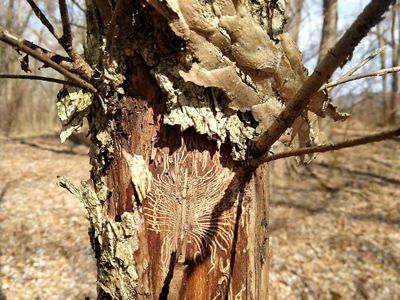
Elms not only once had a firm place along rivers and streams, they also graced parks and streets throughout eastern North America. With their towering height and graceful vase shape, they formed shady archways along streets, inspiring place names like "the Elm City" and "Elm Street." The iconic elm began a slow downfall from Dutch elm disease in the late 1920s, with a shipment of wood from the Netherlands to Ohio. The disease is a non-native fungal pathogen that can be spread by both native and non-native bark beetles. In the 1950s and into the 1970s, Dutch elm disease spread throughout the continent; by the late 1980s, most large American elm trees died. While some American elms can continue to reproduce, they die at a young age- before they get big, mature and suitable for restoring floodplains and creating shady city streets.

To breed survivor trees, scientists had to find trees that managed to survive Dutch elm disease. Teams from TNC and the U.S. Forest Service set out across the Northeast to find survivor elms, meeting many landowners in the process. Arborists were hired to climb high into the elms and cut twigs for propagating.

Twigs from survivor elms were sent to a U.S. Forest Service research facility in Ohio, where they were carefully managed for controlled pollinations and propagation from leaf bud grafts, resulting in a mixture of experimental crosses between elms and clones of the original survivors.

At a TNC preserve in Benson, Vermont, 5,300 American elms—all experimental crosses from New England survivor elms—have been planted and raised over the past few years. TNC has also established another experimental elm site at a northern Vermont wildlife management area and planted others at sites throughout the state. Two plantings of clones of the New England survivor elms were established in Ohio by the US Forest Service, allowing scientists to understand performance and disease resistance in a different climate. TNC and US Forest Service staff have carefully tended the elms, making sure they are pruned, healthy and ready for the next step: injecting them with Dutch elm disease to test their resistance.
Each American elm that's part of this propagation effort has its own unique identifying number, so that researchers know exactly which trees and sites the parent tissues have come from.


Tree breeding is slow work that requires a dedicated community and a good deal of faith. But for American elm and other species facing heavy losses from invasive pests, it remains our best tool for protecting these trees and restoring the systems they once occupied.


Leila Wilson and Kathleen Knight, both researchers for the U.S. Forest Service, have led the efforts to propagate American elms that show strong resistance or tolerance to Dutch Elm Disease. Wilson was on the team from the Forest Service that injected the elms in Vermont with the disease. Over the coming months, some of the trees will show signs of having Dutch elm disease. Some will die within weeks; others may take months. But some will survive, showing resistance to this deadly disease. Survivor elms whose progeny and clones performed well in these tests will be propagated, along with other surviving elms, to ultimately develop seed orchards to produce diverse populations of American elms proven to withstand Dutch elm disease. Those trees may ultimately be the new generation of American elms to restore North America’s floodplains.
If you want to help support the work of restoring the American elm, please contact Catherine Newman, Director of Philanthropy for The Nature Conservancy in Vermont.
More Stories

To Help Iconic Trees, Inject Them with Disease
TNC's Gus Goodwin tells why injecting disease into trees might save the American elm.

Trees in Peril
This visual story shows the threats facing North America's ash, elm, hemlock and beech trees and the urgent efforts to save them from invasive pests and pathogens.

Natural Climate Solutions
Natural climate solutions offer immediate and cost-effective ways to tackle the climate crisis—while also supporting healthy, thriving communities and ecosystems.