

Searching for Heat-Resilient Corals to Protect People and Nature in the Face of Climate Change

In the Republic of the Marshall Islands, students are learning to carefully collect small coral samples from nearby reefs. Two thousand miles away in Hawai'i, a group of fishers from the Olowalu community gather to discuss ways to restore declining fish populations. And on the other side of the globe in Belize, government officials trace geometric shapes on to large coastal maps.
Each group has its own story to tell about their local coasts and waters, but they all are working toward a common goal: protecting coral reefs recently discovered to have the special ability to survive climate change.
We need to find those resilient corals and protect them before they are lost to other threats, so that reefs have a chance to survive climate change.
Around the world, rising ocean temperatures are devastating corals. More than 84% of the world’s reefs have been hit by temperatures hot enough to cause “bleaching,” during which corals expel their colorful, life-sustaining algae and turn white.
The warming waters and increased bleaching caused by climate change are pushing corals toward the “tipping point” of extinction, potentially erasing them forever.
But as scientists study these threatened reefs, they have noticed something surprising—the damage is not uniform. Some corals keep their colors and survive.
These heat-resilient corals offer a powerful tool—and hope—in the fight against climate change.
“We know there are corals out there that are surviving heat waves and increasingly warmer temperatures,” said Annick Cros, The Nature Conservancy’s resilience science lead for Global Oceans. “We need to find those resilient corals and protect them before they are lost to other threats, so that reefs have a chance to survive climate change.”


Finding “the best of the best” corals to fight climate change
Climate change not only threatens coral reefs, but also the communities that rely on them for survival. Coral reefs are the most biologically diverse and economically valuable ecosystems on Earth. They cover less than 1% of the planet’s surface, yet they support 25% of all marine life. More than 1 billion people rely on coral reefs for food, income and daily survival.
The discovery of heat-resilient corals offers hope for the future—but hope without action is not enough. These unique corals face other potentially lethal threats from pollution, overfishing and unsustainable development. Conservation strategies that reduce these pressures allow heat-resilient corals to continue supporting people and nature in the face of climate change. Ensuring their survival also means they can serve as “mother reefs,” spreading larvae—baby corals—to other areas where they can grow into new resilient reefs.
To protect these special corals, scientists first must find them. To that end, The Nature Conservancy partnered with Stanford University and the Woods Hole Oceanographic Institution (WHOI) to launch the Super Reefs project. For the past three years, the partners have piloted innovative strategies in Belize, Hawaiʻi and the Marshall Islands to identify and protect heat-resilient corals.
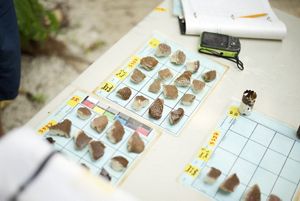
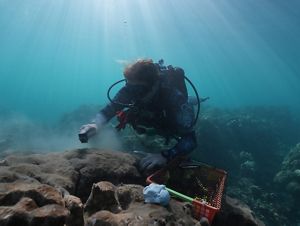
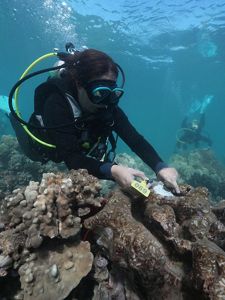
Sample Testing: Coral samples are temporarily removed from their test tanks following heat exposure so that researchers can visually document changes in coral health at different temperatures © TNC
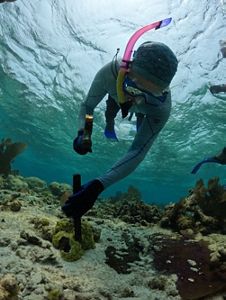
Sampling Coral: A scientist samples corals in Belize’s South Water Caye Marine Reserve in efforts to verify the location of a regional Super Reef. © TNC
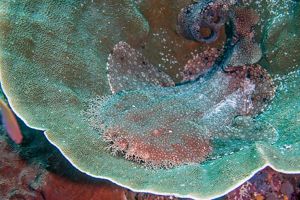
Tasseled Wobbegong Shark: A variety of species rely on healthy coral reefs for survival. © Kip Evans
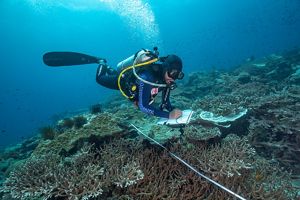
Melisa's Reef, Raja Ampat: A researcher conducts a transect dive to gather data on coral reefs. © Kip Evans
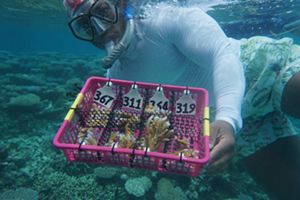
Collecting Coral: Collecting coral colony samples for thermal stress testing on Majuro, Republic of Marshall Islands. © Dan Dale
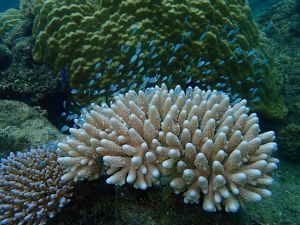
Super Reef: A coral reef identified by Super Reefs modeling as a potential thermal refugia. © Dua Rudolph
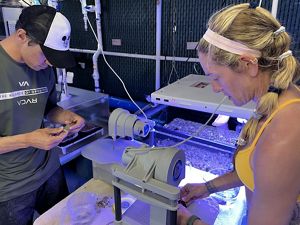
Testing: Stanford University and TNC Hawai'i personnel prepare coral samples for thermal stress testing. © David Wood
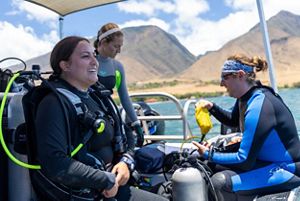
Preparing for a Dive: Personnel from TNC Hawai'i and Stanford University head out to Olowalu reef to collect coral samples for thermal stress testing. © David Wood
Preparations: A scientist brushes a coral reef in preparation to reattach a healthy control sample. © Bryant Grady/TNC
Outplanting: A TNC researcher returns a healthy coral sample that was taken for thermal stress testing to a coral reef as an outplant. © Bryant Grady/TNC
Combining cutting-edge science with traditional Indigenous knowledge, the Super Reefs team developed the “Predict, Prove and Protect” framework through which WHOI created scientific models to predict areas where heat-resilient corals are most likely to thrive. TNC and Stanford University then collected coral samples from those areas and put them through thermal testing to prove their resilience. Once their heat-resilience was confirmed, TNC began working with local communities, government agencies, conservation groups and others to help design effective protection plans to keep the reefs safe for the future.
“It has really instilled in me hope and possibility,” said Nicole Craig, reef resilience specialist for TNC in Belize. “It can get a little depressing at times seeing the decline of the reefs. But we’re finding the best of the best corals. We’re training people how to use these tools and how to support efforts that keep hope alive. It’s a fight worth fighting.”
More stories and insights in your inbox.
Get our latest updates from around the world of nature.
Get the NewsletterProtecting Super Reefs in Belize, Hawaiʻi and the Marshall Islands
In 2021, the government of Belize announced a $364 million debt conversion deal that created sustainable financing for marine conservation including the protection of up to 30% of Belize’s oceans. With the discovery of heat-resilient reefs along their coasts, Belize officials are now using data, maps and technical assistance from the Super Reefs team—as well as input from local communities—to inform their marine special plan and the creation of biodiversity protection zones. During Belize’s first-ever Blue Forum—a national event promoting science-driven ocean management—the Belize Fisheries Department also highlighted the importance of protecting heat-resilient corals.
In Hawai‘i, in the Olowalu community located on the island of Maui, fishers, tourism businesses, local officials and others who depend on healthy reefs have joined together to hold planning sessions for the conservation of super reefs discovered there. The stakeholders look through maps pinpointing heat-resilient reefs while discussing their history of living and working along the coasts, the changes they’ve witnessed over the years and their conservation priorities. In the coming year, TNC will provide technical assistance as community members develop and implement long-term plans that protect local reefs and livelihoods.

“Everyone has seen the decline of the reefs. Everyone knows something has to be done,” said Tiara Stark, project manager with TNC’s Maui Marine Program. “It’s exciting that we can share these climate-smart strategies to reinforce the resilience of the corals.”
Stark added that Hawaiʻi’s super reefs can serve as a bridge to protect coastal systems as conservation strategies take hold.
“We’re working to stop the local stressors on the coral reefs. But the reality is, that takes a long time,” Stark said. “These resilient corals help us get ahead of the curve. They’re giving us an upper hand.”

“We’re training people how to use these tools and how to support efforts that keep hope alive. It’s a fight worth fighting.”
—Nicole Craig, Reef Resilience Specialist for TNC in Belize
TNC also has trained students from the University of Hawai‘i Maui College to test coral samples for heat resilience. Along with helping determine where to target conservation strategies that safeguard super reefs, the coral samples have been strategically transplanted back to Maui’s mother reef—Olowalu—an area hit by rising ocean temperatures. Scientists are now monitoring those transplanted corals to determine which source locations, transplant sites, species and other factors have the greatest impact on coral restoration.
In the Republic of the Marshall Islands, in the Laura community located along the Majuro Atoll, the Marshall Islands Conservation Society (MICS) is collaborating with community members, government leaders and others to establish a locally managed marine area (LMMA) around super reefs discovered there. Through traditional stewardship and the latest science, MICS is ensuring the LMMA not only will keep the heat-resilient reefs strong but also will meet the needs and priorities of those who live and work along the reefs.


“As reefs around the world face growing threats, protecting those that show signs of resilience is more important than ever,” said Dolores deBrum-Kattil, executive director of MICS. “Reef refugia offer an opportunity to safeguard marine biodiversity and build more resilient communities in island nations like ours, which are especially vulnerable to climate change.”
Yimnang Golbuu, coral resilience director for TNC in Micronesia and Polynesia, said the Super Reefs project is helping empower small island nations as they confront growing climate threats.
“It’s not just the big countries that can play a role in fighting climate change,” Golbuu said. “Building the capacity and conservation expertise of local communities offers a smarter, more resilient approach to reef restoration.”

Sharing local lessons for a global impact
The Super Reefs team is part of a global movement working to identify and protect reefs that can withstand the rising ocean temperatures caused by climate change. Working with communities, conservation partners and policy leaders around the world, the team is sharing its data, knowledge and on-the-ground experience to ensure coral reefs will be around for generations to come.
“By placing practical tools in the hands of communities, we enable them to discover resilient corals on their own and lead the way in protecting them,” remarks Courtney Kleypac from Stanford University, who has been training communities at Super Reefs sites.
Marine conservationists from Belize will soon join a Super Reefs learning exchange in the Dominican Republic, where they will learn climate-smart restoration strategies and best practices for selecting and propagating heat-resilient corals. The training will serve as a pilot to launch similar learning exchanges worldwide.
The ability to identify and protect resilient reefs is an incredibly powerful tool in the fight against climate change—and a source of hope for reefs and the people who depend on them.
TNC also is working with partners to develop a Climate-Smart Reef Restoration Guide to help scientists, communities, conservationists, governments and others learn how to identify, protect and propagate heat-resilient corals on damaged reefs, and how to monitor success. The guide will be shared at global workshops and conferences, and through the Reef Resilience Network, a partnership of more than 10,000 coastal conservation practitioners and experts aimed at strengthening the capacity of marine managers across the globe.
“We are taking what we learned in Belize, Hawai‘i and the Marshall Islands, and we’re bringing that knowledge to a global audience,” said Joe Pollock, senior reef strategy lead for TNC’s Hawai‘i and Palmyra Programs. “The ability to identify and protect resilient reefs is an incredibly powerful tool in the fight against climate change—and a source of hope for reefs and the people who depend on them.”
That hope is already being seen—not just in the number of heat-resilient corals that are now being protected, but also in the growing number of people moving the work forward.


More Coral Reef Stories

Coral Reefs as Coastal Defenders
A new study published in Marine Policy estimates that reefs offer protection to up to 5.3 million people and $109 billon in GDP per decade.

8 Easy Ways You Can Help Coral Reefs
You don't have to be a scientist to have a positive impact on coral reefs.

Why We Must Keep Calm and Coral On
We can still save coral reefs—but only if we work together.