

Partnering with Indigenous Peoples and Local Communities
Wisdom Keepers
An audio series from The Nature Conservancy

Plug in, press play and be present as you listen to Wisdom Keepers, an audio series by The Nature Conservancy that shares the stories and messages from Indigenous Elders around the world about living in balance with Mother Earth.
Join host Gabriela Tejeda, a nature advocate and former TNC and NGS extern, who invites us to listen to the messages passed down from our Elders—gifts of story, song and knowledge rooted in tradition, meant for all generations.
Listen to the entire 8-episode Wisdom Keepers audio series on Spotify and Apple Podcasts.

Meet Gabriela Tejeda, your host
Gabriela Tejeda is a conservation storyteller and National Geographic Explorer. She recently relocated from the Florida Keys to Los Angeles, California, and has spent the past three years on The Nature Conservancy’s global Storytelling team. Through her work in conservation outreach and on social media, Gabriela creates powerful visuals and narrative to immerse audiences into our wild spaces.
Content Warning: These stories may contain discussion of historical and ongoing impacts of colonization, including periods when communities experienced significant loss, displacement and other serious hardships. Please take care while listening.

Tom “Sakokwenionkwas” Porter
From the depths of stars, Sky Woman fell and breathed life into the world we know today. Elder Sakokwenionkwas shares the story of his peoples’ beginnings and the ancestral teachings that guide us to live in balance and give thanks to all living beings on Mother Earth.
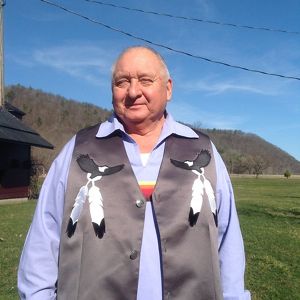
Tom at Kanatsiohareke: Tom “Sakokwenionkwas” Porter. © Kay Olan
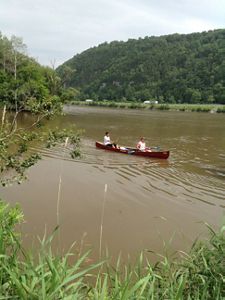
The Mohawk River: Kayakers on The Mohawk River look south from the shores of Kanatsiohareke. © Kay Olan
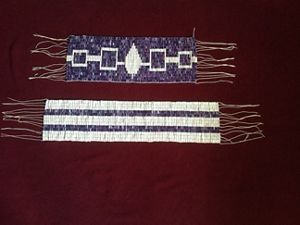
Wampum Belts: Two Wampum belts, Hiawatha (top) and Row Wampum Belt (below), are featured on a hard surface. © Kay Olan
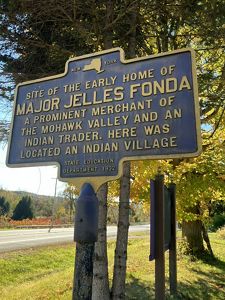
Historic Marker: A historic marker features information about Major Jelles Fonda, a prominent merchant of the Mohawk Valley located at Kanatsiohareke. © Kay Olan
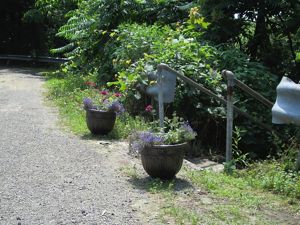
Kanatsioharek: Beautiful planters with flowers are situated at the entrance of the property. © Kay Olan
Ep. 1: The Original Instructions
Tom “Sakokwenionkwas” Porter | Mohawk
Tom "Sakokwenionkwas" Porter: Kanien'kéha enhatá:ti.
That means that the Creator used the dirt, the soil from the Mother Earth and the water and, uh, fire and the wind. And he used those elements to form out of those materials, natural materials, human men and women. And uh, the ones who did it were the twin boys that were born to the Sky woman. The Creator had given them each half the world's power to create and to bring identity to the Mother Earth.
Gabriela Tejeda: Tom Porter, who goes by his Mohawk name of Sakokwenionkwas, often tells the Mohawk creation story.
Sakokwenionkwas: And so when those twins, with the power of the Creator, began to make the human beings, they used the power of the other place called karonhià:ke. And this place where we live, uh Ionkhi'nisténha Ohwéntsia, that this planet Earth and where our great-great-grandmother came from, somewhere in the solar system, there's another planet there. It's similar to this one, and that's where she came from.
So they use that power so in that mixture of making humans, part of our power comes from the stars or the planet karonhià:ke. And also when we finish our life here on this earth, they all say, no matter if it's Senecas, Cayuga Onondaga or Tuscororas, they all say that our, our spirit, once we're done with our physical body, goes back to karonhià:ke from where it came from.
Gabriela Tejeda: Sakokwenionkwas is a member of the Bear Clan of the Mohawk Nation at Akwesasne. He’s been telling this story and many others, about the Mohawk culture, for decades. He’s told these stories throughout Indian Country and in universities all over North America, and in both the Akwesasne Freedom and Kahnawake Survival schools.
Sakokwenionkwas: But the part that I like a lot was it says, uh wa'sakotahstánion.
That means she stood up the, the humans that they made, the new humans, the new doll. And, uh, he blew in their mouth three times. He used the fire too to make them live, and then he blew in their mouth three times and then they began to blink and they began to have a mobility. And then it is said, uh, that time they took those dolls, and they stood them up side-by-side, the woman and the man.
And, uh, even though they had mobility and were alive and movement, their mind was completely blank because they were freshly made.
Gabriela Tejeda: Sakokwenionkwas has spent his life teaching the Mohawk histories, philosophies and language to achieve what he calls the Carlisle School in Reverse.
The Carlisle Indian Industrial School, located in Pennsylvania and operated by the United States Government at the time, opened in 1879, and for almost 40 years saw nearly 8,000 Native American children come through its doors.
In an effort to assimilate them, the school cut their hair, took away their traditional clothing and belongings and forbade them from speaking their languages or practicing their ceremonies.
Instead, they were taught the English language and Western trades.
There were hundreds of schools across the country trying to achieve this same goal: to systematically erase Native American culture by forcing their children to conform to Western culture.
Sakokwenionkwas: And so the Creator, through the twins and so on said, we have to transfer now, uh, my thinking to the dolls. So I need to give them knowledge and wisdom and I need to also instruct them of how they are to survive and if they're gonna survive, how they have to behave and know.
And so he began to transfer his mind and his knowledge to that new, newly made human beings at the beginning when the world was new for humans. And therein is our instructions.
Gabriela Tejeda: Sakokwenionkwas is referring to the Original Instructions, given to all people by the Creator, telling us how we are supposed to be and how we are supposed to act on this earth. He says that some people refer to it as the opening prayer or opening address. Some people call it the Thanksgiving address. He says, "They aren’t exactly wrong, but they aren’t exactly right either." And he translates it to describe its whole meaning.
Sakokwenionkwas: The word we call it is Ohén:ton Karihwatéhkwen in the Mohawk language. And if we were to take that word apart, and I'll try to do that, I think it might be close to being right. Ohén:ton means in a front or before, and karì:wa means the issues or matters that are important. So Ohén:ton Karihwatéhkwen and those are the words that you say before you discuss or meet about matters or issues of importance or anything significant, important to say that. And then when you're done with those discussions of important issues or matters, you have to close it as well with the same speech, almost exactly the same.
And so then it is spiritually, uh, has a front door and a back door. And so that's the knowledge that the Creator gave to them.
Gabriela Tejeda: The translation is important—and part of the reason Sakokwenionkwas has dedicated his life to restoring the language, traditions and culture of the Mohawk nation. Language and culture are intertwined, and without the language, it's hard to fully understand the culture.
He explains to the many young people he’s taught over the years that this speech, that was given to us in the beginning, is still being given today, time and time again, throughout the longhouses of the Mohawk nation.
Sakokwenionkwas: And this instruction was given to everybody, but mostly the native here has never forgot that. Other parts of the world, they no longer follow the original truths. And until we follow the original truths, there will not be peace. And our Mother Earth and all her sacred life will be in jeopardy. If we get back to our original truths, Mother Earth will be happy, rivers will be happy because everybody will be healthy.
Gabriela Tejeda: Sakokwenionkwas tells young people that these Original Instructions, given by the creator to humans, are our skeleton key, as he calls it, to our success and our health—on how to live a good, long life here on Mother Earth. It's spiritual and physical guidance for us all.
This ancestral knowledge was passed down to him from his elders; he continues the tradition of passing down these Original Instructions to the next generation:
Sakokwenionkwas: So this is what he put in their head, the new human beings, when the world was new. The first thing he says, you'll, you will send your words of thank you and greetings in love, first to the Creator for this wonderful universe that we live in.
And so the sun shining and everything growing, and so to our Creator, we say thank you that we can be a part of this wonderful world. And then we say to the Creator, thank you and hello, and send them our greetings, our love.
And then when the people says, now our mind is agreed, and the people hears that our mind is agreed, then all real Mohawk will say, Tó:r. Kids, woman, men, they will say Tó:r. That's the old fashioned way, formerly of the old Mohawk language, when you say yes, or you agree, you say Tó:r.
Gabriela Tejeda: The Creator then gave the next instruction to the first humans: "When you come together," he says, "you will acknowledge one another, that you are brothers and sisters in the gathering, whether it's a community, a village or a meeting or a ceremony."
Sakokwenionkwas: And you will give greetings and thankfulness and kindness to each other. And so to the people gathered, they said, we greet you and we thank you that we are together and our mind is agreed. And then the people heard that, and they said, Tó:r.
Then they said, next one, he says, now we're gonna face the earth. And at the beginning of time, the Creator said, the earth is gonna be a woman. And not only is she gonna be a woman, but she, the earth is gonna be the mother of all life. Be it trees, vegetation, be it water, be it people, or be it animals. And so the Earth is the mother to all life. Everything comes from her. She gives birth. And then when she gives birth, she feeds and nourishes all of us, just like a little baby nurses from the mother when they're little. But this Mother Earth, we get the food from her body every day until we live no more.
Gabriela Tejeda: Sakokwenionkwas says that his elders, in their telling of the Original Instructions, would say the following: That when the creator "made the earth to be our mother," he "chose the strongest, the most consistent, the most stubborn and loving mother that can be found in the universe."
Sakokwenionkwas: Because since the beginning of time, our Mother Earth has never reneged on what the Creator told her to do, and she never abandoned us or threw us away. That's why every single day, every food we put in our mouth and our children's mouth, it came from our loving mother, the earth. And so because she didn't throw us away, we will gather all our minds from our eldest, our middle age, to our kids and our babies, and with one mind we put multiple layers of Thanksgiving, greetings and kindness, compassion layer after layer, and then we give it gently to our mother, the earth.
And we say to Mother Earth, thank you that you never threw us away. Thank you, you still support us every day. Mother Earth, with love, we say thank you and our mind is agreed and all the people said Tó:r.
Gabriela Tejeda: He goes on to explain how they give thanks and greetings to the water, of which the creator gave a spirit and a soul, as well as a voice. It can whisper like a creek, and it can roar like a waterfall. Every day we drink water, he says, and it quenches our thirst, cleans our bodies and gives us life and health.
They send thanks and greetings to the corn, beans and squash—the plants that they grow and also to the ones that grow wild; to the deer, and to the maple tree, the chief of all the trees in the forest.
Sakokwenionkwas: And from the trees we get oranges and apples and plums and pears, peaches and all kinds of good food.
And from the trees, the hickory nut, walnut, all kind, pecan nut, all kind of good food for the birds, the animal and the people. And from that tree also comes the oxygen or the air that we breathe. And in the hot summer's day, when we take our rest and find comfort under the big tree in the shade that we sit in coolness to rest. So to all the trees in the world, we send our thank you, our greetings and our love. And the people when they heard our mind is agreed, they all said Tó:r.
Gabriela Tejeda: He gives thanks "to the birds that sing to us," "to the four winds that bring the changing of the seasons," "to the thunder" that replenishes the rivers and nourishes gardens and the fields, to the sun who shines and "makes the corn grow," to the moon, who enables women to bring new life.
Sakokwenionkwas: And also to the stars that fill the nighttime sky, we send our thank you and our greetings and our love and our mind is agreed. And the people, they said, Tó:r. And then it is to the four sacred beings, we call them Ratironhia'kehró:non, the powers or the spirit of the sky. They're the helpers of our Creator.
We send our thank you, our greetings and our love to them, and our mind is agreed. Then finally, we come back now to our Creator, and he's the one, he gave us several teachers through the years. And to all of those leaders, the prophets, those reminders of the Creator's mind, we say thank you. That's why we still live. That's why we still remember the Creator's teaching.
Gabriela Tejeda: Sakokwenionkwas says that once, when he was a young boy, a professor from one of the prestigious universities like Yale or Princeton, he can't remember which, came to their reservation looking for his grandfather. This man asked him what his people mean when they say Creator, or God. What are you talking about, he asked? What's the definition?
Sakokwenionkwas: And to put it simple, he gave a big, long answer.
He said, if you add up all the humans in the world and you add up all the animals, big and small, and all the fish in the river and ocean, and you count every star in the nighttime sky, and every bird that flies and sings every day and all life in its total. If you add all that up, the total or the sum of that additional of those lives, that's what we call God or that's what we call Creator.
So the Creator is in everything that lives, in the foods we plant in the garden, the big trees that grows in the woods, the Creator is in there. Every star that shines in the night sky, that's the Creator too in there. For everything that lives and everything that is, the God or Creator is in there.
And that's where it's different between the Western world and the Indigenous, real Indigenous people, that all life is sacred in this Creator.
So whenever we have a ceremony and we say Shonkwaia’tíson, or Creator, we're not talking about just a simple human man or woman. We're talking something that is inclusive of all life and that life can turn into a human. That life of that Creator can turn into a deer or a buffalo or a tree, or a hurricane or a tornado, or the sun or the moon when they want to.
Gabriela Tejeda: Many times that’s where elders receive their spiritual messages—from an animal, or a bird or the wind. He says, “That’s important to know when you are studying our nature’s spirituality.”
Sakokwenionkwas: So now he says, when you come together, he says, always you remember that you are part of the Creator. And so the Creator gave us this universe that we live in.
And so everything that we need is here at our fingertips, never to waste or never to abuse anything that was given to us, but to be grateful.
Gabriela Tejeda: Sakokwenionkwas has spent his life sharing these instructions, bringing his people back to their culture and traditions, reminding them, and all people, of these Original Instructions. Sharing, as he calls it, the skeleton key.
Sakokwenionkwas: It's the skeleton o’key that opens our tomorrows and the next tomorrows until we no longer live on this earth, how we are to connect with the spiritual world and make sure that we always respect and love our mother, the earth and everything that she makes born, that we will respect it. And if we do that, our life will be like a circle. It won't end. Because our children will continue that circle, our grandchildren and our great-grandchildren. Long after we are gone, the circle will not be broken.
Gabriela Tejeda: We want to extend a heartfelt thanks to Sakokwenionkwas for being a part of this episode in The Nature Conservancy’s Wisdom Keepers audio series. I’m Gabriela Tejeda—thank you for listening.

Ep. 2: Mother Law Is the Law of the Land
Louise "Mama Bear” Herne | Mohawk
Mama Bear: Recites Ohén:ton Karihwatéhkwen, “Words Before All Else,” the Haudenosaunee Thanksgiving Address
So greetings everyone. I'm quite honored to be part of this day. The Ohén:ton Karihwatéhkwen was the words before all else before, in our way, before we be in any, uh, matters or conversation to address our issues.
So, I just did the opening, which is the standard practice or cultural understanding that everywhere in Haudenosaunee country, before we even begin to, to do anything, we always begin and close with an acknowledgment to creation.
My name is Wakerakats:te which means, uh, resilient snow, 'cause I was born in a snowstorm. My saltwater name is Louise Herne. And, I'm a Bear clan mother. In our language we say Iakóia:ne, Woman of Noble Path. And I, I prefer everybody to call me Mama Bear instead of Louise. I'm trying to decolonize my, my introduction.
Gabriela Tejeda: Mama Bear is the Condoled Bear Clan Mother of the Mohawk Nation Council of Chiefs, an important and revered role within Haudenosaunee society.
Mama Bear: Today I get the opportunity to talk to a little bit about indigination, because in Indian country, the big buzzwords are decolonization and residential schools, and you know, the narrative just gets pretty grim after you sit in it for a long time.
Gabriela Tejeda: Mama Bear says she wants to change the narrative by changing how we talk about it. Perhaps one small way to reclaim what was taken is to reclaim their traditional names, so she does.
Mama Bear: And so I wanna begin to talk about Indigenation for a Nation and how do we begin to Indigenize how we think?
Gabriela Tejeda: Colonization is when a group of people come into a land and spread their customs and cultures, in many cases by force, to the people already living there. For Indigenous Peoples in America, that is what happened when the Europeans arrived. It meant significant loss of their traditional ways of life, their languages, customs and cultures.
Stark examples of colonization are the boarding schools that dotted the United States in the late 1800s, like the Carlisle Indian Industrial School, where Native American children were sent in order to assimilate them into Western culture.
That meant an entire generation and generations that came after them lost their heritage. Some of them even lost their lives.
As the matrilineal leader and spiritual advisor for her clan, Mama Bear's goal is to help give back the heritage that they've lost. That is decolonization, the process of undoing the worldviews, practices and systems pushed upon Indigenous People and helping restore their traditions, languages and sense of identity.
One of the ways Mama Bear aims to restore traditions and culture is by organizing rites of passage like the Ohero:kon, meaning "under the husk."
It's a coming-of-age ceremony, or puberty rite, as Mama Bear calls it. Educating young people and advising families is part of her spiritual responsibility.
She shares a photo of her at the ceremony.
Mama Bear: And these are young adolescent boys that just come out of a fast and, addressing them, each and every one, with their four-day fast and acknowledging them with, uh, feathers. So this is part of my work that I do on the ground in the trenches with the people.
Gabriela Tejeda: She also has political responsibility within her clan. Clan mothers nominate chiefs, advise them and can even remove them if needed.
Mama Bear: Haudenosaunee world is a very matrilineal, matrifocal society. And right from the get-go, in our genesis, it talked about a Sky World. Even before Earth existed, there was a Sky World from which we descended from. And part of that is where a sacred Sky Woman fell through that opening, that celestial opening.
Now they call it portals. And she came here from another world because that world was diminishing, and she brought with her our consciousness and also seeds for cultivation.
Gabriela Tejeda: From the beginning, in the Haudenosaunee creation story, it was women who nurtured the World.
Mama Bear: So in Haudenosaunee society, this lady who we call Atsen’tsí:tson, meaning mature flower or Aientsik, which means fallen star. So there's different versions of how we look at our creation story, but this is our genesis, and it doesn't begin with a man and a woman named Adam and Eve.
It begins with our sacred Atsen’tsí:tson that fell from the Sky World. There's quite a lengthy story to this. It happens in epochs of time and it, there's a part that begins in the Sky World, and then there's another part to the story when she actually gets here.
She lands on a turtle, a sea turtle, and she's already with child when she gets here and there's no earth here. And she recognizes that she needs to create, you know, she begins nesting and she has to create some kind of home for this unborn child that she, she comes with.
And so she calls upon the, the water life to help her create this home. And so she called upon the mink, the beaver and the muskrat, and each one dove and each one died except for the muskrat, who returned to the surface with a very small amount of earth in his little paw. And she took that earth and she put it on the turtle's back, and she began to shuffle and, and shuffle her feet.
And she created the earth to grow to an enormous size. So right from the get-go, the Haudenosaunee society is a culture of cultivators and procreators. And when the seeds fell from underneath her fingernails, they fell into the earth and they grew. And so, she, she started to create this home for her unborn child.
Gabriela Tejeda: Mama Bear points out that her unborn child was a girl. From the very beginning, she says, their society was led by females. That is the foundation of who they are.
Mama Bear: So, you know, because in our genesis, in our Sky Woman story, a woman started everything.
I call that Mother Law, which is also vested in our mitochondrial DNA, which is the powerhouse or the fuel to the center. So all that woman and mother does is essential to the wellness of all of us. And that's why the earth is a woman. And so, to me, Mother Law precedes and is the law of the land.
It outranks any manmade law.
Mama Bear: Deeper into the story, the Sky Woman gave birth to her daughter, who in turn gave birth to two male twins, and the twin that we call our creator Teharonhiawako, Holder of the Heavens or Holders of the Sky, took his mother and flung her into the sky, and she became the moon.
Gabriela Tejeda: Sky Woman's daughter had died in childbirth, but then corn, beans and squash came from her body. So while her mother became the Moon, she became known as Mother Earth.
Mama Bear: So, there's a mother-daughter relationship, and they're both positioned to, to lead and to guide all natural forces here. So we call this a maternal order or a maternal law.
Gabriela Tejeda: Mama Bear explains that when women dance in their long houses, they always do so counterclockwise, as both the earth and the moon spin in that direction.
They reenact and acknowledge, she says, the creation story at their ceremonies.
Mama Bear: We acknowledge all the things that sustains us in our life, from breath to water, to earth, to wind, to sun, to plant life, to animal life.
Gabriela Tejeda: Many eons later, a prophet called Rónikonrawah:nen, also known as The Great Thinker, established the clan system, this matrilineal system that put Clan Mothers at the head of the family groups. Then during a time of great strife when there was a lot of war and bloodshed between the nations, and Mama Bear says, mothers were losing their sons, a man referred to as The Peacemaker arrived.
This Peacemaker is so sacred that they never share his name.
He was born to an unwed mother and raised by her and his grandmother.
Mama Bear: He grew quickly and he became our messenger of peace.
Constructed a white stone canoe and went among the lands of the people that were blood-letting. And one of the first people to accept the message of the great peace was a woman called Jikonsaseh, and she was the mother of all nations, also termed as the Peace Mother. And she was a force to be reckoned with.
Gabriela Tejeda: The Peacemaker had a vision of all the nations united under one Great Law and living in peace. Jikonsaseh helped him achieve his goal, this Great Law of Peace. And in acknowledgment of her efforts, he solidified women's central role in Haudenosaunee society, giving women a political and social role equal to that of men.
Mama Bear: Because of her, the matrilineal, matrifocal society continued because The Peacemaker, seeing the importance of women being a foundation to a society. And so instead of dismissing her, he included the women as a foundational piece to the Great Peace. And, so in, in our way, a man cannot become chief, he cannot rise to leadership unless it's through the uterine voice that puts him into that position.
And it’s not until she crowns him with his antlers upon his brow, that he assumes the responsibility of leadership. So, I've heard them say that, you know, women are the backbone of a nation, and the men are the jawbone.
But we hold that in, in balance and, and in great responsibility.
So, through that system, which I believe is foundational to the house is the mothers. And he established the Great Law of Peace and the ever-growing, white pine tree as our symbol of that union of the Great League of Nations united under one common understanding, but it didn't exist without the women's voice in the women's position, but it creates a division of power for us.
Gabriela Tejeda: The roles The Peacemaker established for chiefs and clan mothers created a division of power, yes, and also a balance of power. For the Haudenosaunee, women hold just as much authority as men. Women are equals, and women are leaders. Even lineage is passed through the maternal line.
This matrilineal society has worked well for the Haudenosaunee people—so well that other groups took notice.
Mama Bear: When the early suffragettes met Haudenosaunee women, they befriended them. And one particular lady called Matilda Jocelyn Gage observed how Haudenosaunee women conducted themselves in our society, and she stood with envy and said, "Never was justice more perfect and never civilization higher than that in the world of the Haudenosaunee" because it was in balance and it was in harmony. And everybody had a place, everybody had a voice, everybody had a responsibility and everybody had a position to be part of a greater whole. There was nothing individualistic about it, but it was held in common and held in cooperation and understanding, to the greater mother.
Gabriela Tejeda: The Suffragettes weren't the only group that took notice of the Haudenosaunee way. Mama Bear mentions how hundreds of years prior, the founding fathers of the new United States looked to the Great Law of Peace and the democratic system it established for the Haudenosaunee for inspiration as they drafted the framework of the Constitution.
She talks about how that part is usually left out of the history books. History was lived by many different races, she says, but only told from one point of view.
Gabriela Tejeda: Mama Bear and her fellow clan mothers are responsible for the well-being of the entire community, and they are tirelessly focused on this goal, as there is much to be done. Mama Bear talks often of healing from trauma and restoring what was lost. Part of that trauma that the Haudenosaunee still carry, that they still feel the effects from, are the boarding schools that took generations of children from their parents, from their clans.
It's this relentless focus on restoring the well-being of the clan that compelled a delegation of Haudenosaunee women to go to the Vatican a few years ago.
While there, they presented the Pope with an empty mohawk cradleboard to keep overnight. In giving him this cradle meant to carry and protect their most precious beings, they hoped he would reflect on the harms inflicted by the Catholic church on their people and their children, including those who never returned home to their clans from the residential schools.
The Catholic Church played a significant role in the forced assimilation of Indigenous Peoples and the suffering they endured because of it. They went to the Vatican in hopes that the Pope would right the wrongs that began back in 1452 when the Pope at the time issued a papal decree that became the foundation for the Doctrine of Discovery.
This doctrine deemed Indigenous People as inferior and their land free to take. These principles are still embedded in United States law today.
Mama Bear: And so the Doctrine of Discovery of 1452 stated, and this law still stands today as in the Sherrill case of the Oneidas, to invade, search out, capture, vanquish and subdue our sacreds and Pagans whatsoever, and other enemies of Christ were so ever placed in the kingdoms, dukedoms, principalities, dominion, possessions and all movable and immovable goods whatsoever, how they're possessed by them to reduce their persons to perpetual slavery. And to apply and appropriate to himself and his successors, the kingdoms, dukedoms, counties, principalities and so on, so to convert them to his and their use and profit.
Gabriela Tejeda: These words set the foundation for colonization and for the centuries of trauma that Indigenous Peoples continue to feel to this day. Mama Bear points out that it was this same worldview laid out in the Doctrine of Discovery that inspired the mindset behind the saying, "kill the Indian, save the man."
The man who coined that phrase was the founder of the Carlisle Indian Industrial School, and while that particular school was operated by the federal government, many others across the United States were run by the churches.
Mama Bear: We've suffered loss of identity, language, culture, community, knowing the ways of our ancestors, knowing the ways of our spirituality, our traditions, customs and ceremonies, and so loss of our own dignity through the assault of every kind, emotional, physical, sexual and, perhaps most profoundly of all, the many years of lost love for every child that was taken and for every parent that was left behind.
Gabriela Tejeda: The immense loss suffered by generations of Native Americans has had devastating effects. Mama Bear talks about how hard they work to restore what was lost, to give back their culture, so they can guide their youth away from the devastating outcomes that can stem from this loss, like violence, drug use and incarceration.
The morning after receiving the cradleboard, the Pope apologized for the damage done to Indigenous Peoples by the Catholic Church.
Mama Bear: And we still suffer the residual effects of that historical happening. And, you know, living on a reserve, some people term them as Prisoner of War camps, because we're not free to be who we are and that we're in constant struggle against the big colonial machine that preys upon who we are.
Gabriela Tejeda: It's not hard to see why Mama Bear felt the apology wasn't enough. A year later, the Pope formally rejected the content of those doctrines, though he did not fully rescind them.
It was Michelle Shenandoah, also known by her Oneida name as Kaluhyanu:wes, from the Wolf clan of the Oneida Nation, who brought the cradleboard back home that day.
Mama Bear says they cried many tears over it, but it has become an emblem of renewed life and hope for their people.
Mama Bear: When I first heard about the Doctrine of Discovery I said, ugh, I was so angry. And I said, well, how do you undiscover something when it's been discovered? Then I realized you don't have to do that because laws are founded on precedence.
What came first and what was already on this land was Mother Law because a lot of Indigenous societies vested the authority of their generations in the mothers. So to me that is matrilineality, and it still stands today and it's a truth that no one can deny.
Gabriela Tejeda: Mama Bear says that there is much left to do, but it's efforts like this, like going to the Vatican and demanding that the church considers its past actions, that regenerates the life force through the women.
She shows a photo of her daughter and granddaughter.
Mama Bear: And then to the left is my own granddaughter, Tsiótenhari:io, my little powerhouse who leads the ancestors, and then my daughter, Iesóthsherine, beautiful corn silk. They're the fuel that keeps me going to help me know that there's another way, there's a better way in how we can heal from the traumatic things that have happened to us as women.
And so, you know, my heart really, uh, beats strong because I have a serious responsibility and I can't ignore the lives that are still yet to be born from the ground.
So, you know, in understanding all the atrocities and the genocides that we have been pummeled with, you know, as, as a mother, I thought, well, how do we change the story? How do we change the experience? How do we get our, get our young women from being murdered and missing from being assaulted, to raise healthy, good families?
Gabriela Tejeda: It was then that Mama Bear visited with local medicine people and faithkeepers and reconstructed the puberty rite, Ohero:kon, “Under the Husk.”
This rite of passage guides Haudenosaunee children from childhood to adulthood, and in the process teaches them about their heritage, their culture, their language. It teaches them who they are.
Mama Bear: And it's in relationship to our sacred corn, our onénste’, the white corn. And, uh, we took our creation story of how Sky Woman landed on a turtle's back and we created, you know, the seven rites of passage all the way from conception to the journey back to the Sky World. And no matter where you are, what stage you are in life, we all interconnect. We're not separate from one another.
So from the womb to the tomb, from the bassinet to the casket, you know, we, we have a ceremony. We have a ritual of transition. And this Ohero:kon today, we have managed to infuse identity, culture, language, ceremony back to our young adolescents.
We're harboring them and, but most of all, we're loving them in a way that our grandparents and our great-grandparents weren't allowed to. We're returning that love and putting it back into them.
Gabriela Tejeda: We want to extend a heartfelt thanks to Mama Bear for being a part of this episode in The Nature Conservancy’s Wisdom Keepers audio series. I’m Gabriela Tejeda. Thank you for listening.

Ep. 3: Live Reciprocity with Grandmother Earth
Henrietta Mann | Cheyenne Tribe
Henrietta Mann: Initially, Ma'heo'o - the Cheyenne everywhere spirit, creator - was alone in a dark void and decided to make a world and people to live in it. So Ma'heo'o created four, four sacred spirit beings who felt the power with which they had been made.
Gabriela Tejeda: Dr. Henrietta Mann has told many stories in her 90 plus years on this Earth, stories about growing up as a citizen of the Cheyenne and Arapaho tribes in Oklahoma, stories about Indigenous peoples and their large and often overlooked role in American history, and stories about the Cheyenne culture and way of life.
Henrietta Mann: I hope that this morning you all got up and greeted the sun and felt the power with which you too are filled as sacred beings. And these four sacred beings are called Nevestanevoo'e. They live in their homes, located in the four semicardinal directions of the universe. The southeast, the southwest, the northwest, the northeast.
Gabriela Tejeda: These are the directions, she says, that they follow in ceremonies, the movement of the sun going around the Earth's circle.
Dr. Mann, whose Cheyenne name is Ho’e-osta-oo-nah’e, meaning Prayer Cloth Woman, is a world renowned scholar, passionate about education and teaching Indigenous life and spirituality. She's lectured and taught across North America, including at UC Berkeley, the University of Montana, and at Harvard, and she is Professor Emerita in Native American Studies at Montana State University.
With her lifetime of knowledge and teaching, Dr. Mann shares the intergenerational wisdom of the Cheyenne way of life. Education, she says, is so important to the Cheyenne people.
She explains that there are protocols to telling the creation story, so she only shares parts of it to, as she puts it, illustrate the foundation of some Cheyenne beliefs.
Henrietta Mann: The Nevestanevoo'e were so happy to be created. And they eagerly asked, how can I help? And Ma'heo'o said, you will witness the act of creation. And they unquestionably stood back to observe. That to me is nothing more than just modeling behavior.
Step back and observe, yes, what can I do for you to be helpful?
So again, utilizing the power of thought, Ma'heo'o created four sacred substances, which we still use in our sundance today. Sweet grass, veho ohtse, which is the beginning of all plant life. Buffalo fat, hotoa vetseske, the beginning of all animal life. Sinew, ho'tseske, which holds the world together because of its strength.
The sinew is a tendon along the spine or backbone of bison or cows or other animals. You take it apart and tear it after it's dry and you have thread. And then finally, Ma'heo'o created red earth paint, ma'om'ohtse, with which to make the earth. We use it as Sundance paint today.
Gabriela Tejeda: Dr. Mann stresses that Ma'heo'o did all of this with the power of thought, that we too have a similar power, the power to create, to build a good life. Cheyennes must be careful, she says, about using our power of thinking. It's critical to always think positively and constructively, to never think an ill thought.
Henrietta Mann: Well, and still in total darkness, Ma'heo'o next created a huge body of water. It was like a lake, but it was salty, and Ma'heo'o knew that all life could and would come out of that water. And next came water beings. Can you imagine: those that lived in or on this water?
Ma'heo'o could hear the splashing of their feet and the flapping of their wings in the darkness. Then Ma'heo'o wanted to see what was created.
Gabriela Tejeda: Light began to grow in the east just as it does now every day at dawn.
The light went all the way around the horizon until it filled the sky. Ma'heo'o thought how beautiful it was. Cheyenne too, Dr. Mann reminds us are taught to think with both the mind and the heart like Ma'heo'o so that they can be compassionate people.
Compassion, she says, is critical.
Dr. Mann was taught the Cheyenne language and ways throughout her childhood by her family, as she has noted, few others were at the time. She was taught about these values, like compassion, being kind, loving, respectful, not just theoretically, but also how to live them fully in her daily life.
Henrietta Mann: Then Snow Goose Woman, who was the biggest and the strongest of all of these bird peoples, paddled to a place in the water and said, I do not see you, but I know you exist. I do not know where you are, but I know you must be everywhere. And then she stated that these water people would sometimes like to get out of the water. Can you imagine?
And so there was the birth of faith, trust, confidence, but also hope. They came into existence as Snow Goose Woman expressed. And Cheyennes today are a hopeful people. Sometimes hope is the only thing that keeps us alive.
Gabriela Tejeda: Dr. Mann's great grandmothers survived two massacres, both the Sand Creek Massacre in 1864 and the Washita Massacre just a few years later. She says that despite the many tragedies like these, she comes from a hopeful and peace loving people.
Henrietta Mann: Then Ma'heo'o said, fly and they did. They flew high in the sky, forming living patterns as they flew. Again, Ma'heo'o thought, how beautiful their wings are in the light.
And then Loon Man was first to drop back to the water and he said, I too know that you are everywhere Ma'heo'o, but he stated that they did not wish to sound ungrateful, but they wished for a dry, solid place where they could walk, rest and build their nest. Ma'heo'o said, I have made water, I have made light, I have made sky, air, and the peoples of the water.
Now you must assist me and find the earth at the bottom of the water. And of course, said the water people, how can we help you? Again, we are reminded that we must help one another to walk through this earth.
Gabriela Tejeda: Dr. Mann certainly embodies this philosophy, having dedicated her time on earth to helping both Indigenous Peoples and allies alike by educating them in Native American ways, culture and spirituality. She has said that "education is the lifeblood of my culture." Because of her work in education, there are programs and institutions across the United States, the land that the first peoples now share.
Henrietta Mann: And then Snow Goose Woman, the biggest and the swiftest of all tried. After her, her brother Loon Man tried, and then her other brother, Mallard man, they were all three unsuccessful.
They did not bring up any mud.
Ma'heo'o looked around. There came the Little Coot Boy, a little coot, dipping his head in the water and shaking the water beads from his scalp lock. And the little coot stated, I don't have the power to fly like my sister and my brothers, but with your permission, he said, I believe I can swim down and try to bring up some Earth.
Of course, Ma'heo'o said, no person can do more than his or her best. So that is a reminder and a teaching that each one of us must do the best that we can as we walk this earth.
Gabriela Tejeda: After a very, very long time, they saw a dark speck coming up out of the water. Eventually they saw the little coot in the light. This little waterbird opened his beak.
Henrietta Mann: and a small ball of mud rolled out into Ma'heo'o's hand. And with that Ma'heo'o said nia'ish, thank you little brother. Go and may what you have brought always protect you. Consequently, a coot's flesh tastes of mud. And neither human or animals will eat a coot unless there is nothing else to eat. So we see that reciprocity was born, which is one of the primary values of the Cheyenne.
Gabriela Tejeda: These trials of all the water people, she thinks, are a good lesson that sometimes we fail, but we shouldn't give up. We should keep trying.
Henrietta Mann: And then holding and rolling the mud with both hands, it expanded until there was too much mud for Ma'heo'o to hold and Ma'heo'o asked to place this mud upon the back of one of these water people.
Gabriela Tejeda: The fish tried to help Ma'heo'o, but they lived too deep in the water and their fins would cut the mud in pieces. Ma'heo'o tried to place the mud on the other water people without success. Ma'heo'o looked at the last water person left.
Henrietta Mann: Grandmother Turtle.
Ma'heo'o beckoned her, and she stated that she was very, very old and very slow, but of course she would try. Again,Grandmother Turtle, despite her age, responded to the call to serve, to be of service, something that all you do, and Ma'heo'o placed the mud upon her rounded back and the mud expanded and increased until Grandmother Turtle was completely hidden from sight.
Then Ma'heo'o decreed that the earth was to be known as our grandmother, and for her eternal service, Ma'heo'o made her amphibious. She belongs to both the water and the land and is the only being that can go swimming or walking as she chooses.
Gabriela Tejeda: Once again, Ma'heo'o showed the importance, Dr. Mann says, of living a life of reciprocity. Rewards come from doing good things. "Grandmother Turtle and all of her descendants," she explains, "walk slowly because they carry the whole weight of the world and all its people on their backs."
Henrietta Mann: After this, Ma'heo'o created four seasons. Ma'heo'o created a man person and a woman person, but they were too powerful to live together. And so Ma'heo'o placed a man person in the south with two assistants: sun, Ese'he, and thunder, Nonoma'e. And they bring spring and summer. Then Ma'heo'o placed a woman person in the north with her assistant winter man, Voh'keem, and they bring fall and winter, and when they come forth from the north, they bring a fine blanket of snow with which to cover Grandmother Earth so she can rest.
I don't think any of us have let our grandmother rest at all.
Gabriela Tejeda: The man in the south brings warmth and rain and the woman in the north brings cold and ice. These two beings continue to bring the four seasons at different times of the year, but never together because they are too powerful. This too brings a lesson to the Cheyenne people.
Henrietta Mann: So consequently, we accept change and learn to adapt to life's changing circumstances. Change. Change is a part of life.
And Ma'heo'o looked at creation and thought deep within the heart that Earth was the most beautiful of all creation.
Gabriela Tejeda: But Ma'heo'o didn't want the beautiful grandmother earth to be alone. So, Dr. Mann describes, the grasses sprang up to become her hair, and the flowers became her delightful ornaments.
Henrietta Mann: Finally, Ma'heo'o created human beings from the elements in their environment. Water, red Earth, fire, light. Then the winds from the four directions came to give them the breath of life. Ma'heo'o then charged the human beings with keeping Grandmother Earth company and to love her and to protect her for all time.
Gabriela Tejeda: Dr. Mann has spoken of how we are all made up of the earth. We are spiritually rooted in the land, that we are instructed to love our earth home, to care for her to respect her.
Henrietta Mann: So thus, it is critical to think with both the mind and the heart. And furthermore, we must continue to carry out the instructions, our first instructions to live responsibly on Earth in return for this precious gift of life.
Gabriela Tejeda: It was then that Ma'heo'o sent the four sacred beings, the four witnesses to creation, to the sacred corners of the universe, the semicardinal directions. Southeast that rules the summer; Southwest that rules the ages; Northwest, that gives good health; and Northeast, the Spirit representative, she says, of the big, holy people.
He asked these sacred beings that he had created in the very beginning with the power of his thoughts to watch over the human beings because Ma'heo'o loved them so much.
Henrietta Mann: So, we know that Ma'heo'o, the everywhere spirit and the Nevestanevoo'e, the four spirits, are today still watching over the people and all creation. Thus, we human beings must be good people as we walk this road of life. And we must protect our only home, this earth. We also know that as a person is inside, how we are inside is how we are outside, when we interact with those other beings that live in our world.
Gabriela Tejeda: When Dr. Mann was born, her grandmother held her and pointed her head to each direction, towards each sacred being. Then she lifted her up towards Ma'heo'o and finally, cradling her tiny body in her hands, brought her down to the earth. This was the Cheyenne way of introducing her to each spirit power of the world as a new member of their people.
Henrietta Mann: And the strong principles that were given to us at creation have helped us to walk long on this earth, to live in balance and in unity with one another, and to live in respectful relationship with all that exists in our earth home.
And so we have been on this road of life for a long time.
Gabriela Tejeda: Many thousands of years ago, Dr. Mann says, Ma'heo'o sent a man by the name of Sweet Medicine to the Cheyenne people. There are many stories of Sweet Medicine, including how, for four years, he was taught at their most sacred place by the spirit powers of the world. He brought these teachings to the Cheyenne people, showing them their value system and how they should govern themselves.
Dr. Mann names these values: Love, respect, honesty, generosity, humility, patience, and understanding. Sweet Medicine shared these with the people and eventually he shared a prophecy as well.
Henrietta Mann: With his power to see into the future this good man sadly told us about our time ahead, that saddened his heart.
Called prophecies, they include the following: He says, countless strangers, you will call the Vé'ho'e The Vé'ho'e will come from the east. They will bring different ways, including hunger for the land, which they will take. The Vé'ho'e will look for the yellow metal Ma'heo'o put within the earth, which makes them crazy. These strangers will bring a stick that speaks with a voice of thunder, nonoma'e.
These strangers will kill off the buffalo and you'll come to eating another kind of animal. They will ask you for your children, but you must say no - for those they take to educate will know nothing.
Gabriela Tejeda: American History is rife with stories of settlers rushing across the prairie looking for gold, but in the process displacing hundreds of thousands of Native American people from their traditional homelands. Not long after boarding schools were opened across the country and Native American children were compelled to go.
Henrietta Mann: They will forget their ways, then the climate will change, and you must attentively watch for these changes from the doors and the windows of your home so you can seek safety. Ultimately, there will be nothing you can do except to sit in the corners of your home and cover your heads with your blankets.
The earth will burn.
We are seeing this with fires and global warming.
American history, our history has shown us the vision Sweet Medicine had in the long ago time. The Vé'ho'e arrived and through treaties and federal legislation, took our lands, displaced us, confined just to tiny land areas called reservations, pueblos, rancherias.
And through one piece of legislation, the 1887 General Allotment Act, we lost 90 million acres of land. Gold, that yellow metal found in California and Colorado territory resulted in a stampede of immigrants across our lands. From our perspective, the wealth which gold represented appeared to make Vé'ho'e crazy indeed.
Gabriela Tejeda: As settlers moved west in the mid 1800's, and Native peoples were removed from their homelands, the displacement often led to violent conflict, including the massacres that both her great-grandmothers survived.
Henrietta Mann: So we have, we have walked into a time where the prophecies of Sweet Medicine continue to be fulfilled through human greed and irresponsibility. Our beautiful Grandmother Earth is suffering catastrophic damage to her health and wellbeing. When the vé'ho'e stripped us of our land, he diminished our indigenous stewardship responsibilities.
Fortunately, we continue to adhere to most of our ceremonies through which we renew the earth and restore balance to the world.
Gabriela Tejeda: Dr. Mann reflects on all that Ma'heo'o's actions teach the Cheyenne people and how Earth is our only home, so we need to take care of it. Just like the water people who stepped forward to help bring up the earth, so we are charged with helping protect and care for the Earth as Ma'heo'o instructed.
She wonders whether we all can love and respect our Grandmother Earth so we can live in sacred interdependence with her. Are we incapable, she asks, of making that sacred connection between the mind and the heart, the one so clearly taught through the Cheyenne creation story? Is there a restriction, she demands, on the boundaries of love?
Henrietta Mann: So for too long, humankind has been insatiable and disrespectful of earth, and the result is climate change.
It is far past the time for us to give back to Earth in abundant reciprocity. All she ever needed is for us to care for her as we do our children and our Elder generation. She must be protected from constant inappropriate barrage of those who have forgotten their first instructions. We have but such a little time left to exercise individual stewardship to restore the earth.
Gabriela Tejeda: She thinks if we were all willing to truly live the values of the Cheyenne, the world would be a more beautiful place as it was when Ma'heo'o created us.
After Dr. Mann's grandmother introduced her to the spirits of the world, she said a prayer over tiny Henrietta, that she live a long and useful life in service to her people.
She prayed that she not forget her identity as Cheyenne, and that she work to make their lives good and happy.
Throughout her life and teachings, Dr. Mann has tried to do this for the Cheyenne people and for all people across the Four Directions.
Henrietta Mann: I want to thank those of you who have been on the worthwhile journey to maintain the life of Grandmother Earth. Heed the lessons of First Nations people who know the secrets of living in loving kinship with all life, especially the Earth where we were placed to walk through life. Honor and remember your children as they come to walk on earth.
Thank you for hearing my words today.
Gabriela Tejeda: We want to extend a heartfelt thanks to Dr. Henrietta Mann for being a part of this episode in The Nature Conservancy’s Wisdom Keepers audio series. I’m Gabriela Tejeda – thank you for listening.
References:
https://www.neh.gov/article/build-better-future-one-we-live-today
Western Heritage Center - Cheyenne Creation Story: https://www.youtube.com/watch?v=dZlqyOQLjVY
National Humanities Medal - https://www.neh.gov/award/henrietta-mann
Yellow Bird Ways of Life https://www.youtube.com/watch?v=xBVcy61lWS8
Ilarion “Kuuyux” Merculieff
As a child, Kuuyux imagined what it was like to be a seabird. His Elders taught him the traditional Unangan ways and skills learned through fishing and hunting on how to connect with Mother Earth—listening with his whole body and being present in the mind and the heart.
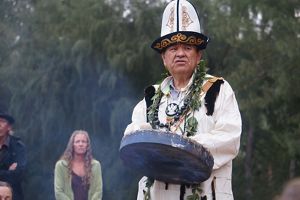
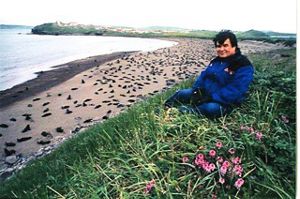
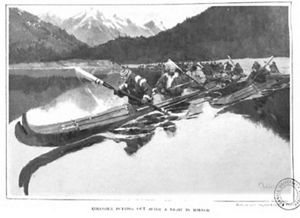
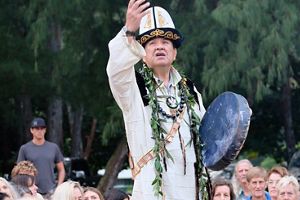
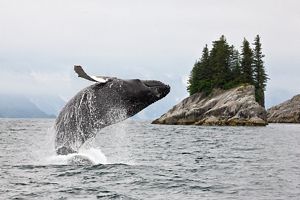
Photo with regalia: Kuuyux has worked with Indigenous peoples from around the world and participated in numerous sacred ceremonies. © GCILL and WWW
At the Beach With Seals: Having had a traditional upbringing, Merculieff has been, and continues to be, a strong voice and activist calling for the meaningful application of traditional knowledge. © Roy Corral
3-hole baidarka: An old black-and-white photo features a group of men putting out after a night at harbor. © Cornell University
Decades of experience: Ilarion (Larry) ‘Kuuyux’ Merculieff has decades of experience serving his people, the Unangan (Aleuts) of the Pribilof Islands. © CGILL and WWW
Learning with nature: A whale swims in Alaska. © Shutterstock
Ep. 4: ‘Tututhax’: Just Listen
Ilarion “Kuuyux” Merculieff | Unangan
Ilarion “Kuuyux” Merculieff: Hello, everyone. Kelum exumnax kelum kusuthax. Aang waan Ting Unangan way. Unangan usuxtax Kuuyux. Ting Cowalungan Unangan way. Ting usuxtax Kuuyux. I said that, uh, I said, good morning. The morning tastes good, which is the way we greet each other every day amongst my people, who are called Unungan. And, uh, the Westerners call us Aleut, but we don't use that because that's a name given to us by our former oppressors.
Gabriela Tejeda: That's Ilarion Merculieff, an elder of the Indigenous Unangan people of the Pribilof Islands. He is also known by his given name, Kuyuux.
Kuuyux: So it's Unungan. And, I said, hello my other self, which is another way we greet each other. And I said, my traditional name is Kuuyux, which means, like, uh, a carrier of ancient knowledge into modern times, uh, messenger, uh, to, to modern times.
Gabriela Tejeda: There's only one person given the name of Kuuyux in each lifetime. This name of messenger to modern times was given to him by the Kuuyux before him when he was just four years old.
The Unangan people, for nearly ten thousand years, lived on and stewarded the lands now known as the Aleutian Islands.
Kuuyux: We have stories about our people coming from Egypt, going across to outer Mongolia, to Siberia, to Kamchatka and across by traditional craft, not across the Bering landbridge, is what people say.
And, we developed a highly sophisticated and advanced, uh, spiritual culture for our time, where we picked the place that's hard to eke out a living, but yet we did, we were, uh, thriving in the Bering Sea.
Gabriela Tejeda: Kuuyux was born on St. Paul Island, an island in the middle of the Bering Sea, that was traditionally hunted but not inhabited by the Unangan people, until they were forcibly relocated by Russian fur traders.
Kuuyux: We called the Islands Tunax Amix, which means land of mother's brother. And this was a name that our people gave the Pribilof Islands, many, many, many years ago before the Russians came, before it was called St. Paul Island. And so the islands were used as hunting grounds and not as a place to settle.
In fact, our shaman told us this is not a place to live because it's a power center.
Gabriela Tejeda: When the Russian traders forced them from their homelands to St. Paul and the neighboring island of St. George, they suffered immensely, losing 80% of their population, he said, in just 50 years, to starvation, malnutrition, disease and genocide.
Despite these hardships, they held on to their traditions and ways of life.
One defining feature of the Unangan culture is that they were the only native Alaskan people that did not have food storage technologies, as he put it, outside of air drying. They didn't worry about where their food would come from the next day.
When Kuuyux was a boy, he got curious about this way of being.
Kuuyux: When I asked my elder on St. Paul Island, what was this all about? He says, look at that seabird over there. Do you think it worries about where it's going to get the food the next day? And are we any different? And of course the answer is no, we're not any different. Uh, that, uh, what we have done to all the people around the world is, um, separate ourselves from the land and we separate from ourselves.
Gabriela Tejeda: Before their forced resettlement to St. Paul and St. George islands, the Unangan had one of the most most densely populated shorelines in North America.
Kuuyux: And the way we did it was to be present in the moment and in the heart, trusting that everything else will be taken care of. And with that approach, we were able to thrive in the Bering Sea.
Gabriela Tejeda: Kuuyux says that his generation was the last to have what he calls a "fully intact traditional upbringing" where the whole village participated in raising the children. He describes how he had to be with his grandfather every single day, all day, for two years, starting at the age of four.
Kuuyux: I would go with him everywhere he went, including during his slave job as the, uh, janitor for the government, uh, in the government house. But anyway, we, uh, would, I would go to work with him every day. I would, uh, go have tea with him, with all of his friends. Um, I would sleep with him, I would go down to the Bering Sea and take off our shirts and spray ourselves with the Bering Sea, praying toward the east. And uh, that night we might go to the Russian Orthodox Church, because he saw no difference in where one got one’s spirituality, and that's the key. Spirituality and not religion.
Gabriela Tejeda: It was during this time, on a rare beautiful day, that his grandfather taught him one of the most important lessons of his life.
Kuuyux: In the Bering Sea, we get 20 days of sunshine a year. And it's blowing most of the time. So there's waves going and, and you know, it's, it's, it's quite blustery and, uh, this, this day was perfect. It was no wind at all.
The sea was calm, the birds were singing, the seals were barking, and it was such a beautiful day that I had to comment at four years old, I said, I said in Unangan Tunuu, in the, uh, Aleut language, um, uh, it's sure beautiful out.
And he goes, ‘Tututhax.’ That's all he said. ‘Tututhax,’ which means listen.
And what we talk about listening is listening without agenda, without your mind. Uh, just listen with your whole body. And, uh, that, that is how our people survived and thrived in the Bering Sea for over 10,000 years, and we're still there.
Gabriela Tejeda: He learned other important cultural lessons from elders during his childhood. One such lesson was in how they use their language.
Kuuyux: We, we don't talk very much, and this is the way that I learned. I had an Aachaa uh, at six years old, which is a traditional relationship between, uh, an older person and younger person, and the way we found each other—literally, we found each other—that when he saw me and I saw him, I was four years old, five years old, and I knew that that was my Aachaa. And, uh, my Aachaa knew that I was his Aachaa, so we called each other Aachaa and he taught me much of what I, I learned about being a man, being in, uh, relationship to others, uh, reverence for all life, the Unungan ethics and values and all these different kinds of things that, that we grew up on. And yet, in the time he had me under his wing from age five to age 13, he literally said no more than 200 words to me because words were considered superfluous and may be dangerous. And besides that, the best learning, uh, about Mother Earth is to be silent and, and, not, uh, clutter ourselves with thought.
Gabriela Tejeda: Kuuyux spent time with the adults in the village too, learning the women's ways, like food preparation, and the men's ways, like hunting and fishing. He talks of weekends spent camping with elders, listening to "story after story." And when he spent time with his peers, he said, his job was to play—and they would.
Kuuyux: We were outdoors every day, all day long until night. Uh, we just, just enjoyed it. I can describe what that's like, but I won't do that right now.
And you know, I, I would be greeted like the long lost son from any household day or night. I would walk into somebody's house and they say, ‘aang lakaiyax, kunguthax, ungaachcith waath, kaakux.’ Come in, sit down, eat. That's the way I lived and uh, that was quite rich.
Gabriela Tejeda: During Kuuyux's time learning the men's ways, they would take him hunting and fishing. They primarily hunted stellar sea lions, only males—the Unangan are among the few that can tell the difference—and only in the seasons when they aren't breeding. They hunt from the shore to the water, and he describes what it was like to go as a child.
Kuuyux: We'd have to go out early in the morning, like six o'clock in the morning at time of sunrise, and sometimes we'd wait the entire day for one sea lion to come by in the water.
And, I'm six years old and by the time noon arrives, I'm just daydreaming and sleepy. But the men, they never did, they never got daydreamy or sleepy and they were never active. They were never talking very much. They were just focused on the water and then all of a sudden, you know, there'd be four or five hunters there, uh, someone would say, ‘cowax ukaakux,’ sea lion coming. And instantly, and I mean instantly, all the men would turn to one spot and look at one spot in the ocean.
Now, mind you, we're, we're, I'm on an island that's 12 miles long and, and, uh, and five miles wide, very small. And we, we face 180 degrees of water and the sea lion could appear at any place, but yet they were looking at this one place.
And, uh, so I looked and looked and looked, and there's no sea lion. But they're still looking sure that the sea lion is gonna be there. So I, I said, okay, I'm gonna watch. And sure enough, the sea lion would appear in the exact spot they're looking, uh, and maybe five minutes before it appeared and it appeared in that one spot.
And I thought, wow, this is magical.
Gabriela Tejeda: He also thought it was magical that the hunters never daydreamed or got sleepy while waiting hours on the shore. Later, he discovered how they did it—by watching the seabirds.
Kuuyux: I just loved it and I loved watching seabirds, and starting at six years old. And so I would walk out of the village, very early in the morning, like four o'clock in the morning. It would be pitch black and then I would, I would get there. Um, and we can't, there, there's no lights there because it's cloudy all the time or foggy and it's just not possible. There's no light, no, no natural light, and so I walked in the dark at six years old and my parents were letting me do it. And so I would get out three miles from the isle, from the village, and go underneath this bird cliff, the closest bird cliff on the island that has intensity of wildlife. And there must have been maybe 10,000 or more seabirds.
Gabriela Tejeda: Red face cormorants, tufted puffins, horn puffins, all kinds of birds, he said, flying around everywhere, making so much noise, circling in front of the cliff at sunrise, gathering with their species to go out foraging.
Kuuyux: And they would fly within inches of me. They'd be oblivious to, to me there. And that's what I love.
And, but I, you know, I noticed how alive they were. And I said, well, I wanna be a seabird.
Kuuyux: And so I'm six years old and I say, okay, uh, I'll be a seabird. “What's the difference between a seabird and a human?” I asked myself. “Well, birds don't think,” and that's what I was thinking when I, when I was six years old. Birds don't think. And they're just, I didn't have the name for that at the time, but they're just a field of awareness. And so I said, okay, I'm going to practice being a bird.
Gabriela Tejeda: And he did. For two months he practiced being a seabird and not thinking, not having a single word come through his head, he said, and eventually, he mastered the art...and then, he went out hunting again.
Kuuyux: That's when the magic happened. I could feel the sea lion before it appeared and then I apply that to halibut fishing. We, we fish for halibut, hook, line and sinker and we can't see the halibut, but I could feel it before it hits the line.
I can tell you its behavior even when it goes over the line, because it has a lateral line down its white side that's a sensing organ, and it moves over the bait in that way. And I can tell you when it's hooked, if it's hooked by the lip or the jaw or the side of the body. I can tell you what size it is, three foot, four foot, five foot halibut. I can tell you whether or not male or female, and I can tell you, uh, how it's gonna fight on the way up. All essential pieces of information that, that a good fisherman needs. And this is, uh, uh, characteristics that we call feminine. And so we don't think, uh, negatively about the feminine side. A good hunter is the one who has these qualities.
And you, you know, it's, it's, it's obvious to me. It's not obvious to a lot of people in the world.
Gabriela Tejeda: Kuuyux says that the adults were "very aware" of the “sacredness of all things" but “especially of children."
Kuuyux: The adult's responsibility, in my culture, was to create the space for a child to learn, not tell them what to learn, how to learn or to define anything. And, uh, this is ingenious because it allows me to expand out to the maximum of my capability without the interference of an adult. And the child's job is to watch, listen and learn.
Gabriela Tejeda: One thing Unangan children learned was to be what he calls "present in the heart," to connect with Mother Earth, just like he did when he was hunting. To not define the things with words that we all feel and know in our hearts, like a beautiful day, and instead to be present with it. This is something we all experienced, he says, as children.
Kuuyux: When you, you remember as a child, when you used to go outside and you'd see one insect, maybe a, a dragonfly, and you say, wow. And you just watch that dragonfly, and that's all, you don't, you beam everything out and you just focus on that one, one fly. Uh, that's the way that our, our children were, and, and are.
Gabriela Tejeda: He worries that now we're doing the opposite, that "we've left our hearts," as he puts it, and think only with our minds. That we're moving faster and faster, talking faster and faster, thinking faster and faster with our minds, instead of our hearts, and this is the opposite of what it means to be in tune with nature.
Kuuyux: What we must do, the elders are saying, is to just be there. Be. We're human beings. That we need just to be there.
And when we are out of the head and we go to the heart and we experience it, uh, this is the way Indigenous People experience, um, communing with Mother Earth. And actually we can talk with Mother Earth. Before there was a language of one where we all could talk with everything in existence, and now we can only talk with us.
Gabriela Tejeda: He points out that of the over 200 Alaskan villages, every single one of them walks and talks slow, acts slow. That's where you can hear Mother Earth, he says, when you slow down.
Kuuyux: Uh, we call the real human being in Alaska, we have Yupʼik, Iñupiat, Dene, Unangan, means the people are the real people. These are codes given to us by our ancestors telling us about how to live, which is being a real human being means being present in the moment and in the heart.
Gabriela Tejeda: The messenger's message is clear: slow down, listen and be present with nature.
Kuuyux: I want to remind everyone, when you're doing business as usual, it's not called for today. What's called for today is to go to your heart, let your heart tell you what you must do.
Gabriela Tejeda: We want to extend a heartfelt thanks to Kuuyux for being a part of this episode in The Nature Conservancy’s Wisdom Keepers audio series. I’m Gabriela Tejeda—thank you for listening.

Ep. 5: Know Your People
Carrie Rose | Tule River Indian Tribe
Carrie Rose: My name's Carrie Rose, Barrios is my maiden name. Then I got married, uh, to a Franco. So I go by that and then, then I cut it off and put Rose. So I like Carrie Rose, 'cause that's my name. Carrie Rose.
Gabriela Tejeda: Carrie Rose has spent her whole life on her Tribe's reservation, the Tule River Reservation in California, in the San Joaquin Valley. She grew up, she says, as wild as could be.
Carrie Rose: And my mother always made sure that nature was a part—whether it was the river, animals, um, my bedding, which she sewed me, quilts and curtains. It was always birds, desert scenes. So when I sit here now, I think, my mom influenced me with nature, was all around us—so we, we are part, we tell ourselves now we're part of nature.
We're like the water, and the wind. We come from the earth.
Gabriela Tejeda: The Tule River Indian Tribe's reservation spans roughly 55,000 acres in the foothills of the Sierra Nevada mountains of California.
Carrie Rose: We have a lot of natural resources here. We have, um, giant Sequoia groves. We have the South Fork Tule River, flows right through here. In the summertime it gets little stagnant pools, but other than that, it's raging through the, um, like right now it's flowing good.
Gabriela Tejeda: The river flows right through their land, but it's been contentious with users downstream for a long time. The Tribe has fought for their water rights for years, and Carrie's not sure it will ever be settled.
Carrie Rose: When you grow up here on the res, you're either hunting, fishing, gathering wood, trying to run away from life, but you always come back home.
You're always here at home. You always have a place right here. They told us we could leave the reservation any, uh, anytime we wanted to, but I never did.
Gabriela Tejeda: Once, she says, she had a chance to leave and join her dad's Tribe, the Tachi. They were a smaller band but they had a lot of wealth from the casino, she recalls. She asked them if she'd be able to gather her basket sticks. Or firewood. Or if her boys could hunt.
No, they said, you can't do those things.
Carrie Rose: So I said, no, I don't want that. I want the hills, I want my animals. I wanna be here. My mama raised me here. And it just ended like that real quick. And um, I just seen my uncle put his head down and a little tear.
Gabriela Tejeda: Carrie called her mom a grizzly bear of a mom. She said, “Anybody knew if they messed with us, she would go after them.”
Carrie Rose: Also, she didn't grow up traditional. She was the baby of eight. Her mother passed away when she was five. And then, then their great grandmama passed away, I think when she was six or seven.
So she never was really traditional, but one thing she did was, um, learn the language. She really talked the language and, and knew the medicines and knew what to go pick.
We'd go right up the canyon, that's what we would do. We'd go right up the canyon when the snow melt and we'd get the watercress and whatever else was around through the creeks. So we'd always go up through the creek and then she'd always take me swimming. And it's so funny when, now that I'm sitting here thinking about it, we'd go right here to the river, she'd say, “come on, Carrie, I'm gonna show you how to swim.”
And I'd hang on her neck like a little cub. And when she'd go diving around, it used to be so fun. And then as I got a little bit older, she goes, “Carrie, I need to show you how to swim.” She threw me in the river in the deep swift part, and she was telling me, just dog paddle. Dog paddle. So she's taught me how to dog paddle.
I mean, our rivers are deep and scary, and I still don't like 'em.
Gabriela Tejeda: Carrie’s mom raised Carrie and her siblings by herself, after asking Carrie’s dad to leave the reservation—he was making too much shame for her, Carrie says. She didn't say a lot about why.
Her mom worked hard at various jobs to provide for her children—picking oranges, working in the olive groves, then a toy store, and eventually, the new state hospital.
Gabriela Tejeda: Carrie didn't go with her dad's Tribe because she didn't like the idea of not being on her land.
Perhaps that's why she didn't like school as much either, especially after sixth grade when they no longer went to Native schools on the reservation. Instead they went out in town, with non-Native kids.
If she'd try to run away from the bus, she said, someone would pull her back by her long braid.
Carrie Rose: I just wanted nothing to do with schools, town, stores, anything. I even fought with the fact, when did we start wearing clothes? I think, uh, I wanna say Victorian. I seen my great-grandma in a Victorian with the corset, the boot, button-up boots, the, I call it Walt Disney dress with the umbrella that matches, the gloves, all like that down in Southern California.
But we used to walk around with nothing, just a little grass skirt, no top, maybe beads, long hair, but I guess we got ogled too much. So we had to start wearing clothes.
So some church lady came and said, you people need to wear clothes. And they used to bring us boxes of clothes, big boxes of clothes we'd dig through the thing.
They even still do that to this day.
Gabriela Tejeda: By high school, many of her friends were going off to Sherman Indian High School, a boarding school hundreds of miles away in Riverside, California. When Carrie asked to go too, her mom said no, you aren't going there. You’ll get into trouble, and it’s too far away.
Although she wanted to join her friends, she also grew up hearing horror stories of the school’s past, back when it was still called the Sherman Institute.
Carrie Rose: They slaved, they beat the language. They tied you up, they threw you in the den if you spoke your language, all that stuff. My, my people never went because they said, my grandpa, um, ran those BIA people off with a, a shotgun.
“You're not taking my daughters,” he said, and shot behind them and they didn't come back. Before that, they came and took a lot of the older ones here. And um, a lot of our people came back knowing how to sew, cook, garden. They learned all the domestic things.
When, uh, the, the grannies came back, they were quilts, cooking, gardens. They were even making the boys sew their own socks.
So there's a flip side too, with that. But the sad part is when, when we'd say, oh grandma, um, how do you say this? She'd just act like she wouldn't hear you. 'Cause they didn't wanna talk about it because of their, what happened to them at the boarding schools.
Gabriela Tejeda: Sherman Indian High School’s mission is vastly different than when her grandmother was sent there—instead of stripping Native children of their culture, they teach and celebrate it.
Carrie stayed in the local school off the reservation until the 10th grade. Later, she began working as a dental assistant; that's where she was, in fact, when she finally accepted that the trauma done to her people might also be trauma she carries too.
Carrie Rose: I guess being a young age, when you're growing up, that trauma just sounds like somebody else's story. It's not my story. And it took a non-Native lady at the clinic to tell me, “Carrie, don't sell yourself short.” And I didn't get what she was meaning. Then finally, I'm so arrogant or whatever, naive, she says, “Carrie, they did your people bad.” She told me this, at the clinic.
Gabriela Tejeda: Carrie's people pass down the stories of their persecution to the younger generations in their oral tradition. They tell of the battles with all different groups, including the army regiments on horseback, and even the Bureau of Indian Affairs, known as the BIA.
Carrie Rose: So they fought the cavalry, the BIA, the militia for two rivers. There's two Tule Rivers, one's North Fork, one's South Fork. They battled over the South Fork, which the Army Corps of Engineers fought like heck—it's all in the books—to shove us over, back over here. And they put a power plant or a hydroplants over there. Big river, beautiful. But that was OG Yaudanchi area too. They got arch sites, paintings, grinding holes, swimming holes. You could see villages, mass burials right under the highway. Oh yeah. It's all there.
When I say mass burials, because, um, the cavalry came there. All the cavalry guys. But by then we were down from, my little Tribe alone, 300,000—we was down to 11 people.
Gabriela Tejeda: She's talking about her mother's people, from the Kern River, about an hour from where she lives. She says they were marched out by soldiers on horseback and that the BIA were often part of the forced relocations.
Carrie Rose: We were, we're in our own village. But we got tore up 'cause gold came to Kern. I used to yell, “It was the oil. It was the oil.” No, it was the gold. And the oil came way later. The gold came in 1850s, 18-Rush. The oil hit, 1915, 19-something.
And speaking for my family alone, um, how we got marched by the cavalry and starved and jailed, pinned up with the cavalries around us. Um, um, yeah.
We have a lot of, um, passed down oral history and the family wouldn't talk about it, but, a lot of the other family my age didn't know our language. But, but since mama hung onto the language, we'd always talk in the house, “Carrie, go see what they're talking about. They're really talking Indian in their house.”
I'd go sneak around the back and listen. Said, “Oh, they're talking about, about, um, we might get a res taken away someday.” That was a big talk. Uh, they say we might wake up one day, we're gonna have highway going through here. It hasn't happened yet, but I, I feel it coming. It's coming.
Gabriela Tejeda: Losing their land again is an ever-present worry, because it's federal land, she says. What if the military decides they need it?
There's a museum near the Kern River where she can go to remember what happened to her people. She wants to take the Elders with her. We forget the past, she says. Some of us want to forget, but some of us don't.
She talks about the effects of this trauma even today. She says when they were by the fires, her auntie Maggie would tell them about the genocide and how her people were dragged away.
Carrie Rose: She would say, “They rounded us up. We didn't wanna go,” she said, “but they rounded us up like cattle, and if we died on the way they just left us.” But, so they starved us. Um, just, they tried to wipe us out. They wanted us gone. No California, but for some how some little spark, some little fire. Some people kept going.
Gabriela Tejeda: The forced march ended at the newly established Tule River Indian Reservation.
Today’s Tule River Indian Tribe is made up of the descendants of the many Native communities forced to march there—those who survived the genocide and against all odds, kept going.
Carrie Rose: Well, here on Tule, we have 58,000 acres, but we have like, at least 13 different Tribes.
Yowlumne, Yaudanchi, Wikchumni, Paiutes, Monos, Chukchansis. We got a little bit of everybody, even some Arizona, um, Natives are married in here.
Gabriela Tejeda: When the kids go off to boarding school, they meet Native kids from all over—some of whom come back to Tule.
Carrie Rose: So every time there's a burial, birth, wedding, it's different. There's so many different Tribes, different clans, different traditions.
A lot of people grew up with no traditions, but when somebody wants to get a, a na a name their baby or, or, a burial. And usually when the burials come, it's usually, even if they're not traditional, somebody will come knocking and say, “Hey, can you guys come sing? Or can we do this? Or can we learn about the face wash?” That's where I step in and, and, um, keep carrying those traditions on.
Gabriela Tejeda: That's part of her role, now that she's an Elder in her Tribe.
She thinks about the young kids in her Tribe and how the intergenerational trauma continues to manifest for them.
Carrie Rose: Sometimes we see it in the youngsters, like they're acting up, acting out or being rebellious. It's because they, they're having these Indian dreams and feelings and don't really know who to go to.
We don't, we don't talk about those things. So, if some youngster would come and say, “Hey Carrie, I dreamed about this,” I believe him. I would take it to heart and believe him and then give him a little bit of advice.
Gabriela Tejeda: Carrie says she tries to build up the kids in her Tribe because they’re broken down.
Carrie Rose: I used to battle Creator. Why, why, why, why, why. Why you do that to my people? Why you do this? Now I'm realizing it's not just Native people. It was all kinds of other races.
But my thing was, why did you do that to us? Let this happen? But now me and Creator got a good thing going. I don't know how that flip switch flipped. Um, he has plans for each and every one of us.
Gabriela Tejeda: Carrie spent 17 years as a dental assistant and then spent another six years as a wildland firefighter. She was the only woman on the crew, putting up with the muck, as she calls it, listening to the men tell her she shouldn't be there.
Now, she sits on her Tribe's archaeology board and fulfills her role of grandmother, taking care of her grandchildren when she's needed. She's also a language keeper, thanks to her mom, teaching the youth their language.
And, she is a weaver, weaving her traditional baskets, though she might take issue with that title at the moment, since to be a weaver, she says, you have to "kick out" a basket a year, and she hasn't so far.
Foraging for her basket weaving sticks, though, remains something she loves to do. It's something she does on her land and can now do on the 17,000 acres of land recently returned to the Tule Tribe through collective efforts with community, Tribal, conservation and government partners.
Carrie Rose: It's very beautiful. It's a lot of oak trees, um, ponds, creeks, grinding holes. There's a lot of artifacts, arc sites there.
Gabriela Tejeda: Basket weaving is an important tradition in her culture, though one that fewer and fewer young people practice. Talking about the different types of baskets reminds her once again of what her people suffered.
Carrie Rose: We, we, we gather in baskets, we with the handle, seed beaters, where you hold the, the basket and um, uh, hit the seeds like chia seeds, of all things, the tiniest chia seeds, a mountain full of 'em. And they're so tiny. But I just like when the birds eat 'em. That's the birds’ food!
But that's, that's what's kind of saved us through hardships back in the day when, you know, we got genocided, we got our granaries tore up, all of our food caches were destroyed. Um, so we had to live off the land. We had to go for those berries. We had to find those roots. We had to, you eat that chia seed, um, rose hips saved the Piautes, and you know when the little rose hips come, they, you can make tea with them or even eat 'em just like that.
The, the tules, you can just pull 'em right out of the mud and eat 'em if you have to. You're not, we're not gonna starve. Long as we got a place, we're not gonna starve.
But I think it's, um, in our DNA already, you know, if, if I was to go out there and live, I, I can, so and I wanna keep teaching the kids that we could live off the land.
We got deer meat, we got fish, we got rabbit, quail, all those things. Turkeys, a lot of turkeys, big old turkeys.
Gabriela Tejeda: Carrie hopes that she can be to the younger generation what her Elders were to her when she was the little one sitting with them.
Carrie Rose: My best memories are, are talking the language with them. Uh, one showed me how to bead, one lady. She told us all the dances, all the dances I do today, the bead work and what language I know I learned from her. Those are my best memories.
Gabriela Tejeda: She still spends time sewing with an Elder, the same one who used to greet her and her friends when they got home from the bus, with big hugs for each child. Carrie remembers that this Elder made her feel better after being in school all day.
She says that the children now gravitate toward her, and she really likes that. She loves to laugh and talk with them.
Carrie Rose: So we sit and talk, we'll talk. If I was to sit with them, I would pull out beads, pull out sticks, show 'em something, introduce 'em to something cultural, even if it's a song. Even if they say, Carrie, I, I have a song coming to me. Well, let’s hear it. Let's sing it. You don't say, nah, that ain't nothing. No, let's hear it.
We wanna, you pull 'em in. And then we also gotta watch which ones, which ones really like to be around the fire. Which ones really like to be around the nature? 'Cause some kids don't, and you gotta watch. And that goes for adults too. Some adults ain't meant to be out there logging. Some adults were meant to be at a desk job.
Gabriela Tejeda: Both Carrie and her son have had dreams that one day, Carrie will be the caretaker to many kids, of all races, she says. She calls it her prophecy, that something will compel families to bring their children to her reservation—maybe an earthquake, maybe war, she doesn't know. But she sees these kids, sees herself helping them, caring for them—her rainbow Tribe, she calls it.
Carrie Rose: There's a lot of responsibility to being an Elder. I, I didn't realize that. Um, and, and making sure we take care of each other, and then we always try to invite the youth.
Gabriela Tejeda: Time is the most precious thing, she says. It's so important, she thinks, for the Elders to show up. To keep weaving, so that the younger generations see her, to keep cooking, to invite them to eat with her. Just show up, she says. Pick your battles, go to ceremony. Go to the gatherings. Attend the meetings. Show up.
She shares her advice with the kids too:
Carrie Rose: There's no future in running wild or being mad at your parents or at your siblings. You know that, that's, that's can't be that no more. I know it's there and I know family has that stuff, but you gotta try, you gotta do better. We gotta be better than that.
Gabriela Tejeda: She says that as a kid she was told to "be nice to everyone." You never know who is walking down the road.
And she reminds the children of this too—that even if they are made up of different clans, that they must be nice to each other.
She reminds them also of their heritage, of the good parts of their family history. Of things their mom or dad did, of what their grandparents did. The Elders told her, she says, to know where you come from.
Carrie Rose: Know your people. We got so separated. We got so genocided, we got so tore apart that we had to hold onto one song. If you go that way, sing that song. They know, they know that you're, we're connecting back.
So we got songs that connects us back all the way from Mexico to New York. I've heard 'em, and it's awesome.
We have to build up our res, our people, our culture, keep teaching them the songs, and that's what keeps carrying us through is our songs. The songs. Some are forgotten, some come back, some come back in dreams. Some are new.
Gabriela Tejeda: And she says, even if her people leave to go to school, or get married, they always have a place to come back to.
Carrie Rose: We're always gonna be here, open for, for them.
Gabriela Tejeda: We want to extend a heartfelt thanks to Carrie Franco for being a part of this episode in The Nature Conservancy’s Wisdom Keepers audio series. I’m Gabriela Tejeda—thank you for listening.

Ep. 6: We’re All Relatives
Dr. Dan Wildcat | Muscogee
Dan Wildcat: Good morning or good afternoon, depending on where you're at right now. I am, a Yuchi Tsoyaha member of the Creek Nation, Muscogee Nation of Oklahoma. And, uh, my name is Wildcat.
Gabriela Tejeda: Daniel R. Wildcat is a Native American scholar, university professor, author, and speaker. His writings and teachings center on Native American knowledge and wisdom, and the importance of listening to Indigenous voices to address the climate crisis.
Dan's taught at Haskell Indian Nations University for 40 years, and combines disciplines like Indigenous knowledge, environmental studies, education, and science and technology to inform his philosophies and insights on modern challenges.
Of course, being a professor, he meets Indigenous college students from all over.
Dan Wildcat: It's a de facto United Nations of Indigenous Higher Education. This semester we've got over a hundred of our federally recognized tribes on our campus from about 40 of the 50 states in the United States.
I got kids from the Everglades. I got kids from the North Slope in Alaska. I got, you know, Southern California, Southwest Maine—every place in between. Very diverse cultures and landscapes where their cultures and their identities emerged.
Gabriela Tejeda: It was one of these students that helped him understand an important lesson very early in his career.
Dan Wildcat: when I came from Oklahoma to Haskell and then started attending meetings in the Northern Plains, I'd always hear this one phrase, Mitákuye Oyás’iŋ. And I thought, well, what does that mean? I had a Lakota student in my class when I came back from one of my first meetings going up to North Dakota and I said, Hey, you, you gotta help me out, Francis.
Every time there's an invocation offered, I hear this phrase, Mitákuye Oyás’iŋ. What does that mean?
Gabriela Tejeda: Francis asks his professor if he's going to be there a while, and Dan says yes. So, Francis tells him he must run back to his room to get something to show him.
Dan Wildcat: What he brought back was this giant button. It was about two and a half, three inches in diameter. There was a time, I guess, when people liked to wear buttons and he had this button, and what it was was that first picture of Earth taken from outer space and written across it was Mitákuye Oyás’iŋ.
And I said, so it's about the earth.
Dan Wildcat: And he says, well, what that says is "to all of my relations, to all of my relatives, when we pray, we give thanks for all of that."
Dan Wildcat: And that's the earth and all the life on it. What a great lesson.
Gabriela Tejeda: It's a great lesson that has stayed with Dan all these years: that we're all relatives, us and all the life on this planet.
Dan Wildcat: Now, I'm gonna speak to you folks today, as relatives, because here's the advantage of doing that.
If I speak to you as a relative, I can just speak honestly.
Dan Wildcat: Now you might say, well, were you gonna speak dishonestly Dan? No, that's not the point I wanna make. The point I wanna make is, you know, sometimes when we work with scientists so much, they're so conservative because they wanna be able to tell you exactly what they know, and they're constantly a little bit hesitant, you know, to kind of say what their gut's telling them or what they think might happen.
Honestly, because they're doing the scientific thing, they're just gonna tell you what they think they know. Well, I'm just gonna speak honestly.
Now that has disadvantage. I can speak to you as relatives and I know that if I get something wrong as relatives, you are going to help me. You're gonna disabuse me of something.
I welcome, someone saying, Hey Dan, I, I want to challenge you on this, or encourage you to think about this a different way. I welcome that because you're my relative and I'm gonna expect you to be good relatives.
Think of the kind of even setting that creates, we're already creating a different space here.
Gabriela Tejeda: Dan shares a reminder of what his friend, Haudenosaunee Faithkeeper Oren Lyons, often says - that in the longhouse, the discussion's not over "until everyone comes to one good mind."
Dan Wildcat: I'm gonna encourage you folks, let's get of one good mind. I’m going to share you some Tsoyaha wisdoms, some insights.
Gabriela Tejeda: Dan talks first about the big picture, as he calls it, about how according to scientists, the earth has reached a new geologic age: The Anthropocene - The age of humans.
Dan Wildcat: I don't have to tell you this, but so far folks, the age of humans has not been very good for the balance of our different than human relatives on this planet.
Species loss, species extinction at a rate that's off the chart, depending on who you talk to by an order of of 10, by an order of of hundreds. It's, it's hard to say precisely, but we are losing species at an alarming rate. The loss of of habitat. and both of those together means a loss in biodiversity on the planet.
Gabriela Tejeda: Dan says, "So far, the age of the Anthropocene has been pretty destructive for the biosphere, for that thin dress our mother earth wears."
But, he has an idea of what must be done, of what is needed right now.
Dan Wildcat: As my brother M. Kalani Souza from the Big Island, uh, traditional Hawaiʻi, uh, Kupuna, Elder likes to say, “Daniel, some minds are always better than one mind.”
We need to really come together right now with difficult discussions, and then we need to be able to take action based on the knowledge, the wisdom that emerges out of these discussions. I happen to believe, and I, I say this frequently, that Indigenous voices will be the most important voices this century if we are going to successfully address climate change, because I come from people who never thought in boxes and they never worked in silos. Their classroom was out of doors. That is the where the knowledge, Indigenous knowledge resides that we most need today.
I'm speaking honestly, that's my opinion.
Gabriela Tejeda: Dan modestly says he is just one of those voices, and knows only a little bit, though his published works and books on Indigenous worldviews and the environment might suggest otherwise.
Indigenous knowledge holders, he believes, must share their knowledge, and remind us of the stark reality we're facing, because they have a specific and important worldview from which we all can learn.
Dan Wildcat: My definition of Indigenous peoples are peoples whose culture emerged out of a symbiotic relationship between a people and a place. In my Tsoyaha traditions, we could have never imagined the question, is it nature or is it culture? How could it be one or the other when both are inextricably linked in Indigenous identities, cultures, traditions. That's why we're so diverse.
Our cultures, materials, symbolic, linguistic, philosophical, educational, ceremony, song, practice language are incredibly diverse because the landscape, the ecosystems of this beautiful blue-green mother earth are incredibly diverse.
Gabriela Tejeda: He says this is the reality, the physical and spiritual reality of this planet: Diversity of landscape, of seascape, of ecosystem, of culture. And those must stay firmly linked. You cannot, should not, talk about one without the other.
Dan Wildcat: And so yes, I believe Indigenous people have old wisdom.
You know, there's a group of cognitive scientists today that have developed something they call the 4E theory of cognition, and what they argue is what we know is a function of embodied knowledge.
So these cognitive scientists have said, you know, this is all a very environmental complex thing, cognition. And they emphasize embodied knowledge, embedded knowledge, song ceremony, custom habit, enacted knowledge again, our behavior, what we do, how we do things. My dad always used to say, uh, Dan, remember, it, it's not solely important what you do, it also matters how you do things. Boy, I tell you that is, that is real wisdom.
Gabriela Tejeda: Dan says children are wonderful teachers of this. They have a way of holding up a mirror to their Elders, especially after we do something we’ve told them not to do.
“Well, you said we shouldn’t do that—but look at what you’re doing.”
They’re always watching, he says. Because, we teach through our actions.
Dan Wildcat: Yeah, you can do things many different ways, but, how you do things should be something taken steeply to heart, and, and one ought to be mindful about that. So we've got, you know, embodied, embedded, enacted, and then they use this term extended, extended out, meaning we, we create systems then where we extend this knowledge like universities and colleges, where unfortunately we've adopt, adopted a very Aristotelian notion of knowledge and we've created all these departments. So you know, you go study economics over here, business over here, natural science over here, chemistry over there, you know, politics over here. And of course the arts and literature, they have their own little silo. But we never, we very seldom put all of those together because that's where I live.
Gabriela Tejeda: Dan lives in an interdisciplinary nature, because that is his worldview. It's all connected. It can't be separate, because it isn't.
Dan Wildcat: I'm not gonna say, well, what's my environmental and economic and political thinking about the sandwich I just ordered. I, I don't break it up that way. Do I have those things operating and, and shaping, you know, my food choices? Sure. But they're deeply interrelated and that's the point, you know?
Gabriela Tejeda: We've built a world where we see things in silos because that's how we're taught. And we need Indigenous voices because they show us another way of being.
They show us, Dan says, in how they live, in how they move through the world, in how they see the world. It's the manner, he says, in which they do things, in which they live, in which they relate, in which they interact—that's how they teach.
Dan Wildcat: And we, we need that. I, I mean, I think we desperately need that today as we think about the climate crisis that is upon us. So the age of the Anthropocene... I think we need to not get too carried away and full of ourselves thinking, oh yeah, look what we've done. And, and this is a difficulty because we, some good things have happened, right?
Gabriela Tejeda: Good things, he says, like medical advancements, devices and technologies that have made life easier and more comfortable. He's not anti-technology. He doesn't want to get rid of those good things.
Dan Wildcat: What I'm saying is, I think if you take an Indigenous perspective on the age of the Anthropocene, you'll begin to realize that one of the reasons we've created the environmental crises that we have is that there are some people on the planet who think really life on this planet is all about us. Everything is about us, humankind, we're the top of the food chain. We're the smartest. We’re in charge.
Gabriela Tejeda: It is this dominant worldview, he says, that leads us to a misunderstanding— a big misunderstanding—we think that we live in a world full of resources.
He once again references his friend Oren Lyons:
Dan Wildcat: He said, you know, when the state sends their natural resources people to come talk to us about how we might better manage our waters, our lands, our plants, and our animals at Onondaga, he says, they always start by saying, well, you know, we're, we're here to talk about natural Resource management.
And Oren said, we tell them, well stop right there. We have no word for resources in Onondaga, because the tree, the deer, the fish, they are relatives.
Gabriela Tejeda: Dan says this isn't Indigenous romanticism. It's modern evolutionary science. It's DNA.
It turns out, he says, we ARE all related. With the trees, with grass, with all of the plant and animal life on earth.
Dan Wildcat: The, the Onondaga were right. Uh, the Lakota were right. My relatives were right. The Indigenous people who said, we live in a world full of relatives, not resources. That's cutting edge, modern science, I guess, or it is now, but it's ancient wisdom. So I would argue, here's one of our challenges.
Gabriela Tejeda: Dan has four guiding principles for how to live once we recognize that we’re all related—to one another and to the world around us.
Dan Wildcat: The first one is we have to move away from the thinking that humans are here, that part of our job is to manage natural resources. And what we need to say is that no, we live in a world full of relatives and our real question is, are we being good relatives to the balance of life around us?
That's not Indigenous romanticism. That is what I like to call Indigenous realism. We've gotta move from this miseducated notion that we live in a world full of resources. By the way, when you start thinking about that, you really see that anthropocentric notion.
Gabriela Tejeda: Resources for whom, he asks? We're managing the fish, for whom? We're managing the forest, for whom? We need to think deeply about these questions, he implores. We must acknowledge that we live in a world full of relatives, not resources. Acknowledging that, he says, could be a gamechanger.
Dan says he doesn’t know of anyone on the planet who does not honor and respect those Creator-given inalienable rights, the liberties that humans possess.
Dan Wildcat: But our discourse on politics and ethics never stops with inalienable rights because we recognize that inalienable rights are groundless, literally, unless they'recoupled with inalienable responsibilities. You're more likely to hear the traditional chief at my grounds, where our, our ceremonies, Tsoyaha ceremonies are conducted, get up and give a lecture about responsibilities we have, more than rights.
Gabriela Tejeda: This—that rights come with responsibilities— is the second principle: one that, he says, is widely shared among Indigenous people.
He asks us to recognize the parallels in the first and second principles: resources to relatives, and rights with responsibilities.
Dan Wildcat: My good friend, um, and, and mentor the late Vine Deloria Jr. said, he said, we're really talking about, the world as full of ecological kinship systems.
And there's a, there's a good way in which a lot of our ribes embody that in terms of their clans, in terms of their organization, that the tribe is more than just human peoples. It's really a statement about a larger community that involves the land, the air, and the water, and the plants and animals that reside there.
Gabriela Tejeda: He says once again, that's not Indigenous romanticism, its Indigenous realism, that we all must embrace.
Then he begins to talk about the idea of sustainability, and his third principle: that we must let go of this idea in favor of advancing resilience. And not the standard idea of resilience, but something more than that. Resilience Plus, as he calls it.
Gabriela Tejeda: In material science, there's the idea, he says, that you can build certain things to withstand some stress, to bend, and then return to its original shape. It can go back to what it was.
But, Dan says, that's not good enough.
Dan Wildcat: I want something better for my granddaughter, my grandson, and as we say in our Indigenous traditions, many of us, seven generations into the future.
Gabriela Tejeda: Sometimes he gets pushback, people tell him that he wants to give up modern comforts, that his ideas will make us poorer, our quality of life less. That he's not appreciating all the Age of the Anthropocene has given us.
Dan Wildcat: And my response to them is always, well, I I, I want you to think about this just for a second.The view that I'm advocating is gonna make you richer. It's gonna make you wealthier, at least within an Indigenous lens, because wealth doesn't reside in the number of resources you own. You're really wealthy if you've got a lot of good relatives. And if you've got good relatives, you're not gonna go hungry. You're not gonna go without when you're in need because those good relatives will come help you. [1] [2]
I think we just need to, to, to tweak that argument with an Indigenous lens that says, well, you're right, we're advocating for a change, but we're advocating for a change that is gonna make life better for your children, your grandchildren, your great-grandchildren, that seven, you know, seven generations into the future.
I'm not interested in any more discussions about sustainability, but I would like to hear your notions on how we advance ‘resilience plus.’ How do we create a richer, more robust world that makes us more responsible, mature, respectful human beings?
I think we've got an opportunity to really advance that kind of discourse and thinking right now, and I think, again, Indigenous people who talk this way and talk about this, I think we, we really need to pay attention to what they're saying.
Gabriela Tejeda: We must move away from the dominant anthropocentric worldview and instead embrace, he says, a reconstitution of our communities as ecological kinship communities full of relatives. That’s Indigenous realism.
Dan Wildcat: And it brings me to the fourth point at which you probably, again, some of you can probably read my mind and kind of see where I'm going. 'cause it ties into this issue about kind of technology and our use of technology and, uh, everything.
People for a long time would come up to me after they'd hear me talking and they'd say, well, you're against progress. And for a long time I was kind of baffled by that because I was thinking, well, progress. Am I, am I anti-progress? No one, I mean, it's kind of our gut reaction, right? In this society no one wants to be against progress, do you?
Well, the more I thought about it, the more I got to think about, well, well just how do we define progress in the age of the Anthropocene? Again, it's all about us, isn't it?
Well, progress is our human comfort. Our human convenience, capital gains. You always gotta be looking at the bank book, right? Your bank account. The three C’s: comfort, convenience, capital gains. And I got to thinking, you know, maybe, maybe I am against progress— but I don't wanna be against something. I wanna live my life for something.
Gabriela Tejeda: When he was writing his second book, Red Alert!, he kept wondering how to state what he was for. It's not that he's against progress, but that he's for a different version of progress.
Dan Wildcat:What we really need at the end of the day is not so much that old industrial revolution notion of progress.
What we need is to think seriously about how we can in our lives promote systems of life enhancement. Not my life, not your life. But my responsible, respectful behavior in that larger eco-kinship community that I'm a part of. We have good hard work ahead of us.
Maybe these are things you've been thinking about, but it helps to hear that some people on the planet have been thinking about this a long time, since time immemorial. And that's the way we frame those questions about what it means to be a good Tsoyaha human being on this planet.[3]
I'm thinking about this in, in the context of what I'm saying now, and this idea of extending out how do we get people to understand and to hear this kind of different view we wanna share.
Gabriela Tejeda: He reads a passage from his dear friend, Keetoowah Cherokee Elder Crosslin Smith, taken from Stand As One, the book Smith co‑authored with Clint Carroll at the University of Colorado.
Dan Wildcat: He said, “here's how I would explain the fundamental teachings that I was gifted. A complete comprehensive respect for life and creation. That has no end.” That's what I wanna fight for. That's what I wanna stand for. That's what I wanna embody, and I hope you good relatives will join that struggle, that fight.
Gabriela Tejeda: We want to extend a heartfelt thanks to Dan Wildcat for being a part of this episode in The Nature Conservancy’s Wisdom Keepers audio series. I’m Gabriela Tejeda. Thank you for listening.
| References: |
https://www.climateone.org/people/daniel-wildcat
https://healthy.ucla.edu/episode88/
Geraldine Patrick Encina
In Mesoamerica, ancestral timekeepers observed the Sun, Moon and Stars to guide planting, ceremonies and life itself. Cultural astronomer and ecologist Geraldine Patrick Encina later found that ancestral timekeeping is cyclical, helping recover Maya, Otomi and Mexica calendars now returning to local schools.
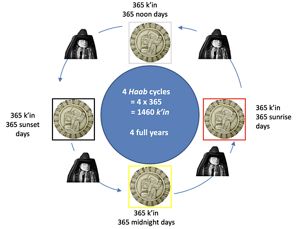
Geraldine A Patrick: Portrait of Geraldine A Patrick. © Geraldine A Patrick
Traditions: Beautiful spiritual ritual. © Norberto May Pat
Learning together: Children holding certificates outside the schoolhouse. © Norberto May Pat
Calendar: Ancestral timekeeping. © Geraldine A Patrick
Joy and Learning: Children learning together. © Norberto May Pat
Ep. 7: The Missing Piece of Ancestral Timekeeping
Geraldine Patrick Encina | Mapuche, Celtic
Geraldine Patrick Encina: I would like to now dive into the philosophical components of being in harmony with time and with place as well that with my husband, we've been looking into for many, many years and that we would really love to share with you.
Gabriela Tejeda: Researcher and cultural astronomer Geraldine Patrick Encina traces her ancestry to the Mapuche peoples in Chile, as well as the Celtic peoples of Ireland and Scotland. Perhaps it's this lineage and connection that leads her to describe herself as "sensible to what Indigenous Peoples have to bring to the consciousness of humanity."
One of those sensibilities is a keen focus on Indigenous knowledge of time, especially in Mesoamerica.
Geraldine Patrick Encina: I've been very closely following the way that they would see cycles and follow seasons and what calendar systems they put in place in the place where my husband and my children were born, which is the Valley of the Moon in Central Highlands of Mexico.
Gabriela Tejeda: Geraldine has her PhD in ethnoecology, where she studied the relationship between Indigenous Peoples and their environments. It was something her husband, an Otomi-Toltec ceremonial leader, said that led her on her current path of study.
Geraldine Patrick Encina: And, coming from the Otomi-Toltec tradition, my husband was able to, at one time in the ceremony, tell me, "You see how we have just performed the ceremony, which is universal. We greet the four directions, we greet above and below, and the seventh is in our heart.
"If this is the way that we have perceived time and space in such an orderly manner, why is it that scholars claim that our timekeeping system is always lagging, that we're missing the leap day?
"And that our calendar that only counts for 365 days is not useful as a calendar for people today.”
Meaning we have no way to keep track of time by using a Mesoamerican calendar. The Otomi or the Maya, or the Mexica or any other calendar that was generated in Mesoamerica, are today of no use.
Gabriela Tejeda: Geraldine agreed with her husband. Something wasn't right. Western Colonial scholars believed that the traditional Mesoamerican calendar was missing a way to include a leap day after four years. If indeed that was the case, it was a big problem. Here's why:
Let's say you watch the sunrise on the March Equinox, March 21st. You would notice that the sun is in a specific place on the horizon.
The next calendar year, 365 days later, you would see that the sun has returned to that same place. But by the fourth year, you'll see that it isn't rising in that same spot. You'd have to wait one more day because the Earth takes 365 and one quarter days to revolve around the sun each year. In order to make up for this apparent gap, early scholars and leaders added a leap day every four years, which became February 29th on the Western calendar.
When Western scholars saw the Mesoamerican calendars, they noticed there was no leap day equivalent. They thought the leap day was the only way to stay in sync with the sun, so they immediately assumed that the Mesoamerican calendars lagged because they counted 365 days, year after year, and never 366.
As Geraldine points out, for hundreds of years, schoolchildren and communities have been told to disregard their ancestral calendars altogether, as apparently, they could not stay in sync with the sun. So, as part of her postdoctoral research, Geraldine set out to uncover what was lost under piles of colonial misinterpretations about the ancient timekeeping system of Mesoamerica.
Geraldine Patrick Encina: And, after opening old books and uh, also going to visit many elders, I was able to understand what was a missing piece in the interpretation.
Gabriela Tejeda: What Geraldine discovered is that these Mesoamerican calendars did, in fact, account for that one quarter day each year, but in a much different way than Western timekeepers' Gregorian calendar system.
Whereas Western conceptions of time see it as linear, marching forward into the future with no end, many Indigenous conceptions see time as cyclical, meaning that somewhere in their timekeeping system there is always a return to the beginning.
Time, in a sense, repeats itself.
A good example of this is the four Year Bearers. The Year Bearer is a timekeeper, and on the Mesoamerican calendar, each of the four Year Bearers stand on one of the cardinal directions: east, north, west and south, and take a turn carrying the year.
When a new Maya year begins on August 13th, the Year Bearer to the east counts each of the 365 days from sunrise, the first of four solar starting points recognized by Mesoamerican timekeepers. When its count of 365 days is complete, it passes the calendar to the next Year Bearer on the north, who begins a quarter day later at noon, then to the Year Bearer on the West, who begins at sunset, and finally to the Year Bearer on the South,who begins at midnight. After all four Year Bearers have taken their turns, the start of the calendar year once again aligns with the sunrise of August 13th, beginning a new cycle.
While Western calendars mark the start of each year at midnight, Mesoamerican timekeepers recognize four solar starting points: sunrise, noon, sunset and midnight, each linked to a cardinal direction and marking where the Year Bearer begins its count. This way of timekeeping reflects a worldview where the four cardinal directions are equally important and where time and space are deeply connected, something linear models of time do not consider. That's why the Maya didn't need to add a leap day every four years like Western calendars do to make up for the missing quarter day.
Geraldine Patrick Encina: Scholars of the Maya and timekeepers today claim that the Haab, which is this Maya 365-day system, perpetually recedes in relation to the sun, meaning that the original month that was marked to see the rising of the sun on the 21st of March, for instance, would suddenly be totally out of place and not be marking that original location of the sun.
Gabriela Tejeda: Because Western Colonial scholars didn't understand the Mesoamerican way of keeping time, they assumed the ancient calendar was drifting, which made the precision of sunrises or sunsets observed at these sites seem to have no original calendar basis.
Geraldine Patrick Encina: And this is something that is aberrational, that the intelligence of the ancestors was not able to create a system that would enable them to follow the seasons appropriately.
Gabriela Tejeda: Having a calendar to live in sync with the sun's days was important to the ancestors. Their ceremonies and festivals marked these cycles and helped them live in accordance with nature. Without their traditional calendar, they couldn't perform their ceremonies accordingly. This was the case with timekeeping rituals that require moving from one cardinal direction to the next.
Geraldine Patrick Encina: And there's today only fragments of that memory that there is a ceremony that needed to happen from one place to another inside a single community.
But that original function of the ceremony has been forgotten. And now people do this, but they don't understand why they're doing it.
But what we're able to now show the teachers in Maya, Yucatan, for instance, is the relevance of following the original version of the calendar.
Gabriela Tejeda: The original version of the calendar, Geraldine points out, has markers that show the start of Equinox in springtime, the summertime solstice, the fall Equinox and the winter solstice. These events weren't just abstract dates. They marked what was happening in the horizon and in the sky and were critically important for these ancestors.
They guided their interactions with the world around them, including signaling exactly when to plant and when to harvest. One of the most stunning examples between the sun and the calendar at the Equinox can be seen at Chichén Itzá, the famous pyramid site in Mexico.
Geraldine Patrick Encina: And we've known this and people have been traveling, especially for the, the observation of a phenomenon that can only be seen in Equinox, which is the apparent descendance, or coming down in movement, of the body of a snake, Kukulcan, along the side of the staircase of Chichén Itzá. This phenomenon, this observation that definitely demonstrates that the ancestors were able to build structures according to the orientations and alignments that were important for them, we can now pair with the presence of that same date, March the 21st, on the actual calendar system.
Gabriela Tejeda: The appearance of this snake due to the sun's alignment on that date confirms that the ancient timekeepers were accurate. The architecture, together with the sun, marks the Equinox every single year.
Geraldine Patrick Encina: And there's many other observational points within Chichén Itzá that are also related to the beginning of other months, like, for instance, in May time. So, when we collect all the observations and of alignments that were happening singly in the Chichén Itzá area, for instance, we see that they were marking the beginning of different months throughout the year.
Now, what was most relevant for Mesoamerican peoples and so many peoples throughout Turtle Island is the possibility to grow corn according to the rainy season.
Gabriela Tejeda: The seeds were blessed in February, then the rainy season began in that part of the world on April 30th. The harvest would come August 13th. To celebrate, people would go into the fields with freshly cut sweet stalks.
Geraldine Patrick Encina: And then September would come and there would be, until today, very special corn flatbreads that would be part of another celebration to Mother Earth, to a mother figure that is the one to whom, you know, there needs to be all sorts of ceremonies to thank for all that she has been giving throughout the year. And finally comes the time to bless the dead. So, Día de Muertos comes in so many communities throughout Mexico and beyond in Guatemala, where the dead are remembered and they come to visit. It is believed that it is a time when they can actually come, come into the world of the living and exchange and celebrate the opportunity of enjoying the food from the newly harvested corn.
Gabriela Tejeda: These special dates were built into Chichén Itzá itself, where alignments with the sun traced each stage of the corn cycle and guided the ancestors in their planting and harvest.
From the blessing of the seeds in February to the Día de Muertos in late October, the lifecycle of corn marked the passage of time. Geraldine points out that this isn't just for planting and harvesting. It also reflected the life cycle of humans.
Women could follow their pregnancies along this same rhythm of nature as the 260-day cycle of corn mirrored the cycle of growing life. These accurate ways of timekeeping were critically important and lost to these cultures for a time, until Geraldine helped uncover the missing timekeeping pieces.
Geraldine Patrick Encina: For now, we go to the next stage where we can go to schools throughout the Maya lands with Maya school teachers and also throughout the Otomi high, Central Mexico lands with school teachers as well, where we can bring back the original calendar system of the ancestors that is still useful today, and it's so beautiful because of how it enables people to really follow through the seasons and carry out ceremonies.
Gabriela Tejeda: Geraldine talks of how important it is to recover this old knowledge and to live by it.
Geraldine Patrick Encina: Today, we are at a time where according to prophecy, it is a new dawn for Indigenous Peoples. When, um, the Spaniards arrived to these territories, there was a lot of turmoil. Millions of people died due to smallpox and other viruses, and yes, pandemia, I would say. And also, there was a lot of destruction of the knowledge that had been built throughout so many generations.
So it was said that the sun had hidden for Indigenous Peoples in Mexico. Our sun has hidden his face from us. He has left us in complete darkness, but we will be back. And he will be back once again to shine on us.
That was said by Cuauhtemoctzin in 1521. And, when he said that, he was meaning that you as a people would need to go and hide out and keep the knowledge away from others but keep cultivating the knowledge so that they would be able to inherit it at an appropriate time to the children that would be coming in the time of the new dawn.
So that is why this that has been given to my husband is relevant and we share it here with you. As you think about the world you're inheriting to your children, think about what children you're inheriting to the world as well. Because, it was said that only children who were able to inherit the knowledge and the wisdom and the harmonious way of conceiving the world and the philosophical components of ancient people, that we would ensure that there would be a good harmonious living.
Gabriela Tejeda: Geraldine continues to share her knowledge of timekeeping and Indigenous perspectives with communities in Mesoamerica and around the world.
Over the past few decades, she and her husband have spent time listening to elders and learning from their wisdom. Drawing from these conversations, they've distilled seven guiding principles that Geraldine describes as "a way of being in the world," a collective understanding, rooted in connection. She shares those as well.
Geraldine Patrick Encina: And the first principle to be as a collective being is to love, is to love yourself, is to love human community, but also Mother Earth and the cosmos, and to think beautifully and send blessings to your relatives.
The next principle is to be conscious of time and space-order. So, to live attentively, pay attention to the unfolding of natural cycles, the changing of seasons and the fruits of each month, to live no slower, no faster than the rhythms marked by nature and live in relation to space, time reference to the four directions and the four seasons.
Gabriela Tejeda: She says that this principle can really ground people and should be applied every day.
Geraldine Patrick Encina: Another principle is to be inclusive and respect self-determination. This means that all communities, every color, need to be honored with equity, respect and trust. We need to remember that communities are comprised of all members, that we need to participate collaboratively with members of the community, especially with those who have been born into and raised in, in that place. And, whenever possible, make sure that original peoples partake in every decision and so to ensure good living.
And we need to be cooperative. There's a principle in the Toltec-Otomi language, which, which is nfoxte. And every community has this kind of language, which is about mutual help and which is something that enables for inclusivity.
Gabriela Tejeda: The fourth principle is to be mindful about biocultural diversity, that it should be, as she says, what drives us to decide things like conservation policy and where we are heading. We should research what our ancestors know about how to live in the world, about the diversity of nature around us, join networks that protect this cultural heritage and, as she says, bring the original names back to the consciousness of everyone living on the land.
Geraldine Patrick Encina: Another principle is to apply precaution in any initiative, any endeavor or task, we need to apply the precautionary principle to avoid the risk of negatively affecting systems, natural systems, especially, to think about the possible consequences of our actions, especially if there's uncertainty about the effects that our decisions or our actions may cause.
And um, remember my husband says that even thoughts have effect in large scales of time and space.
Gabriela Tejeda: The sixth principle that they distilled from all the wisdom they've collected is to be reciprocal. Ask permission to enter a sacred site. First, offer something in return. Ask the people who are the true caretakers before making changes. Even if we think it's right based on science, she says, we should still ask the custodians. They know the language of the land.
Geraldine Patrick Encina: So, ask through them, ask the land, is this what you need from me as I co-participate in, in co-creation in a responsible way, co-creation of nature.
The seventh principle is to respect collective dignity. So, dignity is an inherent quality of every being that is fully thriving. When Mother Earth's dignity is violated, our dignity as the people's, as a collective is also violated. So, it is really hurtful to see what is happening to Mother Earth today.
And that is why we need to think about the world that we are inheriting to our children but also think about what children we're inheriting to Mother Earth.
It is an opportunity every day in every act, in every step we take, that we have the opportunity and the responsibility to be in harmony with Mother Earth every time.
Gabriela Tejeda: We want to extend a heartfelt thanks to Geraldine Patrick Encina for being a part of this episode in The Nature Conservancy’s Wisdom Keepers audio series. I’m Gabriela Tejeda—thank you for listening.

Ep. 8: The Time for Change Is Now
Oren Lyons & Dan Longboat | Haudenosaunee
Oren Lyons: Nyawenha, Nyawenha Sken:nen. That's our, our greeting. Nyawenha. Thank you, thank you for being well. So our, our greeting is, um, standard greeting and relates to health and Sken:nen, peace. Uh, health and peace. Same word: Sken:nen. And so that relates, of course, to what we're talking about now. You can't really have peace without good health.
Gabriela Tejeda: That’s Oren Lyons, a revered Faithkeeper of the Turtle Clan of the Onondaga Nation Council of Chiefs, of the Haudenosaunee Confederacy. He’s been called a “leading voice for Native American rights,” sharing Indigenous perspectives in classrooms across the country and on global stages like the United Nations.
Oren Lyons: And, I know that all, all of our, uh, prayers and all of our spiritual, uh, relations and so forth always acknowledge what the Earth brings to us.
And so in, uh, the Haudenosaunee, which is our, our proper name, the French called us Iroquois, and the English called us Six Nations, Five Nations, the Six Nations. Uh, but we are, we are the Haudenosaunee.
Gabriela Tejeda: The Haudenosaunee, also known as the People of the Longhouse, are, as Oren says, made up of six nations of Native Peoples. Another revered Haudenosaunee scholar, Dan Longboat, breaks down their name:
Dan Longboat: Uh, our languages are polysynthetic languages, and, Haudenosaunee is ʻHaude’, uh, at the beginning of that, the pronoun, it's they, the men, plural. The root word is ‘Kanonhsa’, which is house or houseness. And, ‘Onni’ is to, in a case of a house, to build it or to, or to create it or to lay it down.
Gabriela Tejeda: Dan has spent his career working to advance Indigenous perspectives and science, including at Trent University and the Indigenous Environmental Institute. Despite his accolades, he's careful to say that his knowledge comes from what the Elders have told him, like his friend Oren Lyons.
Dan Longboat: The idea behind it is that, uh, when we talk about it, that in terms of they who build a house, that's how we refer to ourselves as, um, that it refers to the longhouse of the five original Nations and now six: Mohawks, Oneidas, Onondagas, Cayugas, Senecas, and then later on in the Tuscaroras we in, we adopted them in the 1720s when many of them came out from the Carolinas to escape some of the war that was going on with the, with many of the colonists there. And so, when they came up, when we became, uh, formerly recognizing ourselves as the Six Nations People, uh, that's what that refers to, the longhouse of one family, all six nations of peoples living together and, in one, uh, in one structure, one family. So refer, refer to one another as, uh, as just like family, brothers and sisters, uncles and aunties, cousins.
Gabriela Tejeda: There may be Six Nations of Haudenosaunee, and many, many Indigenous Nations and communities across North America, but Dan says that too often, indigenous people are relegated to history, that they have become invisible in their own lands. He recalls a recent drive through the eastern United States, from Canada down to Pennsylvania, and what he noticed.
Dan Longboat: You get to see the, the place names and you get to see the waves of immigrants that have come across the country and the establishment of their places, their names, almost their history in terms of that it's, uh, it tends to be, uh, I guess for lack of a better way of explaining it, a mirror image from where they come from. So many of the place names that were located in their homeland have now been adopted and put into, um, put in here. Every once in a while, you'll see an Indigenous name, you know, pop up, and, uh, and you'll recognize that, that it's sort of the footprint.
So part of the thing that we want to talk about then is the reestablishment and the recognition of our footprints in this land.
Many of the things that we take for granted now on, on the landscape have been instituted by our great ancestors, uh, so long time ago.
Gabriela Tejeda: Dan explains how, as the Nations moved from place to place, they traded with each other and even helped establish ecosystems that would support life.
Dan Longboat: We see a lot of white pine trees. A lot of people talk about then, uh, that as our people travel, they took white pine trees and they put them in different places. A lot of the different nut trees and the different plants, the different things that established themselves that we almost take for granted that today that's part of the ecosystem, our great ancestors were the ones that had moved those around to help sustain not only their lives, but also for animals and the things that they depended on.
Gabriela Tejeda: It's important to recognize not only the people of the land, but what they did for it.
Dan Longboat: The land recognition part of it, it's really talking about, recognizing not just the people, but also what they have done in, in terms of maintaining, sustaining, building, strengthening, uh, ecosystem function within, the particular areas that we live in. And the knowledge that those people have has had, you know, uh, I guess a really powerful impact on the quality of biological life that we see around us now.
Gabriela Tejeda: Oren adds that Native People, specifically the Haudenosaunee, also had a major influence on another aspect of life in North America: democracy.
Oren Lyons: On the landfall of Christopher Columbus, democracy was rampant all over this North America. We called the Turtle Island. That's our name for, for this hemisphere –Turtle Island. It became America named after an Italian, Amerigo Vespucci.
That's pretty long ways away from here. And then they called us Indians, and that was named after India. And again, a pretty long way. So the whole predication of us started out with some kind of a miscast. Not exactly a falsehood, but uh just misrepresentation.
Gabriela Tejeda: In the 1960s, the term “Indian” began to be replaced across North America. In the U.S., people increasingly used “Native American,” while in Canada the shift moved toward “First Nations.” These are the Indigenous Peoples of North America, but not everyone identifies with the same term. As Oren notes, that's why it's important to use the name an Indigenous community uses for itself. For Oren, this isn’t only about what words we use. It’s about the right that his Haudenosaunee community have to identify themselves, and to guide their own governance as they always have.
Oren Lyons: And probably from what I can see in, in North America, uh, the last standing traditional government still in charge of land, across, uh, both the Canadian and the U.S., borders. The U.S. and Canadian governments have established Bureau of Indian Affairs and Department of Indian Affairs in Canada. And, um, the Haudenosaunee has, uh, has kept our distance from that and we've maintained our own integrity. And so, uh, our leadership system remains to be the same as it was so many years ago, probably at least 12, 13, 14 centuries ago, where we established or we, uh, received, I would say a message, of peace, and, uh, the messenger they call the Great Peacemaker came amongst our, our Nations, which were warring, which were in terrible conditions. And I was thinking some years back when I was watching the, the fighting in Kosovo and, and how internal that destruction was and, and uh, it was very similar to the conditions of our people back there at that time. The men were fighting and the families and the people were in fear, and it was rampant. And we received, then, this message, this messenger came amongst us, they called the Great Peacemaker, and he brought this message of peace and it wasn't easy.
Gabriela Tejeda: Oren says they've tried to determine when exactly the Great Peacemaker arrived–that some universities have been investigating it. They think it was sometime around 930 AD.
Oren Lyons: And that was, uh, related to a, it was related to an event when the when the moon covered the sun. And in the history of that time when the, uh, peacemaker was speaking to the Seneca and they were, they were very, very, uh, well, they didn't agree with what he was and they were busy fighting amongst themselves actually, and he predicted that the sun would be covered tomorrow, and it was. And, and that convinced the Senecas that this person was somebody to, who, we should listen to. And it gave us some kind of a, a, a timeframe because the Haudenosaunee doesn't keep recordslike everybody, you know, we, we know it happened and we keep all of that and we keep everything intact, but times we don't.
So anyway, that's, um Peacemaker come among us, and it's a long, epic story of how he brought the Nations together. But at, at one point when we were at this, uh, lake, they call Onondaga Lake now, here central New York, and he had gathered the leaders. He then laid down the process of our governance. There's democratic principles that been espoused by the new United States, so forth. Um, but that was old for us.
Gabriela Tejeda: The Peacemaker told them that the Earth was female, and that their society would be matrilineal. Their origins, and their identity, he says, are on the woman's side.
Oren Lyons: That's the first lesson. Long ago and when he set up the process of governance, he divided the work between the men and the women, which is the natural process of life itself. The mother and the father. And all was important, of course, the mother.
And that's when he said that, you know, the Earth is female, therefore, uh will be a matrilineal. And I've noticed over many of the Nations across, uh, North America that they are also matrilineal. Not all, but many, more than not. So there's a, a kind of a, a, an uh, understanding. There was a general understanding about the relationship between the Earth itself and ours ourself, and the importance of the mother and the importance of the women.
Gabriela Tejeda: He recalls hearing leaders describe the United States of America as the first constituted democratic government in the world. He paused at that. Obviously, he says, the Haudenosaunee were a constituted democratic government. But also, he found the statement interesting from another perspective:
Oren Lyons: If you have a Democratic government, that means equal participation between men and women.
I mean, wouldn't you say? Is this as a general observation and historically it's clear that the women in America could not vote until 1920, so how could you call yourself a democratic constitution if only 50% of the population and a very limited part of that 50%, could vote in the government of the United States.
So my perspective was, oh, hold on Mr. President, let's talk about that. And so in 1920, when the women fought so hard to be recognized as in this political structure and were finally accepted. Even today, I remember, the past election when we had a woman running for president and she talked about a glass ceiling.
And that glass ceiling was still not recognizing the full rights of the women here today, now. So now as we look at the Earth as female and understand how important, where life comes from, uh, that we, we really, truly embrace the idea of equal and fair and uh, it's way past time that this country should embrace the women's side of the women's side of their government and their, their families. That's just an observation from our perspective.
Gabriela Tejeda: Oren also reflects on how the human population has exploded in just his lifetime. He was 20 in 1950, he says, and there were around 2.5 billion people on the planet then. Now, there are over 8 billion.
Oren Lyons: Not sustainable, folks. Not sustainable. Because maybe it would be if everything on Earth was adjudicated fairly to all humanity, then it might be and probably could be. But water is not adjudicated fairly. There are sections of the Earth where there's hardly any water, and losing it fast. And that's the Mid East. And other parts of the world.
And then here where I'm sitting right now, which is, uh, the northeast of the United States, right next to Lake Ontario, which is the Great Lakes, which is understand, uh, the, the Great Lakes and and the water that we have up here, we have over a quarter of the world's potable water right here. A quarter.
And when you look at, uh, let's say Iran for instance, what's the water source? You know, what's the water source of those nations over there and depleting very fast. Where are they gonna go? What's the solution?
These are some of the problems that humanity faces and how we meet those problems, you know, determine the condition of, of, of humanity as it moves forward.
So one of the things that we're experiencing today, is the uncertainty of what's ahead. All the countries are experiencing an uncertainty of what's coming.
And it's a true uncertainty. We don't know because what's gonna happen in the future, much of it is gonna be predicated upon the conduct of humanity itself.
Gabriela Tejeda: He says that when he was a boy, he didn't realize how many Native people there were around the world, nor the vast knowledge they held about survival on their respective lands.
Oren Lyons: They lived very well. They were healthy. That was because the, there was, um, a policy, a common policy that I find and a value and probably a principle. And that is to share. To share, which is totally opposite of the capitalist principle of to gain for one’s own–complete opposite.
Gabriela Tejeda: He reflects on wealth distribution in America—how a tiny fraction of the population holds a disproportionate percentage of the nation's wealth. And he returns to the teachings of the Peacemaker:
Oren Lyons: One of the oldest treaties that the Haudenosaunee has is when we were given this instruction way back from the Peacemaker. Alright, how do we do this? So we made a uh, uh, an agreement, a treaty, and it's called One Dish, One Spoon. It's very old. It's one of the most oldest agreements: One Dish, One Spoon. And what that says is share equally. Simple.
Very easy to say, but pretty difficult to do. And it was pretty standard.
Gabriela Tejeda: The value of sharing is something that Dan Longboat also reflected on, and how this concept was embedded in their earliest treaties with the United States and with Canada, recorded in wampum belts—beaded‑woven records of those agreements. Each belt depicted the relationship being established, grounded in the Haudenosaunee principles of peace, friendship and respect.
Dan Longboat: So embedded within, in all of those treaties is built in the concept of sharing, of sharing land. And so they talk then about not only just sharing, sharing just doesn't mean I will use up everything I want and whatever left over, I'll give that to you. Sharing is being, uh, mindful and conscious of our impact upon one another and our impact upon all of the Earth and being able to care for that. And sharing just doesn't mean between us. Sharing also means over generations. So thinking about what future generations are going to are, are the impact of our decisions on future generations. And so that, for us, and understanding the, the relevancy of those treaties, we can talk about right now that that river of life that we talked about in that wampum belt, is in trouble.
Gabriela Tejeda: There are many different prophecies throughout Indigenous Nations, Dan says, that foretell what will happen to the Earth—that were meant to shed light on the challenges coming. The Haudenosaunee had a leader in the late 1700s that shared his prophecies:
Dan Longboat: His name was Skanientari:yo. And Skanientari:yo means, uh, beautiful water. And they've translated that into, uh, the term Handsome Lake. So Handsome Lake received these visions and dreams from the Four Beings about what was gonna happen.
And they talked about, you know, how the people needed to hold onto our traditions, our language, our ceremonies, our ways of life. And they talked about the onslaught that was gonna happen to us, but more particularly, they talked about, um, some of the impacts of the things that were confronting us and things that were coming.
He talked about times ahead when the Earth would heat up. That the temperature of the Earth would heat, that many of the things that we depend on for food, that the Earth would, our mother would start to pull back her power.
And there's gonna be a shortage of food. There will be sicknesses and diseases that will spread themselves around the world. Talked a lot about how animals and birds would, uh, become extinct, talked about that they would start to change their color, that they would be more white animals and what the meaning behind that was.
Uh, he talked about water that would be undrinkable, and he talked about, you know, how the, the thunders and the, the changing of the seasons would begin to dramatically change and have an effect on biological life. He talked about the winds and how the winds would, would manifest themselves and how turbulent that they would be.
He talked a lot about the idea that many of the things that we depend on, as far as our ceremonies and our way of life would be threatened. Our corn wouldn't grow, our strawberries that we have for strawberry ceremonies wouldn't come to fruition. Many of those things then, you know, we're seeing around us today, you know, simple thing like you talked about, that you, you'll see in the future that trees will die from the top down.
So these are the things that, uh, the Four Beings provided for him, and I think out of the, I want to say that 90 prophetic pieces that were in there, 60 of them have already come true.
Those prophecies are milestones along a road, and we as the human beings have a choice of whether we want to continue to follow a way of degradation and destruction of the natural world, or whether we want to change and be able to work together to strengthen, to sustain, to perpetuate all life. That's our choice.
Gabriela Tejeda: Oren recalls something his brilliant friend, John Mohawk of the Seneca Nation, once said to him along these same lines:
Oren Lyons: He was so smart, and we were having this discussion many years ago. And, uh, John interjected, he says, well, he says, “you know, as far as I can see, this human species is still a biological experiment.”
I wanna chew on that one for a little while. A human species is still a biological experiment, so whether we survive or not, it's really up to us as a species. Nothing ordained, nothing. Our life is in our hands. Our future is in our hands.
Gabriela Tejeda: Oren says the time for change is now, that it must happen. And this brings him back, once again, to the teachings of the Peacemaker:
Oren Lyons: The Haudenosaunee chiefs are told by The Peacemaker, never take hope from the people. Never. And so we fight on. We fight on.
Gabriela Tejeda: We want to extend a heartfelt thanks to Oren Lyons and Dan Longboat for being a part of this episode in The Nature Conservancy’s Wisdom Keepers audio series. I’m Gabriela Tejeda. Thank you for listening.
About the Music
Stories can be shared in all kinds of ways, including through song. In the Wisdom Keepers audio series, you’ll notice the enchanting vocal and flute melodies from Bear Fox and Mignon Geli, inspired by the language, traditions and stories of the Mohawk Nation. These songs reflect the messages, spirit and wisdom passed down from their ancestors and through today’s generations.
Listen to the Wisdom Keepers Audio Series
Subscribe and listen to the entire 8-episode series on your streaming platforms.
-

Spotify
-

Apple Podcasts
A Special Note About Language
We are deeply grateful to the speakers and their community for sharing their knowledge and language. The spellings used in these transcripts reflect the speaker’s pronunciation and understanding of the language as shared. There are often multiple ways to spell words in Indigenous languages. These variations may result from the language traditionally being oral rather than written, differences in regional dialects, historical events such as the suppression of Indigenous languages and other reasons. As a result, standardized spelling systems may not exist or may vary across communities. Thank you for your understanding and respect for the Indigenous languages shared.