
From a prairie to wetlands: How the Ohio Mitigation Program transformed 57 acres of Wannemacher Reserve


Wannemacher Reserve, just south of Troy, once looked like an overgrown prairie with clusters of honeysuckle covering an unbending stream. Most people wouldn’t think twice about this landscape. But a closer look tells a different story.
These 57 acres at John A. Wannemacher Nature Reserve actually began as wetlands.
The Ohio Mitigation Program (OMP), part of The Nature Conservancy (TNC) in Ohio, identified markers in the soil indicating the land was originally a wetland habitat.
“Wetland soils can keep their wetland signatures even once they been drained. Wetland soils are called hydric soils. Discovering a hydric soil is a strong indication of a past wetland ecosystem existed there because they only form in wet conditions,” said Jennifer McDonald, Restoration Ecologist at TNC in Ohio.
After confirming the land was suitable for wetland restoration, OMP and Miami County Parks worked together to transform this land into a space that will benefit both wildlife and the community for years to come.


Construction begins
Before the land was a prairie at Wannemacher Nature Reserve, it had been tiled and drained for agricultural use. Additionally, the stream had also been straightened to be used as a drainage ditch.
To reverse these alterations to the original habitat, the OMP team began construction in 2023.
A new stream channel was the first part of construction—making it curve in a natural stream pattern. Next, the wetlands were created by constructing depressions.
“By constructing depressions, we are mimicking what occurs in natural forested wetland ecosystems. When a tree falls, its roots rip up and create a depression in the landscape. These depressions create irregularities in the landscape that collect and hold water,” said McDonald.
Then, 25,000 trees were planted—also a key part of the wetland habitat.
“We start by planting bare-root trees. The hope is that after 10 years, the site will be forested with a variety of native tree species and over 200 living trees per acre,” said McDonald.
The depressions, altered stream channel, and trees come together to form a forested wetland habitat.


Removing invasive species
Removing invasive species is also a key part of wetlands restoration. Honeysuckle was the most prominent invasive species at the site—it was almost completely covering the stream before construction began.
“We removed honeysuckle and other woody invasives before we started construction,” said McDonald.
During construction, reforesting and the ground disturbances make the area more susceptible to invasive species. To ensure this area stays true to its natural state, OMP has a partnership with Davey Consulting to help treat invasive species in the wetlands area.

"The community planting these trees will be a way for them to feel connected to the park. There is science backing this idea that restoration site are more successful ecologically if the local community is invested in its longevity."
A community celebration
Upon the project’s completion, Miami County Parks and TNC in Ohio hosted a community celebration in April 2025.
It was both an open house for the community and a tree planting event. Community members, as well as TNC and Miami County Parks Staff, planted over 300 additional trees on the north side of the park.
“Miami County Parks has been a great partner. Their knowledge and investment in their community made the event so successful,” said McDonald.
The event encouraged community members to feel a part of the restoration work, which will enhance the success of the project down the road.
"The community planting these trees will be a way for them to feel connected to the park. There is science backing this idea that restoration site are more successful ecologically if the local community is invested in its longevity,” said McDonald.
Planting with the community
Upon the project’s completion, Miami County Parks and TNC in Ohio hosted a community celebration in April 2025. Community members, as well as TNC and Miami County Parks Staff, planted over 300 additional trees on the north side of the park.
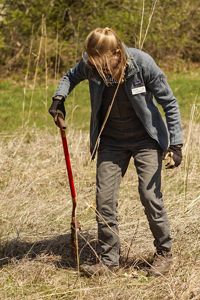
TNC Staff Planting: Liss Whiting, TNC OMP staff, planting at tree planting community event. © Brian Gara
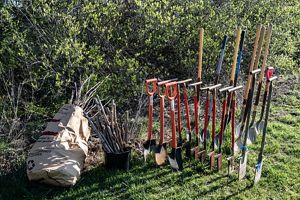
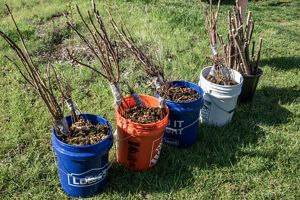
Supplies: Saplings and other planting supplies at the community event. © Brian Gara
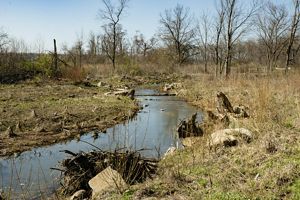
Views: The Wannemacher Reserve site's stream at the April 2025 tree planting event. © Brian Gara
Saplings: Saplings at the Wannemacher community event. © © Brian Gara 2025
The benefits
The benefits to the community and habitat are why this restoration work is so important.
“We are already seeing more amphibians and birds. It is turning into a great bird-watching destination,” says McDonald.
Not only will the spot attract more wildlife now that it has been restored, but the presence of wetlands will also improve water quality for residents.
“The tributary on site flows into Boone Creek, so the project will improve water quality and drinking water within Boone Creek,” says McDonald.
In addition, the trees that were planted will improve air quality and provide habitat for more native species on the reserve.
The partnership with Miami County Parks and OMP led to a project that will improve lives for years to come.
“The site is protected, so that means it will be a natural space for the community forever,” says McDonald.
With your help we have accomplished many goals toward a clean, healthy, thriving Ohio.
There is still more to do, but we can't do it without you.
Explore our Work in Ohio

Ohio Stream and Wetland In-Lieu Fee Mitigation Program
The Nature Conservancy’s Ohio Stream and Wetland In-Lieu Fee Mitigation Program (OMP) restores and protects streams and wetlands for future generations.

Sustainable Agriculture in Ohio
Learn how The Nature Conservancy is working to safeguard Ohio’s food security and abundant water supplies.

Securing Clean Water for Ohio
From the shores of Lake Erie to the banks of the Ohio River, water sustains us. Learn how TNC is helping safeguard clean water so people and nature can thrive.