


Dogs Lend Their Noses to Find Turtles for Science
Specially trained spaniels—aka turtle dogs—are helping researchers find and study elusive ornate box turtles.

A collaborative community and commitment over time are distinguishing factors of the research

As prairie has decreased in Illinois to less than one-tenth of 1% of its original area, the ornate box turtle has become critically endangered in the state. The Nature Conservancy's Nachusa Grasslands Preserve's 4,000 acres of nearly continuous restored tallgrass prairie creates an important oasis for the species. This article discusses how data from yearly ornate box turtle health surveys inform tallgrass prairie restoration practices.
“Oh! Turtle!” The surprise and delight was evident in the first-time volunteer’s voice as she stood, arm raised, the signal for the researchers to walk back and inspect her find. It was the first turtle found on the second day of the annual ornate box turtle count at The Nature Conservancy’s (TNC) Nachusa Grasslands Preserve in Illinois. The turtle stood stocky and still amid blades of grass, blinking its amber eyes in the bright morning light as everyone rushed over to admire it.
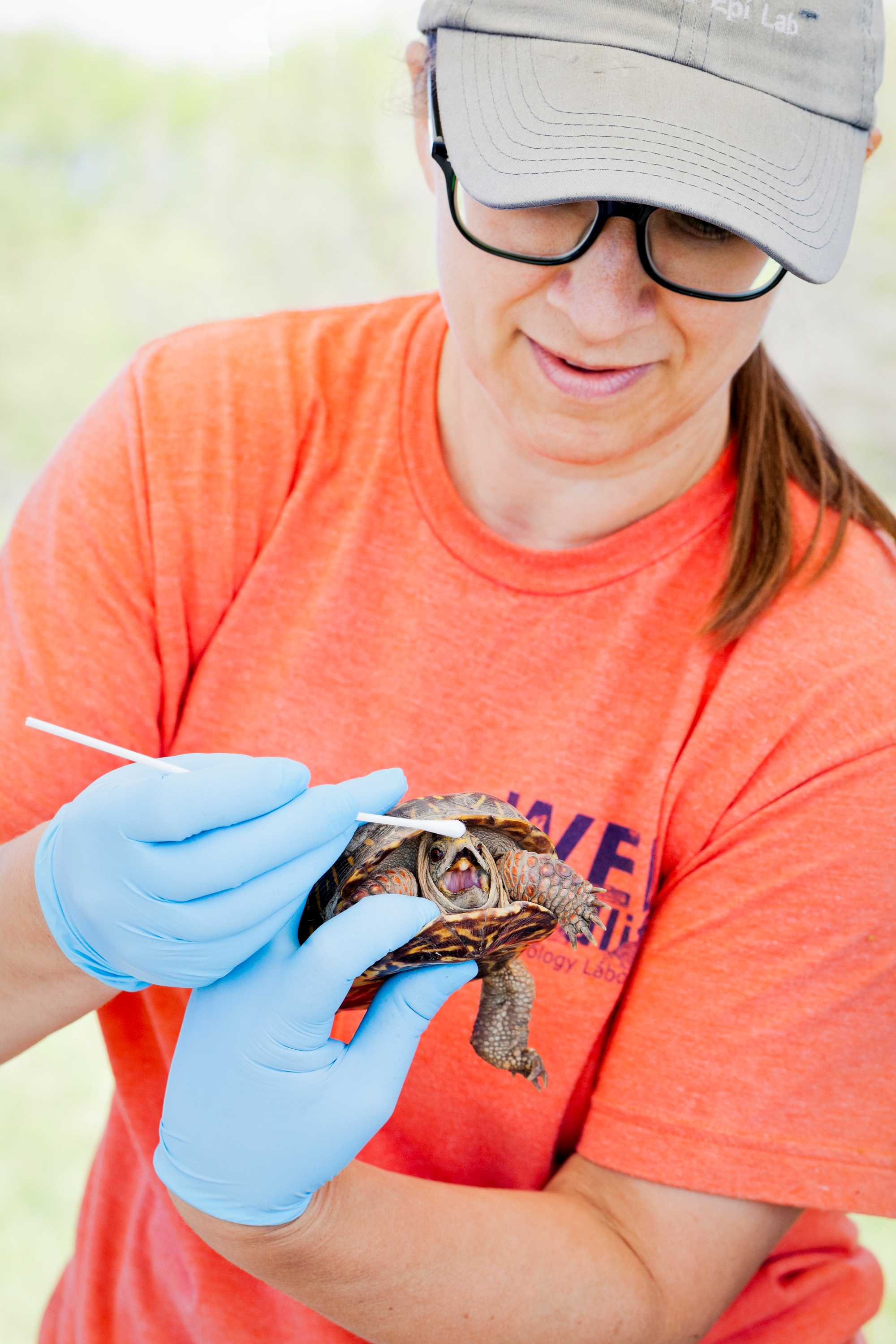
As lead researcher Matt Allender, Brookfield Zoo Chicago veterinarian and faculty member at the University of Illinois College of Veterinary Medicine, carefully picked up the turtle in gloved hands to determine its gender and general state of health, he marveled at the coloration of the red eyes and reddish bumps on the turtle’s green legs. This turtle was a young teenager, an unusual age to spot. With typical teenage ire, it proceeded to release copious amount of urine. “A winter’s worth of pee,” chuckled Allender.
Every spring for the last decade, a team of researchers from the Wildlife Epidemiology Lab at the University of Illinois Urbana-Champaign and the Brookfield Zoo has come to survey Nachusa Grasslands’ ornate box turtle population. The data gathered is used to advance the understanding of the ornate box turtle population’s health and also informs tallgrass prairie restoration practices at Nachusa Grasslands and beyond. “There’s nobody who’s doing this kind of survey,” says Allender. “It informs ornate and eastern box turtle research overall. It’s such a good resource, even beyond the borders of Nachusa.”
Ornate box turtles can live in many different plant communities in a sand prairie. Observing how they use or are affected by a particular plant can help conservation teams plant or selectively manage for it. Potential negative impacts of invasive species on the turtles can also be observed through this longitudinal study.
Allender first started this study with eastern box turtles about 18 years ago in Tennessee as part of his effort to chase down a way to test for ranavirus. This virus results in a 90% mortality rate for box turtles. “When we started this project, we didn’t know what they had or how to test for it,” says Allender. After 4,400 turtles sampled over the years and across various sites in multiple states, the metrics gathered have been fine-tuned. Nachusa Grasslands is now the main research site for the study.


Once found and carefully geotagged, the turtles are placed in pouches in a backpack to be evaluated in a field lab at the end of the morning’s search. Mouth and cloaca swabs are taken to test for viruses and bacteria. The shell is swabbed to look for a new fungus that is now in Illinois. A blood sample will additionally be used to test for viruses, measure white blood cell counts and evaluate liver and kidney function. The turtle is weighed and measured, and a painless notch is added to their shell to mark their participation in this year’s survey. From the resulting data, the researchers will be able to determine if there are areas in the landscape where the turtles are experiencing environmental or reproductive stress and also evaluate disease trends over time.
After their checkup, the turtles are returned to the exact spot where they were found. This part is important as ornate box turtles range about five acres in their lifetime and will travel at any cost to get back to their home site, a heartbreaking dimension to their use in the pet trade and targeting by poachers.

For many years, the turtle searches were conducted with a team of specially trained Boykin spaniels. After that team of “turtle dogs” retired, the survey has leaned on human volunteers for the last two counts. “Humans do ok,” says Allender as we wait at the Visitor Center for everyone to arrive on the fresh spring morning before the search begins. “And even if zero turtles are found, it’s still a nice walk on the prairie.” Unlike other turtles that stay up once they emerge in the spring, ornate box turtles will pop up and down throughout the day. Allender is convinced some “take the season off” and stay underground for an unusually extended period of time.
After preliminary guidance on what to look for, the group of 22 volunteers split into two sections. One group used radio telemetry to search for 11 turtles fitted with radio transmitters, which needed to have batteries swapped out. These turtles have been studied every month for two years, providing fine-point data about trends in turtle biology. The turtles can overwinter up to two feet deep, so that team carried a shovel.
The other half of the volunteers fanned out, walking at a contemplative pace while intently scanning among grasses, berry brambles and emerging goldenrod for the palm-sized creatures. Bumblebees buzzed everywhere as the dew burned off, and grasshoppers sprang away from every slow footfall. The area had been burned with a prescribed fire earlier that winter, clearing out the thatch, making it possible to somewhat see down to the sandy soil of the open prairie habitat ornate box turtles prefer. Only a few months after the burn, the new vegetative growth was already ankle-deep or higher. Numerous holes of various sizes dotted the landscape, but few were the oval hamburger-shaped casts left by a turtle.
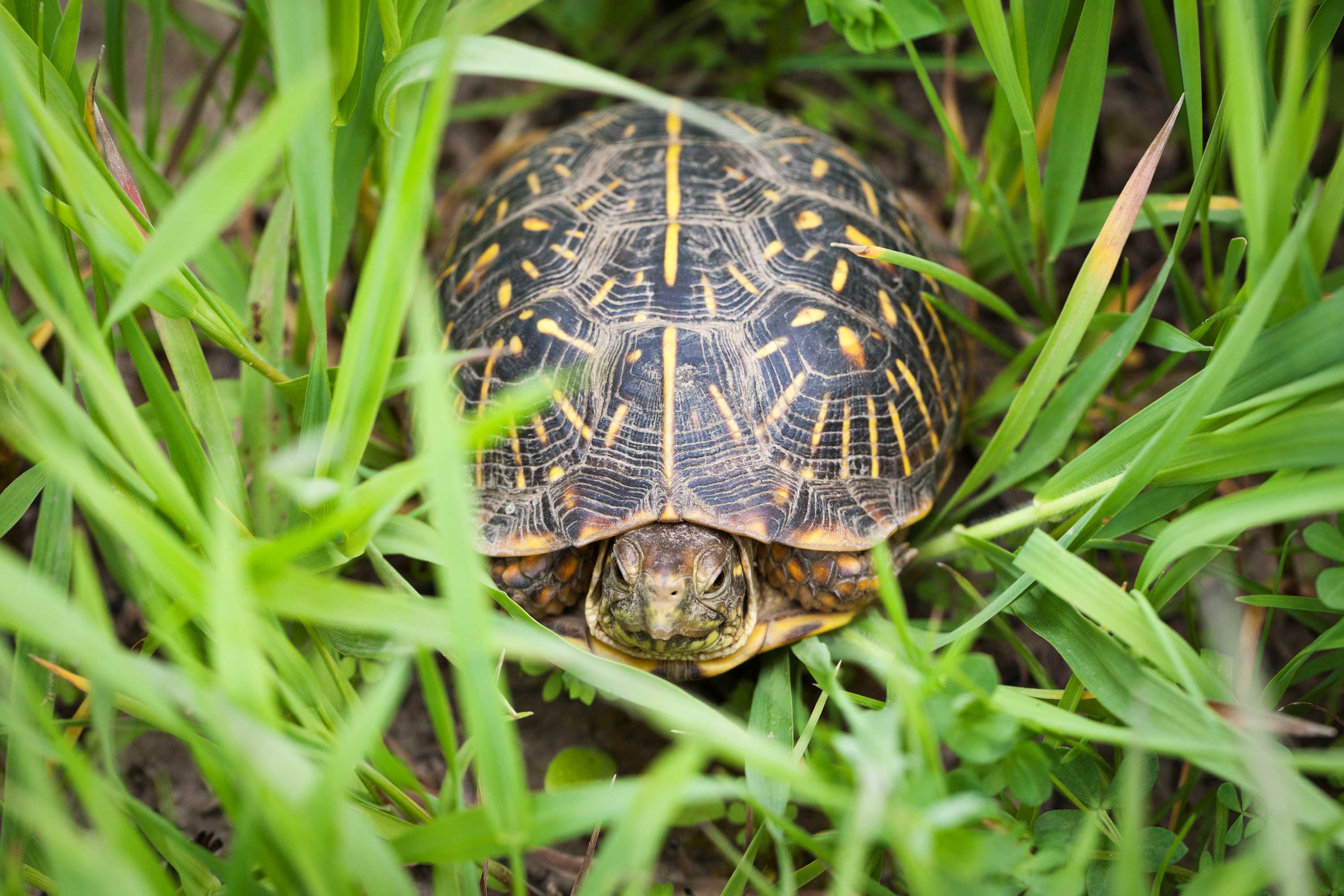
The ornate box turtle is in a slow decline in Illinois. As prairie has decreased in Illinois to less than one-tenth of 1% of its original area, the ornate box turtle has become critically endangered in the state. Nachusa Grasslands, with its 4,000 acres of nearly continuous restored tallgrass prairie, creates an important oasis for the species.
The turtle surveys at Nachusa Grasslands help to advance understanding of trends of disease in ornate box turtles over time, which informs the greater scientific community. Turtles are very long-lived, up to 60 years, so trends can take a while to observe. “Because the turtles are so long-lived, it can take a decade or two to see the impact of something on their health,” says Allender. “Even a full career is not a full turtle lifespan, so the work at Nachusa is so critical.”


As turtle health data is overlaid with geospatial data, interconnections between plant species or management practices, like prescribed burns, can also be observed. For example, using turtle data helped researchers determine optimal burn windows when the turtles would likely be well underground. “Working with the Illinois Natural History Survey, researchers were able to correlate fire and turtle emergence,” says Elizabeth Bach, ecosystem restoration scientist at Nachusa Grasslands. Researchers were able to build a table that provides a probability of risk to the turtles and informs when TNC conducts burns or drives heavy equipment on a unit. “That’s one of our filters on management decisions.”
Allender says that the partnership with TNC at Nachusa Grasslands is one of the most successful for ornate box turtles. Training to be a veterinarian focuses on animal health, not biology. “That’s why we work with biologists and ecologists,” he says. “These collaborative projects are the ones with the most impact.”
Learn more about TNC's turtle research and Nachusa Grasslands Preserve.

