
The Resilience Dividend: Reframing Deforestation and Conversion-Free Policy as a European Strategic Priority
New analysis published by The Nature Conservancy assesses the strategic context of global deforestation and conversion of natural ecosystems

Covid-19, the Russian Invasion of Ukraine, the Iran Crisis - recent, sudden and turbulent disruptions have highlighted how no one is immune to sudden supply chain shocks in an increasingly interconnected world. In Europe, the response to this geopolitical uncertainty has been to pivot to a new set of priorities, centred around security and competitiveness at the expense of its ambitious Green Deal agenda. Yet the consequences of continued environmental crises do not rest in a vacuum. In fact, they pose very similar short and long-term supply chain disruption risks as any other crises we witness today.
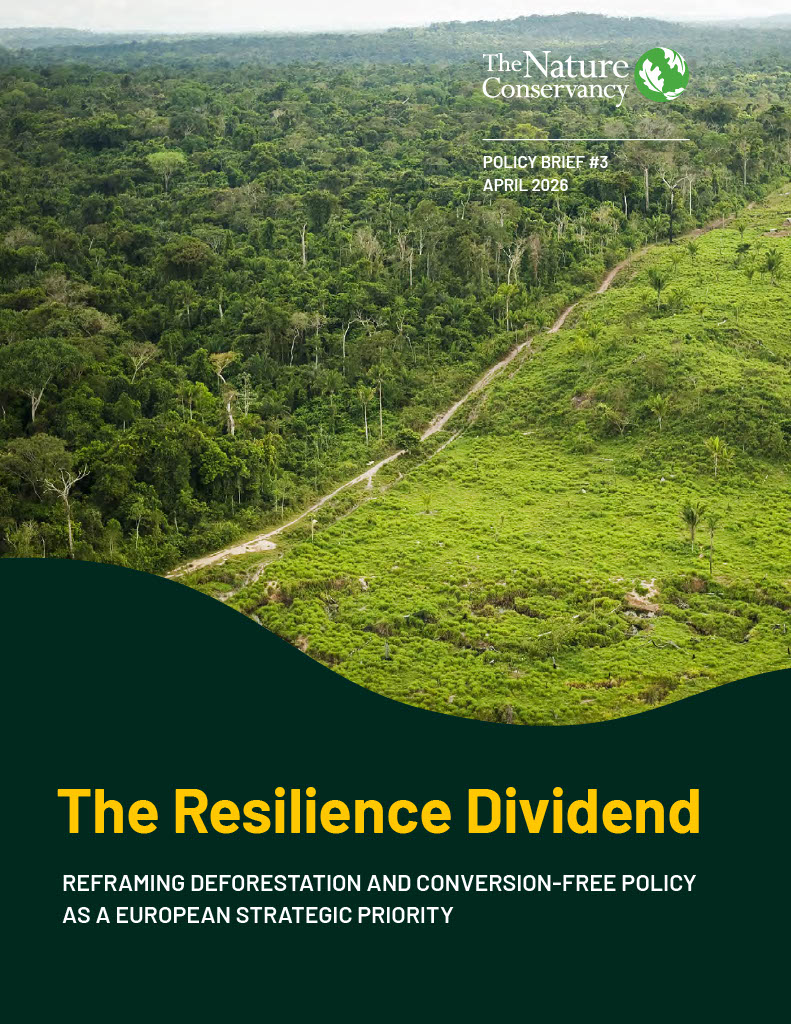
The Resilience Dividend
Reframing Deforestation and Conversion-Free Policy as a European Strategic Priority
DOWNLOAD FULL PAPERAddressing agricultural driven deforestation encapsulates this recent re-shifting of priorities. A central pillar of EU’s Green Deal agenda, the momentum behind addressing European deforestation footprint has effectively stalled, most notably seen in the two subsequent delays of the landmark EU regulation on deforestation (EUDR). However, under closer inspection, decoupling European agricultural consumption from its deforestation exposure goes far beyond the crucial mission to address global environmental degradation. It is a strategic priority that encompasses many of European top strategic priorities – from food and economic security to integrity of its financial markets and health outcomes.
In our new analysis, we examine the implications of continued global deforestation and conversion of natural ecosystems on European strategic priorities that go beyond environmental outcomes.
As global food demand is set to double by 2050, this presents an unprecedented challenge to our food production, stress testing ecosystems that are already on the brink. Ironically, the very land conversion that facilitates agriculture expansion is undermining the yield and productivity results needed to meet the increased demand. Increasingly, the transition to sustainable and deforestation-free agricultural practices are seen more as an economic necessity, rather than simply an environmental conservation measure.

Europe is not immune from these trends – our analysis finds that Europe is highly dependent on certain agricultural imports, and that just 5 forest-risk commodities (soy, beef, palm oil, cocoa, coffee) account for more than 20% of EU’s agriculture import value. What’s more, most of these commodities are sourced from a very limited geographical scope.
In practice, this means that any unexpected disruption, be it lower than expected yield, crop failure, drought, or any other market disruptions will have profound downstream effect on European businesses and consumers. We have seen this with soy and cocoa supply chains already, but with the current trends in demand and trade, these risks are only going to get bigger. For some European businesses and financial institutions whose earnings are exposed to the supply chain risks, continued deforestation expose undermines its competitiveness objectives.

But vulnerable supply chains are not the only consequences of deforestation and conversion in Europe. Whether it’s the increased risk of zoonotic diseases coming out of deforestation frontiers or the impact of illicit activities such as cocaine cultivation or illegal mining, the negative consequences of deforestation in tropical countries casts a long shadow over every day European lives and security.
Consequently, implementation of deforestation and conversion-free (DCF) measures in Europe, be they regulatory or financial in nature, can effectively mitigate many of these risks to European socio-economic priorities. These measures can help make our agricultural supply chain more resilient and financially viable, ensure visibility via transparency, and create better compliance tools for the private sector.
Far more than a risk mitigation measure, European investment in and promotion of deforestation-free initiatives promises to deliver a range of strategic benefits beyond environmental outcomes. At a time of geo-political uncertainty, partnerships with agricultural producing countries in the tropics offers multiple mutually beneficial outcomes, especially since the appetite for transition to sustainable agriculture is increasing globally. The potential for such collaboration has been seen already, and it could be developed further. Likewise, the prospect of sustainable trade opens up pathways for innovation and competitiveness boosts, seizing upon ever growing sustainable ag-tech market.
We named our new report "The Resilience Dividend’’ because like with many other national security measures, prioritisation of deforestation and conversion-free policies is an investment that ultimately will protect the well-being of European citizens and businesses.
As the world becomes increasingly unpredictable, building resilience through sustainability should be seen as asset, not a burden. For European policymakers the choice is clear: accept the risks that deforestation poses to its economies, or work collaboratively with others to safeguard world’s food systems, mitigating dangers to its supply chains and opening up opportunities for productive cooperation.
Download
Reframing Deforestation and Conversion-Free Policy as a European Strategic Priority
DownloadGlobal Insights Newsletter
Sign up to receive our Global Insights newsletter and other select content for thought leaders who believe that, together, we can build a better future for people and the planet. We address the sustainability issues of the moment and explore potential solutions—all in a five-minute read or less.

Related reading

Delay of EU Deforestation Regulation could be a setback for combatting deforestation
A twelve-month delay in Europe’s crucial deforestation law risks lost time, momentum, and fragmented relationships, but the EU has tools to make EUDR work.

The EU’s New Deforestation Law Needs to Engage Producers from the Get-Go
Article 30 of the EU deforestation law aims to cooperate with producer countries to address the root causes of deforestation while assisting with compliance to the new regulations.

Stories in Europe
A collection of articles about The Nature Conservancy’s work in Europe.