

Python Patrol: Stopping a Burmese Python Invasion
Python Patrol trains snake-spotters and wranglers to remove the invasive species from Florida’s Everglades.
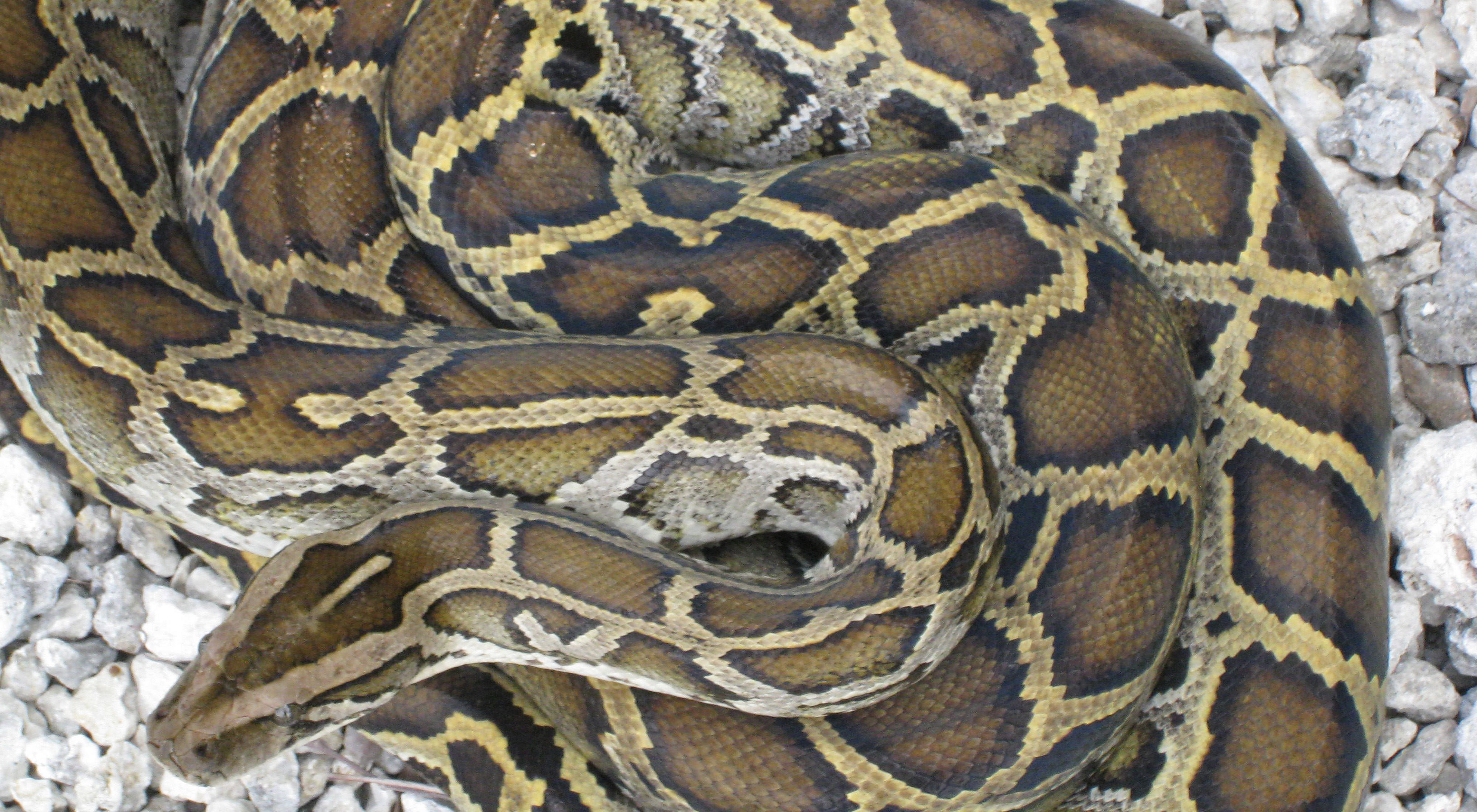
Think you’ve seen a Burmese python or another invasive animal? Report it using the free IveGot1 app, online at IveGot1.org. Or, if the animal is in front you right now call 1-888-IVEGOT1.
The first Burmese python found in the Everglades in 1979 was likely a former pet released or escaped into the wild. Today, after years of breeding, tens of thousands of the snakes inhabit the mainland around Everglades National Park, feasting on rare and endangered species.
Why Florida Needs Python Patrol
While pythons aren’t known to attack people, they are indiscriminate eaters. They have been known to eat a wide range of wildlife from tiny songbirds to adult deer and even alligators up to 6 feet long.
Finding an invasive python in the wild is difficult, which is why an army of trained volunteers and professionals is needed to report and/or respond to python encounters.
Quote: Cheryl Millett
One of the problems with the Burmese python is that it’s an invasive species getting in the way of the area’s natural functioning system. That is why we are trying to remove it.
The first Keys python was discovered in 2007. When researchers checked on the status of a male Key Largo woodrat wearing a radio transmitter, they found it had moved more than a mile from its original documented habitat. The signal led the researchers to a 7-1/2-foot Burmese python with stomach contents that included two collared woodrats.
The Nature Conservancy Florida launched Python Patrol in the Florida Keys in 2008 and, with the help of Everglades National Park, expanded the effort to the mainland in 2010. Any of the over 400 responders trained by the Conservancy can safely and humanely capture and remove pythons or other exotic constrictors they encounter.
Citizens can learn more about pythons at the Florida Fish and Wildlife Conservation Commission (FWC). FWC now coordinates the Python Patrol.
“We encourage anyone who sees a python or other non-native animal to take a photo from a safe distance and report it to the free hotline,” said Cheryl Millett, the Conservancy biologist who transferred Python Patrol to the FWC in 2013.
“Early-detection, rapid-response is the best way to stop them from spreading,” Millett said. “Even if the idea of getting your hands on a python gives you the heebie-jeebies, you can be part of the solution by learning how to spot them, calling it in, and helping us remove them.”
Burmese Python Facts from FWC
- The Burmese python may reach a length of 26 feet and a weight of more than 200 pounds.
- The average size of a Burmese python removed in Florida is 8 to 10 feet.
- The native range of the Burmese python stretches from India to lower China, throughout the Malay Peninsula and on some islands in the East Indies. These pythons usually lives near water.
- A female Burmese python may lay 50-100 eggs and will wrap its body around the clutch to keep it warm and to defend the eggs against predators. The female python can raise its temperature by rhythmically twitching muscles, which generates heat and helps incubate the eggs. This incubation process may last two to three months. Once the eggs are hatched, young pythons are on their own to survive.
- There is a low risk of a human attack by a Burmese python. Documented human attacks by pythons in the United States involve the owners captive snakes and their owner or immediate family.
- Burmese python hatchlings are 18” long and the longest one captured in south Florida was 18 feet 8 inches long.
- A 17-foot Burmese python was recently captured and removed from Big Cypress National Preserve in the Florida Everglades, the largest ever captured there. It weighed 140 pounds and took four people to carry. This story gained national attention and was featured in the New York Times.
Burmese Pythons Are Fast And Slow
Burmese pythons are ambush predators with great camouflage. They spend lots of time hiding in wait and then expend a lot of energy in a short burst to surprise-capture their prey. Python Patrol responders can use python’s lack of endurance to help make capturing them easier.
During training, responders are taught how they can pull an escaping python back by the tail repeatedly to let the snake expend a lot of energy. When the snake is tired, the responder grabs the base of the head to avoid getting entangled with the snake. Pythons captured in the wild are securely bagged, boxed, tagged and dropped off to a designated recipient for research or training.
Remember: Always call a trained responder and NEVER try this at home.
You Can Help Prevent Invasive Species
The Conservancy has long called for a more preventative and proactive approach to address the threat of invasive species.
“Right now, imported species are innocent until proven guilty,” says Kris Serbesoff-King, the Conservancy’s director of science and planning. “As a nation, we need to focus on pre-importation screening—that is to say looking at what will likely be a small number of non-native imported wildlife that could go on to be harmful to the lands and waters we are working to protect.”
What Can You Do?
- Become familiar with distinguishing invasive from native reptiles. Explore this Non-Native Reptiles in South Florida Identification Guide from the University of Florida IFAS Extension.
- Report an invasive species sighting at I-888-I’veGot1, www.IveGot1.org or the free “IveGot1” apps for iPhone or Android, that were developed by the University of Georgia.
- Help us continue our conservation work in Florida.

Stay connected for the latest news from nature.
Get global conservation stories, news and local opportunities near you. Check out a sample Nature News email.
More About Invasives

Slowing the Spread of Florida Invasive Species
The threat posed by invasive species is second only to habitat destruction through development.

New Seabird Life at Hawadax Island Alaska
After removing invasive rats, nesting seabirds returned to the Aleutian Islands–and so did the Unangan name.

Alabama's Worst Invasives
Learn about Alabama's top ten worst invasive, non-native plant species and what you can do to stop their spread.