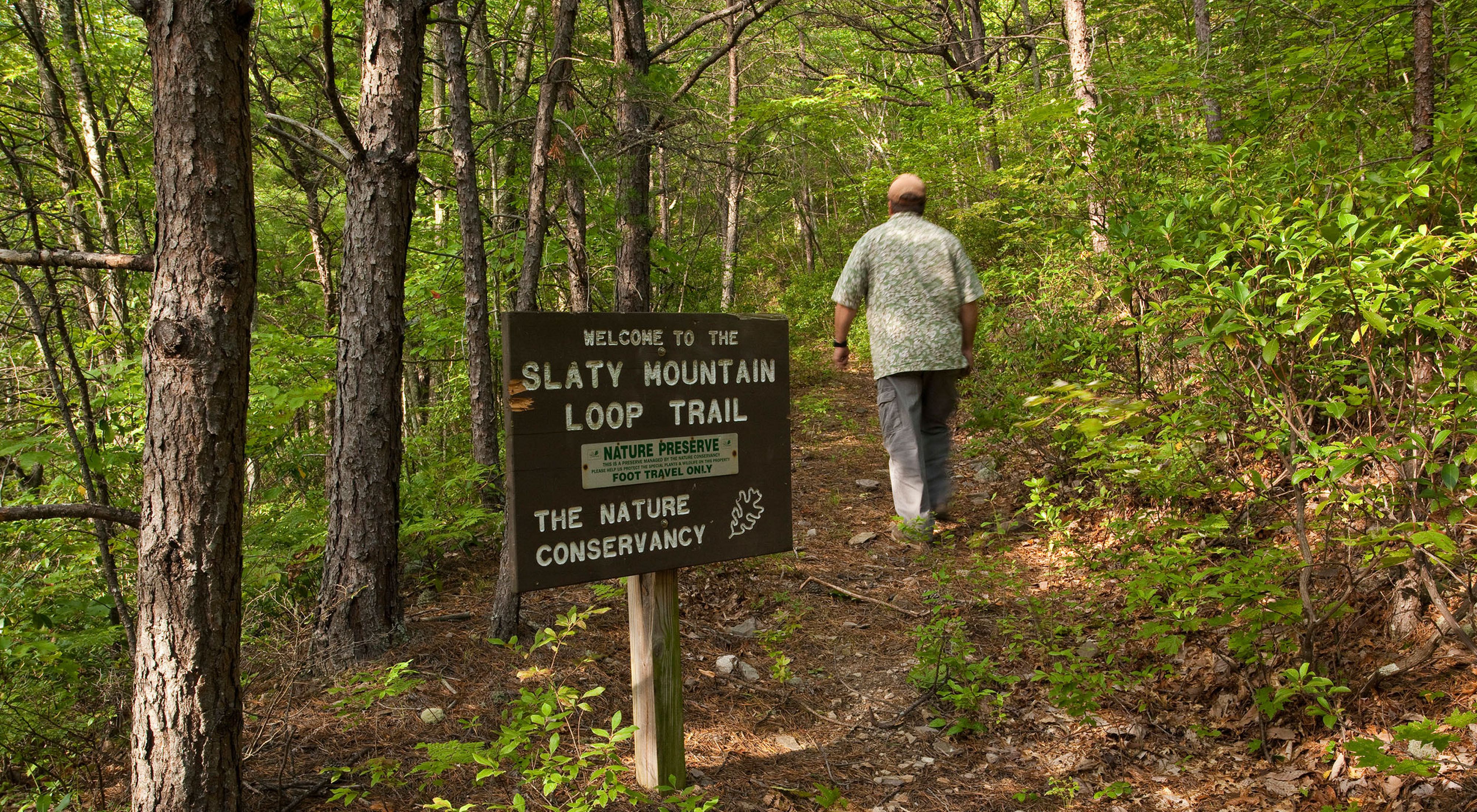
Hiking and visitation is limited to walking along this dirt road. Please respect neighboring land owners by staying on the preserve.
- Bring plenty of drinking water, sun protection (sunscreen, hat, sunglasses), rain gear, and bug protection. Binoculars, field guides, and a camera may be useful.
- Pets are not allowed on Conservancy preserves or field trips.
- Smoking is not permitted.
- Please do not remove any plants, animals, or rocks.
- Keep hiking limited to the dirt road crossing preserve.
Please help us maintain this unique natural environment by taking home everything that you bring, including biodegradable materials.
Weather conditions are often very hot during mid-day visits. Be prepared for these conditions before you visit.
What to See: Plants
Slaty Mountain shale barrens are habitat to many shale barren endemic species. These are species that are restricted to steep, dry, south-facing, shale slopes and limited in distribution to the central Appalachian Mountains. Shale barren endemics include such species as yellow buckwheat (Eriogonum alleni), Allegheny plum (Prunus alleghaniensis), and Kate’s Mountain clover (Trifolium virginicum). In total, 13 shale barren endemic species are known from this preserve. Most of these species can be observed by walking the road crossing the preserve.
What to See: Animals
Many common bird species can be observed from the road traversing the preserve. This preserve is a good place to see and hear the blue-headed vireo, red-eyed vireo, scarlet tanager, rose-breasted grosbeak, blue-gray gnatcatcher, chestnut-sided warbler, black and white warbler, indigo buntings, and many other species. Due to the warm southern aspect and dry arid conditions of shale barrens, these habitats are especially good habitat for a large variety of butterflies. Fence lizards are also commonly observed basking on exposed rocks and tree trunks at this preserve.